Amino Acids
Featured Amino Acids
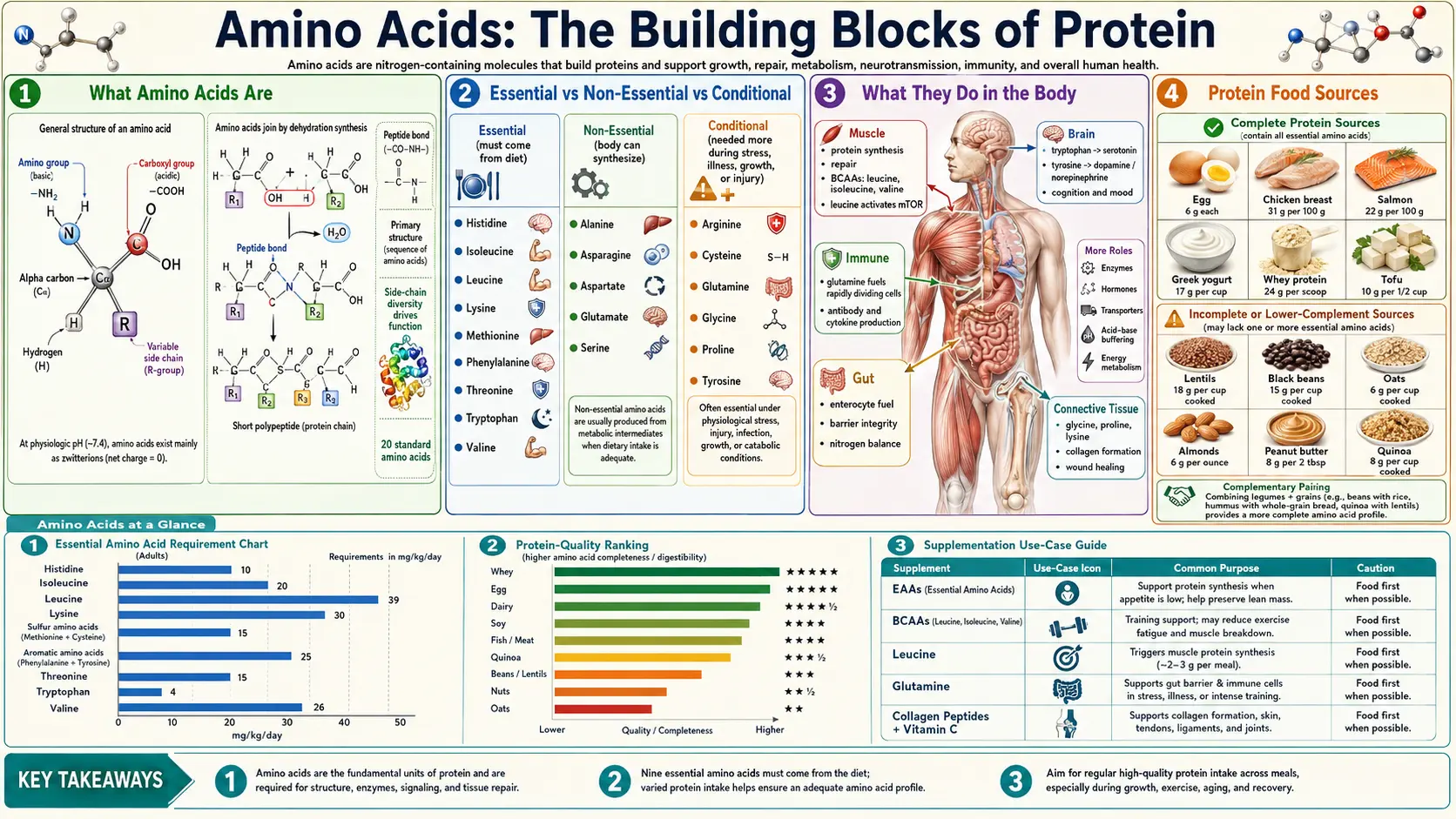
Amino acids are the building blocks of proteins and play critical roles in virtually every biological process. They are essential for muscle growth, immune function, neurotransmitter production, hormone synthesis, and tissue repair. Browse the complete guide to all essential and non-essential amino acids below.
Interactive Visualization DNA → Protein — unzip a gene and build a protein Transcribe DNA into mRNA, then step codon by codon as the ribosome matches tRNA anticodons and links amino acids into a chain. Launch →
Essential Amino Acids
Essential amino acids cannot be synthesized by the human body and must be obtained through diet or supplementation.
| Amino Acid | Body Content (g) | Key Roles | Top Food Sources |
|---|---|---|---|
| Leucine | ~600 g | Protein synthesis, muscle repair, blood sugar regulation, growth hormone | Whey protein, soybeans, beef, chicken, peanuts |
| Lysine | ~600 g | Collagen formation, calcium absorption, immune support, hormone production | Red meat, fish, dairy, eggs, legumes |
| Valine | ~400 g | Muscle growth, tissue repair, energy production, nervous system function | Soy, cheese, mushrooms, peanuts, whole grains |
| Threonine | ~350 g | Collagen and elastin synthesis, immune function, gut health, liver support | Lean meat, cottage cheese, lentils, sesame seeds |
| Phenylalanine | ~350 g | Dopamine and norepinephrine precursor, mood regulation, pain relief | Soybeans, cheese, nuts, seeds, beef, fish |
| Isoleucine | ~300 g | Muscle metabolism, energy regulation, immune function, hemoglobin synthesis | Eggs, soy, seaweed, turkey, lamb, cheese |
| Histidine | ~200 g | Histamine production, immune response, digestion, sleep-wake cycles | Meat, fish, poultry, nuts, seeds, whole grains |
| Methionine | ~200 g | Detoxification, antioxidant (glutathione), tissue growth, sulfur metabolism | Eggs, fish, sesame seeds, Brazil nuts, meat |
| Tryptophan | ~100 g | Serotonin and melatonin precursor, mood, sleep, appetite regulation | Turkey, chicken, oats, cheese, nuts, seeds |
| Taurine | ~70 g | Heart health, bile salt formation, antioxidant, electrolyte balance, nervous system | Shellfish, dark meat poultry, beef, fish, dairy |
Note on Body Content (g): Approximate total grams in a 70-kg adult, combining protein-bound residues and the free amino acid pool. Most essential amino acids are ~99% protein-bound (in muscle, collagen, organ tissue); Taurine is the exception — it has no codon and is not incorporated into proteins, so its ~70 g total is entirely free-pool. By that free-pool metric Taurine dominates (see the "% Free Pool" reference table above), but by absolute mass in the body, Leucine and Lysine come out on top.
Non-Essential Amino Acids
Non-essential amino acids can be synthesized by the body, but supplementation may be beneficial during illness, stress, or intense physical activity.
| Amino Acid | Body Content (g) | Key Roles | Top Food Sources |
|---|---|---|---|
| Glycine | ~1,000 g | Collagen synthesis, neurotransmitter, sleep quality, creatine production | Bone broth, meat, fish, dairy, legumes, spinach |
| Glutamic Acid | ~800 g | Excitatory neurotransmitter, brain function, gut fuel, detoxification | Tomatoes, cheese, mushrooms, soy sauce, seaweed |
| Alanine | ~700 g | Glucose metabolism, energy production, immune support, muscle fuel | Meat, poultry, fish, eggs, dairy, beans |
| Proline | ~700 g | Collagen formation, joint health, skin elasticity, wound healing | Bone broth, gelatin, meat, dairy, cabbage, eggs |
| Aspartic Acid | ~600 g | Neurotransmitter synthesis, energy (Krebs cycle), hormone regulation | Oysters, avocado, asparagus, molasses, meat |
| Arginine | ~550 g | Nitric oxide production, blood flow, wound healing, immune function | Turkey, pork, pumpkin seeds, soybeans, peanuts |
| Glutamine | ~500 g | Gut lining repair, immune fuel, muscle recovery, nitrogen transport | Beef, eggs, tofu, corn, white rice, milk |
| Serine | ~500 g | Phospholipid synthesis, brain function, immune support, muscle growth | Soybeans, eggs, dairy, peanuts, lentils, meat |
| Asparagine | ~400 g | Nervous system function, protein synthesis, ammonia detoxification | Asparagus, dairy, poultry, eggs, potatoes, nuts |
| Tyrosine | ~300 g | Dopamine, adrenaline, and thyroid hormone precursor, stress response | Cheese, soybeans, beef, lamb, fish, dairy, seeds |
| Cysteine | ~200 g | Glutathione synthesis, detoxification, skin and hair health, antioxidant | Poultry, eggs, dairy, garlic, onions, broccoli |
Understanding Amino Acid Classification
The human body requires 20 standard amino acids to build the thousands of proteins it needs. Of these, nine are classified as essential because the body cannot manufacture them — they must come from food. The remaining eleven are non-essential, meaning the body can synthesize them under normal conditions. However, several non-essential amino acids become conditionally essential during periods of illness, trauma, surgery, or intense physical stress, when the body's demand exceeds its production capacity.
A balanced intake of all amino acids — through whole proteins from animal or plant sources, or strategic supplementation — is foundational to optimal health, performance, and longevity.
Amino Acid Derivatives
Compounds synthesized from amino acids that function as distinct supplements in their own right.
- Beta-Alanine — A non-proteinogenic amino acid that combines with histidine to form carnosine, a muscle pH buffer; supplemented at ~3–6 g/day to raise muscle carnosine and improve high-intensity exercise capacity in the 1–4 minute range.
- Carnitine — Synthesized from lysine and methionine; shuttles long-chain fatty acids into mitochondria to be burned for energy, and is concentrated in red meat — also the center of the gut-microbiome TMAO question.
- Creatine — Synthesized from glycine, arginine, and methionine; buffers cellular ATP for muscle strength, power, and cognitive performance.
- Collagen — The body's most abundant protein; a glycine-proline-hydroxyproline triple helix supporting skin, joints, bone, and connective tissue.
- L-Theanine — A glutamate-derived non-proteinogenic amino acid (γ-glutamylethylamide) found almost exclusively in tea (Camellia sinensis); promotes calm, alert focus via alpha-wave activity — popular for anxiety and as a caffeine companion.
- Citrulline — A non-proteinogenic amino acid the body converts into arginine to raise nitric oxide and blood flow; the reason behind watermelon's reputation, and studied for blood pressure and exercise.
- Ornithine — A urea-cycle amino acid central to clearing ammonia; the L-ornithine-L-aspartate (LOLA) form is used medically to lower ammonia in liver disease.
- GABA — Gamma-aminobutyric acid, the brain's chief inhibitory ("calming") neurotransmitter, made from glutamate; sold for relaxation and sleep, with an honest blood-brain-barrier caveat.
- 5-HTP — 5-hydroxytryptophan, the direct precursor to serotonin (made from tryptophan, sourced from Griffonia seeds); studied for mood, sleep, and appetite — with important drug-interaction cautions.
- SAM-e — S-adenosylmethionine, the body's universal methyl donor, made from methionine; among the better-evidenced supplements for depression and osteoarthritis.