Carnitine
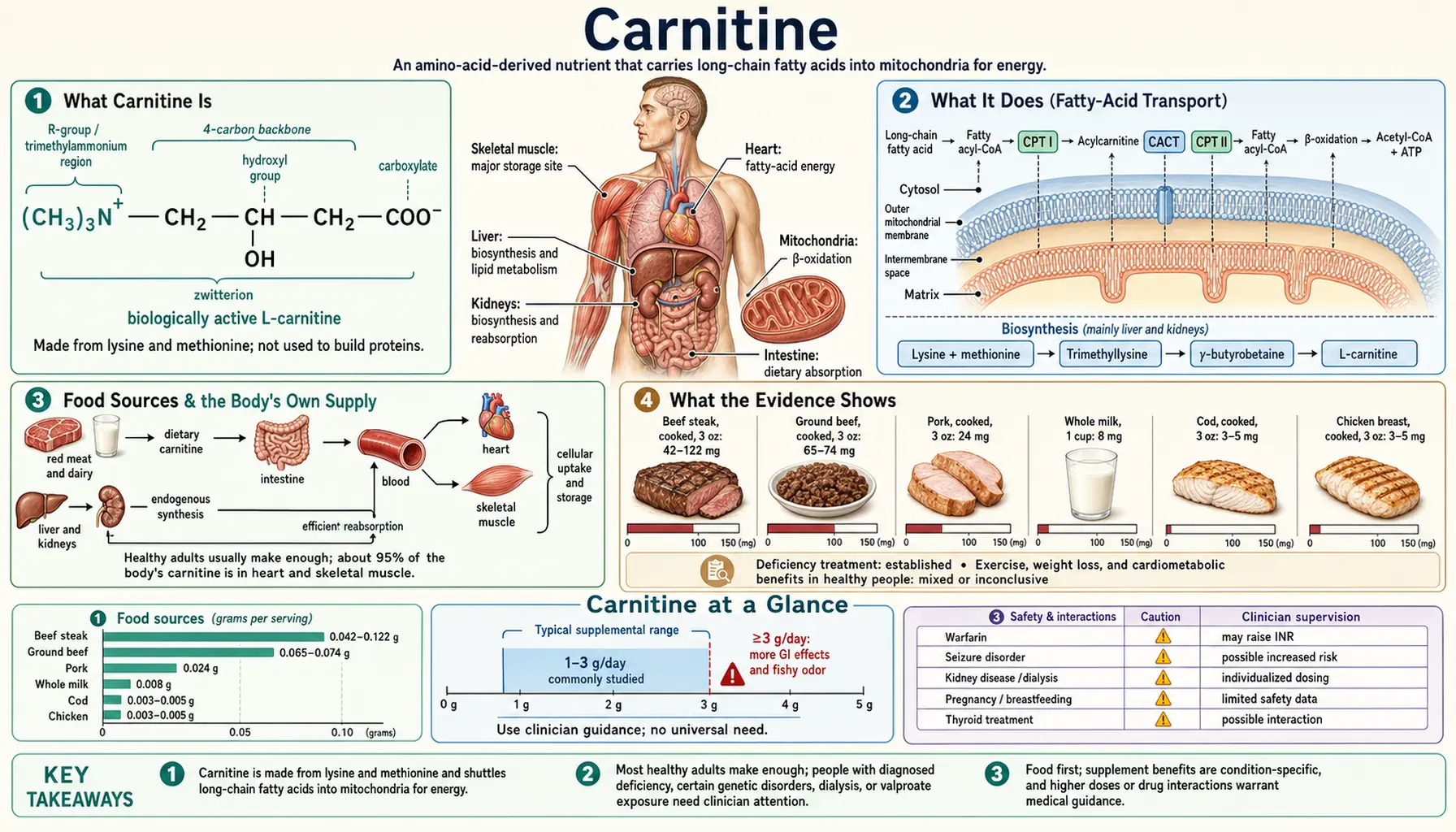
Carnitine is a small compound your body makes on its own and also gets from food, especially red meat. Its main job is one of the most fundamental in human energy metabolism: it ferries fat into the parts of your cells that burn it for fuel. Because the body manufactures carnitine and recycles it efficiently, most healthy people never run short. Supplements are widely sold as fat-burners and energy boosters, but the honest picture is more nuanced — there is reasonable evidence for carnitine as an add-on in certain heart conditions and in people on dialysis, mixed-to-modest evidence for exercise and male fertility, and no convincing evidence that it melts away body fat. A separate question about how gut bacteria turn carnitine into a compound called TMAO has drawn attention in recent years, but it remains unsettled. This page walks through what carnitine actually does, where it comes from, and what the research really supports.
Interactive Visualization Mitochondria & ATP — watch your cells make energy Follow electrons through the transport chain and watch the ATP-synthase motor spin — then block Complex IV and see the chain stall. Launch → Interactive Visualization Fat Burning & Ketosis — what actually happens Follow a fatty acid out of a fat cell to the mitochondrial gate and find it padlocked by insulin. Drop the carbs, open CPT1, and watch the liver start making ketones. Launch →
Table of Contents
- Endurance & Fatigue Recovery
- Acetyl-L-Carnitine & Depression
- What Carnitine Is
- What It Does (Fatty-Acid Transport)
- Food Sources & the Body's Own Supply
- What the Evidence Shows
- The TMAO Question
- Safety & Supplements
- Research Papers
- Connections
- Featured Videos
Endurance & Fatigue Recovery
Carnitine's formal chemical name is a mouthful — L-3-hydroxy-4-N-trimethylaminobutyric acid — but the reason athletes, rehabilitation specialists, and researchers keep coming back to it is simple: it sits at the center of how muscles make energy, recover, and resist fatigue. A 2021 systematic review and meta-analysis in the Journal of Functional Morphology and Kinesiology lays out the case: the benefits of both single-dose and longer-term L-carnitine supplementation are well described in several medical conditions — HIV infection, kidney dialysis, cancer-related wasting (cachexia), and the movement disorder dystonia — and its intake benefits healthy people too. In the elderly, supplementation has been reported to reduce the sensation of fatigue and improve physical, mental, and cognitive function. In athletes, the reviewers note, it facilitates the recovery process, increases blood flow and oxygen supply to muscle tissue, alleviates muscle injury, and reduces markers of cellular damage and free-radical formation (see Research Papers).
A single 2-gram dose before exercise — the 1990 crossover
The study that put pre-workout carnitine on the map is a small Italian double-blind crossover published in 1990. Ten moderately trained young men took either 2 g of L-carnitine or a placebo one hour before riding a stationary cycle whose resistance climbed by 50 watts every 3 minutes until exhaustion; 72 hours later each man repeated the test on the opposite treatment, so every subject served as his own control. With carnitine on board, maximal oxygen uptake (VO₂max) and peak power output were both significantly higher — and at matched submaximal workloads the riders used less oxygen, produced less carbon dioxide, breathed less air, and accumulated less plasma lactate. The authors concluded that pre-treatment with L-carnitine "favoured aerobic processes resulting in a more efficient performance."
A companion study by the same group explains why. Tracking blood and urine chemistry around the same protocol, it found that pre-exercise carnitine lowered post-exercise lactate and pyruvate while raising acetylcarnitine — the signature of a stimulated pyruvate dehydrogenase enzyme. In plain terms: the extra carnitine helps working muscle push pyruvate into the aerobic furnace instead of letting it pile up as lactate, the compound associated with the burning heaviness of hard efforts.
Raising muscle carnitine — the six-month loading study
For years the standard objection was that swallowed carnitine never actually reaches muscle. A rigorous trial in The Journal of Physiology (2011) overturned that — with two catches: time and insulin. Fourteen men took 2 g of L-carnitine L-tartrate together with 80 g of carbohydrate twice daily for 24 weeks (the carbohydrate spikes insulin, which is what pushes carnitine into muscle); controls took the carbohydrate alone. Muscle carnitine rose 21% — the first demonstration that human muscle carnitine can be increased by dietary means — and the effect depended on how hard the muscle was working. During easy cycling (50% of VO₂max), the carnitine group burned 55% less glycogen, sparing carbohydrate stores by burning more fat. During hard cycling (80% of VO₂max), muscle lactate was 44% lower and the muscle's energy reserve (its PCr/ATP ratio) was better preserved. In a 30-minute all-out performance trial, the carnitine group's work output rose 11% from baseline while the control group did not improve at all. The trade-off worth knowing: the protocol added 160 g of sugar per day for six months to make the loading work.
What the pooled numbers say — and the dose that works
Zoom out from single trials to the 2021 meta-analysis — which screened 6,404 articles and included 30 studies of healthy people — and the picture becomes more measured. Pooled across trials, blood lactate did not change significantly at rest or after exercise. What did change significantly: resting VO₂, and serum free and total carnitine both at rest and after exercise. The dosing pattern behind those changes was roughly 2 g per day for 3–4 weeks. The authors' rehabilitation-minded takeaway is that serum carnitine and resting VO₂ are practical markers for following people through training and rehab programs — and that dose matters more than marketing. In other words, the acute 1990 effects and the 2011 loading effects are real findings from real trials, but averaged across every protocol the reliable changes are the metabolic ones; translation into faster finishing times is less consistent (see What the Evidence Shows below, and the Exercise & Recovery deep-dive for practical protocols).
Acetyl-L-Carnitine & Depression
The endurance story is only half of what carnitine research covers. Acetyl-L-carnitine (ALCAR) — the form that crosses into the brain most readily — has a serious body of evidence in depression, and the logic connects back to the same transport job described throughout this page: researchers have observed that low acetyl-L-carnitine appears to play a role in the risk of developing depression, pointing to dysregulated fatty-acid transport into the mitochondria — an energy problem — as part of the biology of low mood.
A 2018 systematic review and meta-analysis in Psychosomatic Medicine pooled 12 randomized controlled trials with 791 participants (average age 54; 65% women). The headline findings:
- Versus placebo or no treatment (nine trials; 231 people on ALCAR vs 236 controls): supplementation significantly reduced depressive symptoms, with a large pooled effect size (standardized mean difference −1.10; 95% CI −1.65 to −0.56) — though the trials varied considerably from one another (I² = 86%), which calls for some caution about the size of the effect.
- Head-to-head against established antidepressants (three trials; 162 people per group): ALCAR performed comparably in reducing depressive symptoms (SMD = 0.06; 95% CI −0.22 to 0.34) — with significantly fewer side effects than the antidepressant group.
- Who benefited most: subgroup analyses suggested ALCAR was most efficacious in older adults.
The authors' conclusion is measured: acetyl-L-carnitine significantly decreases depressive symptoms compared with placebo, offers an effect comparable to established antidepressants with fewer adverse effects — and larger trials are still needed to confirm or refute the findings. Two practical notes follow. First, this evidence concerns the acetyl form specifically, not plain L-carnitine — the acetyl group is what carries it across the blood–brain barrier. Second, depression is not a condition to self-manage: if you take an antidepressant, do not stop it or swap it for a supplement on your own — but this is a legitimately promising, well-tolerated option to raise with your prescriber, particularly for older adults.
What Carnitine Is
Carnitine is a compound your body builds from two amino acids — lysine and methionine — with help from vitamin C, several B vitamins, and iron. It is not a vitamin and not technically an "essential" nutrient, because a healthy body can make enough of it. Nutrition scientists instead call it conditionally essential: usually you make plenty, but in certain situations (some genetic disorders, kidney dialysis, premature infancy, certain medications) the body may not keep up, and dietary or supplemental carnitine becomes important.
About 95% of the body's carnitine is stored in skeletal muscle and heart muscle — the tissues that rely most heavily on burning fat for energy. That concentration is a clue to what carnitine does for a living.
You will see carnitine sold in a few different forms, and the differences matter:
- L-carnitine — the natural, biologically active form. This is the one your body uses and the one to look for on a label.
- D-carnitine — a mirror-image form that is biologically inactive and can actually interfere with natural L-carnitine. It should be avoided. Reputable supplements use the L- form.
- Acetyl-L-carnitine (ALCAR) — L-carnitine with an acetyl group attached. It crosses into the brain more readily and is the form most studied for cognition, mood, and nerve health (see Acetyl-L-Carnitine & Depression).
- L-carnitine L-tartrate — L-carnitine bound to tartaric acid for stability; common in exercise-recovery research.
What It Does (Fatty-Acid Transport)
Carnitine's central role is well-established, textbook biochemistry — not a marketing claim. Your cells generate most of their energy inside tiny internal "power plants" called mitochondria. To burn fat for fuel, long-chain fatty acids have to get inside the mitochondria, but they cannot cross the inner mitochondrial membrane on their own.
Carnitine is the shuttle that carries them across. It attaches to a long-chain fatty acid, escorts it through the membrane, drops it off inside, and then returns to pick up the next one. Once inside, the fatty acid is broken down through a process called beta-oxidation to produce energy (ATP). Without carnitine, long-chain fats simply cannot be efficiently used for fuel — which is exactly why the rare genetic conditions that block carnitine transport cause serious muscle and heart problems.
This is the kernel of truth behind carnitine's "fat-burning" reputation. Carnitine is genuinely required to transport fat for energy. The leap that marketing makes — that taking extra carnitine therefore forces your body to burn more fat and lose weight — is not supported by the evidence (see What the Evidence Shows). In well-nourished people, fatty-acid transport is generally not the bottleneck, so adding more carnitine doesn't speed it up.
Food Sources & the Body's Own Supply
The word "carnitine" comes from the Latin carnis, meaning flesh — a fitting origin, because the richest dietary sources are red meats.
- Beef and lamb — by far the densest sources. A typical serving of cooked red meat supplies roughly 50–150 mg.
- Pork — a moderate source.
- Poultry and fish — smaller amounts.
- Dairy (milk, cheese) — modest amounts.
- Plant foods (grains, vegetables, fruit) — very little.
Here is the key point most supplement ads skip: your body makes its own carnitine, synthesizing it in the liver and kidneys from lysine and methionine. A healthy adult produces enough to cover normal needs even without much from food. On top of that, the kidneys are very good at conserving carnitine — reabsorbing it rather than letting it spill into urine — so the body holds on to its supply.
Because of this, healthy people who eat meat essentially never become carnitine-deficient. Vegetarians and vegans take in much less carnitine and tend to have somewhat lower blood and tissue levels, but their bodies compensate by making more and excreting less, so they generally remain in the adequate range and do not show signs of deficiency. Carnitine is not a nutrient most people need to supplement.
What the Evidence Shows
Carnitine has been studied for decades. The honest summary is that the evidence is genuinely supportive in a few specific medical settings, modest and mixed for fitness, and weak-to-absent for the weight-loss claims that drive most sales.
Heart conditions (as an add-on)
This is carnitine's strongest area. Because heart muscle depends heavily on fatty-acid metabolism, researchers have tested L-carnitine as an adjunct — an add-on to standard care, not a replacement — in conditions like heart failure, angina (chest pain), and recovery after a heart attack. Meta-analyses pooling many trials have found associations with improved outcomes such as reduced angina symptoms, fewer arrhythmias, and better measures of heart pumping function (see Research Papers). The findings are encouraging but come with caveats: many included trials are older, smaller, or from single regions, so most experts view carnitine as a reasonable adjunct worth discussing with a cardiologist, not a proven mainstay therapy.
Kidney dialysis
People on long-term hemodialysis can genuinely become carnitine-deficient, because dialysis filters carnitine out of the blood. In this specific group, carnitine repletion is an accepted medical intervention and is sometimes prescribed by physicians to address dialysis-related problems such as muscle weakness, cramps, and certain types of anemia.
Exercise and recovery
Results here are mixed and modest. The original idea — that extra carnitine would boost fat-burning during exercise and improve endurance — has largely not held up in short-term studies, because muscle carnitine levels are hard to raise quickly with oral supplements; the exception is months-long daily loading paired with carbohydrate (see the six-month loading study above). There is somewhat more consistent evidence that L-carnitine (often the L-tartrate form) may reduce markers of muscle damage and soreness and modestly aid recovery after hard exercise, though effect sizes are small and not every study agrees. It is not a reliable performance enhancer.
Male fertility
Several randomized trials and systematic reviews have tested L-carnitine and acetyl-L-carnitine in men with low sperm quality of unknown cause. Pooled results suggest supplementation may improve sperm motility (movement) and some other semen parameters. The evidence is promising but limited by small studies of varying quality, and improvements in actual pregnancy rates are less certain.
The weight-loss claim
This is the most important thing to get right. Despite being marketed everywhere as a "fat-burner," carnitine is not a proven weight-loss aid. Trials in healthy and overweight people have generally found little to no meaningful effect on body fat or weight from carnitine supplements on their own. The "burns fat" tagline borrows the real biochemistry of carnitine's transport job and stretches it into a claim the data do not support.
The TMAO Question
One genuinely interesting line of research concerns what happens to carnitine in the gut. Some of the carnitine you eat (and some of the carnitine in supplements) is metabolized by gut bacteria into a compound that the liver then converts into TMAO (trimethylamine-N-oxide). Choline, another nutrient found in eggs and meat, feeds the same pathway.
This matters because several studies have associated higher TMAO levels with higher cardiovascular risk, and laboratory work in animals has suggested TMAO can promote the artery-clogging process of atherosclerosis. A widely cited 2013 study (see Research Papers) proposed this gut-bacteria–TMAO pathway as one possible reason red meat might affect heart health.
Here is the balanced view, because this is easy to sensationalize:
- The link between TMAO and heart disease is largely an association — meaning TMAO travels with higher risk, which does not by itself prove TMAO causes the harm. Higher TMAO could be a marker of something else, such as kidney function or overall diet.
- People with different gut bacteria make very different amounts of TMAO from the same food. Long-term vegetarians, interestingly, produce less TMAO from a carnitine dose than habitual meat-eaters.
- Fish naturally contains TMAO, often in larger amounts than carnitine produces — yet fish is consistently linked with good heart outcomes, which complicates a simple "TMAO is bad" story.
- This is an active, unsettled area of research. It is worth being aware of, especially if you are considering high-dose carnitine supplements long-term, but it is not established proof of harm and not a reason to panic about eating a normal diet.
If you have specific cardiovascular concerns and are thinking about carnitine supplements, the TMAO question is a reasonable thing to raise with your doctor.
Safety & Supplements
L-carnitine is generally well tolerated by most people at common doses. Typical supplement doses studied range from about 500 mg to 2,000 mg (0.5–2 g) per day, sometimes higher in medical settings under supervision. Acetyl-L-carnitine is dosed similarly.
Possible side effects, mostly at higher doses, include:
- Stomach upset — nausea, abdominal cramps, vomiting, and diarrhea.
- A "fishy" body odor — a distinctive and harmless but unpleasant smell on the breath, sweat, and urine, caused by carnitine-derived compounds. It usually fades if the dose is lowered.
- Restlessness or trouble sleeping in some people, particularly with acetyl-L-carnitine.
Some people should be more cautious and check with a doctor or pharmacist before supplementing:
- Kidney disease or dialysis — carnitine handling is altered, and supplementation should be physician-guided rather than self-directed.
- Thyroid conditions / thyroid hormone medication — carnitine can blunt the action of thyroid hormone, which may interfere with treatment for an underactive thyroid.
- Blood-thinning medication (such as warfarin) — carnitine may enhance the drug's effect and increase bleeding risk, so monitoring may be needed.
- Seizure disorders — there are reports of increased seizure activity in susceptible individuals.
Always choose products that specify L-carnitine (or acetyl-L-carnitine) and avoid the inactive D-carnitine form. As with all supplements, look for independent quality testing where available.
Finally, a reassuring note: true carnitine deficiency is rare in the general population. It mainly occurs in specific medical situations — certain inherited metabolic disorders, long-term dialysis, severe malnutrition, premature infants, or as a side effect of a few medications (such as valproic acid). For the average healthy person eating a varied diet, the body's own production and recycling keep carnitine where it needs to be.
Research Papers
- DiNicolantonio JJ, Lavie CJ, Fares H, Menezes AR, O'Keefe JH. L-carnitine in the secondary prevention of cardiovascular disease: systematic review and meta-analysis. Mayo Clinic Proceedings. 2013;88(6):544–551. doi:10.1016/j.mayocp.2013.02.007 — Pooling 13 trials (3,629 patients), L-carnitine after a heart attack was associated with lower all-cause mortality, fewer arrhythmias, and less angina — supporting its role as a cardiac adjunct.
- Song X, Qu H, Yang Z, et al. Efficacy and safety of L-carnitine treatment for chronic heart failure: a meta-analysis of randomized controlled trials. BioMed Research International. 2017;2017:6274854. doi:10.1155/2017/6274854 — Across 17 trials (1,625 heart-failure patients), L-carnitine improved measures of heart pumping function, though the authors call for larger high-quality trials.
- Koeth RA, Wang Z, Levison BS, et al. Intestinal microbiota metabolism of L-carnitine, a nutrient in red meat, promotes atherosclerosis. Nature Medicine. 2013;19(5):576–585. doi:10.1038/nm.3145 — The landmark study proposing that gut bacteria convert carnitine into TMAO, which was associated with atherosclerosis — the foundation of the still-unsettled TMAO debate.
- Khaw SC, Wong ZZ, Anderson R, Martins da Silva S. L-carnitine and L-acetylcarnitine supplementation for idiopathic male infertility. Reproduction & Fertility. 2020;1(1):67–81. doi:10.1530/RAF-20-0037 — A systematic review finding carnitine supplementation may improve sperm motility and morphology in men with unexplained infertility.
- Yarizadeh H, Shab-Bidar S, Zamani B, et al. The effect of L-carnitine supplementation on exercise-induced muscle damage: a systematic review and meta-analysis of randomized clinical trials. Journal of the American College of Nutrition. 2020;39(5):457–468. doi:10.1080/07315724.2019.1661804 — Pooling 14 trials, L-carnitine modestly reduced some markers of exercise-induced muscle damage — illustrating the small, mixed nature of the exercise evidence.
- Vecchio M, Chiaramonte R, Testa G, Pavone V. Clinical effects of L-carnitine supplementation on physical performance in healthy subjects, the key to success in rehabilitation: a systematic review and meta-analysis from the rehabilitation point of view. Journal of Functional Morphology and Kinesiology. 2021;6(4):93. doi:10.3390/jfmk6040093 — Across 30 studies of healthy people, supplementation reliably raised serum carnitine and changed resting VO₂, while pooled blood lactate did not shift significantly; roughly 2 g daily for 3–4 weeks was the dose behind the significant changes.
- Vecchiet L, Di Lisa F, Pieralisi G, et al. Influence of L-carnitine administration on maximal physical exercise. European Journal of Applied Physiology and Occupational Physiology. 1990;61(5-6):486–490. doi:10.1007/BF00236072 — Double-blind crossover in ten moderately trained men: 2 g taken one hour before a graded cycle test significantly raised VO₂max and power output while lowering plasma lactate — carnitine "favoured aerobic processes."
- Siliprandi N, Di Lisa F, Pieralisi G, et al. Metabolic changes induced by maximal exercise in human subjects following L-carnitine administration. Biochimica et Biophysica Acta. 1990;1034(1):17–21. doi:10.1016/0304-4165(90)90147-o — The companion mechanism study: pre-exercise carnitine lowered post-exercise lactate and pyruvate while raising acetylcarnitine, pointing to stimulated pyruvate dehydrogenase — pyruvate is diverted away from lactate and into aerobic metabolism.
- Wall BT, Stephens FB, Constantin-Teodosiu D, et al. Chronic oral ingestion of L-carnitine and carbohydrate increases muscle carnitine content and alters muscle fuel metabolism during exercise in humans. The Journal of Physiology. 2011;589(Pt 4):963–973. doi:10.1113/jphysiol.2010.201343 — First demonstration that human muscle carnitine can be raised orally (+21% after 24 weeks with carbohydrate): 55% glycogen sparing at low intensity, 44% lower muscle lactate at high intensity, and an 11% work-output gain.
- Veronese N, Stubbs B, Solmi M, et al. Acetyl-L-carnitine supplementation and the treatment of depressive symptoms: a systematic review and meta-analysis. Psychosomatic Medicine. 2018;80(2):154–159. doi:10.1097/PSY.0000000000000537 — Across 12 RCTs (791 participants), acetyl-L-carnitine reduced depressive symptoms versus placebo and matched established antidepressants head-to-head with fewer side effects — most efficacious in older adults.
Connections
- Carnitine Deficiency — signs, drug depleters, testing, and who is actually at risk
- Dr. Peter Osborne — whose carnitine crash course this site fact-checked in full
- All Amino Acids
- Fat Burning & Ketosis — interactive animation
- Mitochondria & ATP — interactive animation
- Lysine
- Methionine
- Beef
- Organ Meats for Heart and CoQ10 — beef heart as a dense whole-food source of carnitine.
- Alpha Lipoic Acid for Mitochondrial Function & Bioenergetics — the Ames–Hagen ALA + acetyl-L-carnitine rejuvenation research.