Salt and Hydration Protocol for POTS
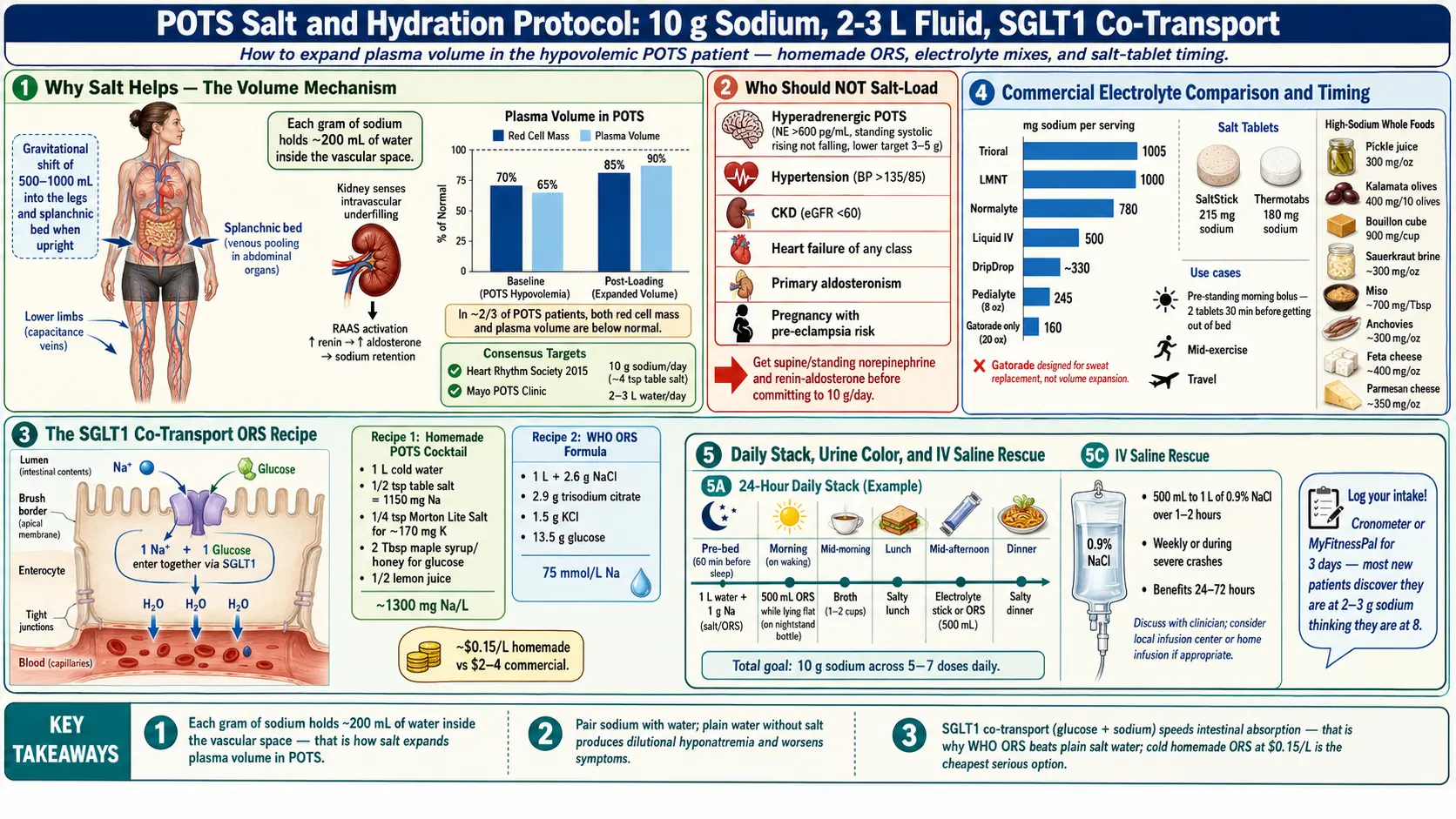
Table of Contents
- Why Salt Is Used in POTS
- Who the Research Raises Concerns For
- Fluid Intake in the Guidelines
- Where Dietary Sodium Comes From
- Oral Rehydration Solutions
- Commercial Electrolyte Products
- Salt Tablets vs Food-Based Salt
- What the Research Says About Timing
- IV Saline for Crisis and Flares
- Measurements Used to Track Response
- Side Effects and Trade-offs
- Key Research Papers
- Connections
- Featured Videos
1. Why Salt Is Used in POTS
Many, but not all, people with POTS have a low blood volume. The 2015 Heart Rhythm Society (HRS) expert consensus statement reports that blood volume is reduced in up to 70% of patients. Reviews list low blood volume as one of several overlapping mechanisms, alongside partial sympathetic neuropathy, a hyperadrenergic state, mast cell activation, deconditioning and immune-mediated processes (Arnold 2018). In a 2005 study using radiolabelled albumin, 15 patients with POTS had an average plasma volume deficit of 334 mL, against 10 mL in 14 healthy controls, along with a red blood cell volume deficit (Raj 2005); a later review describes the plasma volume deficit as almost 13% (Raj 2013).
On standing, gravity shifts about 500 mL of blood from the chest to the abdomen, buttocks and legs (Raj 2013; the HRS statement gives 500 to 800 mL), and a further 10–25% of the plasma volume moves out of the blood vessels into the surrounding tissue (Raj 2013). Less blood returns to the heart, and the heart rate rises to compensate.
Sodium is what holds water in the circulation. When blood volume falls, the renin–angiotensin–aldosterone system normally signals the kidneys to retain sodium and water (Vernino 2021). In POTS this response appears blunted: in the 2005 study, plasma renin activity was no higher than in controls and aldosterone was paradoxically low despite the volume deficit (Raj 2005). Extra salt taken with extra fluid is the dietary way of expanding the volume.
A 2021 randomized crossover trial, described by its authors as the first study to test whether increasing dietary sodium reduces the orthostatic tachycardia of POTS, enrolled 14 women with POTS and 13 healthy women. Compared with 6 days of a low-sodium diet (10 mmol of sodium a day), 6 days of a high-sodium diet (300 mmol, about 6.9 g of sodium a day) increased plasma volume and total blood volume, lowered standing norepinephrine and reduced the rise in heart rate on standing. The rise still stayed larger than in the healthy women (median 46 vs 19 beats/min), and symptom scores improved without reaching statistical significance (Garland 2021). Long-term data on sustained benefit and late adverse effects are still needed (Raj 2022).
The published intake figures differ, and they are not all stated in the same units:
- 2015 HRS consensus: up to 2–3 L of water and 10–12 g of salt (sodium chloride) daily “may be considered” (Class IIb), for patients known or strongly suspected to have low blood volume, “if tolerated”, using salt tablets if necessary. That is about 3.9–4.7 g of sodium (170–205 mmol; Garland 2021).
- Raj 2013 review: 8–10 cups (2–2.5 L) of water and 8–10 g of salt a day, by diet or with 1 g salt tablets.
- 2022 CMAJ review by Raj, Fedorowski and Sheldon (Raj and Sheldon are authors of the 2020 Canadian Cardiovascular Society position statement): 3 L of water and 2 teaspoons (5 mL) of salt a day, as part of the initial approach.
- 2019 NIH expert consensus meeting (published 2021): at least 2–3 L of water a day, with sodium increased to 3 to 10 g of sodium daily from table salt, salt tablets or electrolyte solutions, citing the Canadian statement. It adds that further research is needed to establish the true benefit of salt loading and the optimal sodium intake.
For scale: one teaspoon of table salt contains about 2.3 g of sodium (Vernino 2021), or about 6 g of salt, since sodium is about 39% of sodium chloride by weight. The top of the NIH range, 10 g of sodium, is therefore about 25 g of salt, a little over 4 teaspoons — two to two-and-a-half times the HRS figure, which is stated as salt. The 2020–2025 Dietary Guidelines for Americans set a limit of less than 2,300 mg of sodium a day for the general population, and average US intake is about 3.2 g a day for women and 4.3 g for men (figures quoted in Garland 2021).
2. Who the Research Raises Concerns For
The guideline wording is conditional. The HRS statement applies its salt and water figures to patients with known or strongly suspected low blood volume, “if tolerated”, and grades the evidence as level E, which it defines as consensus opinion. The research and standard care raise concerns in these groups:
- Hyperadrenergic POTS. The HRS statement describes this presentation in up to 50% of patients, defined by a systolic blood pressure rise of 10 mm Hg or more during 10 minutes of standing and a standing plasma norepinephrine of 600 pg/mL or more; some of these patients have blood pressure that rises on standing (orthostatic hypertension; Vernino 2021). Raj 2013 describes the high norepinephrine seen in many POTS patients as most commonly secondary to a partial dysautonomia or to low blood volume, with a small subgroup in whom the primary problem seems to be excessive sympathetic discharge. Evidence specific to salt in this group is limited: in the 2021 trial, the high-sodium diet lowered standing norepinephrine in patients whose levels suggested a hyperadrenergic state (Garland 2021). The subtypes are described on the POTS Subtypes page.
- High blood pressure. Sodium restriction is part of the standard care of hypertension, so a high-salt regimen runs against it.
- Chronic kidney disease and heart failure, in which sodium and fluid intake are usually restricted rather than increased.
- Primary aldosteronism or other mineralocorticoid excess, in which the body already retains too much sodium.
Supine and standing plasma norepinephrine, each drawn after at least 10 minutes in the position, are the measurements Raj 2013 describes for this question: the supine value is often normal in POTS, while the upright value is frequently above 600 pg/mL.
3. Fluid Intake in the Guidelines
The fluid figures are 2–3 L of water a day in the HRS statement and the NIH consensus, 2–2.5 L (8–10 cups) in Raj 2013, and 3 L in the 2022 CMAJ review. Each document pairs the fluid figure with increased salt.
- Water on its own has a short-term effect. In a small study, 9 patients with orthostatic tachycardia (described as idiopathic orthostatic intolerance) drank 480 mL of tap water in under 5 minutes; their standing heart rate fell from 123 to 108 beats/min on average. The authors describe the effect as moderate and water drinking as a possible add-on treatment (Shannon 2002).
- Keeping the water in the circulation depends on sodium. Volume expansion relies on the kidneys retaining sodium and water together (Vernino 2021), which is why the guidance pairs them.
- Hyponatremia. Raj 2013 raises a concern about low blood sodium (hyponatremia) when desmopressin — a drug that makes the kidneys retain free water but not sodium — is combined with drinking large amounts of water.
Urine colour is widely used as a rough everyday hydration marker, with pale straw read as adequate hydration and dark amber as under-hydration. The HRS, CMAJ and NIH documents set no urine-colour target.
4. Where Dietary Sodium Comes From
The two guidelines state their figures in different units. The NIH consensus gives 3–10 g of sodium a day and names three routes — ordinary table salt, salt tablets and electrolyte solutions. The HRS figure of 10–12 g of salt is about 3.9–4.7 g of sodium, a band that overlaps average US intake (3.2 g a day for women and 4.3 g for men, the figures quoted by Garland and colleagues in 2021). The diagram below sets both ranges and some common sources on one sodium scale.
Table salt in food
1 teaspoon of table salt ≈ 2.3 g sodium ≈ 6 g salt. Two to three teaspoons added across the day’s food contain about 4.6–6.9 g of sodium.
Broth
Ready-to-serve chicken broth averages about 370 mg of sodium per 100 g in the USDA FoodData Central database — about 920 mg per cup, or about 1,850 mg in two cups; canned beef broth is similar. A dry beef bouillon cube (3.6 g) carries about 860 mg. Reduced-sodium chicken broth carries about 230 mg per 100 g, and homemade broth depends on the salt added.
Electrolyte mixes
Commercial electrolyte powders and drinks differ several-fold in sodium per serving, and some contain glucose; they are described in section 6.
High-sodium whole foods
Pickles, olives, sauerkraut brine, miso, soy sauce, anchovies, feta and parmesan are high in sodium. USDA FoodData Central lists dill pickles at about 810 mg of sodium per 100 g, or about 1,090 mg in one large (4-inch) pickle.
Salt tablets
Sodium chloride tablets are named in the HRS statement, Raj 2013 and the NIH consensus as a route when diet alone does not reach the figure; Raj 2013 lists 1 g tablets. They are covered in section 7.
Measuring intake
The HRS statement lists a 24-hour urine sample as the way to assess sodium intake (see section 10); food diaries give an estimate from logged foods.
5. Oral Rehydration Solutions
Oral rehydration solutions (ORS) rely on sodium–glucose co-transport (SGLT1) in the small intestine: glucose and sodium are absorbed together, and water follows. ORS was developed to treat dehydration from cholera and other diarrhoeal disease. In POTS, one small laboratory study compared it with IV saline: in 10 young people with POTS, orthostatic tolerance during lower-body negative pressure improved 1 hour after drinking ORS and 1 hour after an equal volume of IV saline (a normalized orthostatic index of 155.6 after ORS and 134.5 after saline, against 100 untreated), and only ORS kept cerebral blood flow velocity significantly above the untreated level at −45 mm Hg of lower-body suction (Medow 2019).
WHO reduced-osmolarity ORS (per litre)
- 1 liter water
- 2.6 g sodium chloride (table salt)
- 2.9 g trisodium citrate dihydrate
- 1.5 g potassium chloride
- 13.5 g anhydrous glucose
This is the World Health Organization reference formula: 75 mmol/L of sodium (about 1,725 mg per litre), 20 mmol/L of potassium, 10 mmol/L of citrate and 75 mmol/L of glucose.
6. Commercial Electrolyte Products
Electrolyte drinks, powders, sachets and tablets differ several-fold in sodium per serving, in potassium content, and in whether they contain glucose (used for sodium–glucose co-transport) or are sugar-free. The label’s sodium per serving and serving volume allow comparison with the WHO ORS benchmark of 75 mmol (about 1,725 mg) of sodium per litre.
Sports drinks are formulated for exercise: a 2023 review of hydration beverages puts most sports drinks intended to replace sweat sodium losses at 10–25 mmol/L of sodium (Pérez-Castillo 2023), well below WHO ORS. The NIH consensus lists electrolyte solutions among the routes for raising sodium intake.
7. Salt Tablets vs Food-Based Salt
The guidance documents treat food and tablets as alternative routes to the same daily total:
- The HRS statement describes increasing dietary salt “using salt tablets, if necessary”.
- Raj 2013 describes supplemental sodium chloride tablets, taken with meals, when the figure cannot be reached by changing the diet, and lists 1 g tablets as needed; the patient described in that review took 1 g three times a day.
- The NIH consensus names table salt, salt tablets and electrolyte solutions.
- The 2021 trial raised sodium through the diet rather than with tablets, which its authors describe as more consistent with the recommendations (Garland 2021).
In every one of these documents the salt figure is given together with a water figure.
8. What the Research Says About Timing
The guideline documents give daily totals rather than a timetable. Two findings bear on timing:
- Mornings are harder. In 54 patients with POTS and 26 healthy volunteers, standing heart rate was higher in the morning than in the evening, and more people met the POTS heart-rate criterion in the morning (Brewster 2012).
- A quick water bolus. In the water-drinking study, 480 mL of tap water drunk in under 5 minutes lowered standing heart rate by about 15 beats/min on average in 9 patients with orthostatic tachycardia (Shannon 2002).
Raj 2013 describes salt tablets taken with meals. Pre-bed salt loading and multi-dose daily schedules appear in patient materials; the guideline documents above do not set them.
9. IV Saline for Crisis and Flares
Intravenous normal saline (0.9% sodium chloride) expands blood volume directly. In a 1997 study of 13 patients, 1 L of saline lowered upright heart rate from 112 to 91 beats/min one hour after the infusion, a larger effect on the standing heart-rate rise than midodrine or clonidine in the same patients (Jacob 1997). The HRS statement notes that expert centres report, anecdotally, that 1 L infused over 1 hour decreases orthostatic tachycardia and improves symptoms for several hours to 2 days.
The guideline position separates short-term rescue from regular use:
- HRS 2015, Class IIa: it is reasonable to treat short-term clinical decompensation with an acute IV infusion of up to 2 L of saline.
- HRS 2015, Class III: regular IV saline infusions are not recommended in the absence of evidence, and chronic or repeated IV cannulation is described as potentially harmful; long-term infusions usually require a chronic central venous catheter, with its attendant complications.
- NIH consensus (2021): useful as rescue therapy in clinically decompensated patients, but long-term infusions are not currently recommended for routine care because of the complications of chronic venous catheterization.
Two case series describe regular infusions in patients whose symptoms had not responded to medications:
- Ruzieh 2017: an observational before-and-after telephone survey of 57 patients; infusions averaged 1.5 L, at a mean frequency reported as 11.3 days, and symptom scores (Orthostatic Hypotension Questionnaire) and quality-of-life scores (SF-36) improved.
- Moak 2016: 39 teenagers and young adults (mean age 16) given 1–2 L a day, 3–7 days a week, for between 1 week and 3.8 years; 79% (31 of 39) reported improved quality of life. Access was through intermittent IV lines (10), PICC lines (22) or implanted ports (7), and complications included 3 upper-limb deep vein thromboses and 4 infections.
10. Measurements Used to Track Response
The measurements used in the guidance documents and trials are:
- Orthostatic vital signs. The 2022 CMAJ review describes heart rate and blood pressure measured after 5–10 minutes lying down, then at 1, 3, 5, 8 and 10 minutes of standing. POTS is defined by a heart-rate rise of 30 beats/min or more on standing (40 or more at ages 12–19) without orthostatic hypotension (HRS 2015), and that rise was the main outcome of the 2021 salt trial.
- Active stand and tilt testing — see Tilt Table & NASA Lean Test.
- Symptom scores. Trials used questionnaires such as the Vanderbilt Orthostatic Symptoms Scale (Garland 2021) and the Orthostatic Hypotension Questionnaire (Ruzieh 2017).
- 24-hour urine sodium. The HRS statement lists a 24-hour urine sample to assess sodium intake as part of an expanded evaluation, and the 2021 trial used urinary sodium to confirm diet compliance. In 30 children with POTS, a 24-hour urinary sodium below 124 mmol before treatment predicted response to salt supplementation with 76.9% sensitivity and 93% specificity (Zhang 2012).
- Serum potassium with fludrocortisone, which can lower it (Raj 2022; Vernino 2021).
In the 2021 trial, the high-sodium diet reduced but did not normalize the standing heart-rate rise (Garland 2021). Medicines used in POTS are covered on the pharmacotherapy page; the 2022 CMAJ review describes starting them at the first visit when symptoms are severe.
11. Side Effects and Trade-offs
- Swelling. Retained sodium and fluid can show as swelling (edema) of the ankles or hands; edema is a listed adverse effect of fludrocortisone, the drug used to boost sodium retention (Raj 2013; Raj 2022). Compression garments are covered on the Compression & Exercise Program page.
- Headache. Worsening headache is listed among fludrocortisone’s adverse effects (Raj 2013).
- Nausea, bloating and reflux are commonly described by patients with large salt loads or salt tablets; Raj 2013 describes tablets taken with meals.
- Potassium. Fludrocortisone can cause low potassium (hypokalemia), and the CMAJ review and NIH consensus describe monitoring serum potassium. Salt substitutes made with potassium chloride add potassium as well as, or instead of, sodium.
- Blood vessels and long-term effects. Six days of the 300 mmol/day sodium diet did not impair endothelial function in 14 women with POTS (Smith 2021). Long-term data on sustained benefit and late adverse effects of high salt intake in POTS are still needed (Raj 2022).
Key Research Papers
- Raj SR. Postural tachycardia syndrome (POTS). Circulation. 2013;127(23):2336–2342. — doi:10.1161/CIRCULATIONAHA.112.144501
- Raj SR, Guzman JC, Harvey P, et al. Canadian Cardiovascular Society position statement on postural orthostatic tachycardia syndrome (POTS) and related disorders of chronic orthostatic intolerance. Can J Cardiol. 2020;36(3):357–372. — doi:10.1016/j.cjca.2019.12.024
- Sheldon RS, Grubb BP 2nd, Olshansky B, et al. 2015 Heart Rhythm Society expert consensus statement on the diagnosis and treatment of postural tachycardia syndrome, inappropriate sinus tachycardia, and vasovagal syncope. Heart Rhythm. 2015;12(6):e41–e63. — doi:10.1016/j.hrthm.2015.03.029
- Miller AJ, Raj SR. Pharmacotherapy for postural tachycardia syndrome. Autonomic Neuroscience. 2018;215:28–36. — doi:10.1016/j.autneu.2018.04.008
- Arnold AC, Ng J, Raj SR. Postural tachycardia syndrome – diagnosis, physiology, and prognosis. Autonomic Neuroscience. 2018;215:3–11. — doi:10.1016/j.autneu.2018.02.005
- Raj SR, Biaggioni I, Yamhure PC, et al. Renin-aldosterone paradox and perturbed blood volume regulation underlying postural tachycardia syndrome. Circulation. 2005;111(13):1574–1582. — PubMed PMID: 15781744
- Garland EM, Gamboa A, Nwazue VC, et al. Effect of high dietary sodium intake in patients with postural tachycardia syndrome. J Am Coll Cardiol. 2021;77(17):2174–2184. — PubMed PMID: 33926653
- Smith EC, Celedonio J, Nwazue VC, et al. High-sodium diet does not worsen endothelial function in female patients with postural tachycardia syndrome. Clin Auton Res. 2021;31(4):563–571. — PubMed PMID: 33689063
- Raj SR, Fedorowski A, Sheldon RS. Diagnosis and management of postural orthostatic tachycardia syndrome. CMAJ. 2022;194(10):E378–E385. — PubMed PMID: 35288409
- Vernino S, Bourne KM, Stiles LE, et al. Postural orthostatic tachycardia syndrome (POTS): state of the science and clinical care from a 2019 National Institutes of Health Expert Consensus Meeting – Part 1. Autonomic Neuroscience. 2021;235:102828. — PubMed PMID: 34144933
- Shannon JR, Diedrich A, Biaggioni I, et al. Water drinking as a treatment for orthostatic syndromes. Am J Med. 2002;112(5):355–360. — PubMed PMID: 11904109
- Brewster JA, Garland EM, Biaggioni I, et al. Diurnal variability in orthostatic tachycardia: implications for the postural tachycardia syndrome. Clin Sci (Lond). 2012;122(1):25–31. — PubMed PMID: 21751966
- Jacob G, Shannon JR, Black B, et al. Effects of volume loading and pressor agents in idiopathic orthostatic tachycardia. Circulation. 1997;96(2):575–580. — PubMed PMID: 9244228
- Ruzieh M, Baugh A, Dasa O, et al. Effects of intermittent intravenous saline infusions in patients with medication-refractory postural tachycardia syndrome. J Interv Card Electrophysiol. 2017;48(3):255–260. — PubMed PMID: 28185102
- Moak JP, Leong D, Fabian R, et al. Intravenous hydration for management of medication-resistant orthostatic intolerance in the adolescent and young adult. Pediatr Cardiol. 2016;37(2):278–282. — PubMed PMID: 26446285
- Zhang Q, Liao Y, Tang C, Du J, Jin H. Twenty-four-hour urinary sodium excretion and postural orthostatic tachycardia syndrome. J Pediatr. 2012;161(2):281–284. — PubMed PMID: 22424949
- Medow MS, Guber K, Chokshi S, et al. The benefits of oral rehydration on orthostatic intolerance in children with postural tachycardia syndrome. J Pediatr. 2019;214:96–102. — PubMed PMID: 31405524
- Pérez-Castillo ÍM, Williams JA, López-Chicharro J, et al. Compositional aspects of beverages designed to promote hydration before, during, and after exercise: concepts revisited. Nutrients. 2023;16(1):17. — PubMed PMID: 38201848
PubMed Topic Searches
Curated PubMed topic searches — each link opens a live query so you always see the most recent literature.
- PubMed: POTS salt, sodium, volume expansion
- PubMed: Oral rehydration in POTS
- PubMed: IV saline for POTS
- PubMed: Fludrocortisone for POTS
- PubMed: Hypovolemia in postural tachycardia
- PubMed: Salt loading for orthostatic intolerance
- PubMed: Hyperadrenergic POTS norepinephrine
- PubMed: Sodium-glucose co-transport rehydration