Clonorchis sinensis (Chinese Liver Fluke)
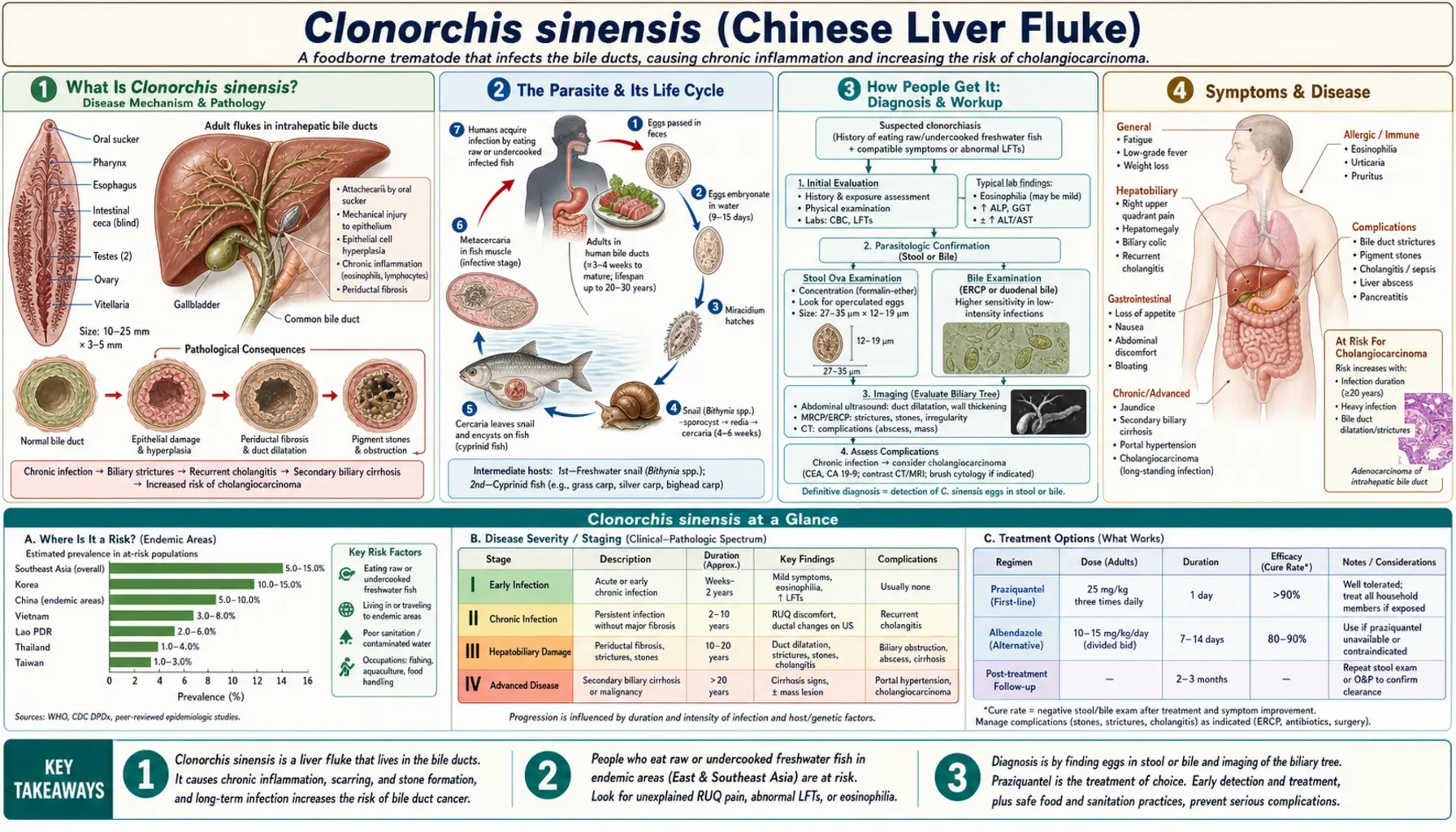
Clonorchis sinensis, the Chinese liver fluke, is a small, flat, leaf-shaped worm — a trematode, or fluke — that makes its home inside the bile ducts of the liver. People pick it up in one specific way: by eating raw or undercooked freshwater fish. It is one of the most important fish-borne parasites in the world, infecting an estimated 15 million or more people, the great majority in China, Korea, Vietnam, and the Russian Far East. Many infections are mild or cause no symptoms at all, but a heavy or long-standing infection can inflame and scar the bile ducts, trigger gallstones and obstruction, and — most seriously — raise the risk of bile-duct cancer. That last link is strong enough that the World Health Organization's cancer agency lists this fluke as a proven human carcinogen. This page explains, in plain language, what the parasite is, how its unusual two-host life cycle works, how people get infected, what the disease does to the body, the honest story of the cancer link, and how clonorchiasis is diagnosed, treated, and — most importantly — prevented.
Table of Contents
- What Is Clonorchis sinensis?
- The Parasite & Its Life Cycle
- How People Get It
- Symptoms & Disease
- The Cancer Link: Cholangiocarcinoma
- Who's at Risk & Geography
- Diagnosis
- Treatment
- Prevention
- Key Research Papers
- Featured Videos
1. What Is Clonorchis sinensis?
Clonorchis sinensis is a flatworm, not a bacterium or virus. More precisely it is a trematode — a type of parasitic flatworm commonly called a "fluke." The adult worm is small and delicate: roughly 10 to 25 millimeters long and only a few millimeters wide, flat and translucent, shaped a little like a slender leaf or a flattened teardrop. It uses two muscular suckers to grip the walls of the tiny bile ducts that thread through the liver, where it feeds and lays eggs.
Its common name, the Chinese liver fluke (it is also called the Oriental liver fluke), reflects both where it lives in the body and where it is most common. The disease it causes is called clonorchiasis. Because it is caught by eating fish rather than by contact with an infected person, it belongs to a family of illnesses known as food-borne trematodiases — fluke infections acquired from food. Along with its close relatives in the genus Opisthorchis, it is one of the most important of these fish-borne flukes.
Two features make Clonorchis worth understanding. First, it is remarkably long-lived: an adult fluke can survive in the bile ducts for years, even decades, quietly producing eggs the whole time. Second, and unlike most intestinal parasites, chronic infection is tied to a serious cancer. Those two facts — long residence and a cancer link — are the reasons this otherwise obscure worm receives so much scientific attention, and they run through every section below.
2. The Parasite & Its Life Cycle
The life cycle of Clonorchis sinensis is a small marvel of biology, and understanding it explains everything about how the infection spreads and why it is hard to eliminate. Crucially, the fluke cannot pass directly from one person to another. Before it can infect a human, it must first pass through two different water animals — a snail and then a fish. Here is the journey, step by step.
Step 1 — The egg. Adult flukes living in a person's (or a dog's, cat's, or pig's) bile ducts lay tiny eggs. The eggs are carried in bile down into the intestine and passed out in the stool. If that stool reaches fresh water — a pond, a ditch, a fish farm — the cycle can continue.
Step 2 — The freshwater snail. The egg must be eaten by a particular kind of freshwater snail, the first intermediate host. Inside the snail, the parasite goes through several developmental stages and multiplies, eventually producing free-swimming larvae called cercariae that leave the snail and swim out into the water.
Step 3 — The freshwater fish. The swimming cercariae seek out a freshwater fish — most often members of the carp family (cyprinids) — and burrow into its skin and muscle. There they settle down, form a protective cyst, and become metacercariae: the dormant, infective stage waiting in the flesh of the fish. A single fish can carry many of these microscopic cysts hidden in its meat.
Step 4 — The human meal. When a person eats that fish raw, undercooked, pickled, salted, or "drunken" (marinated in alcohol), the metacercariae survive the meal. In the small intestine they hatch out, and the young flukes migrate upstream through the bile opening (the ampulla) into the bile ducts of the liver. Over about one month they mature into egg-laying adults, and the cycle is complete — ready to begin again the next time an infected person's or animal's waste reaches water containing the right snails and fish.
Two points deserve emphasis. First, because dogs, cats, pigs, and rats can all host the adult fluke, these animals act as a natural reservoir that keeps the parasite circulating even where human sanitation improves. Second, the requirement for both a snail and a fish is why the infection is tied to specific freshwater ecosystems and fish-farming regions — and why it simply cannot spread from person to person.
3. How People Get It
There is essentially one way to catch Clonorchis sinensis: eating raw or undercooked freshwater fish that carry the parasite's metacercariae in their flesh. Everything else follows from that single fact.
The risky foods are traditional and often prized dishes made from freshwater fish that never see enough heat to kill the parasite:
- Raw fish dishes — thin slices of fresh raw freshwater fish, sometimes served with sauces or seasonings.
- Pickled, salted, or dried fish — curing methods that, contrary to common belief, do not reliably kill the encysted larvae.
- "Drunken fish" — freshwater fish marinated in wine or spirits; the alcohol does not make it safe.
- Undercooked fish — lightly cooked, smoked, or fermented preparations where the center of the flesh stays cool.
- Raw-fish porridge or congee and similar home dishes in endemic regions.
A few honest clarifications help put the risk in perspective. This is a freshwater parasite: it comes from pond, river, and farm fish, not from ocean fish or typical marine sushi. You cannot catch clonorchiasis from another person — not by touch, not through shared food someone prepared, not through coughing or close contact — because the parasite has to pass through a snail and a fish before it can infect anyone. And an infected person who never eats raw freshwater fish again cannot re-infect themselves; new infection always requires a new contaminated fish meal. Those distinctions matter, because they mean prevention comes down almost entirely to what happens to the fish before it is eaten.
4. Symptoms & Disease
Clonorchiasis is highly variable, and the number of flukes a person carries makes all the difference. Someone with just a few worms may feel nothing at all, while someone with hundreds or thousands, built up over years of repeated raw-fish meals, can become seriously ill. Because the early phase is often silent, many people do not realize they are infected until damage has accumulated.
Light or early infection is frequently asymptomatic or produces only vague complaints — a bit of indigestion, mild abdominal discomfort, or fatigue that is easy to attribute to something else.
Heavier or chronic infection tends to announce itself through the bile ducts and upper abdomen. Common problems include:
- Abdominal pain, typically in the upper-right part of the belly over the liver.
- Indigestion, poor appetite, nausea, and sometimes diarrhea.
- Fatigue and, in long-standing heavy infection, weight loss.
- Inflammation of the bile ducts (cholangitis) as the flukes and their eggs irritate the duct lining.
- Gallstones and bile-duct stones — the flukes and their eggs seed the formation of pigment stones inside the liver's ducts.
- Blockage (obstruction) of bile flow, which can cause jaundice (yellowing of the skin and eyes) and bouts of fever and pain from infected, backed-up bile.
- Pancreatitis — inflammation of the pancreas — when flukes or eggs affect the pancreatic duct.
Over many years, the constant irritation can thicken and scar the walls of the bile ducts, widen and deform them, and in severe cases lead to recurrent bacterial infections of the biliary tree, liver abscesses, and biliary cirrhosis. This slow, grinding damage is the backdrop against which the most feared complication — bile-duct cancer — develops, and it is the subject of the next section.
5. The Cancer Link: Cholangiocarcinoma
The most important reason to take Clonorchis sinensis seriously is its link to cholangiocarcinoma — cancer of the bile ducts. This is not a fringe claim or a scare story. Chronic clonorchiasis is a recognized, well-documented risk factor for this cancer, and the evidence is strong enough that the International Agency for Research on Cancer (IARC) — the cancer research arm of the World Health Organization — classifies Clonorchis sinensis as a Group 1 carcinogen, meaning it is carcinogenic to humans. Group 1 is the highest, most certain category IARC uses — the same tier that contains tobacco smoke and asbestos.
Cholangiocarcinoma is a serious cancer that arises in the lining of the bile ducts. It is often found late and is difficult to treat, which is exactly why an avoidable cause like a parasite matters so much. Strikingly, some of the regions where this fluke is most common — parts of northeastern China and Korea — also have among the highest rates of bile-duct cancer in the world, a pattern that first alerted researchers to the connection.
How does a worm cause cancer? The mechanism is best understood as decades of chronic injury and repair inside the bile ducts. It comes together in a few plain steps:
- Physical damage. The flukes cling to and scrape the delicate lining of the ducts with their suckers, causing ongoing mechanical wear.
- Constant inflammation. The worms' feeding, their waste products, and the eggs they lodge in the duct walls keep the immune system permanently switched on in that spot — a low-grade fire that never goes out.
- Endless repair. To replace the damaged lining, the duct cells must divide over and over. Every round of cell division is a chance for a copying error — a mutation — to slip in.
- Chemical DNA damage. Chronic inflammation floods the tissue with reactive oxygen and nitrogen molecules (free radicals) that can directly damage the DNA of the very cells being forced to divide.
Run that injury-inflammation-repair cycle for years to decades, and the odds rise that some bile-duct cell will accumulate enough genetic damage to become cancerous. It is the same broad principle behind other inflammation-driven cancers — a persistent irritant, chronic inflammation, and continuous tissue repair together set the stage.
An honest note on the size of the risk. It is important not to overstate this. Most people infected with Clonorchis will never develop bile-duct cancer. The elevated risk is concentrated in those with heavy, long-standing infection — typically people in highly endemic areas who have eaten raw freshwater fish regularly for many years. But the association is consistent and biologically well explained, and because the infection is preventable and treatable, reducing it is a genuine opportunity to prevent a hard-to-treat cancer. That is the practical bottom line: clearing the parasite and, above all, not getting re-infected removes an avoidable cancer risk.
6. Who's at Risk & Geography
Clonorchiasis is a disease of specific places and specific habits. Geographically, it is concentrated in East and Southeast Asia and the Russian Far East:
- China — by far the largest share of the world's cases, with well-known endemic provinces in the south (such as Guangdong and Guangxi) and the northeast.
- South Korea — a long-standing endemic country, especially around certain river basins.
- Northern Vietnam.
- The Russian Far East — particularly the Amur River region bordering China.
- Historically also parts of Taiwan and Japan.
Within those regions, risk is driven by diet and local ecology. The people most likely to be infected are those who regularly eat raw or undercooked freshwater fish as part of their food culture. Infection tends to build up with age, simply because the flukes are long-lived and each raw-fish meal can add more worms over a lifetime. In many endemic communities, men are infected more often than women, a pattern usually linked to social eating customs that pair raw fish with alcohol.
Two ecological factors keep the parasite entrenched. Fish farming (aquaculture) in ponds that are exposed to human or animal waste can turn out large numbers of infected fish. And the animal reservoir — dogs, cats, and pigs that also carry the adult fluke — continually re-seeds the environment, so the cycle persists even as sanitation improves. Travelers and immigrants from endemic regions can carry a silent, long-lasting infection with them, which is worth remembering when unexplained bile-duct problems appear in someone with that background.
7. Diagnosis
Because clonorchiasis often causes only vague symptoms — or none — the diagnosis usually depends on looking for the parasite rather than on how a person feels. Several methods are used, often in combination.
Finding eggs in the stool is the traditional and most direct method. Under the microscope, Clonorchis eggs are tiny (roughly 28–35 micrometers), yellow-brown, and have a distinctive shape often likened to an old-fashioned light bulb: a small lid (operculum) at one end sitting on a slight shoulder, with a little knob at the opposite end. An important honest caveat is that these eggs look very similar to those of related flukes — Opisthorchis and several small intestinal flukes — so egg appearance alone cannot always tell the exact species apart, and expert examination is needed. Because egg output can be low in light infections, stool-concentration techniques and repeat samples collected on different days improve the odds of finding them.
Blood and molecular tests add useful backup. Antibody (serology) and antigen or DNA (PCR) tests can help detect infection, particularly when egg counts are low, though their availability varies by region. A raised eosinophil count (a type of white blood cell that reacts to parasites) on a routine blood test can be a supporting clue.
Imaging is valuable both for diagnosis and for assessing damage. Ultrasound, CT, and MRI (including MRCP, a detailed scan of the bile ducts) can reveal the telltale widening of the small peripheral bile ducts deep in the liver, thickened duct walls, stones, and sometimes the flukes themselves. Imaging also matters for spotting complications and screening for cholangiocarcinoma in people with long-standing heavy infection.
8. Treatment
The good news is that clonorchiasis is curable with medication, and the drugs work well. Treatment should be directed by a clinician, and the notes below describe what is typically reported rather than a prescription.
Praziquantel is the first-line treatment. It is a highly effective anti-fluke drug, usually given as a short course over a single day, and it kills the adult worms living in the bile ducts. Albendazole is an alternative, generally taken over a longer course of several days. Both are established treatments for this infection.
A few honest points round out the picture. Killing the flukes stops the ongoing damage, but medication cannot undo scarring or injury that has already occurred in the bile ducts, and it does not erase a cancer risk that decades of infection may have built up — which is why prevention matters as much as cure. People with heavy infection or complications — blocked ducts, stones, recurrent cholangitis — may need additional care beyond the anti-parasite drug, sometimes including procedures to clear the bile ducts and ongoing monitoring. And because treatment gives no lasting immunity, someone who goes back to eating raw freshwater fish in an endemic area can simply become infected again. Lasting benefit comes from pairing treatment with a real change in eating habits.
9. Prevention
Clonorchiasis is one of those infections where prevention is genuinely simple and almost completely effective, because the parasite has to survive inside a fish meal to reach you. Break that link and you break the infection.
Cook freshwater fish thoroughly. Heat kills the metacercariae hiding in the flesh. Cooking freshwater fish all the way through, so the center is hot and fully done, is the single most reliable way to make it safe. Adequate freezing can also kill the parasite, but home freezers may not reach a low enough temperature for long enough to be dependable, so thorough cooking is the surest method.
Avoid raw and lightly-treated freshwater fish in endemic areas. This means steering clear of raw fish slices, and of pickled, salted, dried, smoked, and "drunken" (alcohol-marinated) freshwater fish — because salting, drying, and alcohol do not reliably kill the larvae. Remember the key distinction: the concern is freshwater fish from ponds, rivers, and fish farms, not ocean fish.
Beyond the individual plate, communities reduce clonorchiasis through public-health measures: keeping human and animal waste out of fish ponds, not fertilizing aquaculture ponds with untreated night soil, improving sanitation, treating infected people (and where feasible reservoir animals), and health education in regions where raw-fish dishes are traditional. For travelers, the rule is easy to remember: in endemic parts of Asia and the Russian Far East, do not eat raw or undercooked freshwater fish.
Key Research Papers
Peer-reviewed reviews and studies on Clonorchis sinensis and clonorchiasis — the fluke's biology and life cycle, how it spreads through freshwater fish, its well-documented link to bile-duct cancer, and how the infection is diagnosed, treated, and prevented. Journal names appear as plain text; the year/volume/pages link opens the full citation via DOI.
- Qian MB, Utzinger J, Keiser J, Zhou XN. Clonorchiasis. The Lancet. 2016;387(10020):800–810.
- Hong ST, Fang Y. Clonorchis sinensis and Clonorchiasis, an Update. Parasitology International. 2012;61(1):17–24.
- Lun ZR, Gasser RB, Lai DH, et al. Clonorchiasis: a Key Foodborne Zoonosis in China. The Lancet Infectious Diseases. 2005;5(1):31–41.
- Sripa B, Kaewkes S, Sithithaworn P, et al. Liver Fluke Induces Cholangiocarcinoma. PLoS Medicine. 2007;4(7):e201.
- Bouvard V, Baan R, Straif K, et al. A Review of Human Carcinogens—Part B: Biological Agents. The Lancet Oncology. 2009;10(4):321–322.
- Shin HR, Oh JK, Masuyer E, et al. Epidemiology of Cholangiocarcinoma: an Update Focusing on Risk Factors. Cancer Science. 2010;101(3):579–585.
- Choi D, Lim JH, Lee KT, et al. Cholangiocarcinoma and Clonorchis sinensis Infection: a Case–Control Study in Korea. Journal of Hepatology. 2006;44(6):1066–1073.
- Qian MB, Chen YD, Liang S, Yang GJ, Zhou XN. The Global Epidemiology of Clonorchiasis and Its Relation with Cholangiocarcinoma. Infectious Diseases of Poverty. 2012;1(1):4.
- Sithithaworn P, Yongvanit P, Duenngai K, Kiatsopit N, Pairojkul C. Roles of Liver Fluke Infection as Risk Factor for Cholangiocarcinoma. Journal of Hepato-Biliary-Pancreatic Sciences. 2014;21(5):301–308.
- Kim TS, Pak JH, Kim JB, Bahk YY. Clonorchis sinensis, an Oriental Liver Fluke, as a Human Biological Agent of Cholangiocarcinoma: a Brief Review. BMB Reports. 2016;49(11):590–597.
- Tang ZL, Huang Y, Yu XB. Current Status and Perspectives of Clonorchis sinensis and Clonorchiasis: Epidemiology, Pathogenesis, Omics, Prevention and Control. Infectious Diseases of Poverty. 2016;5(1):71.
- Keiser J, Utzinger J. Food-Borne Trematodiases. Clinical Microbiology Reviews. 2009;22(3):466–483.
Live PubMed Searches
Each link opens a live PubMed query so results stay current as new papers are indexed.
- Clonorchis sinensis clonorchiasis
- Clonorchis sinensis and cholangiocarcinoma
- Clonorchis life cycle and freshwater fish
- Clonorchiasis praziquantel treatment
- Clonorchis epidemiology in China and Korea
- Liver fluke and bile-duct cancer (IARC)
- Clonorchis diagnosis: stool eggs and PCR
- Clonorchis prevention and raw-fish food safety
Connections
- All Parasites
- Fasciola (Liver Fluke)
- Schistosoma
- Giardia
- Tapeworm
- Gastroenterology
- Infectious Disease
- Food
- All Conditions