Beans for Gut Health and Longevity
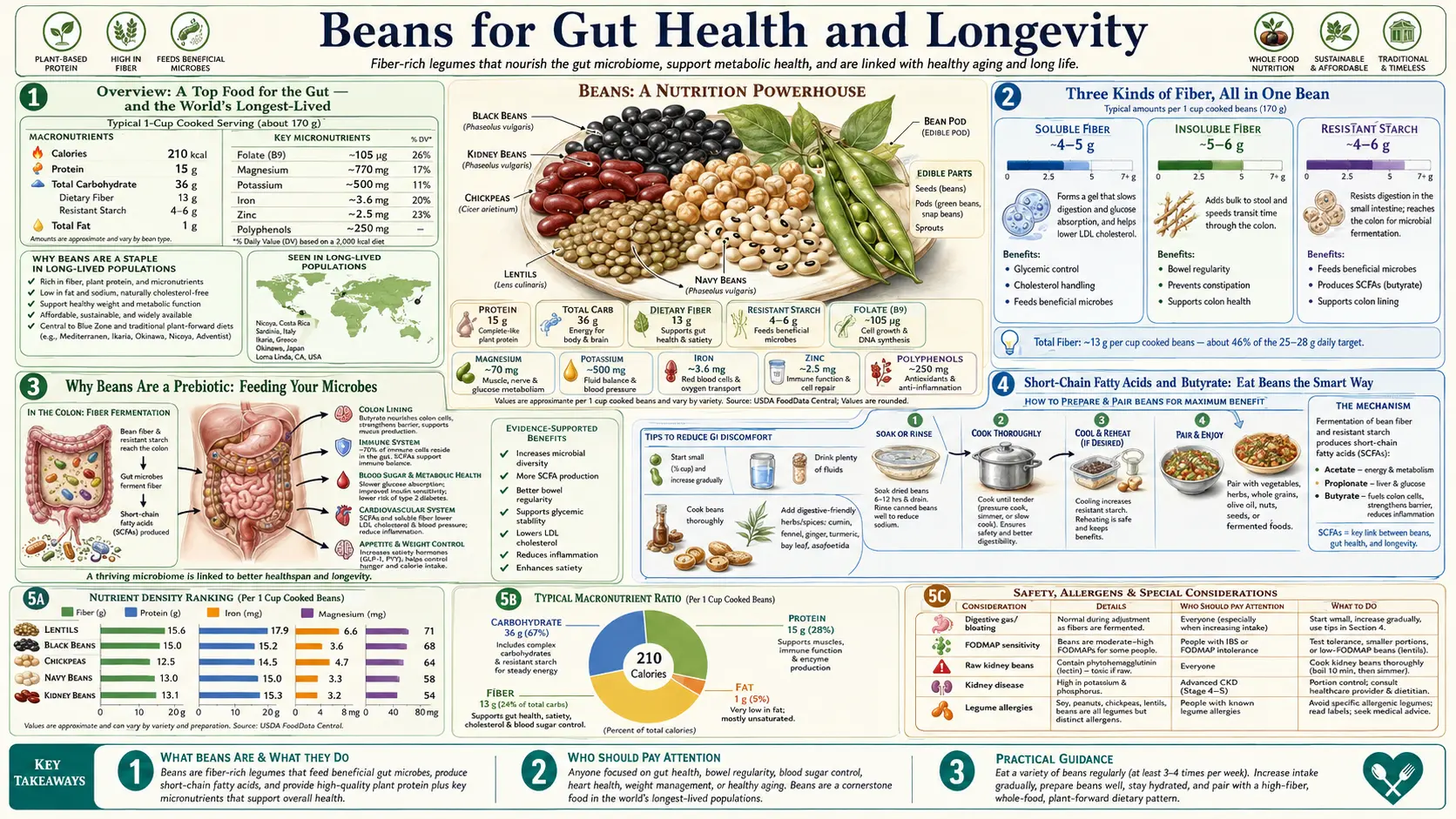
If you want one cheap, ordinary food that feeds the trillions of helpful bacteria living in your gut — and that turns up again and again in the diets of the world's longest-lived people — it is beans. Black, kidney, pinto, navy, and cannellini beans (all varieties of Phaseolus vulgaris) are among the richest everyday sources of the fermentable fiber and resistant starch your own body cannot digest but your gut microbes thrive on. As those microbes ferment what you couldn't, they make short-chain fatty acids like butyrate that nourish and calm the lining of your colon. This page explains, in plain language, how beans support your gut and your weight — and what the longevity research does and does not actually show.
Table of Contents
- Overview: A Top Food for the Gut — and the World's Longest-Lived
- Three Kinds of Fiber, All in One Bean
- Why Beans Are a Prebiotic: Feeding Your Microbes
- Short-Chain Fatty Acids and Butyrate
- Microbiome Diversity and Whole-Body Health
- Satiety and Weight: Why Beans Keep You Full
- Beans and Longevity: What the Evidence Shows
- How to Eat Beans for a Happier Gut
- Honest Caveats: Gas, Adaptation, and Safety
- Key Research Papers
- Connections
- Featured Videos
Overview: A Top Food for the Gut — and the World's Longest-Lived
Two facts about beans tend to surprise people. The first is that a large share of what is in a bean never gets digested by you at all. The fiber and resistant starch pass intact through your stomach and small intestine and arrive in your large intestine, where they become food for the bacteria living there. In other words, beans feed two organisms at once — you, and your gut microbiome. That makes them one of the most reliable everyday prebiotic foods: ordinary, fermentable fuel for the microbes that, in turn, do real work for your health.
The second fact is geographic. When researchers look at the populations that reach old age in the largest numbers — the so-called Blue Zones in places like Okinawa (Japan), Sardinia (Italy), Nicoya (Costa Rica), Ikaria (Greece), and the Loma Linda Adventists (California, USA) — a humble pattern keeps appearing. These diets differ in many ways, but legumes — beans, lentils, soy, and the like — are a common thread. They are a staple, eaten daily, often as the everyday source of protein in place of large amounts of meat.
It is important to be careful with that second observation, and we will return to it in detail below. The Blue Zone diets are whole patterns — lots of vegetables, beans, and whole grains; little processed food; physical activity; strong social ties. Beans are part of those patterns, not a proven magic bullet on their own. But the gut and weight benefits of beans, which we can study directly in experiments, are real, well-documented, and plausibly part of why a bean-rich way of eating tends to track with better long-term health.
Three Kinds of Fiber, All in One Bean
"Fiber" is not one thing. It is a family of plant carbohydrates your digestive enzymes cannot break down, and beans are unusual in delivering all the main kinds at once. A single cooked cup of beans supplies roughly 11 to 15 grams of total fiber — a large fraction of the daily target most adults never reach.
- Soluble fiber dissolves in water and forms a soft gel in the gut. That gel slows digestion, helps blunt the rise in blood sugar after a meal, and binds some cholesterol and bile acids so they are carried out of the body. Much soluble fiber is also readily fermented by gut bacteria.
- Insoluble fiber does not dissolve. It adds bulk to stool and helps it move through the colon, supporting regularity and easing constipation. It is the "roughage" that keeps things moving.
- Resistant starch is a starch that "resists" digestion in the small intestine and behaves much like fiber, reaching the colon intact. Beans are one of the best ordinary food sources of it. Resistant starch is especially good fuel for the bacteria that produce butyrate (more on that below). Interestingly, cooking and then cooling beans — as in a bean salad — increases their resistant-starch content as some of the starch re-crystallizes.
The practical point is that you do not have to assemble a complicated diet to get a balanced mix of fibers and resistant starch. A serving of beans delivers all three at once, which is part of why beans punch so far above their weight for gut health.
Why Beans Are a Prebiotic: Feeding Your Microbes
A prebiotic is, simply, food for your good gut bacteria — a substance you cannot digest yourself, but that beneficial microbes can ferment and grow on. This is the opposite of a probiotic (which is the live bacteria themselves, as in yogurt or a supplement). Prebiotics are the meal; probiotics are the guests. Beans are a prebiotic powerhouse because the very fibers and resistant starch that slip past your own digestion become a feast in the colon.
Here is what happens. Your large intestine is home to trillions of bacteria. When fermentable fiber and resistant starch arrive, the bacteria that specialize in breaking down carbohydrates — including beneficial groups such as Bifidobacteria and various butyrate-producing species — ferment them for energy. As those helpful, carbohydrate-loving bacteria flourish, they tend to crowd out less desirable, protein-fermenting species. The end products of carbohydrate fermentation are largely beneficial; the end products of heavy protein fermentation can include compounds that are not. So feeding your gut a steady supply of bean fiber gently shifts the whole community in a healthier direction.
This is also why the benefit is a habit, not a single meal. The microbiome responds to what it is fed regularly. Eat beans a few times a week and you are, in effect, cultivating a fiber-loving community in your gut — one that gets better at extracting these benefits the more consistently you feed it.
Short-Chain Fatty Acids and Butyrate
When gut bacteria ferment the fiber and resistant starch from beans, they release short-chain fatty acids (SCFAs) — mainly acetate, propionate, and butyrate. These small molecules are not waste; they are some of the most useful compounds your gut microbes make, and they are a large part of why a high-fiber diet is good for you. Butyrate in particular deserves attention.
- Fuel for the colon lining. Butyrate is the preferred energy source for the cells (colonocytes) that line your large intestine. Those cells essentially run on butyrate, so a fiber-rich diet that keeps butyrate flowing helps keep the gut lining well-nourished and healthy.
- Supporting the gut barrier. A healthy colon lining acts as a tight barrier that lets nutrients through but keeps bacteria and their byproducts from leaking into the bloodstream. Butyrate helps maintain the integrity of that barrier — the junctions between cells — which matters because a "leaky" barrier is linked to inflammation.
- Calming inflammation. SCFAs, and butyrate especially, have anti-inflammatory effects in the gut and beyond. They help regulate immune cells and dampen unnecessary inflammatory signaling, which is one mechanism connecting a high-fiber diet to lower chronic inflammation.
The chain of cause and effect here is direct and worth remembering: you eat beans → your fiber and resistant starch reach the colon → bacteria ferment them → butyrate and other SCFAs are produced → your gut lining is fed, your barrier is supported, and inflammation is calmed. Beans, because they are so rich in resistant starch, are particularly good at driving the butyrate end of this process.
Microbiome Diversity and Whole-Body Health
One of the clearest markers of a healthy gut is diversity — a rich variety of bacterial species, rather than a few dominant ones. Generally speaking, a more diverse microbiome is a more resilient one, better able to resist invading pathogens, recover from disturbances (such as a course of antibiotics), and produce a broad range of beneficial compounds. Lower microbial diversity, by contrast, is associated with several conditions, including obesity, type 2 diabetes, inflammatory bowel conditions, and more.
Diet is one of the strongest levers on microbiome diversity, and dietary fiber is at the center of it. Different fibers feed different microbes, so a diet rich and varied in plant fibers tends to support a more varied microbial community. Beans contribute several fermentable substrates at once — soluble fiber, resistant starch, and resistant oligosaccharides — and so help feed a broader range of beneficial species than a single, refined carbohydrate would. A diet built around fiber-rich whole foods like beans, vegetables, fruit, and whole grains is, in effect, a diet that cultivates diversity.
Why does this matter beyond the gut? Because the microbiome talks to the rest of the body. Through the SCFAs it produces, the immune signaling it shapes, and the barrier it helps maintain, the gut community influences metabolism, blood sugar regulation, inflammation, and immune function. This is why a well-fed, diverse gut is increasingly seen as a foundation of metabolic and immune health — and why a simple, fiber-rich food like beans can have effects that reach well past digestion. For more on supporting the gut community directly, see Fermented Foods and Probiotics; beans (prebiotics) and fermented foods (probiotics) work as natural partners.
Satiety and Weight: Why Beans Keep You Full
Beans are unusually filling for the calories they contain, and that has a direct bearing on weight. The reason is the combination they carry: a generous amount of protein together with a large amount of fiber, both in a low-energy-density package (a lot of food volume for relatively few calories). Protein and fiber are the two nutrients most consistently linked to fullness.
- They slow stomach emptying. The soluble fiber in beans forms a gel that slows how quickly food leaves the stomach, so you feel full for longer after a meal and the urge to snack later is blunted.
- They steady blood sugar. Because beans have a low glycemic effect, they avoid the sharp blood-sugar spike-and-crash that can trigger hunger an hour or two after eating a refined-carbohydrate meal. Steadier blood sugar tends to mean steadier appetite. (See the companion page on Blood Sugar and Diabetes.)
- They influence fullness signals. Protein and the products of fiber fermentation can prompt the gut to release hormones that signal satiety to the brain, reinforcing the feeling of having eaten enough.
In practical terms, people who include beans in their meals tend to feel satisfied on fewer calories, which is why beans feature so often in sensible weight-management eating patterns. They are filling, inexpensive, and nutrient-dense — an easy swap that helps with appetite control without calorie counting. None of this requires a special "diet"; it is simply what naturally happens when a meal is built around a high-fiber, high-protein whole food.
Beans and Longevity: What the Evidence Shows
This is the section where it is most important to be accurate, because longevity is where claims tend to outrun the evidence. The honest summary is encouraging but carefully bounded: beans are strongly associated with longer, healthier lives in observational studies of dietary patterns — but association is not proof that beans alone cause long life.
Two lines of evidence stand out. The first is the Blue Zones work popularized by Dan Buettner and colleagues, which catalogued the diets and lifestyles of the world's longest-lived communities. Across very different cultures, a daily serving of legumes was one of the recurring dietary features. The second, and more striking, is a 2004 study by Darmadi-Blackberry and colleagues, which pooled data on older adults across several countries and food cultures (Japanese, Swedish, Greek, and Australian). Among the foods examined, legumes were the single dietary factor most strongly and consistently associated with survival in older people — the researchers estimated that each additional small daily serving of legumes was associated with a meaningful reduction in the risk of dying over the follow-up period. That a finding so consistent held across such different cuisines is what makes it notable.
Now the necessary caution. Both of these are observational: they watch what people eat and what happens to them, rather than randomly assigning diets. Observational studies cannot, by themselves, prove cause and effect, because people who eat lots of beans may differ in other ways — they may eat less processed meat, more vegetables, move more, or live in settings that support health. Good studies try to adjust for these factors, but they can never fully separate the bean from the whole way of life it belongs to. So the most defensible reading is this: a dietary pattern in which legumes are a daily staple is reliably linked to longer survival, and beans are a central, plausible, and inexpensive part of that pattern — not a stand-alone elixir that adds years on its own. That is a genuinely good reason to eat beans regularly. It is not a reason to expect a single food to defy mortality.
How to Eat Beans for a Happier Gut
The single most important rule for newcomers is to start small and build up gradually. If you rarely eat beans and suddenly eat a large bowl, the unfamiliar fermentable fiber can cause gas and bloating. But this is temporary and adaptive: as you eat beans regularly, your gut microbiome shifts to handle them, and the gas typically settles down over a few weeks. Begin with a few tablespoons stirred into a dish, and increase the portion as your gut adjusts.
- Eat a variety. Different beans feed different microbes, so rotating black, kidney, pinto, navy, and cannellini beans — plus lentils and chickpeas — supports a more diverse gut community than always eating the same one. See Lentils as an easy, quick-cooking partner.
- Build them into everyday meals. Beans are forgiving and versatile: add them to soups and stews, toss them into salads (a cooled bean salad also boosts resistant starch), spoon them into grain bowls and tacos, blend them into dips, or simply have beans on toast. The goal is regular, ordinary inclusion rather than a special regimen.
- Dried or canned both work. Dried beans are inexpensive and let you control sodium; soak and cook them thoroughly. Canned beans are a perfectly good, convenient option — just rinse them well to remove much of the added sodium and some of the gas-causing sugars.
- Pair prebiotic with probiotic. Combining beans (the prebiotic fuel) with fermented foods like yogurt, kefir, or sauerkraut (live cultures) gives your gut both the helpful microbes and the food they thrive on.
- Drink water. Fiber works best with adequate fluid, which helps it do its job in the colon comfortably.
For a broader food-source overview, see the main Beans page and the Resistant Starches page.
Honest Caveats: Gas, Adaptation, and Safety
Beans are healthy for the great majority of people, but a fair account includes the real caveats — and one genuine safety rule that everyone should know.
- Gas and bloating. Beans contain a group of carbohydrates called oligosaccharides (chiefly raffinose, stachyose, and verbascose) that humans cannot digest. They reach the colon intact and are fermented by gut bacteria — which is exactly the prebiotic effect that makes beans good for you, but the fermentation also produces gas. For most people this eases as the microbiome adapts to regular bean-eating. Soaking dried beans and discarding the soak water, rinsing canned beans, cooking them thoroughly, and increasing intake gradually all help reduce the gas.
- The red kidney bean rule — a real safety point. Raw and undercooked dried red kidney beans contain a natural toxin called phytohaemagglutinin (a lectin), which can cause severe nausea, vomiting, and diarrhea within hours. The toxin is destroyed by proper cooking, but only at a full boil — not the lower temperatures of a slow cooker, which can actually leave the toxin more concentrated. The standard guidance is to soak dried kidney beans, then boil them vigorously for at least 10 minutes before simmering until tender. Canned kidney beans are already fully cooked and completely safe to eat as-is. This rule is specific and worth following exactly — it is the one place where preparation genuinely matters for safety.
- Active IBS, flares, or specific GI conditions. The same fermentable carbohydrates that feed a healthy gut can worsen symptoms for some people with irritable bowel syndrome (IBS) or during a flare of certain gut conditions. Beans are high in FODMAPs (fermentable carbohydrates), and people who are sensitive may need to limit them or choose smaller, well-rinsed portions, sometimes under the guidance of a low-FODMAP approach. This is an individual matter — many people with sensitive guts tolerate modest amounts of beans, especially canned and rinsed — and it is best worked out with a clinician or dietitian rather than by blanket avoidance.
None of these caveats changes the broad picture: for most people, beans are one of the best and most affordable foods for the gut. They simply deserve to be introduced thoughtfully, cooked properly, and individualized for those with particular digestive conditions.
Key Research Papers
- Darmadi-Blackberry I, Wahlqvist ML, Kouris-Blazos A, et al. (2004). Legumes: the most important dietary predictor of survival in older people of different ethnicities. Asia Pacific Journal of Clinical Nutrition. — PubMed
- Slavin J (2013). Fiber and prebiotics: mechanisms and health benefits. Nutrients. — PubMed
- Buettner D, Skemp S (2016). Blue Zones: Lessons From the World's Longest Lived. American Journal of Lifestyle Medicine. — PubMed
- Mudryj AN, Yu N, Aukema HM (2014). Nutritional and health benefits of pulses. Applied Physiology, Nutrition, and Metabolism. — PubMed
- Polak R, Phillips EM, Campbell A (2015). Legumes: health benefits and culinary approaches to increase intake. Clinical Diabetes. — PubMed
- Bouchenak M, Lamri-Senhadji M (2013). Nutritional quality of legumes, and their role in cardiometabolic risk prevention: a review. Journal of Medicinal Food. — PubMed
PubMed Topic Searches
- PubMed: Resistant starch, butyrate & short-chain fatty acids
- PubMed: Legume consumption and all-cause mortality
- PubMed: Beans, satiety & body weight (randomized trials)
- PubMed: Prebiotic fiber & gut microbiome diversity
Connections
- All Food
- Beans (Main Page)
- Beans Benefits Hub
- Beans for Kidney Health
- Beans for Heart Health & Cholesterol
- Beans for Blood Sugar & Diabetes
- Resistant Starches
- Fermented Foods
- Probiotics
- Lentils