Chicken
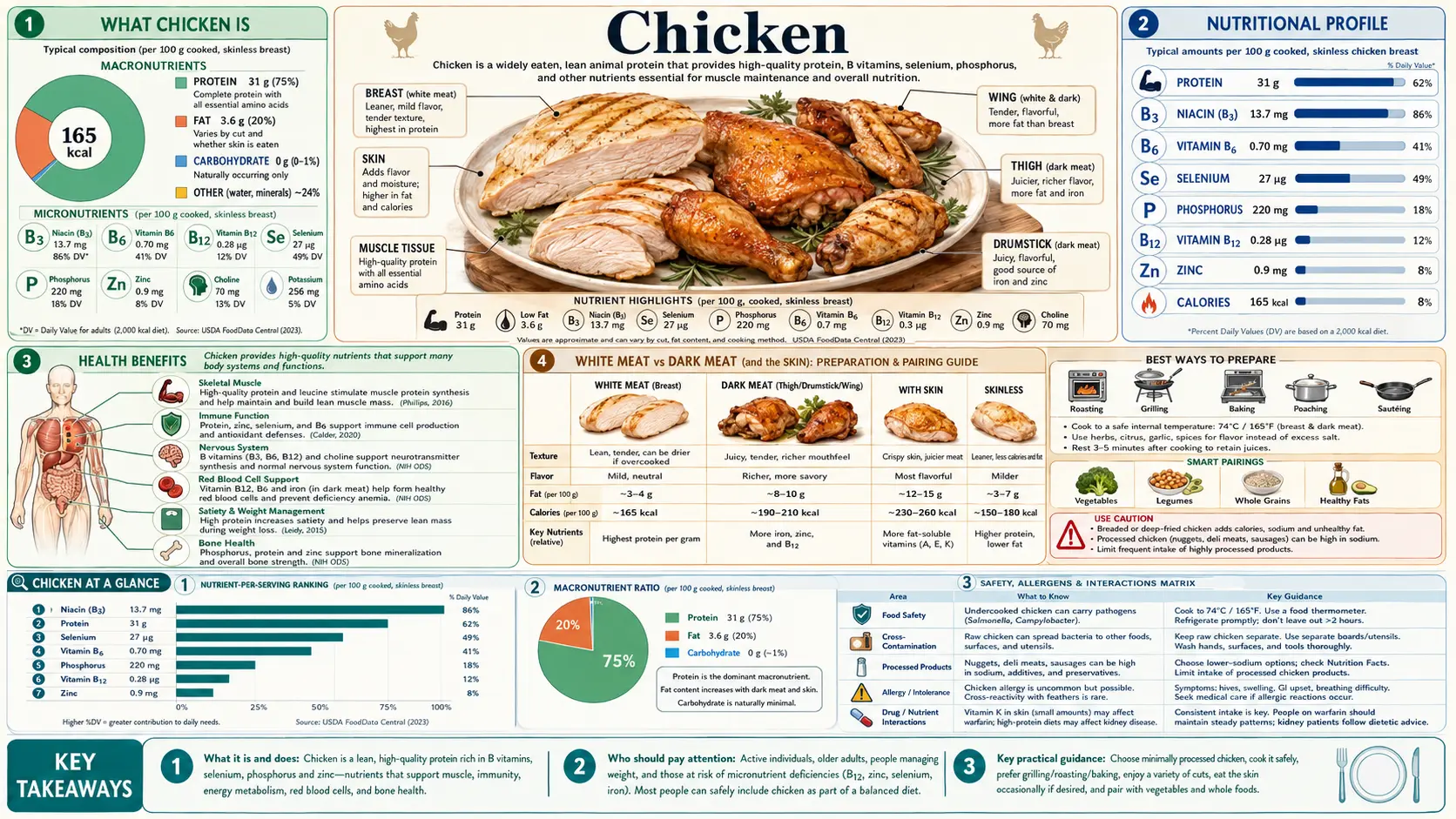
Chicken is the most widely eaten meat in the world and one of the most practical sources of high-quality protein you can put on a plate. A skinless cooked chicken breast delivers roughly 31 grams of complete protein per 100 grams for only about 165 calories, along with a strong dose of B vitamins, selenium, and phosphorus. It is leaner than most red meat, inexpensive, and endlessly versatile. The two things that matter most for your health are simple: cook it to a safe internal temperature, and choose whole cuts over heavily processed chicken products. This page covers chicken's nutrition, its real (and honestly-framed) health benefits, the white-meat-versus-dark-meat question, safe cooking, and what the sourcing labels on the package actually mean.
Table of Contents
- What Chicken Is
- Nutritional Profile
- Health Benefits
- White Meat vs Dark Meat (and the Skin)
- How to Cook It Safely
- Considerations
- Research Papers
- Connections
- Featured Videos
What Chicken Is
Chicken is the meat of the domesticated fowl Gallus gallus domesticus, raised for both meat and eggs. As a food, "chicken" almost always means the muscle meat of the bird — the breast, thighs, drumsticks, and wings — rather than the organs, which are sold and discussed separately (chicken liver, for example, is a very different food nutritionally).
The main cuts you will see at the store are:
- Breast — the large, lean muscle on the front of the bird. The most popular cut in much of the world.
- Thigh — the upper part of the leg. Juicier and more flavorful, with a bit more fat.
- Drumstick — the lower leg. Inexpensive, forgiving to cook, popular with kids.
- Wing — small, skin-heavy, popular fried or roasted.
Chicken is sold many ways: as a whole bird for roasting, or broken down into parts. Cuts can be bone-in or boneless and skin-on or skinless. Bone-in, skin-on cuts tend to be cheaper and stay moist; boneless, skinless cuts are convenient and lower in fat. You will also find it fresh (refrigerated) or frozen — frozen chicken is just as nutritious as fresh, since freezing preserves the meat without meaningful nutrient loss.
One distinction runs through everything below: white meat versus dark meat. White meat (the breast and wings) is paler and leaner. Dark meat (the thighs and drumsticks) is darker because those leg muscles are used more for standing and walking, so they carry more of the oxygen-storing protein myoglobin and a bit more fat. Both are nutritious; they simply have different strengths.
Nutritional Profile
Chicken is, first and foremost, an excellent source of high-quality, complete protein — meaning it supplies all nine essential amino acids your body cannot make on its own, in the right proportions for human needs. It is also relatively lean, especially the skinless breast.
The figures below are approximate USDA values for cooked, roasted, skinless chicken breast (meat only), per 100 grams (about 3.5 ounces) — numbers vary with cut, skin, and cooking method:
- Calories: ~165 kcal
- Protein: ~31 g
- Total fat: ~3.6 g (low; mostly unsaturated)
- Niacin (vitamin B3): ~13.7 mg — well over a day's worth
- Vitamin B6: ~0.6 mg
- Pantothenic acid (vitamin B5): ~1 mg
- Vitamin B12: ~0.3 mcg
- Selenium: ~28 mcg — roughly half a day's needs
- Phosphorus: ~228 mg
- Choline: ~85 mg
Chicken also supplies zinc and iron, and here the cut matters: dark meat (thigh and drumstick) is notably higher in zinc (roughly 1.9 mg per 100 g in thigh versus about 1 mg in breast) and carries slightly more iron and certain B vitamins. So while breast wins on leanness and total protein, dark meat is the better pick if you are after a little more of those minerals. (It is worth keeping perspective: chicken is a helpful contributor of iron and zinc but not a powerhouse for them the way red meat or shellfish are.)
Health Benefits
Complete protein for muscle and satiety. Chicken's standout feature is its protein quality. Adequate dietary protein supports the maintenance and repair of muscle — important at every age, and especially as we get older and tend to lose muscle. Protein is also the most filling of the three macronutrients: gram for gram it tends to satisfy hunger more than carbohydrate or fat, which is why higher-protein meals can make weight management easier by reducing the urge to overeat. A lean, high-protein food like skinless chicken breast fits that role well.
A leaner alternative to red and processed meat. This is where the evidence needs to be framed honestly. Large studies and meta-analyses generally find that replacing red meat — and especially processed meat — with poultry is associated with modestly better cardiovascular and mortality outcomes. This is association from observational research, not proof that chicken itself extends life; people who eat more poultry instead of bacon and burgers often differ in other healthy ways too, and the measured effects are generally small and of low-to-moderate certainty. The practical takeaway is reasonable and widely shared by nutrition guidelines: as a substitution, swapping processed and red meats for poultry (and fish, beans, and other lean proteins) is a sensible move, and chicken is one of the easiest swaps to make.
Affordable, accessible, versatile protein. Chicken is one of the cheapest animal proteins per gram, available almost everywhere, and works in nearly any cuisine or cooking style. For many households it is the most realistic way to get enough quality protein without strain on the budget — a genuine, everyday benefit.
B vitamins and selenium. Chicken is rich in niacin, vitamin B6, B12, and pantothenic acid, the B vitamins that help your body turn food into usable energy and keep the nervous system and red blood cells working. Its selenium content supports the body's antioxidant defenses and normal thyroid hormone function. A single serving of breast covers a large share of the day's niacin and roughly half the selenium.
White Meat vs Dark Meat (and the Skin)
The white-versus-dark debate is mostly overblown. Both are healthy.
- White meat (breast, wing) is leaner and slightly higher in protein. Skinless breast is the lowest-fat cut, which is why it is the go-to for people watching calories or fat.
- Dark meat (thigh, drumstick) is juicier and more flavorful, and is higher in iron, zinc, and some B vitamins. It carries modestly more fat — roughly 8 grams per 100 g in a skinless thigh versus about 3.6 grams in breast — but that fat is mostly unsaturated, and the extra moisture makes dark meat much harder to overcook and dry out.
It is not "white good, dark bad." If you want the leanest, highest-protein option, choose breast. If you want more flavor, juiciness, and a little more iron and zinc, choose thigh. Either way you are eating a nutritious food.
What about the skin? Chicken skin adds calories and saturated fat, so removing it lowers both. But the skin also adds a lot of flavor and helps the meat stay moist while it cooks — cooking a piece skin-on and removing the skin afterward, if you prefer, gives you the moisture benefit with fewer calories. Eating the skin in moderation is perfectly fine within a balanced diet; it is not something to fear.
How to Cook It Safely
Chicken is one of the most versatile proteins in the kitchen — you can roast, grill, bake, poach, stir-fry, or slow-cook it. But because raw chicken commonly carries harmful bacteria, food safety is the part that genuinely matters.
Cook chicken to a safe internal temperature of 165°F (74°C). Raw chicken can carry Salmonella and Campylobacter, two of the most common causes of food poisoning. According to the USDA and CDC, the only reliable way to kill these bacteria is heat: cook all chicken — whole birds and parts alike — to 165°F (74°C), checked with a food thermometer in the thickest part of the meat (and, on a whole bird, in the innermost part of the thigh and wing). Color is not a reliable guide; safely cooked chicken can still look slightly pink, and undercooked chicken can look done. An inexpensive instant-read thermometer is the single best tool for getting this right.
Do NOT wash or rinse raw chicken. This is the food-safety point most people get wrong. Rinsing raw chicken under the tap does not make it safer — washing cannot remove the bacteria. Instead, the splashing water spreads chicken juices (and their bacteria) up to several feet around your sink, onto countertops, utensils, and nearby ready-to-eat foods. The CDC and USDA are explicit: raw chicken is ready to cook and should not be washed first. Cooking, not rinsing, is what makes it safe.
Avoid cross-contamination. Keep raw chicken and its juices away from foods you will eat raw, like salad. Use a separate cutting board for raw chicken, and wash your hands, knives, boards, and any surfaces the raw meat touched with hot, soapy water before they meet other food.
A practical cooking tip: breast meat is lean, so it overcooks and dries out quickly — this is exactly where a thermometer pays off, since you can pull it the moment it hits 165°F. Thighs and drumsticks are far more forgiving thanks to their extra fat and connective tissue, and actually taste better cooked a little past the minimum.
Considerations
Whole cuts beat processed chicken. Not all "chicken" is equal. Processed chicken products — nuggets, breaded patties, chicken sausages, and deli or luncheon meats — can be high in sodium, padded with refined-starch breading, and made with binders, preservatives, and other additives. As with other processed meats, these are best limited. A plain chicken breast or thigh is a whole food; a breaded nugget is a processed one, and the nutrition reflects that. When you can, choose whole cuts you cook yourself.
Fried chicken versus roasted or grilled. How you cook chicken can change its nutrition as much as which cut you pick. Deep-frying — and the batter or breading that comes with it — soaks up oil and adds a large amount of fat and calories compared with roasting, grilling, baking, or poaching. Fried chicken can certainly be an occasional pleasure, but it is not nutritionally the same food as a roasted breast.
What the sourcing labels mean (and don't). Chicken packaging carries a lot of marketing terms. Honestly, here is what they do and don't guarantee:
- "Organic" — a regulated USDA label: the birds eat certified-organic feed and get no antibiotics. It does not by itself promise more outdoor access or any particular nutritional advantage.
- "Free-range" — the birds have some access to the outdoors, but the term says nothing about how much space, how long, or the quality of that access.
- "Pasture-raised" — implies more genuine time on pasture, but it is not a strictly defined federal term, so what it means varies by producer.
- "No antibiotics" / "raised without antibiotics" — the birds were not given antibiotics. Worth knowing: U.S. rules already require that any antibiotics clear a withdrawal period before slaughter, so conventional chicken in stores is not supposed to contain antibiotic residues either.
- "Air-chilled" — a processing method (chilled with cold air rather than a water bath). Fans say it gives better texture and less retained water; it is a quality/preference claim, not a safety or nutrition guarantee.
These labels can reflect real differences in farming and animal welfare and may matter to you for those reasons — just don't assume any of them dramatically changes the meat's core nutrition.
The bottom line on "chicken" nutrition: there is no single number, because it depends heavily on the cut (breast vs thigh), whether the skin is on, and the cooking method (poached vs deep-fried). A skinless poached breast and a battered, deep-fried thigh are both "chicken" and yet are nutritionally worlds apart.
Research Papers
- U.S. Department of Agriculture, FoodData Central. Chicken, broilers or fryers, breast, meat only, cooked, roasted (FDC ID 171477). fdc.nal.usda.gov — The source for chicken breast's per-100 g figures: ~31 g protein, ~165 kcal, high niacin, and about half a day's selenium.
- Centers for Disease Control and Prevention. Chicken and food poisoning (food safety). cdc.gov — Official guidance: don't wash raw chicken (it spreads Salmonella and Campylobacter around the kitchen), and cook it to a safe internal temperature of 165°F.
- U.S. Department of Agriculture, Food Safety and Inspection Service. Safe minimum internal temperature chart. fsis.usda.gov — Confirms 165°F (74°C) as the safe internal temperature for all poultry, measured with a food thermometer.
- Zeraatkar D, Han MA, Guyatt GH, et al. Red and processed meat consumption and risk for all-cause mortality and cardiometabolic outcomes: a systematic review and meta-analysis of cohort studies. Annals of Internal Medicine. 2019;171(10):703–710. doi:10.7326/M19-0655 — Found that reducing red and processed meat is associated with small reductions in cardiometabolic and mortality risk (low-certainty evidence) — a careful, honestly-framed look at the substitution question.
- Papp RE, Hasenegger V, Ekmekcioglu C, et al. Association of poultry consumption with cardiovascular diseases and all-cause mortality: a dose-response meta-analysis of prospective cohort studies. Critical Reviews in Food Science and Nutrition. 2023;63(15):2366–2387. doi:10.1080/10408398.2021.1975092 — A dose-response meta-analysis of 24 cohorts: a small inverse association between higher poultry intake and all-cause mortality, with a modest effect size.
- Paddon-Jones D, Westman E, Mattes RD, et al. Protein, weight management, and satiety. American Journal of Clinical Nutrition. 2008;87(5):1558S–1561S. doi:10.1093/ajcn/87.5.1558s — Review explaining why higher-protein foods like lean chicken increase fullness and support muscle.
Connections
- All Food
- Beef
- Pork
- Eggs
- Chicken Liver
- History of Eggs — from red junglefowl to the modern laying hen.
- Preventing Campylobacter: Poultry Safety, Water, and Food Hygiene
- Restaurant & Travel Survival Guide for Alpha-Gal Syndrome
- Complete Mammalian Foods List for Alpha-Gal Syndrome — why chicken stays on the safe list when beef and pork do not.