Chickpeas
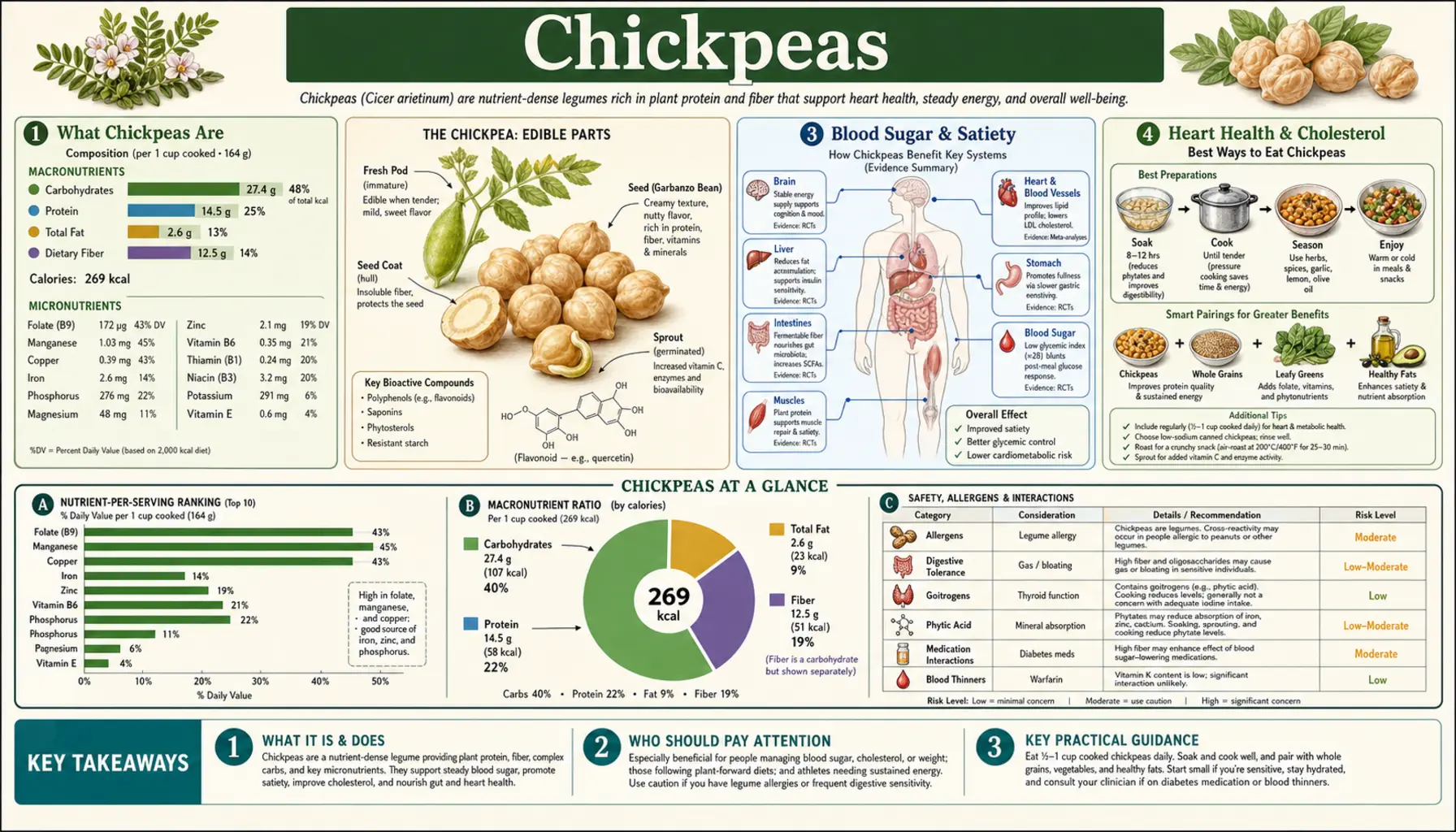
Chickpeas — also known as garbanzo beans — are a cheap, shelf-stable legume that has fed people across the Middle East, India, and the Mediterranean for thousands of years. They pack an unusual one-two punch of plant protein and fiber, give blood sugar a slow, steady rise rather than a spike, and, as part of the well-studied pulse family, are linked to lower cholesterol and better heart health. Whether you blend them into hummus, roast them for a crunchy snack, or simmer them into a stew, they are one of the simplest, most affordable ways to make a meal more filling and more nourishing.
Table of Contents
- What Chickpeas Are
- Nutritional Profile
- Blood Sugar & Satiety
- Heart Health & Cholesterol
- Gut Health & Weight
- How to Use Them
- Considerations
- Research Papers
- Connections
- Featured Videos
What Chickpeas Are
Chickpeas (Cicer arietinum), also called garbanzo beans, are a legume — part of the same plant family as lentils, beans, and peas. Within nutrition they belong to a group called pulses, which simply means the dried, edible seeds of legumes. They have a mild, nutty flavor and a firm, slightly creamy texture when cooked.
There are two main types. The larger, round, pale-cream kabuli chickpea is the one most people in North America and Europe know — it is what usually ends up in cans. The smaller, darker, more angular desi chickpea is common across India and much of South Asia, where it is often split and sold as chana dal.
Chickpeas have been a dietary staple for thousands of years across the Middle East, India, and the Mediterranean. They are the base of beloved dishes like hummus (blended with tahini, lemon, and garlic) and falafel (ground, spiced, and fried). They are also one of the most practical foods you can keep on hand: inexpensive, widely available, and — whether canned or dried — shelf-stable for a long time.
Nutritional Profile
For a plant food, chickpeas are unusually well-rounded. Their two headline nutrients are protein and fiber.
- Plant protein. A cooked cup supplies roughly 12–15 grams of protein, making chickpeas a useful protein source for vegetarian, vegan, and budget-conscious eaters.
- Fiber, including resistant starch. A cooked cup delivers around 10–12 grams of fiber. Some of their starch is resistant starch — starch that escapes digestion in the small intestine and behaves more like fiber, feeding bacteria further down in the gut.
- Vitamins and minerals. Chickpeas are a good source of folate (a B vitamin important in pregnancy), iron, phosphorus, magnesium, and manganese.
- Some healthy fats. Unlike most beans, chickpeas contain a modest amount of fat, and it skews toward unsaturated (polyunsaturated and monounsaturated) fats.
One practical note about the iron: it is non-heme iron, the plant form, which the body absorbs less efficiently than the iron in meat. You can meaningfully boost absorption by eating chickpeas alongside a source of vitamin C — a squeeze of lemon, some tomato, peppers, or a side of citrus all help.
Blood Sugar & Satiety
Chickpeas have a low glycemic index, meaning they raise blood sugar slowly and gently rather than causing a sharp spike. The combination of protein, fiber, and resistant starch slows digestion, which blunts the post-meal glucose rise and helps you feel full.
The evidence here is strongest when chickpeas are considered as part of the broader pulse family. A systematic review and meta-analysis of controlled trials found that pulses — alone, or as part of a low-glycemic-index or high-fiber diet — improved markers of longer-term blood-sugar control, including fasting glucose and HbA1c (a measure of average blood sugar over months).
Pulses also tend to be filling. A meta-analysis of short-term feeding trials found that meals containing pulses produced noticeably greater feelings of fullness than comparison meals. Honestly, though, that extra fullness did not reliably translate into people eating less at their next meal in those studies — so the satiety effect is real and measurable, but its knock-on effect on total intake is less certain.
Heart Health & Cholesterol
As a pulse, chickpeas fit into one of the better-supported stories in nutrition: regularly eating legumes is linked to lower LDL cholesterol (the "bad" cholesterol) and better cardiovascular markers.
A large meta-analysis of randomized controlled trials found that eating about one serving of pulses per day significantly lowered LDL cholesterol compared with control diets. The likely drivers are the same two nutrients chickpeas are rich in: soluble fiber, which binds cholesterol-related compounds in the gut and carries them out of the body, and plant protein, which appears to displace some of the saturated fat and refined carbohydrate that push cholesterol up.
Chickpea-specific trials point the same direction, if modestly. In controlled studies where people added chickpeas to their usual diet for several weeks, total and LDL cholesterol dropped by a small but real amount — partly because eating chickpeas naturally crowded out less healthy foods.
Gut Health & Weight
The fiber and resistant starch in chickpeas act as prebiotics — food for the beneficial bacteria living in your large intestine. When those bacteria ferment this material, they produce short-chain fatty acids that nourish the cells lining the colon and support overall gut health.
Chickpeas can also be a helpful part of weight management, though not because of anything magical in the bean itself. They are filling, high in fiber and protein, and relatively low in calories for the volume you get — so they help round out a meal and may make it easier to feel satisfied. The real benefit shows up when chickpeas are part of an overall higher-fiber, plant-forward way of eating, rather than as a single "superfood" fix.
How to Use Them
Chickpeas are one of the easiest foods to fold into everyday cooking.
- Canned — the convenient option. Just drain and rinse them, which washes away a good portion of the added sodium and rinses off some of the gas-causing compounds along the way.
- Dried — cheaper and lower in sodium. Soak them for several hours (or overnight), drain, then simmer until tender. A pressure cooker speeds this up considerably.
From there, the uses are endless:
- Blended into hummus with tahini, lemon, and garlic.
- Tossed in oil and spices and roasted until crunchy for a snack.
- Simmered into curries and stews, where they soak up flavor.
- Added cold to salads for protein and bulk.
- Even blended into baking — mashed chickpeas turn up in some brownie and cookie recipes.
Two extra tricks worth knowing. The thick, starchy liquid from a can of chickpeas, called aquafaba, can be whipped and used as an egg-white substitute in things like meringues and vegan mayonnaise. And because plant proteins each fall a little short on certain amino acids, pairing chickpeas with grains (rice, bread, couscous) gives you a more complete protein — the classic logic behind hummus with pita.
Considerations
Chickpeas are safe and healthy for most people, but a few things are worth keeping in mind.
- Gas and bloating. Like all legumes, chickpeas contain oligosaccharides — carbohydrates we can't fully digest, which gut bacteria ferment and produce gas. This is normal and usually manageable: soak and rinse dried chickpeas well, rinse canned ones, increase your portions gradually, and give your body time — most people adapt and find the effect fades with regular eating.
- Cook dried chickpeas properly. Raw and undercooked legumes contain lectins, compounds that can cause digestive upset. Normal soaking followed by thorough boiling reduces them to safe levels — so always cook dried chickpeas fully (canned chickpeas are already cooked).
- Legume allergy. A true chickpea or legume allergy is possible. It is less common than peanut or soy allergy, but it is real — anyone with a known legume allergy should be cautious.
- Phytates. Chickpeas contain phytic acid, which can modestly reduce how much of certain minerals (like iron and zinc) you absorb. This is rarely a concern in a varied diet, and soaking, cooking, and sprouting all lower phytate levels.
Research Papers
- Sievenpiper JL, Kendall CWC, Esfahani A, et al. Effect of non-oil-seed pulses on glycaemic control: a systematic review and meta-analysis of randomised controlled experimental trials in people with and without diabetes. Diabetologia. 2009;52(8):1479–1495. doi:10.1007/s00125-009-1395-7 — Pulses, alone or in low-GI/high-fiber diets, improved fasting glucose and HbA1c.
- Ha V, Sievenpiper JL, de Souza RJ, et al. Effect of dietary pulse intake on established therapeutic lipid targets for cardiovascular risk reduction: a systematic review and meta-analysis of randomized controlled trials. CMAJ. 2014;186(8):E252–E262. doi:10.1503/cmaj.131727 — About one serving of pulses a day significantly lowered LDL cholesterol.
- Pittaway JK, Ahuja KDK, Robertson IK, Ball MJ. Effects of a controlled diet supplemented with chickpeas on serum lipids, glucose tolerance, satiety and bowel function. J Am Coll Nutr. 2007;26(4):334–340. doi:10.1080/07315724.2007.10719620 — A chickpea-supplemented diet produced small reductions in total and LDL cholesterol.
- Pittaway JK, Robertson IK, Ball MJ. Chickpeas may influence fatty acid and fiber intake in an ad libitum diet, leading to small improvements in serum lipid profile and glycemic control. J Am Diet Assoc. 2008;108(6):1009–1013. doi:10.1016/j.jada.2008.03.009 — Adding canned chickpeas modestly improved cholesterol and insulin markers, largely via increased fiber.
- Li SS, Kendall CWC, de Souza RJ, et al. Dietary pulses, satiety and food intake: a systematic review and meta-analysis of acute feeding trials. Obesity (Silver Spring). 2014;22(8):1773–1780. doi:10.1002/oby.20782 — Pulses increased feelings of fullness, though without measurably reducing intake at the next meal.
- Messina V. Nutritional and health benefits of dried beans. Am J Clin Nutr. 2014;100(Suppl 1):437S–442S. doi:10.3945/ajcn.113.071472 — A review concluding that bean-containing diets lower LDL cholesterol and reduce risk of heart disease and diabetes.