High Resistant Starch Foods: Measured Content, Cooking and Cooling, and Trial Doses
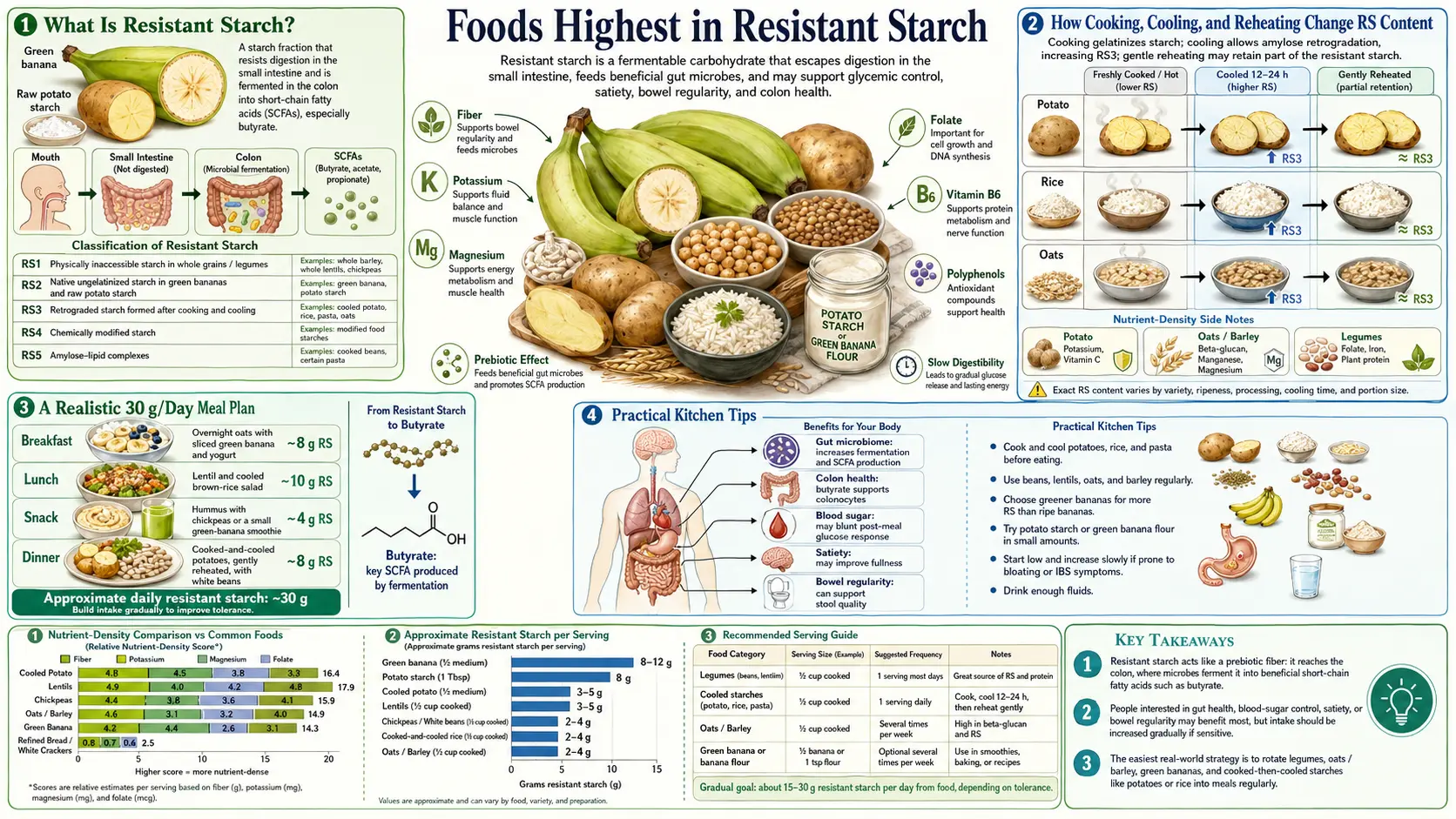
Resistant starch (RS) is the part of dietary starch that escapes digestion in the small intestine and reaches the colon, where gut bacteria ferment it. Americans aged 1 year and older were estimated to eat about 4.9 g of resistant starch a day (range 2.8 to 7.9 g, depending on the food values used), with breads, cooked cereals and pastas, and vegetables other than legumes as the top sources (Murphy 2008, PMID 18155991). Supplement trials have used larger amounts, such as 30 g a day (Robertson 2005, PMID 16155268). This page covers the resistant-starch types, which whole foods have been measured and what was found, how cooking, cooling and reheating changed the measured amounts, the doses trials used and what they reported, and the overlap with FODMAPs that matters for people with irritable bowel syndrome (IBS).
Table of Contents
- Why Resistant Starch Is a Fermentable Fiber
- RS1 to RS5: How the Types Are Defined
- Measured Resistant Starch in Whole Foods
- Cooking, Cooling and Reheating: What Studies Measured
- Intake Estimates and Doses Used in Trials
- Why Food Resistant-Starch Figures Vary
- Tolerance and Changes in Gut Bacteria
- FODMAP Considerations and Irritable Bowel Syndrome Overlap
- Butyrate, Colon Cells, and Why This Matters Biologically
- Foods and Ingredients Studied as Resistant-Starch Sources
- Key Research Papers
- Connections
- Featured Videos
1. Why Resistant Starch Is a Fermentable Fiber
Most of the starch in freshly cooked foods is broken down by amylase enzymes and absorbed as glucose in the small intestine. In people with ileostomies who ate freshly cooked potato, only 3% of the starch escaped digestion in the small intestine (Englyst and Cummings 1987, PMID 3812341). Resistant starch behaves differently. Because of its physical form or structure it is not digested there; it reaches the large bowel, where colonic bacteria ferment it to short-chain fatty acids (SCFAs), mainly acetate, propionate and butyrate (Topping and Clifton 2001, PMID 11427691). Nutritionally it therefore behaves more like a fermentable fiber than like a digestible starch, even though chemically it is still made of glucose chains.
In 1992 Englyst, Kingman and Cummings classified dietary starch as rapidly digestible, slowly digestible or resistant, and divided resistant starch into three categories according to the reason it resists digestion. They published a laboratory method whose resistant-starch values were similar to the amounts of starch escaping digestion in the small intestine of people with ileostomies (PMID 1330528). Topping and Clifton's 2001 review states that fermentation of some resistant-starch types favors butyrate production (PMID 11427691).
Human studies described further down this page link resistant starch with a lower blood-glucose response to cooled rice, higher insulin sensitivity on a 30 g/day supplement, and lower liver fat in a 4-month trial in people with non-alcoholic fatty liver disease, while a large trial in Lynch syndrome found no effect on colorectal adenoma or cancer. Each finding is given with its source in the sections that follow.
2. RS1 to RS5: How the Types Are Defined
Englyst and colleagues defined three types (RS1 to RS3) in 1992. Later reviews add chemical modification as a further reason starch resists digestion (RS4; PMID 11427691), and food-science studies describe amylose–lipid complexes as a fifth type (RS5) (Okumus 2018, PMID 28946310). Reviews of the field describe these types and the factors that affect how much forms in a food (PMID 24228189; PMID 33412740).
- RS1 — Physically inaccessible. Starch enclosed in intact plant tissue, as in whole or partly milled grains, seeds and legumes. In a comparison of boiled and pressure-cooked foods, legumes had more resistant starch than cereals and tubers, and the authors attributed this partly to intact tissue and cell structures enclosing the starch granules; pressure cooking lowered resistant starch compared with boiling (by up to 15%, in pea), which they linked to changes in cell-wall integrity (Yadav 2010, PMID 23572606).
- RS2 — Resistant granules. Native, ungelatinized starch granules, as in raw potato and green banana. When six healthy volunteers ate freeze-dried green banana flour, 83.7% of the ingested alpha-glucans reached the end of the small intestine, mostly as insoluble starch granules similar to raw banana starch, and were almost totally fermented in the colon (Faisant 1995, PMID 7857906). Cooking in water gelatinizes the granules: starch from freshly cooked potato was well digested (Englyst and Cummings 1987, PMID 3812341).
- RS3 — Retrograded. Starch that was cooked (gelatinized) and then cooled, during which part of it re-crystallizes into a form that resists digestion. This is the type that changes with cooking and cooling at home; measured examples are in section 4.
- RS4 — Chemically modified. Starch modified so that it resists enzyme digestion (Topping and Clifton 2001). In a crossover trial in ten people who ate crackers containing RS2, RS4 or ordinary starch for three weeks each, RS2 and RS4 changed the fecal bacteria in different ways (details in section 7) (Martínez 2010, PMID 21151493).
- RS5 — Amylose–lipid complexes. In a laboratory study of brown lentil starch, adding lipids or fatty acids raised the measured resistant starch, with a larger effect in cooked starch (22.2–67.7%) than in raw starch (Okumus 2018, PMID 28946310). This is a food-science finding on isolated starch, not a measurement of whole foods.
In short: RS1 is starch enclosed in intact plant structure, RS2 is raw granular starch, and RS3 is starch that re-crystallized after cooking and cooling.
3. Measured Resistant Starch in Whole Foods
Published measurements use different methods and report on different bases — grams per 100 g of food, percent of dry matter, or the share of starch or carbohydrate recovered at the end of the small intestine — so the figures below cannot be compared directly with each other. Each is given as the study reports it. A review notes that the resistant-starch content of a food is strongly influenced by how it is prepared and processed (Raigond 2015, PMID 25331334), and Topping and Clifton point to the lack of a generally accepted analytical procedure (PMID 11427691).
| Food and preparation | Reported resistant starch | Basis | Source |
|---|---|---|---|
| White rice, freshly cooked | 0.64 g/100 g | Laboratory assay | Sonia 2015 |
| White rice, cooked then cooled 10 hours at room temperature | 1.30 g/100 g | Laboratory assay | Sonia 2015 |
| White rice, cooked, cooled 24 hours at 4°C, then reheated | 1.65 g/100 g | Laboratory assay | Sonia 2015 |
| Potato, freshly cooked | 3% of starch escaped small-intestinal digestion | Ileostomy volunteers | Englyst and Cummings 1987 |
| Potato, cooked and cooled | 12% of starch escaped small-intestinal digestion | Ileostomy volunteers | Englyst and Cummings 1987 |
| Potatoes (three varieties), baked or boiled; served hot, chilled or reheated | Chilled higher than hot or reheated; baked higher than boiled; no difference by variety | Laboratory assay | Raatz 2016 |
| Lentils, boiled | 5.0% (4.9% pressure-cooked) — the highest of the foods tested | Dry-weight basis | Yadav 2010 |
| Legumes, freshly cooked (mean of those tested) | 4.18%, rising to 8.16% after three heating/cooling cycles | Dry-matter basis | Yadav 2009 |
| Cereals, freshly cooked (mean) | 1.86%, rising to 3.25% after three cycles | Dry-matter basis | Yadav 2009 |
| Tubers, freshly cooked (mean) | 1.51%, rising to 2.51% after three cycles | Dry-matter basis | Yadav 2009 |
| Unripe banana flour (one variety, specific drying conditions) | 48.99 g/100 g | Dry-weight basis | Menezes 2011 |
| Freeze-dried green banana flour | 83.7% of ingested alpha-glucans reached the terminal ileum | Six healthy volunteers (intubation) | Faisant 1995 |
Sources: Sonia 2015 (PMID 26693746); Englyst and Cummings 1987 (PMID 3812341); Raatz 2016 (PMID 27132853); Yadav 2010 (PMID 23572606); Yadav 2009 (PMID 19562607); Menezes 2011 (PMID 21732181); Faisant 1995 (PMID 7857906). These sources report resistant starch per 100 g, per dry weight or as a recovered fraction rather than per serving, so per-serving gram figures are not given here.
4. Cooking, Cooling and Reheating: What Studies Measured
Cooking in water gelatinizes starch granules. When cooked starch cools, its chains re-associate (retrogradation) and part of the starch becomes resistant to digestion — resistant starch type 3 (Sonia 2015, PMID 26693746); review: PMID 33412740. The studies below measured how much this changed the resistant starch in particular foods.
- White rice. Resistant starch was 0.64 g/100 g in freshly cooked rice, 1.30 g/100 g after 10 hours of cooling at room temperature, and 1.65 g/100 g after 24 hours at 4°C followed by reheating. In a randomized, single-blind crossover study in 15 healthy adults, the cooled-and-reheated rice produced a lower blood-glucose response than freshly cooked rice (125 ± 50.1 vs 152 ± 48.3 mmol·min/L; p = 0.047). The study did not measure chilled rice that was not reheated (Sonia 2015, PMID 26693746).
- Potato, in people. In ileostomy volunteers given 300 g test meals, 3% of the starch from freshly cooked potato escaped digestion in the small intestine, compared with 12% from cooked and cooled potato. The starch made resistant by cooling became more digestible again on reheating: overall, 9%, 18% and 14% of the total carbohydrate was recovered from freshly cooked, cooled and reheated potato. Eating the cooled potato as large lumps or finely sieved made no difference (Englyst and Cummings 1987, PMID 3812341).
- Potato, in the laboratory. Yukon Gold, Dark Red Norland and Russet Burbank potatoes were baked or boiled and served hot (65°C), chilled (4°C) or reheated (held at 4°C for 6 days, then reheated to 65°C). Resistant starch varied by cooking method and serving temperature but not by variety: baked potatoes had more than boiled, and chilled potatoes had more than either hot or reheated ones (Raatz 2016, PMID 27132853).
- Legumes, cereals and tubers. Three repeated heating/cooling cycles raised the mean resistant starch of cooked legumes from 4.18% to 8.16%, of cereals from 1.86% to 3.25%, and of tubers from 1.51% to 2.51% (dry matter), with the largest increase in pea (114.8%) and the smallest in sweet potato (62.1%). Resistant-starch content correlated with amylose content (Yadav 2009, PMID 19562607).
Across these studies, cooling raised resistant starch in rice, potatoes, legumes and cereals. Reheating gave different results by food: rice that had been chilled and then reheated still had more resistant starch than freshly cooked rice, while in potatoes reheating lowered resistant starch compared with chilled potato (Englyst and Cummings 1987; Raatz 2016).
5. Intake Estimates and Doses Used in Trials
Usual intake. A study linking a literature-based database of resistant-starch concentrations to 24-hour dietary recalls from 18,305 participants in the 1999–2002 US National Health and Nutrition Examination Surveys estimated that Americans aged 1 year and older eat about 4.9 g of resistant starch a day (range 2.8–7.9 g); breads, cooked cereals/pastas and vegetables other than legumes contributed 21%, 19% and 19% (Murphy 2008, PMID 18155991).
Doses and findings in human studies:
- Insulin sensitivity: in a 4-week placebo-controlled study in 10 healthy subjects, 30 g of resistant starch a day raised insulin sensitivity measured by euglycemic-hyperinsulinemic clamp (9.7 vs 8.5 × 10⁻² mg glucose/kg/min per mU insulin/L; P = 0.03), and insulin sensitivity during a meal tolerance test was 33% higher (P = 0.05). The supplement was well tolerated (Robertson 2005, PMID 16155268).
- Bowel function: twelve healthy volunteers ate controlled diets for 15-day periods with resistant starch from potato, banana, wheat or maize (17–30 g/day). Stool weight rose by 1.6–2.7 g per gram of resistant starch, less than the 4.9 g per gram from wheat-bran fiber; the authors described resistant starch as mildly laxative (Cummings 1996, PMID 8695600).
- Liver fat: in a 4-month randomized placebo-controlled trial in people with non-alcoholic fatty liver disease, the resistant-starch group (n = 99) had a 9.08% absolute reduction in intrahepatic triglyceride content relative to control (n = 97), or 5.89% after adjusting for weight loss (Ni 2023, PMID 37673036).
- Colorectal neoplasia in Lynch syndrome: in the CAPP2 trial, 30 g of resistant starch a day for up to 4 years did not change the development of colorectal adenoma or carcinoma (18.7% vs 18.4% on placebo among 727 participants; relative risk 1.0) (Burn 2008, PMID 19073976). At a median follow-up of 52.7 months (463 on resistant starch, 455 on placebo), the authors reported no detectable effect on colorectal cancer (hazard ratio 1.40, 95% confidence interval (CI) 0.78–2.56; p = 0.26) (Mathers 2012, PMID 23140761).
Reviews summarize that resistant starch feeding in humans improves insulin sensitivity without a major effect on fat mass, whereas rodent studies often show both (Bindels 2015, PMID 26406392), and that only one of several human studies reported a rise in the gut hormone glucagon-like peptide-1 (PMID 25770258; the authors of that review disclosed funding from a manufacturer of resistant-starch ingredients). The trial amounts above were supplements or controlled diets; the sources do not translate them into servings of particular foods.
6. Why Food Resistant-Starch Figures Vary
Figures for the same food can differ widely between sources, for several documented reasons:
- Method. In the green-banana-flour study, the laboratory (in vitro) methods tested were inadequate to estimate the whole fraction of starch that reached the end of the small intestine in people (Faisant 1995, PMID 7857906).
- Preparation. Baking versus boiling and the serving temperature changed resistant starch in potatoes (Raatz 2016, PMID 27132853); pressure cooking gave less than boiling (Yadav 2010, PMID 23572606); and the banana-flour figure above applies to flour obtained under specific drying conditions (Menezes 2011, PMID 21732181).
- The food itself. Potato variety made no difference among the three varieties tested (Raatz 2016), while across cereals, legumes and tubers resistant starch correlated with amylose content (r = 0.829) (Yadav 2009, PMID 19562607).
- The person eating it. On a controlled high-resistant-starch diet, more than 60% of the resistant starch remained unfermented in two of 14 volunteers, compared with less than 4% in the other 12; those two had low numbers of Ruminococcus bromii relatives (Walker 2011, PMID 20686513). In another controlled-diet study, five of twelve subjects were unable to break down one or two of the resistant-starch sources (Cummings 1996, PMID 8695600).
7. Tolerance and Changes in Gut Bacteria
Tolerance. The 30 g/day supplement in the insulin-sensitivity study was reported as well tolerated (Robertson 2005, PMID 16155268), and the controlled-diet study described resistant starch as mildly laxative (Cummings 1996, PMID 8695600). The abstracts cited on this page do not report rates of gas or bloating.
Which bacteria respond.
- In laboratory culture, Ruminococcus bromii and Bifidobacterium adolescentis used RS2 and RS3 starches far better than Eubacterium rectale or Bacteroides thetaiotaomicron, and R. bromii was unique in stimulating resistant-starch use by the other three; the authors called it a “keystone species” for resistant-starch degradation in the human colon (Ze 2012, PMID 22343308).
- In 14 overweight men on precisely controlled diets, relatives of R. bromii made up a mean of 17% of total bacteria on the resistant-starch diet compared with 3.8% on a non-starch-polysaccharide diet, and relatives of E. rectale rose to a mean of 10.1%. These “blooms” occurred rapidly after the dietary change and were rapidly reversed by the next diet (Walker 2011, PMID 20686513).
- In the cracker crossover trial, RS2 raised the proportions of R. bromii and E. rectale compared with RS4, while RS4 increased Bifidobacterium adolescentis and Parabacteroides distasonis. Responses varied between individuals and were reversible (Martínez 2010, PMID 21151493).
- In a dietary crossover study comparing diets high or low in resistant starch, the high-resistant-starch diet increased the ratio of Firmicutes to Bacteroidetes (Maier 2017, PMID 29042495).
8. FODMAP Considerations and Irritable Bowel Syndrome Overlap
Resistant starch is not one of the FODMAP carbohydrate groups (fermentable oligosaccharides, disaccharides, monosaccharides and polyols), but several foods that contain resistant starch — legumes and lentils (galacto-oligosaccharides) and wheat products (fructans) — are also FODMAP sources. In a randomized, single-blind crossover trial in 30 people with irritable bowel syndrome and 8 controls, 21 days of a diet low in FODMAPs lowered overall gastrointestinal symptom scores compared with a typical Australian diet, with less bloating, pain and passage of wind; symptoms in the controls were minimal on either diet (Halmos 2014, PMID 24076059).
- Resistant-starch foods that are not major FODMAP sources: rice and potatoes. The Monash University FODMAP programme rates firm, less-ripe bananas lower in FODMAPs than ripe bananas, with ratings that depend on serving size.
- Resistant-starch foods that are also FODMAP sources: lentils, chickpeas, beans and wheat products.
- Isolated starches and flours: potato starch is starch rather than a FODMAP carbohydrate; the unripe banana flour analysed by Menezes and colleagues contained 0.05 g of fructans per 100 g (Menezes 2011, PMID 21732181).
Small intestinal bacterial overgrowth (SIBO) is a separate condition in which bacteria in the small intestine ferment carbohydrate before it reaches the colon; it is covered in the small intestinal bacterial overgrowth overview and the Root Causes deep-dive. Decisions about diet changes for irritable bowel syndrome or small intestinal bacterial overgrowth belong with a clinician.
9. Butyrate, Colon Cells, and Why This Matters Biologically
In samples taken at autopsy from sudden-death victims, total short-chain fatty acid concentrations were high in all regions of the colon (131 mmol/kg in the caecum to 80 mmol/kg in the descending colon) and low in the terminal ileum. Acetate was the principal short-chain fatty acid (SCFA), and the changing proportions from colonic contents to portal and hepatic blood indicated greater uptake of butyrate by the colonic lining and of propionate by the liver; colonic pH and short-chain fatty acid concentrations were inversely related (Cummings 1987, PMID 3678950).
In isolated human colon cells given butyrate as the only fuel, butyrate accounted for 73% (ascending colon) and 75% (descending colon) of oxygen consumption; the author proposed that bacterial fatty acids are a major energy source for the colonic lining, particularly in the distal colon (Roediger 1980, PMID 7429343). Topping and Clifton describe butyrate as a preferred substrate for colon cells that appears to promote a normal phenotype in them, and short-chain fatty acids as stimulating colonic blood flow and fluid and electrolyte uptake (Topping and Clifton 2001, PMID 11427691).
Beyond the colon, a review describes short-chain fatty acids as directly activating G-protein-coupled receptors, inhibiting histone deacetylases and serving as energy substrates, and so affecting various physiological processes (Koh 2016, PMID 27259147). In mice, butyrate induced the differentiation of colonic regulatory T cells, increased histone acetylation at the Foxp3 gene, and lessened colitis in a T-cell transfer model; this is an animal study (Furusawa 2013, PMID 24226770).
Population evidence concerns dietary fiber as a whole. A series of meta-analyses found that, in observational studies, people with the highest dietary fiber intakes had 15–30% lower all-cause and cardiovascular mortality and lower incidence of coronary heart disease, stroke, type 2 diabetes and colorectal cancer than those with the lowest intakes (Reynolds 2019, PMID 30638909). Topping and Clifton note that epidemiological data suggest resistant starch may be more protective against colorectal cancer than non-starch polysaccharides, possibly via butyrate (2001). In the CAPP2 randomized trial, however, a resistant-starch supplement had no detectable effect on cancer development in carriers of hereditary colorectal cancer, and the authors concluded that supplementation “does not emulate the apparently protective effect of diets rich in dietary fibre” (Mathers 2012, PMID 23140761).
10. Foods and Ingredients Studied as Resistant-Starch Sources
The foods and ingredients below are those for which the studies on this page report resistant-starch measurements or outcomes:
- Unripe (green) banana and unripe banana flour — RS2; 48.99 g/100 g dry weight in one flour (Menezes 2011); most of the starch in green banana flour reached the end of the small intestine (Faisant 1995).
- Raw potato starch — RS2 granules; resistant starch from potato was one of the four sources in the controlled-diet study (Cummings 1996).
- Potatoes, cooked and cooled — RS3; more resistant starch when chilled than hot or reheated (Englyst and Cummings 1987; Raatz 2016).
- White rice, cooked and cooled — RS3; 0.64 g/100 g fresh vs 1.65 g/100 g chilled and reheated (Sonia 2015).
- Lentils and other legumes — RS1 and RS3; the highest values among boiled cereals, legumes and tubers tested, and rising with repeated heating and cooling (Yadav 2010; Yadav 2009).
- Cereals and tubers, including sweet potato — increases after repeated heating/cooling cycles (Yadav 2009).
- Retrograded wheat and maize starch — RS3 sources in the controlled-diet study (Cummings 1996).
- Chemically modified starch — RS4, studied in crackers (Martínez 2010).
- Resistant-starch supplements — 30 g/day in the insulin-sensitivity study and in CAPP2 (Robertson 2005; Burn 2008).
In the controlled-diet studies, the changes in gut bacteria were tied to continued intake: they reversed when the diet changed (Walker 2011) or when resistant starch was no longer eaten (Martínez 2010).
Key Research Papers
- Englyst HN, Kingman SM, Cummings JH. Classification and measurement of nutritionally important starch fractions. Eur J Clin Nutr. 1992;46 Suppl 2:S33-50. — PubMed PMID: 1330528
- Birt DF, Boylston T, Hendrich S, et al. Resistant starch: promise for improving human health. Adv Nutr. 2013;4(6):587-601. — PubMed PMID: 24228189 · doi:10.3945/an.113.004325
- Topping DL, Clifton PM. Short-chain fatty acids and human colonic function: roles of resistant starch and nonstarch polysaccharides. Physiol Rev. 2001;81(3):1031-64. — PubMed PMID: 11427691 · doi:10.1152/physrev.2001.81.3.1031
- Robertson MD, Bickerton AS, Dennis AL, Vidal H, Frayn KN. Insulin-sensitizing effects of dietary resistant starch and effects on skeletal muscle and adipose tissue metabolism. Am J Clin Nutr. 2005;82(3):559-67. — PubMed PMID: 16155268 · doi:10.1093/ajcn.82.3.559
- Ze X, Duncan SH, Louis P, Flint HJ. Ruminococcus bromii is a keystone species for the degradation of resistant starch in the human colon. ISME J. 2012;6(8):1535-43. — PubMed PMID: 22343308 · doi:10.1038/ismej.2012.4
- Bindels LB, Walter J, Ramer-Tait AE. Resistant starches for the management of metabolic diseases. Curr Opin Clin Nutr Metab Care. 2015;18(6):559-65. — PubMed PMID: 26406392 · doi:10.1097/MCO.0000000000000223
- Keenan MJ, Zhou J, Hegsted M, et al. Role of resistant starch in improving gut health, adiposity, and insulin resistance. Adv Nutr. 2015;6(2):198-205. — PubMed PMID: 25770258 · doi:10.3945/an.114.007419
- Sajilata MG, Singhal RS, Kulkarni PR. Resistant starch — a review. Compr Rev Food Sci Food Saf. 2006;5(1):1-17. — PubMed PMID: 33412740 · doi:10.1111/j.1541-4337.2006.tb00076.x
- Raigond P, Ezekiel R, Raigond B. Resistant starch in food: a review. J Sci Food Agric. 2015;95(10):1968-78. — PubMed PMID: 25331334 · doi:10.1002/jsfa.6966
- Halmos EP, Power VA, Shepherd SJ, Gibson PR, Muir JG. A diet low in FODMAPs reduces symptoms of irritable bowel syndrome. Gastroenterology. 2014;146(1):67-75. — PubMed PMID: 24076059 · doi:10.1053/j.gastro.2013.09.046
- Furusawa Y, Obata Y, Fukuda S, et al. Commensal microbe-derived butyrate induces the differentiation of colonic regulatory T cells. Nature. 2013;504(7480):446-50. — PubMed PMID: 24226770 · doi:10.1038/nature12721
- Koh A, De Vadder F, Kovatcheva-Datchary P, Bäckhed F. From dietary fiber to host physiology: short-chain fatty acids as key bacterial metabolites. Cell. 2016;165(6):1332-1345. — PubMed PMID: 27259147 · doi:10.1016/j.cell.2016.05.041
- DeMartino P, Cockburn DW. Resistant starch: impact on the gut microbiome and health. Curr Opin Biotechnol. 2020;61:66-71. — PubMed PMID: 31765963 · doi:10.1016/j.copbio.2019.10.008
- Maier TV, Lucio M, Lee LH, et al. Impact of dietary resistant starch on the human gut microbiome, metaproteome, and metabolome. mBio. 2017;8(5):e01343-17. — PubMed PMID: 29042495 · doi:10.1128/mBio.01343-17
- Murphy MM, Douglass JS, Birkett A. Resistant starch intakes in the United States. J Am Diet Assoc. 2008;108(1):67-78. — PubMed PMID: 18155991 · doi:10.1016/j.jada.2007.10.012
- Englyst HN, Cummings JH. Digestion of polysaccharides of potato in the small intestine of man. Am J Clin Nutr. 1987;45(2):423-31. — PubMed PMID: 3812341 · doi:10.1093/ajcn/45.2.423
- Sonia S, Witjaksono F, Ridwan R. Effect of cooling of cooked white rice on resistant starch content and glycemic response. Asia Pac J Clin Nutr. 2015;24(4):620-5. — PubMed PMID: 26693746 · doi:10.6133/apjcn.2015.24.4.13
- Raatz SK, Idso L, Johnson LK, et al. Resistant starch analysis of commonly consumed potatoes: Content varies by cooking method and service temperature but not by variety. Food Chem. 2016;208:297-300. — PubMed PMID: 27132853 · doi:10.1016/j.foodchem.2016.03.120
- Yadav BS, Sharma A, Yadav RB. Resistant starch content of conventionally boiled and pressure-cooked cereals, legumes and tubers. J Food Sci Technol. 2010;47(1):84-8. — PubMed PMID: 23572606 · doi:10.1007/s13197-010-0020-6
- Yadav BS, Sharma A, Yadav RB. Studies on effect of multiple heating/cooling cycles on the resistant starch formation in cereals, legumes and tubers. Int J Food Sci Nutr. 2009;60 Suppl 4:258-72. — PubMed PMID: 19562607 · doi:10.1080/09637480902970975
- Menezes EW, Tadini CC, Tribess TB, et al. Chemical composition and nutritional value of unripe banana flour (Musa acuminata, var. Nanicão). Plant Foods Hum Nutr. 2011;66(3):231-7. — PubMed PMID: 21732181 · doi:10.1007/s11130-011-0238-0
- Faisant N, Buléon A, Colonna P, et al. Digestion of raw banana starch in the small intestine of healthy humans: structural features of resistant starch. Br J Nutr. 1995;73(1):111-23. — PubMed PMID: 7857906
- Okumus BN, Tacer-Caba Z, Kahraman K, et al. Resistant starch type V formation in brown lentil (Lens culinaris Medikus) starch with different lipids/fatty acids. Food Chem. 2018;240:550-558. — PubMed PMID: 28946310 · doi:10.1016/j.foodchem.2017.07.157
- Cummings JH, Beatty ER, Kingman SM, et al. Digestion and physiological properties of resistant starch in the human large bowel. Br J Nutr. 1996;75(5):733-47. — PubMed PMID: 8695600 · doi:10.1079/bjn19960177
- Ni Y, Qian L, Siliceo SL, et al. Resistant starch decreases intrahepatic triglycerides in patients with NAFLD via gut microbiome alterations. Cell Metab. 2023;35(9):1530-1547.e8. — PubMed PMID: 37673036 · doi:10.1016/j.cmet.2023.08.002
- Burn J, Bishop DT, Mecklin JP, et al. Effect of aspirin or resistant starch on colorectal neoplasia in the Lynch syndrome. N Engl J Med. 2008;359(24):2567-78. — PubMed PMID: 19073976 · doi:10.1056/NEJMoa0801297
- Mathers JC, Movahedi M, Macrae F, et al. Long-term effect of resistant starch on cancer risk in carriers of hereditary colorectal cancer: an analysis from the CAPP2 randomised controlled trial. Lancet Oncol. 2012;13(12):1242-9. — PubMed PMID: 23140761 · doi:10.1016/S1470-2045(12)70475-8
- Walker AW, Ince J, Duncan SH, et al. Dominant and diet-responsive groups of bacteria within the human colonic microbiota. ISME J. 2011;5(2):220-30. — PubMed PMID: 20686513 · doi:10.1038/ismej.2010.118
- Martínez I, Kim J, Duffy PR, et al. Resistant starches types 2 and 4 have differential effects on the composition of the fecal microbiota in human subjects. PLoS One. 2010;5(11):e15046. — PubMed PMID: 21151493 · doi:10.1371/journal.pone.0015046
- Roediger WE. Role of anaerobic bacteria in the metabolic welfare of the colonic mucosa in man. Gut. 1980;21(9):793-8. — PubMed PMID: 7429343 · doi:10.1136/gut.21.9.793
- Cummings JH, Pomare EW, Branch WJ, et al. Short chain fatty acids in human large intestine, portal, hepatic and venous blood. Gut. 1987;28(10):1221-7. — PubMed PMID: 3678950 · doi:10.1136/gut.28.10.1221
- Reynolds A, Mann J, Cummings J, et al. Carbohydrate quality and human health: a series of systematic reviews and meta-analyses. Lancet. 2019;393(10170):434-445. — PubMed PMID: 30638909 · doi:10.1016/S0140-6736(18)31809-9
PubMed Topic Searches
Connections
- All Food
- Resistant Starches Overview
- Gut Microbiome (Benefits)
- Fatty Liver Disease (Benefits)
- Visceral Fat (Benefits)
- High Resistant Starch Foods (Benefits hub version)
- Fermented Foods
- Probiotics
- Gut Healing
- Gut-Brain Axis
- Bananas
- Lentils
- Oats
- Gastroenterology
- Small Intestinal Bacterial Overgrowth
- Irritable Bowel Syndrome
- Insulin Resistance