Mullein for Respiratory and Lung Health
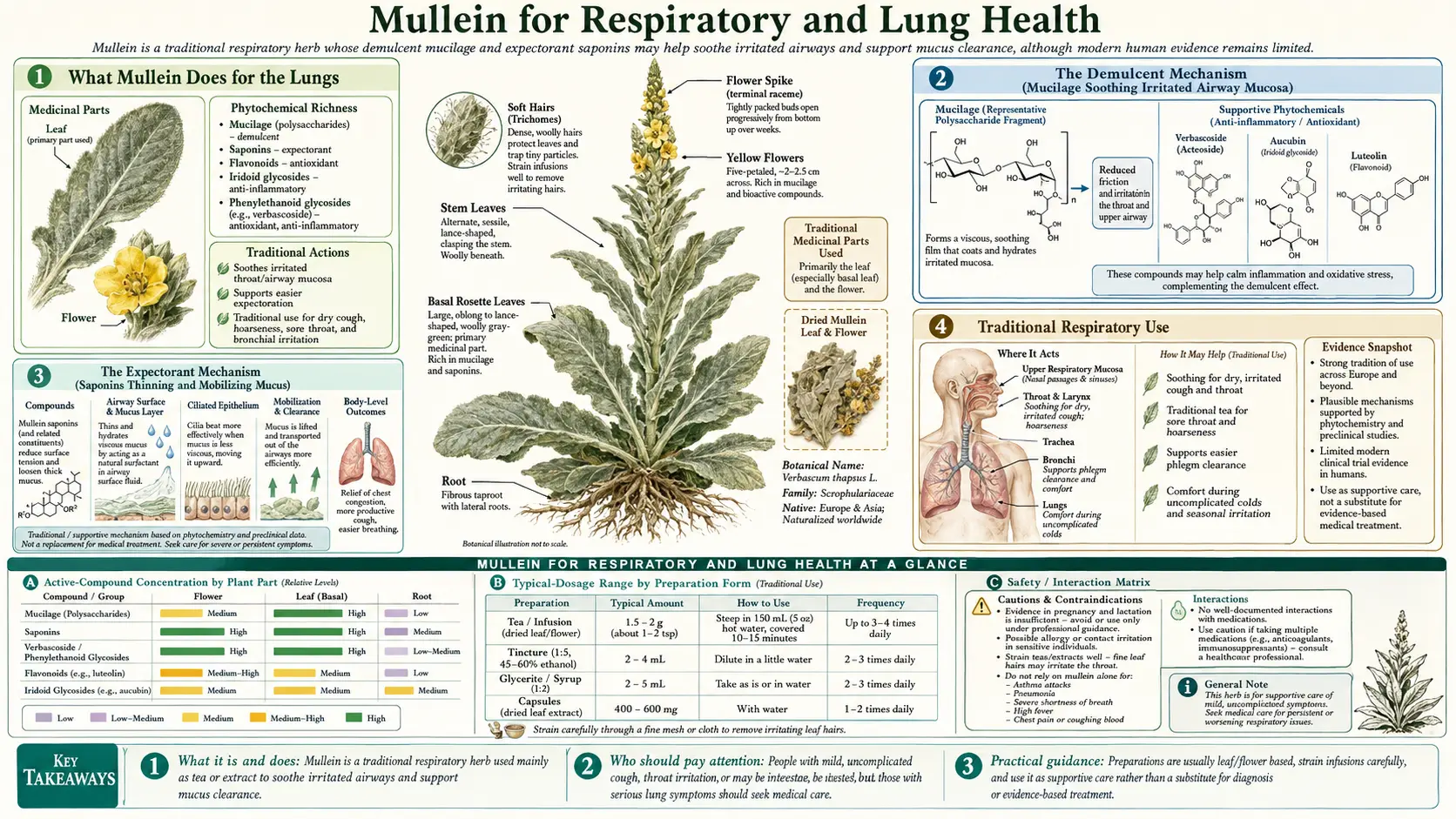
Table of Contents
- What Mullein Does for the Lungs
- The Demulcent Mechanism (Mucilage)
- The Expectorant Mechanism (Saponins)
- Traditional Respiratory Use
- Supportive Care in Asthma & COPD
- Bronchodilator and Smooth-Muscle Evidence
- Mullein and Lung Recovery
- How to Use Mullein for the Lungs
- Evidence and Limitations
- Safety for Respiratory Use
- Research Papers and References
- Connections
- Featured Videos
What Mullein Does for the Lungs
Mullein (Verbascum thapsus) is one of the most enduring respiratory herbs in Western and Eclectic herbal practice. The tall, woolly-leaved biennial has been used for centuries as a lung remedy, and its reputation rests on a genuinely dual action: it both soothes irritated airway tissue and helps loosen and move stagnant mucus. These two effects address the two most common complaints in respiratory illness — the dry, raw, tickling irritation of an inflamed throat and bronchial lining, and the thick, stuck congestion that a cough cannot clear.
The soothing action comes from mucilage, a slippery soluble fiber concentrated in the leaves and flowers that coats and protects irritated mucous membranes. The mucus-moving action comes from saponins, soap-like compounds that act as expectorants, thinning secretions and stimulating the cough reflex so that the airways can clear. Mullein is therefore classed in herbal medicine as a demulcent (soothing) and expectorant herb, and unusually it is both at once — which is why traditional practitioners reached for it across the whole arc of a chest cold, from the early dry-cough phase to the later productive, congested phase.
It is important to frame this accurately. Mullein is a gentle, supportive botanical with a long traditional record and a favorable safety profile, but the modern clinical evidence base in humans is thin. Most of what is known comes from traditional use, ethnobotanical surveys, and laboratory (in-vitro and animal) studies of its compounds. It is best understood as comfort-and-recovery support for ordinary respiratory irritation — not as a treatment for serious lung disease and not as a substitute for medical care or prescribed inhalers.
The Demulcent Mechanism (Mucilage Soothing Irritated Airway Mucosa)
A demulcent is a substance that forms a soothing, protective film over a mucous membrane. Mullein leaves and flowers are rich in mucilage — long-chain polysaccharides (sugar polymers, including arabinogalactans and rhamnogalacturonans) that swell in water into a viscous, slippery gel. When this gel contacts the lining of the throat and upper airway, it physically coats the tissue, much as a balm coats chapped skin.
This coating action explains mullein's classic use for a dry, raw, tickling cough and a scratchy, irritated throat. Inflamed respiratory mucosa has exposed and sensitized nerve endings; every breath of dry or cold air, and every cough, re-irritates them, producing the self-perpetuating cycle of a hacking, unproductive cough. By laying down a protective demulcent layer, mullein reduces this surface irritation, dampens the cough-trigger reflex at the throat, and allows the tissue a window to calm down.
Mucilage works locally, at the point of contact, rather than by being absorbed into the bloodstream. This is why the preparation method matters so much for the demulcent effect: a water-based tea or infusion (which extracts the water-soluble mucilage) delivers the soothing polysaccharides directly across the throat as you sip it. An alcohol tincture extracts the saponins and other compounds well but captures far less mucilage, so it leans more toward the expectorant and systemic side than the soothing side. Practitioners who specifically want the demulcent, throat-coating effect almost always favor a properly prepared tea.
The Expectorant Mechanism (Saponins Thinning and Mobilizing Mucus)
The second half of mullein's respiratory action is expectorant: it helps thin thick mucus and promote its expulsion from the airways. This is attributed largely to its saponins — a class of plant compounds named for their soap-like, foaming, surface-active properties. Verbascosaponins and related triterpene saponins are documented constituents of Verbascum thapsus.
Saponins are thought to act as expectorants through two complementary routes. First, as surfactants they can directly reduce the surface tension and viscosity of respiratory secretions, helping to break up sticky, tenacious mucus into a thinner form that cilia and a productive cough can move. Second, mild irritation of the gastric and bronchial mucosa by saponins is believed to reflexively increase the watery output of the bronchial glands, again loosening secretions. The practical result is that a congested, "stuck" cough becomes looser and more productive, so the chest can actually clear rather than rattling unproductively.
This is the mechanistic reason mullein is useful across the full course of a chest illness. In the early, dry phase the mucilage soothes and quiets the irritating cough; as the illness moves into a wet, congested phase, the expectorant saponins help mobilize and clear the phlegm. Few single herbs cover both ends of that spectrum, and the combination is a large part of mullein's traditional standing as a "lung herb."
Traditional Respiratory Use
Mullein's use as a respiratory remedy spans European, North American Eclectic, and folk traditions and stretches back to antiquity. The dried leaves and the bright yellow flowers were prepared as teas and syrups for coughs, hoarseness, bronchial irritation, and chest "catarrh" (the old term for thick mucus congestion). Reviews of the ethnobotany and traditional applications of Verbascum thapsus consistently list respiratory complaints as its single most common historical use.
Several traditional delivery methods are notable:
- Leaf and flower tea — the standard preparation for soothing a cough and irritated throat, taken warm and sipped slowly.
- Mullein flower syrup — honey or sugar-based syrups concentrate the demulcent quality and add honey's own throat-coating, cough-easing effect; a classic home remedy for children's and adults' coughs.
- Smoke and steam inhalation — in a number of traditions the dried leaf was burned or smoldered and the smoke inhaled, or the leaves were steeped in hot water and the steam breathed in, to deliver the herb directly to congested airways. Modern practice strongly favors gentle steam inhalation of the infusion over smoking, since inhaling any combustion smoke irritates and inflames the very tissue you are trying to soothe.
- Mullein flower oil — an infused oil of the flowers is a traditional remedy, though that preparation is used mainly for the ears (earache) rather than the lungs.
The consistency of this traditional respiratory use across unrelated cultures is one of the stronger arguments in mullein's favor: independent traditions arriving at the same use for the same plant is a meaningful ethnobotanical signal, even where formal clinical trials are lacking.
Mullein as Supportive Care in Asthma & COPD
Read this section carefully. Asthma and chronic obstructive pulmonary disease (COPD) are serious, potentially life-threatening medical conditions. Mullein is, at most, a complementary comfort measure for the everyday irritation and mucus that accompany them. It is not a treatment for asthma or COPD and must never replace prescribed inhalers, bronchodilators, corticosteroids, oxygen, or any other component of medical care. An asthma or COPD flare is a medical situation; reaching for mullein tea instead of a rescue inhaler can be dangerous.
Within those firm limits, some people with these conditions use mullein as adjunct support between flares for two reasons that map onto its mechanisms. The demulcent mucilage may ease the chronic throat and airway irritation and the dry, nagging cough that often accompany these diseases, and the expectorant saponins may help with the productive, mucus-heavy mornings common in chronic bronchitis and COPD by making secretions easier to clear. Traditional herbalists have long included mullein in respiratory blends used by people with chronic chesty conditions for exactly this supportive, symptom-easing role.
The evidence for any disease-modifying effect in asthma or COPD is essentially absent — there are no robust human trials demonstrating improved lung function, fewer exacerbations, or reduced reliance on medication. Mullein should be viewed strictly as background comfort care layered on top of, and fully subordinate to, a proper medical management plan. Anyone with asthma or COPD should discuss any herb with the clinician managing their condition before adding it, and should be especially cautious with steam inhalation, which can occasionally trigger bronchospasm in sensitive airways.
Bronchodilator / Smooth-Muscle Relaxant Evidence
Beyond soothing and expectoration, a smaller body of laboratory research has examined whether Verbascum extracts can relax airway smooth muscle — the property that, if present in a clinically meaningful way, would make a substance a bronchodilator (an opener of constricted airways). Some pharmacological studies of Verbascum species report a relaxant effect on isolated tracheal smooth-muscle preparations in the laboratory, which is the kind of pre-clinical signal that motivates the herb's traditional use in spasmodic, tight coughs.
These findings should be read with strong caution. They are in-vitro and animal-tissue results, typically using concentrated extracts applied directly to excised tissue in an organ bath. That is a long way from demonstrating that drinking a cup of mullein tea opens a person's airways during real-world bronchospasm. There is no human clinical trial establishing mullein as a bronchodilator, and the effect sizes and active compounds responsible are not well characterized. Mullein is in no sense a substitute for a rescue inhaler such as albuterol, whose bronchodilating action is fast, potent, and clinically proven.
The honest summary is that a plausible smooth-muscle-relaxant mechanism exists at the laboratory bench and is consistent with how the herb has been used traditionally, but it remains unproven in people. If you want the current primary literature on this specific question, the PubMed search linked in the References section (Verbascum thapsus relaxant tracheal smooth muscle) collects the relevant pharmacology studies.
Mullein and Lung Recovery (Smokers, Post-Illness Mucus)
A common contemporary use of mullein is as a gentle support during the recovery phase of respiratory irritation — the lingering tail end of a chest cold, the residual mucus and cough after bronchitis, and the chronic phlegm and throat irritation many current and former smokers experience. This use again follows directly from the herb's two mechanisms rather than from any specialized "detox" property.
For the post-illness phase, the value is in helping the airways finish clearing. After a chest infection, many people are left with a productive cough and a feeling of residual congestion as the bronchial tree clears the last of the inflammatory mucus. The expectorant saponins can help thin and mobilize those leftover secretions, while the demulcent mucilage soothes the raw, over-coughed throat — a combination well suited to the recovery window.
For smokers and ex-smokers, mullein is traditionally used to ease the chronic morning cough and mucus associated with smoke-irritated airways. It is worth being clear-eyed about what this can and cannot do: mullein may make existing mucus easier to clear and the throat more comfortable, but it does not reverse smoking-related lung damage, it does not undo emphysema or chronic bronchitis, and it is no substitute for stopping smoking, which is by far the single most effective action for the lungs. Mullein is, at best, modest symptomatic comfort layered on top of cessation — not a remedy that makes continued smoking safer.
How to Use Mullein for the Lungs
The way mullein is prepared strongly shapes which of its actions you get, so matching the form to the goal matters.
- Tea / infusion (the workhorse for the lungs) — steep roughly 1–2 teaspoons of dried mullein leaf (or a teaspoon of dried flowers) in a cup of just-boiled water, covered, for 10–15 minutes, up to three times daily. Covering the cup keeps the volatile soothing fraction in the liquid. The water extraction captures the demulcent mucilage, so a warm tea sipped slowly is the best vehicle for soothing an irritated throat and dry cough.
- Strain out the leaf hairs — this step is not optional. Mullein leaves are covered in fine, woolly hairs that break off into the tea and are a notorious throat irritant; ironically, an unstrained mullein tea can scratch and tickle the very throat you are trying to soothe. Always pour the finished tea through a very fine-mesh strainer, a paper coffee filter, or a tightly woven cloth to remove every trace of the tiny hairs before drinking.
- Tincture — an alcohol extract is convenient and shelf-stable and delivers the saponins and other actives well, making it a reasonable choice when the expectorant action is the priority. It carries comparatively little mucilage, so it does less of the throat-coating soothing; some people add a tincture dose to a cup of warm water or tea to combine convenience with a bit of demulcent warmth.
- Steam inhalation — make a strong infusion, pour it into a bowl, lean over it with a towel draped over the head, and breathe the warm vapor for a few minutes (eyes closed, at a comfortable, non-scalding temperature). This delivers warm moisture and the herb's volatile fraction directly to congested airways and can feel loosening when the chest is tight and stuffy. People with asthma or reactive airways should be cautious, as hot steam can occasionally provoke bronchospasm; stop if breathing tightens.
- Syrup — a honey-based mullein syrup combines the herb's demulcent quality with honey's own well-documented cough-soothing effect and makes a palatable option for a nagging cough.
For complete preparation details, dosing ranges, and quality/sourcing notes, see the Forms, Dosage & Safety article in this hub.
Evidence and Limitations
Honesty about the evidence is essential. The case for mullein as a respiratory herb rests on three legs of very different strength. The strongest is its long and cross-cultural traditional use for coughs and chest complaints, which is genuinely substantial. The second is laboratory research on its isolated compounds — mucilage's demulcent film-forming, saponins' surfactant/expectorant behavior, and reported antiviral, antibacterial, and anti-inflammatory activity of various extracts in cell and tissue models. The third leg, human clinical trials, is by far the weakest: well-designed, controlled studies of mullein for any respiratory outcome in people are essentially lacking.
This means the demulcent and expectorant actions are best described as mechanistically plausible and traditionally supported rather than clinically proven by modern standards. Effects, where present, are gentle and symptomatic. Mullein has not been shown to shorten respiratory infections, to improve measured lung function, or to treat any lung disease. It eases discomfort and supports the body's own clearing of mucus; it does not cure.
The practical takeaway: mullein is a reasonable, low-risk comfort measure for ordinary cough, sore throat, and chest congestion, and a supportive adjunct during recovery. It is not appropriate as a stand-alone treatment for asthma, COPD, pneumonia, or any condition causing significant breathing difficulty, and any persistent cough (more than two to three weeks), cough with blood, fever, chest pain, or shortness of breath warrants prompt medical evaluation rather than continued self-treatment with an herb.
Safety for Respiratory Use
Mullein leaf and flower have a favorable traditional safety record and are generally well tolerated. The main practical cautions are specific and worth observing:
- Always strain the leaf hairs. The single most common problem with home-brewed mullein tea is throat and mouth irritation from the fine leaf hairs. Filter thoroughly through fine mesh, paper, or cloth every time.
- Avoid inhaling smoke. Although smoking mullein is a traditional practice, inhaling any combustion smoke irritates and inflames airway tissue and is counterproductive for a soothing remedy. Prefer steam inhalation of the infusion if you want a directly inhaled form.
- Steam caution in reactive airways. Hot steam can occasionally trigger bronchospasm in people with asthma or very sensitive airways. Keep the steam comfortably warm, not scalding, and stop if breathing tightens.
- Allergy. Allergic reactions are uncommon but possible; contact with the woolly leaves can cause skin irritation in some people. Discontinue if a rash, itching, or other reaction occurs.
- Pregnancy and breastfeeding. There is insufficient safety data for medicinal-strength use during pregnancy and lactation; avoid in the absence of professional guidance.
- Children. Mild leaf/flower teas and honey-based syrups have a long folk history for children's coughs, but honey must never be given to infants under 12 months (botulism risk), and any persistent cough in a child should be assessed by a clinician.
- Not a substitute for medical care. Mullein does not replace inhalers, antibiotics where genuinely indicated, or evaluation of serious or persistent respiratory symptoms.
Detailed dosing, drug-interaction notes, and product-quality guidance are covered in Forms, Dosage & Safety.
Research Papers and References
The references below combine the verified review literature on Verbascum thapsus with curated PubMed topic-search links. PubMed search links always resolve to the current published literature and each opens at the National Library of Medicine.
- Turker AU, Gurel E. (2005). Common mullein (Verbascum thapsus L.): recent advances in research. Phytotherapy Research; 19(9):733–739. — doi:10.1002/ptr.1653
- Health-promoting and disease-mitigating potential of Verbascum thapsus L.: A review. Phytotherapy Research. — doi:10.1002/ptr.7393
- Verbascum thapsus — demulcent, expectorant, and respiratory use. — PubMed: Verbascum thapsus respiratory cough expectorant
- Mucilage polysaccharides of Verbascum and demulcent activity. — PubMed: Verbascum mucilage polysaccharide
- Saponins of Verbascum thapsus (verbascosaponins). — PubMed: Verbascum thapsus saponins
- Verbascum relaxant effect on tracheal smooth muscle (bronchorelaxant). — PubMed: Verbascum thapsus relaxant tracheal smooth muscle
- Anti-inflammatory activity of Verbascum thapsus extracts. — PubMed: Verbascum thapsus anti-inflammatory
- Antiviral and antibacterial activity of Verbascum thapsus. — PubMed: Verbascum thapsus antiviral antibacterial
- Mullein in the management of cough and bronchitis. — PubMed: mullein cough bronchitis
- Phytochemistry and ethnobotany of Verbascum thapsus. — PubMed: Verbascum thapsus ethnobotany phytochemistry
External Resources
- NCCIH — Herbs at a Glance
- MedlinePlus — Herbs and Supplements
- PubMed — All research on Verbascum thapsus
Connections
- All Herbs
- Mullein Hub
- Cough, Bronchitis & Congestion
- Mullein Antiviral Properties
- Active Compounds and Pharmacology
- Forms, Dosage & Safety
- Eucalyptus
- Thyme
- Peppermint
- Asthma
- COPD