Immunoglobulins (IgG, IgA, IgM, IgE)
Immunoglobulins are antibodies — the specialized proteins your immune system makes to recognize, tag, and neutralize germs. A blood test can measure how much of each main type you have, and that single panel opens two very different doors. If the levels are too low, it can point to an immune deficiency that leaves you catching infection after infection. If one type is too high in a particular pattern, it can be an early clue to inflammation, autoimmune disease, or a blood cancer such as multiple myeloma. A separate antibody, IgE, tells a different story again — it is the one tied to allergies and parasites.
This page explains, in plain language, what immunoglobulins are, what the test actually measures, the several reasons a doctor might order it, and how to make sense of a result that comes back high or low. Antibody testing is a well-established, reliable part of medicine, but the numbers only mean something in the context of your symptoms and your age — a value that is worrying in an adult can be perfectly normal in a baby. We will keep coming back to that point.
Table of Contents
- What Immunoglobulins Are
- Meet the Five Antibody Classes
- What the Test Measures
- Why It's Ordered: Looking for Low Levels
- Why It's Ordered: Looking for High Levels
- Why It's Ordered: The Allergy and IgE Angle
- How to Interpret Your Results
- Related and Follow-Up Tests
- When to Talk to a Doctor
- Research Papers
- Connections
- Featured Videos
What Immunoglobulins Are
An immunoglobulin is an antibody — a Y-shaped protein built to lock onto one specific target. Picture the two tips of the Y as a pair of matched grippers, each shaped to grab a particular piece of a germ (that piece is called an antigen). Once an antibody grips its target, it can neutralize a virus so it cannot enter your cells, coat a bacterium so immune cells swallow it more easily, or flag the invader for destruction by other parts of the immune system.
Antibodies are made by B cells and, especially, by the mature form of B cells called plasma cells. When you meet a new germ, a handful of B cells that happen to recognize it multiply rapidly and turn into antibody factories. Some of them become long-lived memory cells, which is why you usually do not catch chickenpox or measles twice, and why vaccines work. Each plasma cell makes antibody against just one target, so a healthy immune response is polyclonal — thousands of different clones, each contributing its own slightly different antibody. That word, polyclonal, matters later when we talk about what a high level means.
All antibodies share the same basic Y-shaped blueprint, but the “stem” of the Y comes in five different versions. That stem determines the antibody’s class — where it travels in the body and what job it does — and it is why we talk about IgG, IgA, IgM, IgE, and IgD as five separate tools rather than one.
Meet the Five Antibody Classes
Each class specializes. Knowing what each one normally does makes a high or low result far easier to understand.
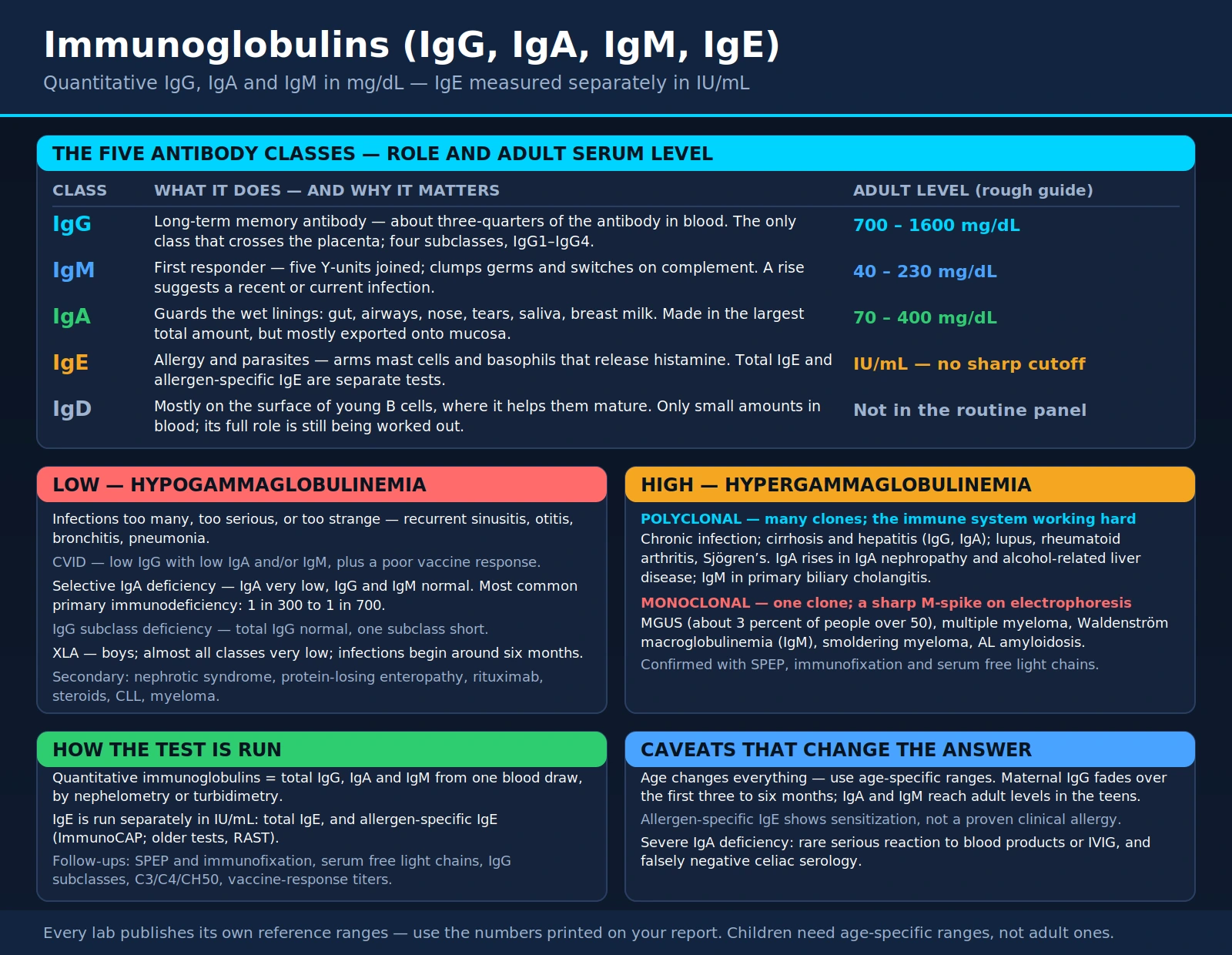
- IgG — the long-term memory antibody. IgG is the most abundant antibody in your blood, making up roughly three-quarters of the total. It is the workhorse of lasting immunity: after an infection or a vaccine, IgG levels build and stay, ready to respond fast the next time. IgG is also the only class that crosses the placenta, so a mother passes her IgG to her baby before birth — that borrowed protection guards the newborn for the first months of life. IgG comes in four subclasses (IgG1 through IgG4), and a shortage of just one subclass can matter even when the total looks normal.
- IgM — the first responder. IgM is the first antibody your body produces when it meets a brand-new threat. It is a large, star-shaped molecule (five Y-units joined together) that is very good at clumping germs and switching on the complement system. Because it appears early, a rise in IgM against a specific germ often signals a recent or current infection, while a rise in IgG points to past exposure or immunity.
- IgA — the guardian of your surfaces. IgA patrols the wet linings of your body — the gut, the airways, the nose, tears, and saliva — where most germs first try to get in. It is also secreted into breast milk, coating a newborn’s gut with protection. When you add up everything the body makes, IgA is actually produced in the largest amounts of any antibody, most of it exported onto those mucosal surfaces rather than kept in the blood.
- IgE — the allergy and parasite antibody. IgE is present in blood in tiny amounts, but it packs a punch. It arms mast cells and basophils, the cells that release histamine. When IgE bound to those cells meets its trigger, it sets off the immediate reactions we recognize as allergy — sneezing, hives, wheezing, or, at the extreme, anaphylaxis. Its original job is thought to be defense against parasitic worms.
- IgD — the minor player. IgD is found mostly on the surface of young B cells, where it helps them mature, and only in small amounts in the blood. Its full role is still being worked out, and it is not part of the routine panel.
What the Test Measures
“Immunoglobulins” on a lab order usually means quantitative immunoglobulins — the total amount of IgG, IgA, and IgM in your blood, each reported as a concentration (in the United States, milligrams per deciliter, mg/dL). These three are measured together because they are the classes that circulate in meaningful amounts and that most often reveal a deficiency or an excess. The measurement is done on a simple blood draw using automated methods called nephelometry or turbidimetry, which gauge how much the antibody clouds a beam of light.
IgE is measured separately and reported in different units (international units per milliliter, IU/mL), because it circulates in such small quantities and is ordered for a different reason — allergy and parasites rather than immune deficiency. IgE testing comes in two flavors: total IgE, the overall amount, and allergen-specific IgE, which measures antibody against one particular trigger such as peanut, cat dander, or birch pollen.
Some situations call for finer detail. If the total IgG is normal but a subclass problem is suspected, a lab can measure the four IgG subclasses individually. If a doctor is worried about a single overactive clone rather than a shortage, the immunoglobulin panel is usually paired with serum protein electrophoresis and related tests, described further below. IgD is not part of the standard panel and is measured only in rare, specific circumstances.
Why It's Ordered: Looking for Low Levels
The most common reason to measure immunoglobulins is a pattern of infection that seems out of proportion — recurrent, severe, unusually stubborn, or caused by germs that rarely trouble healthy people. Doctors sometimes summarize the warning signs as infections that are too many, too serious, or too strange. Classic clues are repeated sinus, ear, and chest infections (sinusitis, otitis, bronchitis, pneumonia), especially from encapsulated bacteria, and infections that keep coming back after treatment. When antibody levels are low — a state called hypogammaglobulinemia — the immune system is missing part of its defense.
Low immunoglobulins can reflect a primary immunodeficiency — an inborn problem with the immune system. The main ones this test helps uncover include:
- Common variable immunodeficiency (CVID) — the most common symptomatic primary antibody deficiency. It shows up as low IgG together with low IgA and/or IgM, plus a poor antibody response to vaccines. CVID can appear at any age but is frequently diagnosed in adults, and beyond infections it raises the risk of autoimmune disease and certain cancers. Many people go years before the pattern is recognized, which is why the test matters.
- Selective IgA deficiency — the most common primary immunodeficiency of all, affecting roughly 1 in 300 to 1 in 700 people of European descent. Here IgA is very low or absent while IgG and IgM are normal. Most people with it never know, because other antibodies compensate; a minority have more frequent respiratory and gut infections, allergies, autoimmune conditions, or celiac disease. It carries one specific caution around blood products, covered in the interpretation section.
- IgG subclass deficiency — a shortage of one or more IgG subclasses even when total IgG looks normal, which can still leave gaps in protection against particular bacteria.
- X-linked agammaglobulinemia (XLA) — a more severe inherited condition, seen in boys, in which B cells barely develop and nearly all antibody classes are extremely low. Infections typically begin in infancy once the mother’s borrowed IgG fades, around six months of age.
Low immunoglobulins are not always inborn. Many secondary causes lower antibody levels too: losing protein through the kidneys (nephrotic syndrome) or the gut (protein-losing enteropathy); certain medications, notably rituximab and long-term steroids; and some blood cancers such as chronic lymphocytic leukemia. Multiple myeloma is a striking example — the malignant clone floods the blood with one antibody while suppressing all the normal ones, so a myeloma patient can have a high total protein yet dangerously low functional immunity. When a genuine deficiency is confirmed, one of the main treatments is immunoglobulin replacement therapy (donated antibodies given into a vein or under the skin), which can dramatically reduce infections.
Why It's Ordered: Looking for High Levels
High immunoglobulins — hypergammaglobulinemia — are read very differently depending on their shape. The key question a doctor asks is whether the rise is polyclonal or monoclonal, and this is where the immunoglobulin test connects to the world of blood cancer.
Polyclonal elevation: the immune system working hard
A polyclonal increase means many different antibody clones are raised at once — a broad, reactive response. This is generally a sign that the immune system is busy, not a sign of cancer. Common causes include chronic or repeated infections, chronic liver disease (cirrhosis and hepatitis often raise IgG and IgA), and autoimmune conditions such as lupus, rheumatoid arthritis, and Sjögren’s syndrome. Certain patterns are suggestive: IgA can rise in IgA nephropathy and alcohol-related liver disease, while a high IgM is classically linked with primary biliary cholangitis. A polyclonal rise usually prompts a search for the underlying inflammatory or infectious cause.
Monoclonal elevation: a single clone taking over
A monoclonal increase is the opposite — one plasma-cell clone multiplying out of control and pumping out a single, identical antibody. That abnormal antibody is called a monoclonal protein, M-protein, or paraprotein, and on a lab called serum protein electrophoresis it shows up as a sharp, narrow spike — the famous “M-spike.” A monoclonal pattern needs investigation because it is the fingerprint of plasma-cell and lymphoproliferative disorders:
- Monoclonal gammopathy of undetermined significance (MGUS) — a small M-spike with no symptoms and no organ damage. It is common, found in roughly 3 percent of people over 50, and usually benign, but it carries a small yearly risk of progressing, so it is monitored over time.
- Multiple myeloma — a cancer of plasma cells in which one clone overproduces a single immunoglobulin, driving a large M-spike along with bone pain, anemia, kidney injury, and high calcium. This is the elevated-immunoglobulin result no one wants to miss, and it is a major reason the pattern is taken seriously.
- Waldenström macroglobulinemia — a lymphoma that overproduces IgM specifically, thickening the blood.
- Smoldering myeloma and light-chain (AL) amyloidosis — related plasma-cell conditions that also produce monoclonal proteins.
Because the quantitative immunoglobulin panel alone cannot always tell a broad rise from a single clone, a suspected monoclonal result is confirmed with serum protein electrophoresis and immunofixation, backed up by serum free light chains — the tests that actually pin down and identify the M-protein.
Why It's Ordered: The Allergy and IgE Angle
IgE testing answers a completely separate question: is an allergy (or, less commonly, a parasite) at work? This is why IgE is measured on its own rather than lumped in with IgG, IgA, and IgM.
Total IgE tends to be higher in people with allergic (atopic) conditions — hay fever, allergic asthma, and atopic dermatitis (eczema) — and in parasitic worm infections, which are a common cause worldwide. Very high total IgE also appears in a few uncommon conditions, such as allergic bronchopulmonary aspergillosis and the rare hyper-IgE syndrome. On its own, a total IgE number is a broad clue rather than a diagnosis.
Allergen-specific IgE is the more useful allergy test. It measures antibody against one particular trigger — a food, a pollen, pet dander, a stinging insect — and modern versions (you may hear the brand name ImmunoCAP; older ones were called RAST) can screen many triggers from one blood sample. There is an important subtlety: a positive specific-IgE result shows sensitization, meaning your body has made antibody to that substance, but sensitization is not the same as a clinical allergy. Plenty of people test positive to foods they eat without trouble. That is why allergen-specific IgE must always be read alongside your actual history of reactions, and why blood testing complements — rather than replaces — skin testing and a careful clinical story.
How to Interpret Your Results
Immunoglobulin results are only meaningful against the right yardstick. Three ideas do most of the interpreting.
Age changes everything
Normal antibody levels shift dramatically with age, so a value must be compared with an age-specific reference range, not an adult one. A newborn starts life with mostly the mother’s IgG, delivered across the placenta. That borrowed IgG fades over the first three to six months while the baby’s own production ramps up, creating a natural low point — and in some infants a prolonged but ultimately harmless dip called transient hypogammaglobulinemia of infancy. IgA and IgM start very low at birth and climb steadily through childhood, reaching adult levels in the teenage years. The practical lesson: a number flagged “low” in a baby may be exactly right for that age, and only a clinician using pediatric ranges can tell.
As a rough adult guide (every lab publishes its own ranges, so use the numbers printed on your report): total IgG is often about 700 to 1600 mg/dL, IgA about 70 to 400 mg/dL, and IgM about 40 to 230 mg/dL. Total IgE varies enormously between healthy people and has no sharp cutoff, which is part of why specific-IgE testing is usually more informative than the total.
Polyclonal versus monoclonal, again
When a level is high, the single most important interpretive step is deciding whether the rise is broad (polyclonal, pointing to infection, inflammation, or autoimmunity) or a narrow spike (monoclonal, prompting a myeloma and lymphoma workup). The quantitative panel raises the flag; electrophoresis settles the question.
The low-IgA caution worth knowing
Selective IgA deficiency deserves one special note even in people who feel perfectly well. A minority of those with severe IgA deficiency develop antibodies against IgA, and if they later receive blood products or intravenous immunoglobulin that contain IgA, they can — rarely — have a serious allergic or anaphylactic reaction. That is why the finding is recorded in the chart and why IgA-depleted or washed products are used when needed. A second practical consequence: because standard celiac blood tests rely on an IgA-based antibody, IgA deficiency can produce a falsely negative celiac result, so labs often check total IgA whenever they run celiac serology.
Related and Follow-Up Tests
Immunoglobulin results rarely stand alone. Depending on which direction the numbers point, a doctor commonly adds:
- Serum protein electrophoresis (SPEP) and immunofixation — the tests that detect and identify a monoclonal M-protein when a high or narrowly elevated immunoglobulin raises concern for myeloma or MGUS.
- Serum free light chains (kappa and lambda, with their ratio) — a sensitive way to detect and monitor plasma-cell disorders, including those that make only light chains.
- Urine protein electrophoresis — to look for light chains spilling into the urine (Bence Jones protein).
- IgG subclasses — when total IgG is normal but a subclass deficiency is suspected.
- Allergen-specific IgE panels and tryptase — to pin down allergic triggers and assess mast-cell activity.
- Complement testing (such as C3, C4, and CH50) — another arm of the immune system, often checked alongside antibodies in recurrent infection or autoimmune workups.
- Vaccine-response titers — measuring antibody before and after a vaccine to see whether the immune system can actually respond, which is central to diagnosing CVID.
- Complete blood count and total protein with albumin — a wide gap between total protein and albumin (the “globulin gap”) can be an early hint of excess immunoglobulin.
When to Talk to a Doctor
Consider asking about immunoglobulin testing, or discussing results you already have, if you notice a pattern rather than a single bad cold. Reasons to seek advice include recurrent, severe, or unusual infections; infections that need repeated courses of antibiotics or hospital care; a known family history of immune deficiency; or symptoms such as unexplained weight loss, bone pain, anemia, or kidney trouble that could point toward a plasma-cell disorder. Anyone already told they have IgA deficiency should mention it before receiving blood products or IVIG.
Above all, do not try to diagnose yourself from one number. An immunoglobulin level is a clue, not a verdict, and its meaning depends on your age, your symptoms, and the pattern across all the classes. A primary-care doctor, an immunologist (for deficiency and allergy), or a hematologist (for a monoclonal result) can put the result in context and decide whether any follow-up test is truly needed.
Research Papers
- Bonilla FA, Barlan I, Chapel H, et al. International Consensus Document (ICON): Common Variable Immunodeficiency Disorders. Journal of Allergy and Clinical Immunology: In Practice. 2016;4(1):38-59. doi:10.1016/j.jaip.2015.07.025 — expert consensus defining how CVID is diagnosed, including the low-IgG-plus-low-IgA/IgM pattern and impaired vaccine response.
- Cunningham-Rundles C. Common variable immune deficiency: Dissection of the variable. Immunological Reviews. 2019;287(1):145-161. doi:10.1111/imr.12728 — review of why CVID is so heterogeneous, spanning infection, autoimmunity, and cancer risk.
- Resnick ES, Moshier EL, Godbold JH, Cunningham-Rundles C. Morbidity and mortality in common variable immune deficiency over 4 decades. Blood. 2012;119(7):1650-1657. doi:10.1182/blood-2011-09-377945 — long-term follow-up showing how early diagnosis and immunoglobulin replacement improve outcomes.
- Gathmann B, Mahlaoui N, Gerard L, et al. Clinical picture and treatment of 2212 patients with common variable immunodeficiency. Journal of Allergy and Clinical Immunology. 2014;134(1):116-126. doi:10.1016/j.jaci.2013.12.1077 — large European registry describing how CVID actually presents across thousands of patients.
- Yel L. Selective IgA deficiency. Journal of Clinical Immunology. 2010;30(1):10-16. doi:10.1007/s10875-009-9357-x — overview of the most common primary immunodeficiency, why most cases are silent, and who becomes symptomatic.
- Odineal DD, Gershwin ME. The Epidemiology and Clinical Manifestations of Autoimmunity in Selective IgA Deficiency. Clinical Reviews in Allergy & Immunology. 2020;58(1):107-133. doi:10.1007/s12016-019-08756-7 — details the links between IgA deficiency and autoimmune disease, allergy, and celiac disease.
- Rajkumar SV, Dimopoulos MA, Palumbo A, et al. International Myeloma Working Group updated criteria for the diagnosis of multiple myeloma. Lancet Oncology. 2014;15(12):e538-e548. doi:10.1016/S1470-2045(14)70442-5 — the reference criteria distinguishing myeloma from MGUS and smoldering disease.
- Kyle RA, Therneau TM, Rajkumar SV, et al. Prevalence of monoclonal gammopathy of undetermined significance. New England Journal of Medicine. 2006;354(13):1362-1369. doi:10.1056/NEJMoa054494 — population study finding MGUS in about 3 percent of adults over 50.
- Rajkumar SV. Multiple myeloma: 2020 update on diagnosis, risk-stratification and management. American Journal of Hematology. 2020;95(5):548-567. doi:10.1002/ajh.25791 — practical review connecting the monoclonal-protein finding to the full myeloma workup.
- Katzmann JA, Clark RJ, Abraham RS, et al. Serum reference intervals and diagnostic ranges for free kappa and free lambda immunoglobulin light chains. Clinical Chemistry. 2002;48(9):1437-1444. doi:10.1093/clinchem/48.9.1437 — established the free-light-chain reference ranges used to detect plasma-cell disorders.
- Hamilton RG, Adkinson NF Jr. In vitro assays for the diagnosis of IgE-mediated disorders. Journal of Allergy and Clinical Immunology. 2004;114(2):213-225. doi:10.1016/j.jaci.2004.06.046 — explains how total and allergen-specific IgE blood tests work and how to interpret them.
- Jolliff CR, Cost KM, Stivrins PC, et al. Reference intervals for serum IgG, IgA, IgM, C3, and C4 as determined by rate nephelometry. Clinical Chemistry. 1982;28(1):126-128. doi:10.1093/clinchem/28.1.126 — classic paper establishing adult reference intervals for the quantitative immunoglobulin panel.
Connections
- All Lab Tests
- Immunology (Immune System Conditions)
- Common Variable Immunodeficiency (CVID)
- Selective IgA Deficiency
- X-Linked Agammaglobulinemia
- Oncology (Cancer)
- Multiple Myeloma
- Complete Blood Count (CBC)
- Comprehensive Metabolic Panel (Total Protein)
- Celiac Panel (IgA-Based Testing)
- ANA Test (Autoimmune Screen)
- Inflammatory Markers
- Edelman & Porter — what an immunoglobulin actually is, and why both ends of the Y matter