Boron – Trace Mineral for Human Health
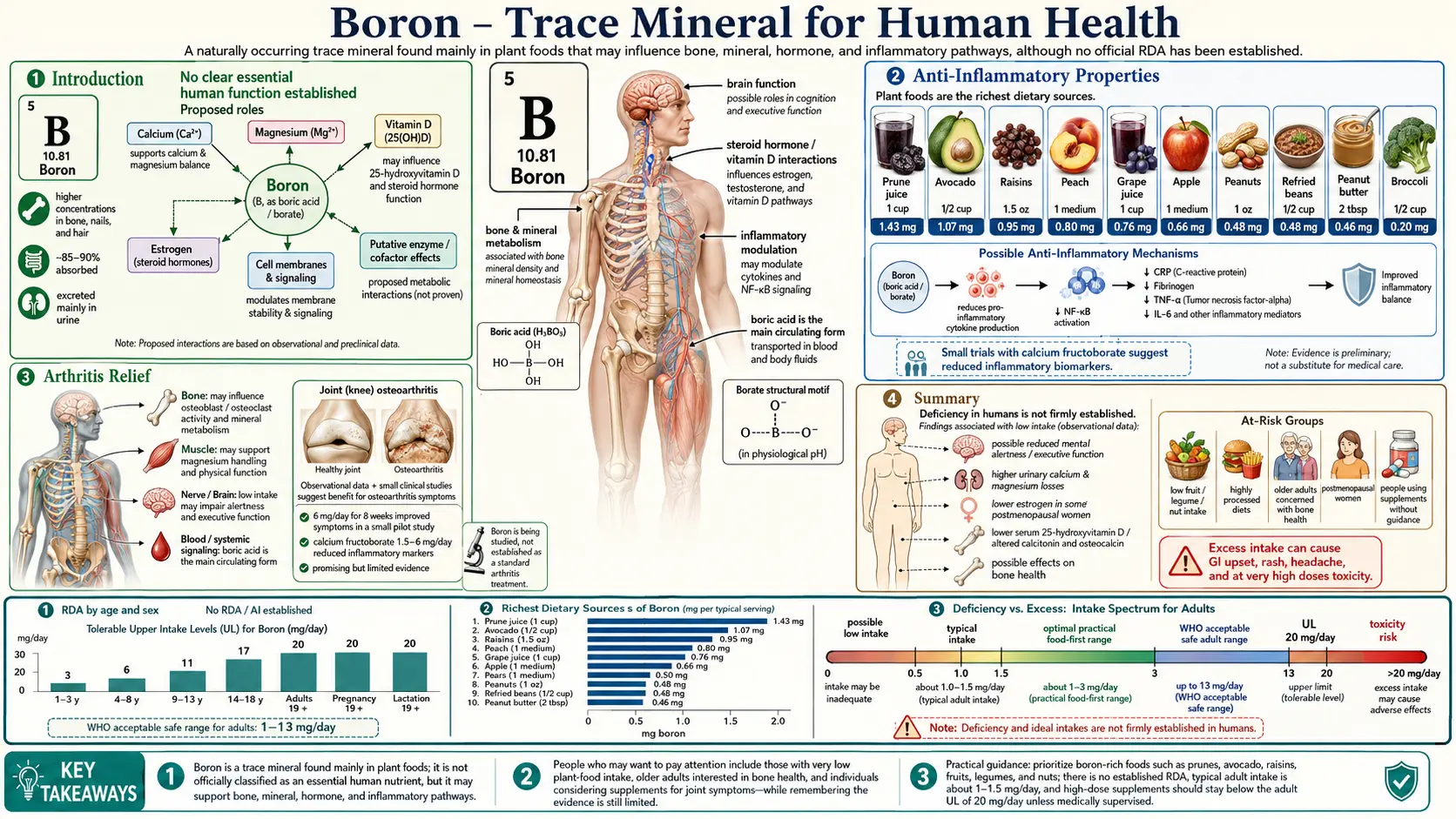
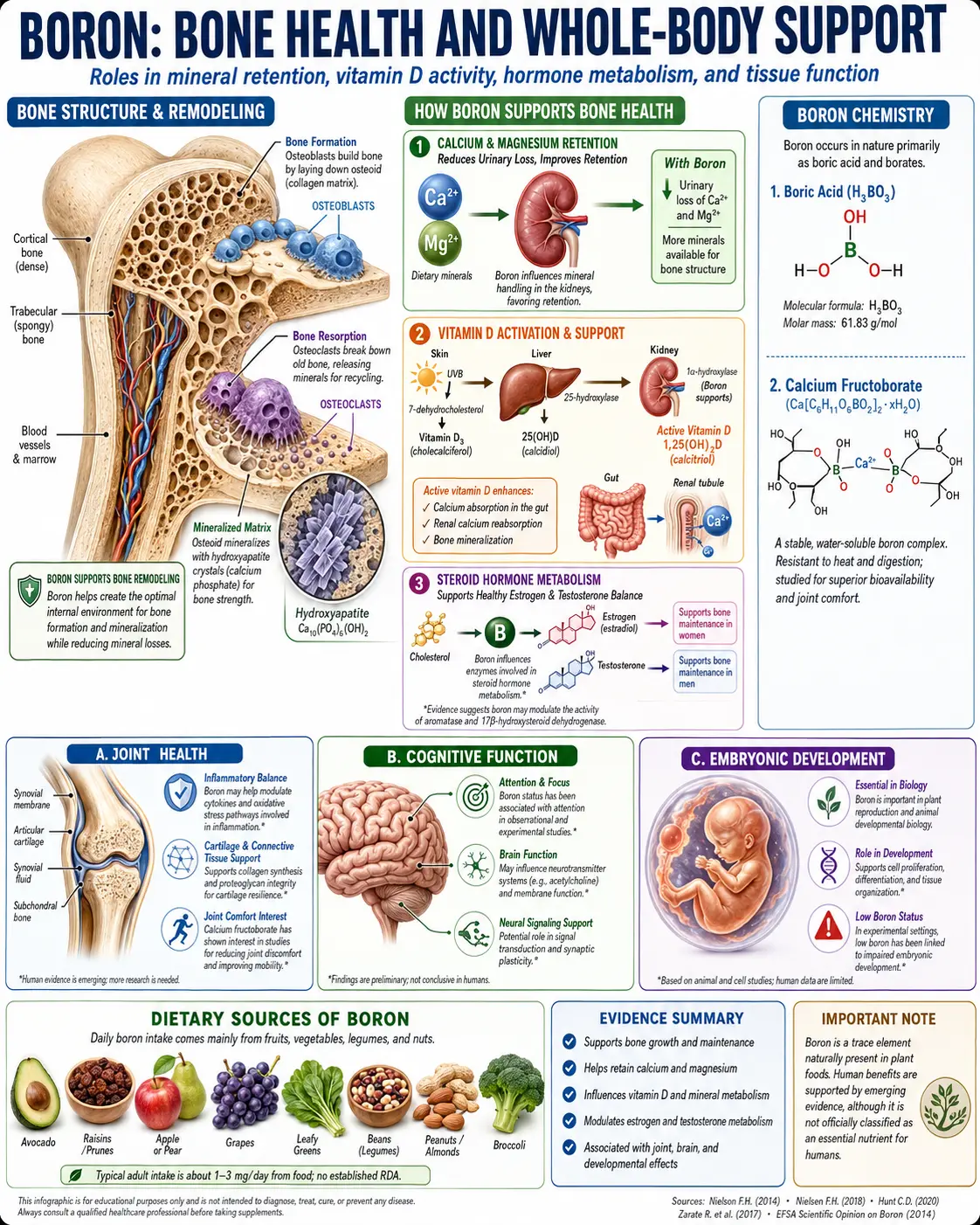
Table of Contents
- Introduction
- Bone Metabolism and Skeletal Health
- Hormone Regulation
- Anti-Inflammatory Properties
- Brain Function and Cognition
- Wound Healing
- Arthritis Relief
- Embryonic Development
- Mineral Absorption Enhancement
- Summary
- Deficiency and Excess
- Connections
Introduction
- Boron is an ultra-trace mineral increasingly recognized as essential for human health, despite not yet having an established Recommended Dietary Allowance (RDA).
- It participates in bone metabolism, hormone regulation, cognitive function, and inflammatory modulation.
- Boron is obtained primarily from fruits, vegetables, nuts, and legumes, and is absorbed efficiently from the gastrointestinal tract as boric acid.
- Typical beneficial intake ranges from 1 to 13 mg per day, with most research centering on 3 to 6 mg daily for therapeutic effects.
Bone Metabolism and Skeletal Health
- Calcium utilization – Boron reduces urinary calcium excretion, thereby improving calcium retention and its availability for bone mineralization.
- Magnesium metabolism – Boron enhances magnesium absorption and reduces its renal loss, supporting the magnesium-dependent enzymatic reactions involved in bone matrix formation.
- Vitamin D activation – Boron extends the biological half-life of 25-hydroxyvitamin D and supports its conversion to the active 1,25-dihydroxyvitamin D3 form, which is critical for intestinal calcium absorption and osteoblast differentiation.
- Osteoblast stimulation – In vitro studies demonstrate that boron promotes osteoblast proliferation and alkaline phosphatase activity, both markers of active bone formation.
- Osteoporosis prevention – Epidemiological data from regions with higher boron intake correlate with lower rates of osteoarthritis and osteoporosis, suggesting a protective role in age-related bone loss.
Hormone Regulation
- Estrogen metabolism – Boron supplementation in postmenopausal women has been shown to increase serum 17-beta-estradiol levels, which is significant for bone density maintenance and cardiovascular protection after menopause.
- Testosterone support – Studies demonstrate that boron supplementation (approximately 6 mg daily) can increase free testosterone levels and decrease sex hormone-binding globulin (SHBG) within one week, enhancing bioavailable testosterone.
- Steroid hormone synthesis – Boron influences the hydroxylation reactions involved in steroid hormone production, potentially modulating the cytochrome P450 enzyme pathways responsible for hormone biosynthesis.
- DHEA levels – Boron has been associated with increases in dehydroepiandrosterone (DHEA), a precursor hormone with widespread metabolic and immune effects.
Anti-Inflammatory Properties
- NF-kB pathway modulation – Boron inhibits the nuclear factor kappa-B (NF-kB) signaling cascade, a master regulator of pro-inflammatory gene expression, thereby reducing the production of inflammatory cytokines.
- C-reactive protein reduction – Clinical observations indicate that boron supplementation can lower elevated C-reactive protein (CRP) levels, a systemic marker of inflammation.
- Cyclooxygenase inhibition – Boron compounds demonstrate inhibitory activity against cyclooxygenase (COX) and lipoxygenase (LOX) enzymes, reducing prostaglandin and leukotriene synthesis.
- Inflammatory cytokine suppression – Boron reduces levels of tumor necrosis factor-alpha (TNF-alpha) and interleukin-6 (IL-6), key mediators in chronic inflammatory conditions.
Brain Function and Cognition
- Electroencephalographic activity – Boron deprivation studies in humans reveal altered EEG patterns consistent with reduced alertness and impaired cognitive processing, suggesting a role in optimal brain electrical activity.
- Psychomotor performance – Low boron intake correlates with decreased manual dexterity, attention, and short-term memory performance in controlled human trials.
- Neurotransmitter regulation – Boron may influence the metabolism of neurotransmitters through its effects on membrane-bound enzymes and ion channel function.
- Neuroprotection – Boron compounds demonstrate protective effects against oxidative damage in neuronal cell models, potentially relevant to neurodegenerative disease prevention.
Wound Healing
- Fibroblast proliferation – Boron at physiological concentrations stimulates fibroblast growth and extracellular matrix production, accelerating tissue repair.
- Collagen synthesis – Boron supports the enzymatic processes required for stable collagen cross-linking, essential for wound tensile strength.
- Angiogenesis support – Boron-containing compounds promote new blood vessel formation at wound sites, improving nutrient and oxygen delivery to healing tissues.
- Topical applications – Boric acid solutions have a long history of use as antiseptic wound rinses, and emerging evidence supports boron-based biomaterials for advanced wound care.
Arthritis Relief
- Epidemiological evidence – Populations in regions where daily boron intake exceeds 3 mg report significantly lower rates of arthritis compared to regions with intake below 1 mg per day.
- Cartilage protection – Boron supports the synthesis and maintenance of glycosaminoglycans and proteoglycans in articular cartilage.
- Synovial inflammation – Through its anti-inflammatory mechanisms, boron reduces synovial membrane inflammation and associated joint pain and stiffness.
- Clinical trials – A double-blind trial demonstrated that 6 mg daily of boron supplementation improved symptoms in 50% of osteoarthritis patients compared to 10% in the placebo group.
Embryonic Development
- Reproductive health – Animal studies demonstrate that boron deprivation during gestation leads to impaired embryonic development, including skeletal malformations and reduced fetal viability.
- Cell membrane integrity – Boron stabilizes cell membranes by interacting with cis-hydroxyl groups on phospholipids, a function particularly critical during rapid embryonic cell division.
- Nucleotide metabolism – Boron participates in the synthesis and utilization of nucleotides, including NAD+ and S-adenosylmethionine (SAMe), which are required for DNA replication and methylation during development.
Mineral Absorption Enhancement
- Phosphorus metabolism – Boron influences phosphorus utilization and its incorporation into bone hydroxyapatite crystals.
- Trace mineral interactions – Boron modulates the absorption and metabolic activity of several other trace minerals, including manganese and copper.
- Alkaline phosphatase activation – Boron enhances the activity of alkaline phosphatase, an enzyme critical for the dephosphorylation reactions involved in mineral transport and bone calcification.
- Synergistic nutrient effects – The benefits of boron are amplified when combined with adequate calcium, magnesium, and vitamin D intake, suggesting its role as a metabolic integrator of mineral nutrition.
Summary
- Boron is an essential trace mineral with far-reaching roles in skeletal, hormonal, neurological, and immunological health.
- It functions as a metabolic regulator that enhances the utilization of calcium, magnesium, and vitamin D while modulating steroid hormone levels.
- Its anti-inflammatory and neuroprotective properties make it relevant to arthritis management and cognitive preservation.
- Adequate boron intake through diet or supplementation supports overall health optimization across multiple organ systems.
Deficiency and Excess
Too little or too much boron can both cause problems. Low intake is linked to weaker bones, altered hormone levels, and impaired cognitive performance, while very high doses (well above dietary levels, typically from concentrated supplements or industrial exposure) can be toxic. For a full, patient-friendly guide to the symptoms, causes, and treatment, see Boron Deficiency: What the Evidence Shows and Boron Toxicity: What the Evidence Shows.
Connections
- All Minerals
- Boron Deficiency: What the Evidence Shows
- Boron Toxicity: What the Evidence Shows
- Boron Benefits Deep Dive
- Boron for Bone Density
- Boron for Hormone Balance
- Boron for Cognitive Function
- Boron for Arthritis & Joints
- Calcium
- Magnesium
- Osteoporosis
- Arthritis
- Phosphorus
- Manganese
- Vitamin D3
- Vitamin K
- Silicon
- Manganese and Bone Formation
- Testosterone
- DHEA-S
- Collagen
- Joint Pain
- Copper
- Vitamin D Test
- Calcium and Bone Health