Magnesium Sulfate (Epsom Salt)
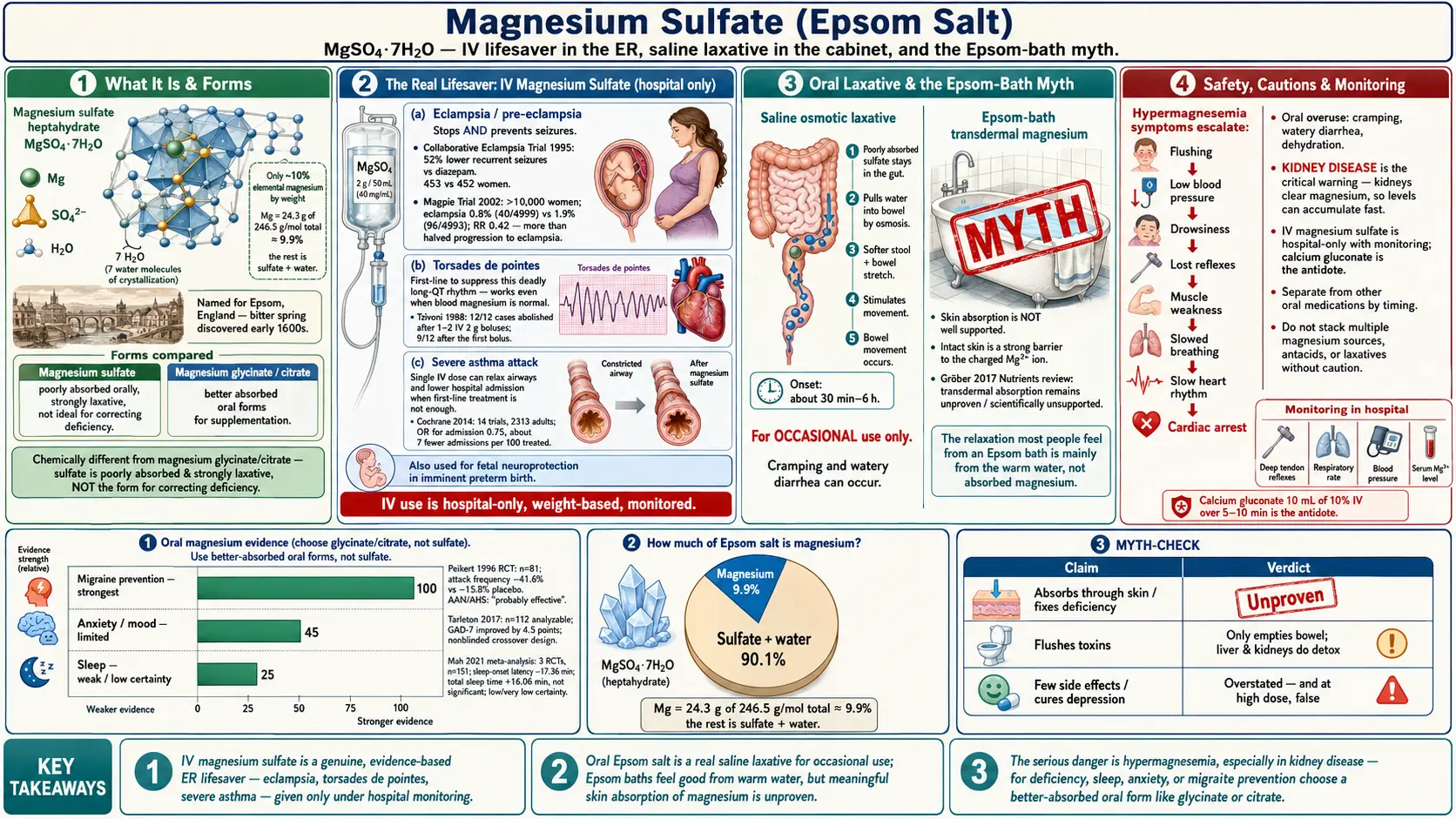
Magnesium sulfate is the chemical name for the white crystals most people know as Epsom salt. It leads a double life. On one hand, it is one of the most genuinely lifesaving drugs in a hospital: given through a vein, it stops the seizures of eclampsia in pregnancy, calms a deadly heart rhythm called torsades de pointes, and opens the airways in a severe asthma attack. On the other hand, the version in your bathroom cabinet is a much humbler thing — an old-fashioned laxative and a bath additive surrounded by claims that run far ahead of the evidence. This page separates the two, explains what a 1926 medical reference believed about it, and gives you the honest modern picture, including the safety facts the marketing usually leaves out. For the broader story of magnesium the nutrient — diet, deficiency, and supplement forms — see our main Magnesium page; this article focuses on the sulfate salt specifically.
Table of Contents
- What It Actually Is
- Historical Medical Use (1926 U.S. Dispensatory)
- The Real Lifesaver: IV Magnesium Sulfate
- Oral Epsom Salt: A Saline Laxative
- Epsom Baths: What's Real and What Isn't
- Magnesium for Sleep, Anxiety & Migraine
- How It's Used Today
- Safety, Cautions & Myths
- Key Research Papers
- Connections
- Featured Videos
What It Actually Is
Magnesium sulfate is a simple salt made of a magnesium ion paired with a sulfate ion. The form you buy as Epsom salt is the heptahydrate — written MgSO₄·7H₂O — meaning each unit of the salt is bundled together with seven molecules of water locked into its crystal structure. That trapped water is why Epsom salt forms clear, chunky crystals rather than a fine powder, and it's also why, by weight, Epsom salt is only about 10% elemental magnesium. A heaping tablespoon looks like a lot, but most of what you're holding is sulfate and water, not magnesium.
The name "Epsom" comes from the town of Epsom in England, where a bitter mineral spring was discovered in the early 1600s. Locals noticed the water had a strong laxative effect, and the salt that crystallized out of it — "Epsom salt" — became a famous remedy across Europe. So the very first thing humans used magnesium sulfate for was, fittingly, as a purgative.
It's worth being clear up front that magnesium sulfate is chemically different from the magnesium supplements many people take for general health. Magnesium glycinate, citrate, malate, and the like are designed to deliver magnesium gently into the bloodstream with minimal laxative effect. Magnesium sulfate, swallowed, does the opposite — the sulfate makes it poorly absorbed and strongly laxative, which is exactly why it isn't the form you'd choose to correct a dietary deficiency. The sulfate salt earns its keep in two very different arenas: the emergency room (by vein) and the bathroom (as a laxative or a soak).
Historical Medical Use (1926 U.S. Dispensatory)
In the era of the United States Dispensatory (21st edition, 1926) — the authoritative American drug reference of its day — magnesium sulfate was already a well-established medicine, valued mainly as a reliable saline cathartic (laxative) and, by injection, as a depressant of the nervous and muscular systems. Around that same period, magnesium sulfate also picked up a reputation in some quarters as a general calming agent: a treatment to relax people, help them sleep, ease anxiety, relieve pain, and even lift depression, with the appealing selling point of "very few side effects."
Here is the honest historical framing. Part of that reputation rests on something real: injected magnesium genuinely does depress nerve and muscle excitability, which is why high enough doses produce sedation, lower blood pressure, and quiet muscle twitching — and at the extreme, dangerous weakness and breathing failure. Early-twentieth-century physicians observed those calming, anticonvulsant, muscle-relaxing effects directly, and they were not imagining them. What was overstated was the idea of magnesium sulfate as a gentle, low-risk, all-purpose tonic for mood and sleep. Injected magnesium has a narrow safety window, and the "few side effects" claim badly undersells how quickly too much becomes toxic. And the notion of Epsom salt as a treatment for clinical depression was never well founded — that is not how it's used in medicine today.
So the 1926 picture is a mix worth untangling: a correct observation (magnesium relaxes nerve and muscle) wrapped in an overconfident promise (a near-harmless cure-all for stress, pain, sleep, and depression). The rest of this page replaces that promise with what modern evidence actually supports.
The Real Lifesaver: IV Magnesium Sulfate
If there is a heroic side to this molecule, this is it. Given intravenously, in a hospital, by trained clinicians, magnesium sulfate is a frontline emergency drug with rock-solid evidence behind it. None of what follows is something to attempt at home — it requires dosing by weight, blood-pressure and reflex monitoring, and the ability to reverse it. But understanding it shows why this otherwise humble salt sits on every crash cart.
Eclampsia and pre-eclampsia in pregnancy
This is magnesium sulfate's most important and best-proven use. Pre-eclampsia is a dangerous pregnancy complication marked by high blood pressure and organ stress; when it progresses to seizures, it becomes eclampsia, a leading cause of maternal death worldwide. IV magnesium sulfate both stops eclamptic seizures and prevents them in women with severe pre-eclampsia — and it does so better than the older anti-seizure drugs.
The landmark Collaborative Eclampsia Trial (1995) randomly assigned women who had already had eclamptic seizures to magnesium sulfate or to standard anticonvulsants (diazepam or phenytoin). Magnesium roughly halved the chance of a recurrent seizure compared with diazepam and cut it by about half again versus phenytoin. The Magpie Trial (2002), enrolling over 10,000 women with pre-eclampsia, then showed that magnesium sulfate more than halved the risk of progressing to eclampsia, with a reassuring safety profile for mother and baby. Later Cochrane reviews confirmed it as the treatment of choice. This is real, life-saving obstetric medicine — not a wellness claim. See our Preeclampsia page for the bigger picture of the condition.
Torsades de pointes (a deadly heart rhythm)
Torsades de pointes is a specific, life-threatening fast heart rhythm that can arise when the heart's electrical "reset" (the QT interval) is stretched too long — often by certain drugs or by low potassium or magnesium. IV magnesium sulfate is the recognized first-line treatment to suppress it, and strikingly, it works even when a person's blood magnesium level is normal. The classic 1988 report by Tzivoni and colleagues showed rapid termination of these episodes with magnesium, and it has been standard cardiology practice ever since. You can read more about heart-rhythm disorders on our Arrhythmia page.
Severe asthma attacks
In a severe asthma flare that isn't responding well to the usual inhaled bronchodilators and steroids, a single IV dose of magnesium sulfate can relax the tight airway muscles and reduce the need for hospital admission. A Cochrane review of emergency-department trials found that IV magnesium modestly improved lung function and lowered admission rates in adults with acute severe asthma. It's an add-on rescue measure for serious attacks — not a daily controller and not an inhaler you'd use at home. Our Asthma page covers routine management.
(Magnesium sulfate is also used in hospitals for other purposes — for example, neuroprotection of the baby's brain in very preterm labor, and to correct documented low blood magnesium — but the three above are the classic emergency uses.)
Oral Epsom Salt: A Saline Laxative
Swallowed, magnesium sulfate is fundamentally a saline (osmotic) laxative — the modern name for the "purgative" effect that made Epsom spring water famous four centuries ago. The mechanism is simple physics, not detox. The sulfate salt is poorly absorbed from the gut, so it stays in the intestine and pulls water in by osmosis, the way salt draws moisture. The added fluid softens the stool and stretches the bowel wall, which triggers it to contract and move things along. The result is a bowel movement, usually within 30 minutes to 6 hours.
This makes it useful for occasional, short-term constipation and as part of some pre-procedure bowel cleanouts. It is recognized as an over-the-counter laxative, and it works. But a few honest caveats matter:
- It is for occasional use. Routine daily reliance on a saline laxative is not appropriate — for ongoing constipation, fiber, fluids, movement, and gentler agents come first, with a clinician's input.
- Because it works by moving water and salts around, it can cause cramping, watery diarrhea, and — importantly — fluid and electrolyte disturbances and dehydration, especially with too large a dose. (See Safety.)
- The "flushing out toxins" language often attached to it is the old humoral idea dressed up for marketing. It empties the bowel; it does not cleanse the body of "toxins" in the way detox products imply. Your liver and kidneys do the actual detoxifying.
The dose is also self-limiting in an unpleasant way: take too much hoping for a benefit and you simply get diarrhea and dehydration, not extra wellness.
Epsom Baths: What's Real and What Isn't
This is where honesty matters most, because Epsom-bath claims are everywhere. The popular story is that soaking in an Epsom-salt bath lets magnesium absorb through your skin ("transdermally") to relax muscles, ease aches, reduce stress, and correct a magnesium deficiency. It's a soothing idea. The trouble is that the skin-absorption claim is not well supported by evidence.
Healthy skin is a remarkably good barrier — its whole job is to keep things out. Magnesium is an electrically charged ion that does not cross that barrier easily, and the few small, often poor-quality studies that exist have not convincingly shown that a meaningful amount of magnesium gets into your bloodstream from a bath. A careful 2017 review in Nutrients titled, tellingly, "Myth or Reality — Transdermal Magnesium?" concluded that the case for absorbing useful amounts through intact skin remains unproven and rests on weak data. In short: do not count on an Epsom bath to raise your body's magnesium or fix a deficiency. If your magnesium is low, that's a job for diet and oral supplements (see the Magnesium page), guided by your clinician.
So why do Epsom baths feel good? Almost certainly because of the bath itself, not the salt. A warm soak relaxes muscles through heat, eases tension, improves your sense of comfort, and gives you a quiet, screen-free pause — all genuinely worthwhile. Buoyancy takes load off sore joints. None of that requires magnesium to be crossing your skin. If an Epsom bath helps you unwind or soothes tired muscles after exercise, that's a real and pleasant effect — just understand that the warm water is doing the heavy lifting, and the relaxation is not evidence that you've "absorbed magnesium." Enjoy the bath for what it honestly is, and don't pay a premium expecting a supplement you're not actually getting.
Magnesium for Sleep, Anxiety & Migraine
The 1926-era reputation of magnesium as a calming, sleep-promoting, anxiety-easing agent isn't pure fiction — but the legitimate version of that idea is about oral magnesium taken by mouth and absorbed into the body, not about Epsom salt in bathwater, and the evidence is "promising but modest" rather than a guarantee. Importantly, for these everyday purposes most people would choose a better-absorbed, less laxative form (such as glycinate or citrate) rather than the sulfate salt. Here's the honest evidence:
- Sleep. Some small trials suggest oral magnesium can modestly improve sleep, particularly in older adults and in people who are low in magnesium. But a 2021 systematic review concluded the existing studies are few, small, and of low certainty — enough to be hopeful, not enough to call it a proven sleep aid. It's reasonable to try if you're deficient; it's oversold as a cure for insomnia.
- Anxiety and mood. Low magnesium has been linked with anxiety and depression, and some randomized data are encouraging — a 2017 open-label trial found oral magnesium improved depressive and anxiety symptoms over six weeks. The signal is real but the evidence base is still limited and the effect is best thought of as a helpful adjunct, especially when intake is low — not a replacement for treatment of a diagnosed mood disorder. The 1926 framing of Epsom salt as a depression cure goes well beyond this.
- Migraine. This is the strongest of the three. Oral magnesium has reasonable evidence for preventing migraines: a randomized trial by Peikert and colleagues (1996) found that high-dose oral magnesium reduced attack frequency, and the American Academy of Neurology's guideline rates magnesium as "probably effective" for migraine prevention. (In the emergency room, IV magnesium is also sometimes used for acute migraine, especially with aura.) See our Migraine page for the full prevention toolkit.
The thread through all three: oral magnesium has a genuine, if modest, role — most reliably in migraine prevention — and it helps most in people who are actually short on magnesium. That is a far cry from the "relaxing, anti-anxiety, anti-depression Epsom bath" promise, which the absorption science does not support.
How It's Used Today
Putting it together, magnesium sulfate has a small set of legitimate modern roles, sorted by how strong the evidence is:
- Hospital IV medicine (strong evidence). Eclampsia/pre-eclampsia, torsades de pointes, severe asthma, fetal neuroprotection in preterm labor, and treating documented low blood magnesium. Dosed and monitored by clinicians — never a do-it-yourself use.
- Occasional oral laxative (works, for short-term use). A saline laxative for short-term constipation or bowel prep, taken per label directions with plenty of water. Not for daily or long-term use.
- Bath soak (pleasant, but not a magnesium delivery system). Fine as a relaxing warm-water soak; just don't expect it to raise your magnesium or treat a deficiency.
- For deficiency, sleep, anxiety, or migraine prevention, reach for a better-absorbed oral magnesium (such as magnesium glycinate or citrate) rather than the sulfate salt, and treat the evidence as supportive, not curative. Dietary magnesium — from greens, nuts, seeds, legumes, and whole grains — is the foundation; see the Magnesium page.
There is no good reason to chase high doses of oral or transdermal magnesium sulfate hoping for a bonus health effect. More does not mean better here — it just means more diarrhea and, in the wrong circumstances, real danger.
Safety, Cautions & Myths
This is the section the old "very few side effects" claim glossed over. Magnesium sulfate is safe when used correctly, but it absolutely can harm people who overuse it or who have the wrong medical conditions.
Oral overuse: diarrhea, dehydration, and hypermagnesemia
Because oral magnesium sulfate is poorly absorbed, a normal dose mostly stays in the gut and acts as a laxative. The predictable downsides of overdoing it are cramping, watery diarrhea, fluid loss, and dehydration, along with disturbances of sodium, potassium, and calcium balance.
The more serious danger is hypermagnesemia — too much magnesium in the blood. Even with poor absorption, taking large repeated doses can push blood levels up, and the consequences escalate with severity: nausea and flushing, then low blood pressure, drowsiness and confusion, loss of reflexes, muscle weakness, slowed breathing, dangerously slow heart rhythm, and in extreme cases cardiac arrest. This is exactly the same nerve-and-muscle "depression" the 1926 doctors valued in small injected doses — taken too far, it becomes lethal.
Kidney disease is the critical warning
Your kidneys are what clear excess magnesium from your body. People with reduced kidney function cannot do this efficiently, so magnesium can accumulate to toxic levels much faster — sometimes from doses a healthy person would tolerate. Anyone with chronic kidney disease, reduced kidney function, or who is older with possibly diminished kidney reserve should not take oral magnesium-salt laxatives or magnesium supplements without a clinician's guidance. Serious and even fatal hypermagnesemia has been reported in exactly these situations. See our Kidney Disease page.
IV use is hospital-only
To be explicit: intravenous magnesium sulfate is a hospital procedure. It demands weight-based dosing and close monitoring of blood pressure, reflexes, and breathing, with calcium gluconate kept on hand as the antidote for overdose. It is never something to improvise, and you'll never need to — the emergency uses above only happen under medical care.
Other cautions and interactions
- Don't ignore the warning signs. Stop and seek care if a laxative dose causes severe or persistent diarrhea, light-headedness, muscle weakness, an irregular or very slow heartbeat, or confusion.
- Heart and other conditions. People with serious heart conditions, certain neuromuscular diseases, or known low calcium should use magnesium products only under medical advice.
- Medications. Magnesium can interact with some heart drugs, certain antibiotics and other oral medications (it can reduce their absorption — separate the timing), and other agents; check with a pharmacist if you take regular medicines.
- Don't combine multiple magnesium sources blindly. Stacking a magnesium laxative on top of magnesium supplements (and antacids that contain magnesium) adds up.
Myth check
- Myth: "Epsom baths absorb magnesium through your skin and fix deficiency / detox you." — Not supported. The relaxation is from the warm water; meaningful skin absorption is unproven.
- Myth: "Epsom salt flushes toxins from your body." — No. Oral Epsom salt empties the bowel; it doesn't detoxify the body. Your liver and kidneys do that.
- Myth: "Magnesium has very few side effects, so more is safer / it cures depression." — Overstated and, for high doses, false. Oral overuse causes diarrhea and dangerous hypermagnesemia (especially with kidney disease), and Epsom salt is not a treatment for clinical depression.
Used sensibly — as an occasional laxative, a pleasant bath, or, in better-absorbed oral forms, as modest support for migraine prevention or low magnesium — magnesium sulfate is helpful and safe. The danger comes from treating it as a harmless cure-all and overdoing it, particularly if your kidneys aren't fully up to the job.
Key Research Papers
- The Eclampsia Trial Collaborative Group. (1995). Which anticonvulsant for women with eclampsia? Evidence from the Collaborative Eclampsia Trial. The Lancet, 345(8963):1455–1463. — The landmark trial establishing magnesium sulfate as superior to diazepam and phenytoin for preventing recurrent eclamptic seizures. (PMID: 7769899)
- The Magpie Trial Collaborative Group. (2002). Do women with pre-eclampsia, and their babies, benefit from magnesium sulphate? The Magpie Trial: a randomised placebo-controlled trial. The Lancet, 359(9321):1877–1890. — Over 10,000 women: magnesium sulfate more than halved the risk of eclampsia in pre-eclampsia, with a reassuring safety profile. (PMID: 12057549)
- Duley L, Henderson-Smart DJ, Walker GJA, Chou D. (2010). Magnesium sulphate versus diazepam for eclampsia. Cochrane Database of Systematic Reviews, (12):CD000127. — Systematic review confirming magnesium sulfate as the anticonvulsant of choice for eclampsia. (PMID: 21154341)
- Tzivoni D, Banai S, Schuger C, et al. (1988). Treatment of torsade de pointes with magnesium sulfate. Circulation, 77(2):392–397. — Classic demonstration that IV magnesium rapidly suppresses torsades de pointes, even with normal serum magnesium. (PMID: 3338130)
- Kew KM, Kirtchuk L, Michell CI. (2014). Intravenous magnesium sulfate for treating adults with acute asthma in the emergency department. Cochrane Database of Systematic Reviews, (5):CD010909. — IV magnesium modestly improved lung function and reduced hospital admissions in severe acute asthma. (PMID: 24865567)
- Gröber U, Werner T, Vormann J, Kisters K. (2017). Myth or Reality—Transdermal Magnesium? Nutrients, 9(8):813. — A careful review concluding that meaningful absorption of magnesium through intact skin (e.g., Epsom baths) remains unproven and rests on weak data. (PMID: 28788060)
- Peikert A, Wilimzig C, Köhne-Volland R. (1996). Prophylaxis of migraine with oral magnesium: results from a prospective, multi-center, placebo-controlled and double-blind randomized study. Cephalalgia, 16(4):257–263. — High-dose oral magnesium reduced migraine attack frequency in a randomized trial. (PMID: 8792038)
- Holland S, Silberstein SD, Freitag F, et al. (2012). Evidence-based guideline update: NSAIDs and other complementary treatments for episodic migraine prevention in adults. Neurology, 78(17):1346–1353. — The American Academy of Neurology rates magnesium as "probably effective" for migraine prevention. (PMID: 22529203)
- de Baaij JHF, Hoenderop JGJ, Bindels RJM. (2015). Magnesium in man: implications for health and disease. Physiological Reviews, 95(1):1–46. — Comprehensive review of magnesium balance, deficiency, and the kidney's central role in clearing excess (the basis of hypermagnesemia risk). (PMID: 25540137)
- Tarleton EK, Littenberg B, MacLean CD, Kennedy AG, Daley C. (2017). Role of magnesium supplementation in the treatment of depression: A randomized clinical trial. PLOS ONE, 12(6):e0180067. — Oral magnesium improved depression and anxiety symptoms over six weeks; supportive but limited (open-label). (PMID: 28654669)
- Mah J, Pitre T. (2021). Oral magnesium supplementation for insomnia in older adults: a systematic review and meta-analysis. BMC Complementary Medicine and Therapies, 21:125. — Found only weak, low-certainty evidence that oral magnesium improves sleep — promising but not proven. (PMID: 33865376)
Live PubMed Searches
- Magnesium sulfate & eclampsia
- Magnesium sulfate & torsades de pointes
- IV magnesium & acute asthma
- Epsom-salt bath & skin absorption
- Oral magnesium, sleep & anxiety
- Hypermagnesemia, laxatives & kidney disease
Connections
- All Minerals
- Magnesium (the mineral)
- Magnesium Glycinate
- Cramp Prevention
- Preeclampsia
- Migraine
- Asthma
- Arrhythmia
- Kidney Disease