 — March 2, 2026
· Fecal Microbiota Transplantation
— March 2, 2026
· Fecal Microbiota Transplantation
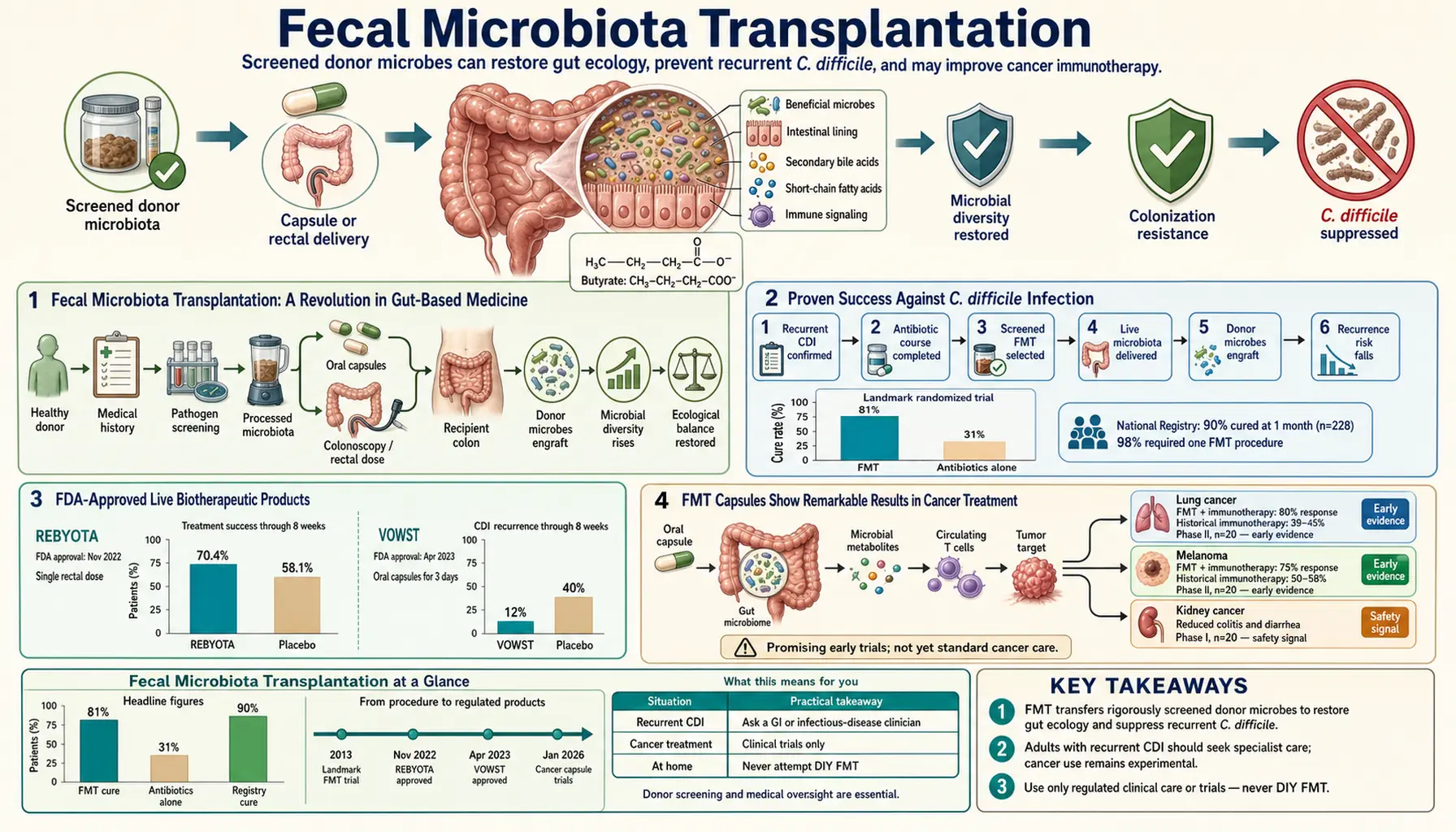


Table of Contents
- Fecal Microbiota Transplantation: A Revolution
- Proven Success Against C. difficile Infection
- FDA-Approved Live Biotherapeutic Products
- FMT Capsules in Cancer Treatment
- FMT After Stem Cell Transplantation
- Tracking Donor Bacteria After FMT
- Expanding Applications: IBD, IBS, and Beyond
- Next-Generation Microbiome Therapies
- Research Papers
- Connections
- Featured Videos
Fecal Microbiota Transplantation: A Revolution in Gut-Based Medicine
Fecal microbiota transplantation (FMT) — the transfer of processed stool from a healthy donor into a patient's gastrointestinal tract — has emerged as one of the most promising breakthroughs in modern medicine. Once considered unconventional, FMT is now backed by robust clinical evidence and FDA-approved products, with expanding applications far beyond its original use in treating gut infections.
What began as a last-resort treatment for antibiotic-resistant infections has evolved into a platform technology with potential to treat cancer, autoimmune diseases, metabolic disorders, and neurological conditions — all by harnessing the power of the human gut microbiome.
Proven Success Against C. difficile Infection
FMT's most established application is in treating recurrent Clostridioides difficile infection (CDI), a potentially life-threatening condition that affects nearly 500,000 Americans annually. A landmark 2013 randomized controlled trial demonstrated an 81% cure rate with FMT, compared with just 31% for antibiotics alone.
The FMT National Registry reported even more impressive results: one-month cure of recurrent CDI in 90% of the first 228 patients treated, with 98% requiring only a single FMT procedure. These outcomes have made FMT the standard of care for recurrent or refractory CDI.
In 2025, FMT was further validated when a new study showed it to be non-inferior to vancomycin — a frontline antibiotic — for treating even initial episodes of CDI, expanding its potential role from last resort to first-line therapy.
Source: Cleveland Clinic Journal of Medicine — FMT: Current Evidence and Future Directions
FDA-Approved Live Biotherapeutic Products
The U.S. Food and Drug Administration has approved two groundbreaking FMT-based products, marking a new era for microbiome-based medicine:
- Rebyota (fecal microbiota, live-jslm) — Approved in November 2022, administered as a single rectal dose. Phase 3 trials demonstrated a 70.4% success rate compared to 58.1% for placebo in preventing CDI recurrence.
- Vowst (fecal microbiota spores, live-brpk) — Approved in April 2023 as the first oral FMT capsule, taken over three consecutive days. Trials showed a recurrence rate of just 12% compared to 40% for placebo.
These FDA approvals represent a critical step toward standardized, regulated, and widely accessible microbiome therapies.
Source: American Gastroenterological Association — FDA Approves First FMT Therapy
FMT Capsules Show Remarkable Results in Cancer Treatment
One of the most exciting developments in FMT research is its application in cancer immunotherapy. Clinical trials using FMT capsules (LND101) processed from healthy donor stool have demonstrated striking improvements in treatment outcomes across multiple cancer types.
Lung Cancer
The Phase II FMT-LUMINate Trial enrolled 20 patients with non-small cell lung cancer. Those receiving FMT alongside immunotherapy achieved an extraordinary 80% response rate, compared to just 39–45% with immunotherapy alone — an improvement of 35 to 41 percentage points.
Melanoma
In the same FMT-LUMINate Trial, 20 melanoma patients receiving FMT achieved a 75% response rate, compared to 50–58% with standard immunotherapy alone — an improvement of 17 to 25 percentage points.
Kidney Cancer
The Phase I PERFORM Trial at the Verspeeten Family Cancer Centre enrolled 20 patients with renal cell carcinoma. FMT significantly reduced toxic side effects from immunotherapy — particularly colitis and diarrhea — enabling patients to complete their treatment courses without early discontinuation.
These trials, led by researchers at the London Health Sciences Centre Research Institute, Lawson Research Institute, and the Centre de recherche du Centre hospitalier de l'Université de Montréal, suggest that restoring a healthy gut microbiome can fundamentally enhance the body's response to cancer immunotherapy.
FMT Supports Recovery After Stem Cell Transplantation
A Phase 2 clinical trial led by Dr. Armin Rashidi at Fred Hutch Cancer Center, published in Nature Communications in January 2025, found that oral FMT capsules are a feasible and safe addition to preventing graft-versus-host disease (GVHD) in patients undergoing stem cell transplantation for blood cancers.
In the study, 20 patients received capsules containing purified microbial communities from healthy donors three times daily for seven days. Key findings included:
- 67% microbiota engraftment rate from the top-performing donor, characterized by high levels of Bifidobacterium adolescentis
- No major infections were reported despite introducing millions of live microbes into immunocompromised patients
- Patients with lower pre-treatment microbial diversity showed better donor microbiota establishment
Based on these results, a randomized Phase 2 trial with 126 patients is now actively enrolling to evaluate whether FMT can reduce acute GVHD, lower infection rates, and improve overall survival.
Source: Fred Hutch Cancer Center — FMT After Stem Cell Transplantation (January 2025)
Breakthrough: Tracking Donor Bacteria After FMT
Researchers at the Icahn School of Medicine at Mount Sinai have developed a revolutionary technology to track what happens to donor bacteria after transplantation. Published in Nature Microbiology in October 2025, the study used long-read DNA sequencing combined with a computational tool called LongTrack to follow individual bacterial strains with unprecedented precision.
Key discoveries from this research:
- Donor bacteria successfully colonized and persisted in recipients' microbiomes for up to five years post-transplant
- Some transplanted strains displayed genetic mutations indicating adaptation to their new hosts
- Different gut environments shaped bacterial evolution uniquely between individuals
Senior author Dr. Gang Fang explained that this approach allows scientists to "follow donor bacteria strain by strain with a level of reliability and scalability that wasn't possible before." The research provides a roadmap for developing safer, more predictable microbiome therapies that could eventually replace whole-stool transplants with targeted bacterial mixtures.
Source: Mount Sinai — Scientists Develop Way to Track Donor Bacteria After FMT (October 2025)
Expanding Applications: IBD, IBS, and Beyond
FMT research is actively exploring a wide range of conditions linked to disrupted gut microbial populations:
Inflammatory Bowel Disease (IBD)
Aggregate data from nine randomized controlled trials showed that patients receiving FMT achieved clinical remission at higher rates (32.8%) compared to controls (16.3%). The 2024 American Gastroenterological Association (AGA) Practice Guidelines now include specific recommendations for FMT in IBD management.
Irritable Bowel Syndrome (IBS)
The AGA has recommended further evaluation of FMT for IBS in clinical trials, recognizing early signals of benefit in this common and often debilitating condition.
Other Emerging Applications
- Metabolic syndrome and obesity — Early trials exploring microbiome restoration for metabolic health
- Autoimmune conditions — Investigating the gut-immune axis in diseases like rheumatoid arthritis
- Neurological disorders — Research into the gut-brain axis and conditions such as Parkinson's disease and autism spectrum disorder
- Chronic constipation — Systematic reviews showing FMT may improve stool frequency and gut transit
The Future: Next-Generation Microbiome Therapies
The field is rapidly advancing beyond traditional whole-stool transplants toward more refined approaches:
- Defined microbial consortia — Precisely engineered mixtures of beneficial bacteria, eliminating the variability of donor stool
- Fecal virome transplantation (FVT) — A new approach that introduces the fecal virome as a key ecological regulatory layer, accelerating microbiota reconstitution and reshaping host immune responses
- Personalized FMT — Donor-recipient matching based on microbiome profiling to optimize engraftment rates
- Oral capsule formulations — Making FMT more accessible and less invasive, as demonstrated by Vowst and the LND101 cancer trials
As Dr. Fang's LongTrack technology enables precise strain-level tracking, the vision of replacing whole-stool FMT with targeted, standardized microbial therapeutics is moving closer to reality.
Source: PMC — What's New and What's Next in Fecal Microbiota Transplantation?
Sources
- Cleveland Clinic Journal of Medicine — FMT: Current Evidence and Future Directions
- American Gastroenterological Association — FDA Approves First FMT Therapy
- Medical Xpress — Fecal Transplant Capsules Show Promising Results in Cancer Clinical Trials (January 2026)
- Fred Hutch Cancer Center — FMT After Stem Cell Transplantation (January 2025)
- Mount Sinai — Scientists Develop Way to Track Donor Bacteria After FMT (October 2025)
- Frontiers in Microbiology — FMT: Application Scenarios and Efficacy Prediction (2025)
- PMC — What's New and What's Next in Fecal Microbiota Transplantation?
- PMC — Fecal Microbiota Transplantation in 2025: Two Steps Forward, One Step Back
- PMC — Science of Fecal Microbiota Transplant: From History to Cutting-Edge Practice
- PMC — Exploring FMT: Potential Benefits, Risks, and Challenges in Cancer Treatment
Research Papers
- Clinical trials on fecal microbiota transplantation — PubMed search
- Clinical trials on FMT for C. difficile infection — PubMed search
- Clinical trials on FMT and cancer immunotherapy — PubMed search
- Clinical trials on FMT for IBD — PubMed search
- Clinical trials on gut microbiome and GVHD — PubMed search
- Clinical trials on microbiome therapeutics — PubMed search
Connections
- Gut Healing
- Gut-Brain Axis
- Probiotics
- Fermented Foods
- Resistant Starches
- Gastroenterology
- Oral Microbiome
- Immune Boosting