 — March 15, 2026
· Sodium Bicarbonate and Cancer
— March 15, 2026
· Sodium Bicarbonate and Cancer
Sodium Bicarbonate and Cancer: A Comprehensive Review of Emerging Research
An expanding body of scientific research is investigating the therapeutic potential of sodium bicarbonate (NaHCO3) — commonly known as baking soda — as an adjunct to conventional cancer treatments. While sodium bicarbonate is not a standalone cancer cure, peer-reviewed studies from major cancer centers and universities around the world have demonstrated that it can modify the acidic tumor microenvironment, enhance the effectiveness of chemotherapy and immunotherapy, reduce metastasis, and boost immune responses against cancer cells. This article surveys 25 key research studies that present favorable findings on sodium bicarbonate in the context of cancer therapy.
Table of Contents
- Overview
- Understanding Tumor Acidity and the Warburg Effect
- Preclinical Studies: Reducing Metastasis
- Enhancing Immunotherapy with Bicarbonate
- Potentiating Chemotherapy
- Sodium Bicarbonate Nanoparticles: Next-Generation Delivery
- TILA-TACE: Breakthrough in Liver Cancer
- Alkalization Therapy in Pancreatic Cancer
- Ovarian Cancer: Bicarbonate as Adjuvant
- Transdermal Bicarbonate for Bladder Cancer
- Prostate Cancer Prevention in Transgenic Models
- Phase I Clinical Trials and Safety
- Important Cautions and Limitations
- References
- Research Papers
- Connections
- Featured Videos
1. Understanding Tumor Acidity and the Warburg Effect
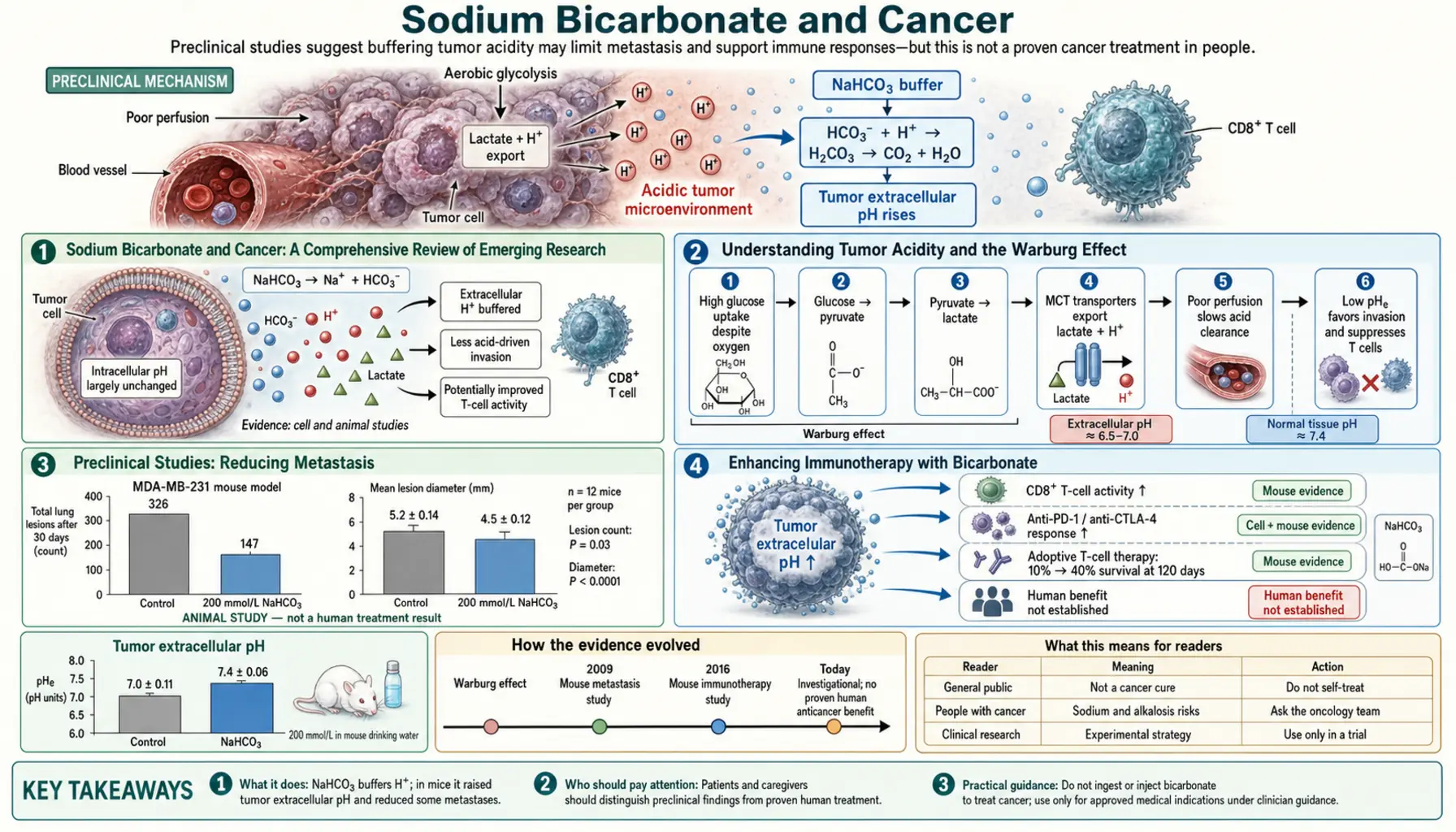
Cancer cells metabolize glucose differently from normal cells. Through a phenomenon called the Warburg effect, tumor cells preferentially use glycolysis even in the presence of oxygen, producing large amounts of lactic acid. This acidifies the extracellular tumor microenvironment (TME) to a pH of 6.5–6.9, compared to the normal tissue pH of 7.2–7.4.
This acidic environment is not merely a byproduct of cancer — it actively promotes tumor progression. Research published in Frontiers in Oncology by Hamaguchi et al. (2022) documented how acidic TME conditions promote multidrug resistance, immune escape, enhanced invasiveness, and metastatic potential. The study found that a close to 2,000-fold increase in doxorubicin resistance occurred in lung tumor cells when internal pH shifted from 7.0 to 7.4, underscoring how profoundly pH influences treatment outcomes [1].
A comprehensive review by Yang, Zhong, and Yuan (2020) in Integrative Cancer Therapies further detailed how the acidic TME causes drug resistance, immune evasion, chronic autophagy, decomposition of the tumor matrix, and epithelial-mesenchymal transformation — all of which accelerate tumor invasion and metastasis [2].
The rationale behind sodium bicarbonate therapy is straightforward: by buffering the acidic tumor microenvironment, researchers aim to reverse these tumor-promoting conditions and restore conditions favorable to immune function and drug efficacy.
2. Preclinical Studies: Reducing Metastasis
One of the most cited studies in this field was published by Robey et al. (2009) in Cancer Research. The team at the University of Arizona Cancer Center demonstrated that oral administration of sodium bicarbonate selectively increased the extracellular pH of tumors in mouse models without affecting the pH of normal tissues. Using 31P magnetic resonance spectroscopy and fluorescence microscopy, they showed that bicarbonate significantly increased tumor extracellular pH, reduced the rate of lymph node involvement, and significantly reduced the formation of hepatic metastases following intrasplenic injection [3].
A follow-up study by Robey and Nesbit (2013) in BMC Cancer evaluated pH-altering therapies in a mouse model of metastatic breast cancer. The researchers confirmed that oral sodium bicarbonate raised tumor pH and significantly reduced the formation of spontaneous metastases, particularly to the lungs and lymph nodes. Notably, the treatment did not affect levels of circulating tumor cells, suggesting that the reduced metastases were due to inhibited extravasation and colonization rather than reduced intravasation [4].
These foundational studies established the principle that systemic buffering could target the acidic tumor microenvironment and slow cancer spread, even without directly killing primary tumor cells.
3. Enhancing Immunotherapy with Bicarbonate
Perhaps the most exciting area of sodium bicarbonate cancer research involves its potential to dramatically enhance immunotherapy — one of the most promising frontiers in modern oncology.
A landmark 2016 study by Pilon-Thomas, Kodumudi, and colleagues at the Moffitt Cancer Center, published in Cancer Research, demonstrated that tumor acidity profoundly suppresses T-cell function. In vitro experiments showed that acidic pH completely abrogated IFN-γ and TNF-α secretion by T cells. When researchers neutralized this acidity using oral sodium bicarbonate, they observed increased T-cell infiltration within tumors, increased T-cell activation, and elevated expression of IFN-γ, IL-2, and IL-12p40 mRNA in tumor tissues [5].
Critically, when sodium bicarbonate was combined with anti-PD-1 or anti-CTLA-4 checkpoint inhibitors, or with adoptive T-cell transfer, the effects were dramatically enhanced. Treatment with sodium bicarbonate plus checkpoint inhibitors reduced melanoma and pancreatic tumor growth compared to single-agent treatment. Lead researcher Dr. Robert Gillies stated: "By neutralizing this acid with buffers, we were able to improve the response of melanoma and pancreatic tumors to immunotherapy." The team calculated a clinically achievable human-equivalent dose of 800 mg/kg/day [5].
Building on this work, a 2023 study by Oluwatola et al. published in Cancers (MDPI) investigated immunotherapy enhancement by targeting extracellular tumor pH in a triple-negative breast cancer mouse model. The researchers found that bicarbonate treatment increased extracellular pH in tumor tissues, accompanied by increased T-cell infiltration and activation. These changes were further enhanced when combined with anti-PD-L1 therapy [6].
A 2026 review in CancerNetwork by investigators at Moffitt Cancer Center summarized the overall findings: neutralizing intratumoral pH may significantly improve responses to immunotherapy across multiple cancer types, representing a potential paradigm shift in how we approach immune checkpoint therapy [7].
4. Potentiating Chemotherapy
The acidic tumor microenvironment creates a physiological barrier that prevents many chemotherapy drugs from penetrating cancer cells effectively. Ionizable weak-base drugs such as doxorubicin freely permeate cell membranes in their uncharged form, but in the acidic TME they become charged and their cellular permeability is severely retarded — a phenomenon known as "ion trapping."
A 2019 study by Abumanhal-Masarweh et al. published in the Journal of Controlled Release addressed this challenge directly. The team loaded 100-nm liposomes with sodium bicarbonate and used them as adjuvants to elevate tumor pH. In triple-negative breast cancer cells (4T1), combined treatment with doxorubicin and liposomal sodium bicarbonate enhanced drug uptake and increased anticancer activity. In vivo, 3.7% of the injected liposomal dose reached the tumor after 24 hours — a 21-fold increase compared to free non-liposomal bicarbonate (0.17%). Analysis of the tumor microenvironment demonstrated increased immune cell populations (T-cells, B-cells, and macrophages) in tumors treated with liposomal bicarbonate [8].
A follow-up 2022 study published in the Journal of Controlled Release confirmed that oral administration of sodium bicarbonate can enhance the therapeutic outcome of Doxil (liposomal doxorubicin) via neutralizing the acidic tumor microenvironment, further supporting the role of bicarbonate as a chemotherapy potentiator [9].
Earlier foundational work by Raghunand et al. (1999) published in the British Journal of Cancer had already demonstrated that manipulation of tumor pH with sodium bicarbonate enhanced the cytotoxicity of several chemotherapy agents in animal models, establishing the principle that pH modification could overcome drug resistance [10].
5. Sodium Bicarbonate Nanoparticles: Next-Generation Delivery
One of the major challenges with conventional sodium bicarbonate therapy is delivering adequate concentrations to the tumor. Recent advances in nanotechnology have opened new doors.
A groundbreaking 2023 study by Ding et al. published in Angewandte Chemie International Edition described the preparation of alkalescent sodium bicarbonate nanoparticles (NaHCO3 NPs) via a fast microemulsion method. These nanoparticles achieve two simultaneous anticancer effects: they neutralize lactic acid in the acidic TME to reverse immunosuppression, and they release high amounts of Na+ ions inside tumor cells, inducing a surge in intracellular osmolarity that activates the pyroptosis pathway and immunogenic cell death (ICD). This releases damage-associated molecular patterns (DAMPs) and inflammatory factors that boost immune responses. The nanoparticles observably inhibited primary and distal tumor growth as well as tumor metastasis [11].
In 2024, researchers published a study in Nano Research describing drug-free sodium bicarbonate nanoparticles with high water tolerance fabricated under aqueous conditions. These nanoparticles target the fragile lysosomes of cancer cells, inducing carbon dioxide-mediated lysosomal rupture. The resulting cell death occurs through a combination of necrosis, pyroptosis, and ferroptosis rather than conventional apoptosis, making it harder for cancer cells to develop resistance. When coated with cancer cell membranes, these nanoparticles showed favorable targeting and tumor inhibition after intravenous administration [12].
These nanoparticle approaches represent a significant advance because they can deliver bicarbonate directly to tumors at therapeutic concentrations without the gastrointestinal side effects associated with high-dose oral administration.
6. TILA-TACE: Breakthrough in Liver Cancer
One of the most clinically advanced applications of sodium bicarbonate in cancer treatment is TILA-TACE (Targeting Intratumoral Lactic Acidosis Transarterial Chemoembolization) for hepatocellular carcinoma (HCC), the most common form of liver cancer.
The original TILA-TACE study, published by Zhang et al. in eLife, included both a nonrandomized cohort and a randomized controlled trial. The results were striking: bicarbonate-integrated TACE achieved an objective response rate (ORR) of 100%, compared to 63.6% for conventional TACE. The approach involved local administration of a 5% sodium bicarbonate solution directly into tumor-feeding arteries alongside standard chemoembolization agents [13].
A large real-world validation study published in Signal Transduction and Targeted Therapy (Nature, 2025) enrolled 413 patients and confirmed these findings at scale. Bicarbonate-integrated TACE achieved an ORR of 99.01% for intrahepatic tumors, including 72.8% complete responses, with a median survival of 27 months in advanced-stage patients. The main adverse events were transient liver enzyme or bilirubin abnormalities (86.44% and 56.66%, respectively), consistent with the known side-effect profile of standard TACE [14].
A 2025 study published on Research Square further demonstrated that intratumoral bicarbonate functions as an adjuvant to potentiate PD-1 blockade in hepatocellular carcinoma, suggesting the TILA-TACE approach may be combined with immunotherapy for even greater efficacy [15].
The TILA-TACE results represent the strongest clinical evidence to date for sodium bicarbonate as a cancer treatment adjunct, though further validation in multi-center randomized trials is ongoing.
7. Alkalization Therapy in Pancreatic Cancer
Pancreatic cancer is one of the most lethal malignancies, with a five-year survival rate below 12%. Research into alkalization therapy has produced encouraging preliminary results.
Hamaguchi, Narui, and Wada (2020) published a study in Anticancer Research evaluating the effects of alkalization therapy on chemotherapy outcomes in 28 patients with metastatic or recurrent pancreatic cancer. The protocol combined standard chemotherapy with an alkaline diet and oral sodium bicarbonate supplementation (3.0–5.0 g/day). The results were notable: patients with a urine pH greater than 7.0 had a median overall survival of 16.1 months, compared to just 4.7 months for those with lower urine pH — a statistically significant difference (p<0.05) [16].
A larger retrospective case-control study by the same group, published in In Vivo (2020), expanded the analysis and found that the median overall survival in the alkalization group was 15.4 months versus 10.8 months in the control group (p<0.005). Patients who achieved a urine pH increase greater than 1.0 had the best outcomes, with a median survival of 16.1 months compared to 4.3 months for those with smaller pH changes [17].
A follow-up study published in Cancers (PMC, 2024) further explored the potential of alkalization therapy for managing metastatic pancreatic cancer, reinforcing the association between higher urine pH achieved through bicarbonate supplementation and improved survival outcomes [18].
While these studies are retrospective and involve small patient numbers from a single center, they provide compelling preliminary evidence that alkalization therapy may meaningfully enhance chemotherapy effectiveness in one of the most difficult-to-treat cancers.
8. Ovarian Cancer: Bicarbonate as Adjuvant
Research in ovarian cancer has produced two particularly notable findings regarding sodium bicarbonate.
A 2024 study published in Frontiers in Oncology by Bogdanov et al. from the Napalkov Saint Petersburg Clinical Research Center presented both preclinical and clinical evidence for bicarbonate in ovarian cancer with malignant ascites. In mice with Ehrlich ascites carcinoma, sodium bicarbonate perfusion extended median survival from 14 days (control) to 30 days (p<0.05). In a clinical case, a patient with treatment-resistant ovarian cancer received intraperitoneal sodium bicarbonate perfusions, resulting in a CA-125 reduction from 5,600 U/mL to 2,200 U/mL and complete disappearance of ascites [19].
A separate 2024 study published in Biomedicine & Pharmacotherapy investigated the combination of sodium bicarbonate with Olaparib (a PARP inhibitor) for ovarian cancer. The researchers found that the combination treatment exerts synergistic cytotoxicity on ovarian cancer cells, promoting apoptosis and hindering migration and invasion in vitro. The mechanism involves the cGMP/PKG pathway: sodium bicarbonate scavenges reactive oxygen species (ROS) and promotes M1 macrophage transformation, thereby enhancing Olaparib's anticancer activity. The study concluded that sodium bicarbonate holds great potential as an adjuvant to established PARP inhibitor therapy [20].
9. Transdermal Bicarbonate for Bladder Cancer
A cutting-edge 2026 study published in Frontiers in Immunology by Oluwatola, Bazargan, Irrera, Pilon-Thomas, and colleagues from the H. Lee Moffitt Cancer Center introduced a novel approach: transdermal delivery of sodium bicarbonate for bladder cancer treatment [21].
Recognizing that oral sodium bicarbonate therapy is limited by the high doses required and gastrointestinal disturbances, the team developed a proprietary transdermal formulation called DYV800 — a sodium bicarbonate cream delivery system. In a murine bladder cancer model (MB49 cell line), DYV800 was more efficient at alkalizing urine compared to oral bicarbonate water, and significantly increased intratumoral pH as confirmed by Chemical Exchange Saturation Transfer MRI (CEST-MRI).
The results were compelling: DYV800 substantially decreased tumor burden compared to controls, enhanced antigen-specific CD8+ T-cell responses, and led to durable antitumor immune responses. The authors concluded that transdermal bicarbonate delivery represents a more clinically feasible alternative to oral therapy, potentially opening new treatment avenues for bladder cancer patients.
10. Prostate Cancer Prevention in Transgenic Models
Research using the TRAMP (Transgenic Adenocarcinoma of Mouse Prostate) model has revealed a remarkable preventive potential for sodium bicarbonate.
Studies conducted by the group of Gillies, Ibrahim-Hashim, and Gatenby at Moffitt Cancer Center demonstrated that oral administration of 200 mM sodium bicarbonate to 4-week-old TRAMP mice effectively prevented the development of intraepithelial neoplasia (PIN) — a precancerous condition. When bicarbonate concentration was doubled after PIN development at 10 weeks, it prevented tumor cell progression. Their research, published in Frontiers in Oncology (2022), showed that preventive administration in transgenic prostate models effectively doubled survival outcomes, and that increasing systemic buffers with NaHCO3 reduced the transition from intraductal carcinoma to invasive cancer [22].
Related work by Lee et al. (2021) published in Oncology Reports found that the sodium bicarbonate transporter NBCe1 is upregulated in prostate cancer and regulates the proliferation and viability of human prostate cancer cell lines LNCaP and PC3, suggesting that pH regulation pathways are intrinsically linked to prostate cancer biology [23].
11. Phase I Clinical Trials and Safety
The team at Moffitt Cancer Center has conducted three Phase I/IIa clinical trials (NCT01350583, NCT01198821, NCT01846429) testing the tolerability of oral sodium bicarbonate in cancer patients, as documented by Gillies, Ibrahim-Hashim, Ordway, and Gatenby (2022) in Frontiers in Oncology. The main compliance challenges were gastrointestinal discomfort and poor palatability, but the therapy was generally feasible at clinically relevant doses [22].
A clinical trial with healthy volunteers found that 90 days of sodium bicarbonate consumption at a median dose of 0.17 g/kg/day was feasible and safe, with increased urine pH observed consistently throughout the study period [1].
The NCI (National Cancer Institute) lists active clinical trials using sodium bicarbonate, including the extended-use study NCT02531919, which is evaluating the long-term safety and efficacy of sodium bicarbonate supplementation in cancer patients [24].
A comprehensive 2021 review by Chao et al. published in the Chinese Journal of Chemistry summarized the preclinical and emerging clinical evidence, concluding that sodium bicarbonate represents a promising and inexpensive potential active agent for cancer therapy, with multiple mechanisms of action including pH buffering, immune enhancement, and drug sensitization [25].
12. Important Cautions and Limitations
While the research presented above is encouraging, several critical caveats must be emphasized:
- Not a standalone cure — No study has demonstrated that sodium bicarbonate alone can cure cancer. Its primary value appears to be as an adjunct to conventional treatments such as chemotherapy, immunotherapy, and radiation.
- Limited clinical trial data — Most evidence comes from preclinical (cell culture and animal) studies. Large-scale, randomized, controlled clinical trials are still needed to establish definitive efficacy and optimal dosing protocols.
- Risk of metabolic alkalosis — Excessive or unsupervised use of sodium bicarbonate can cause metabolic alkalosis, a potentially dangerous condition where blood pH becomes too high. Symptoms include muscle twitching, nausea, vomiting, confusion, and in severe cases, cardiac arrhythmias.
- Electrolyte imbalances — High sodium intake from bicarbonate can disrupt electrolyte balance, particularly in patients with kidney disease or heart conditions.
- Gastrointestinal side effects — Clinical trials have noted GI discomfort, bloating, and poor palatability as common compliance challenges.
- Variable tumor response — Preclinical studies show that bicarbonate therapy is more effective against less aggressive tumor types. Highly aggressive, rapidly growing cancers may not respond adequately to pH modification alone.
- Self-medication is dangerous — Patients should never attempt to self-treat cancer with baking soda without medical supervision. Intravenous sodium bicarbonate administered without proper medical oversight has resulted in fatalities.
Bottom line: Sodium bicarbonate shows genuine promise as a complementary approach to cancer therapy, particularly in enhancing immunotherapy and chemotherapy efficacy by targeting the acidic tumor microenvironment. However, it should only be used under medical supervision and in conjunction with, not as a replacement for, evidence-based cancer treatments. Patients interested in alkalization therapy should discuss it with their oncologist and consider enrollment in clinical trials.
References
- Hamaguchi R, Isowa M, Narui R, Morikawa H, Wada H. "Clinical review of alkalization therapy in cancer treatment." Frontiers in Oncology, 2022; 12:1003588. Full Text
- Yang M, Zhong X, Yuan Y. "Does Baking Soda Function as a Magic Bullet for Patients With Cancer? A Mini Review." Integrative Cancer Therapies, 2020; 19:1534735420922579. Full Text
- Robey IF, Baggett BK, Kirkpatrick ND, et al. "Bicarbonate increases tumor pH and inhibits spontaneous metastases." Cancer Research, 2009; 69(6):2260–2268. PubMed
- Robey IF, Nesbit LA. "Bicarbonate and dichloroacetate: Evaluating pH altering therapies in a mouse model for metastatic breast cancer." BMC Cancer, 2013; 11:235. Full Text
- Pilon-Thomas S, Kodumudi KN, El-Kenawi AE, et al. "Neutralization of tumor acidity improves antitumor responses to immunotherapies." Cancer Research, 2016; 76(6):1381–1390. Full Text
- Oluwatola O, et al. "Immunotherapy Enhancement by Targeting Extracellular Tumor pH in Triple-Negative Breast Cancer Mouse Model." Cancers, 2023; 15(20):4931. Full Text
- CancerNetwork. "Neutralizing Intratumoral pH May Improve Responses to Immunotherapy." Article
- Abumanhal-Masarweh H, et al. "Sodium bicarbonate nanoparticles modulate the tumor pH and enhance the cellular uptake of doxorubicin." Journal of Controlled Release, 2019; 296:1–13. ScienceDirect
- Abumanhal-Masarweh H, et al. "Oral administration of sodium bicarbonate can enhance the therapeutic outcome of Doxil via neutralizing the acidic tumor microenvironment." Journal of Controlled Release, 2022. ScienceDirect
- Raghunand N, He X, van Sluis R, et al. "Enhancement of chemotherapy by manipulation of tumour pH." British Journal of Cancer, 1999; 80(7):1005–1011. Full Text
- Ding Y, et al. "Sodium Bicarbonate Nanoparticles for Amplified Cancer Immunotherapy by Inducing Pyroptosis and Regulating Lactic Acid Metabolism." Angewandte Chemie International Edition, 2023; 62(40):e202307706. Wiley
- Drug-free sodium bicarbonate nanoparticles. "Construction of drug-free sodium bicarbonate nanoparticles with high water-tolerance for gas therapy to selectively induce non-apoptotic death of cancer cells." Nano Research, 2024. ScienceDirect
- Zhang H, et al. "A nonrandomized cohort and a randomized study of local control of large hepatocarcinoma by targeting intratumoral lactic acidosis." eLife, 2016; 5:e15691. Full Text
- Bicarbonate-integrated TACE real-world study. "Bicarbonate-integrated transarterial chemoembolization (TACE) in real-world hepatocellular carcinoma." Signal Transduction and Targeted Therapy (Nature), 2025. Full Text
- Intratumoral bicarbonate and PD-1 blockade in HCC. "Intratumoral Bicarbonate Functions as an Adjuvant to Potentiate PD-1 Blockade in Hepatocellular Carcinoma." Research Square, 2025. Preprint
- Hamaguchi R, Narui R, Wada H. "Effects of Alkalization Therapy on Chemotherapy Outcomes in Metastatic or Recurrent Pancreatic Cancer." Anticancer Research, 2020; 40(2):873–880. Full Text
- Hamaguchi R, et al. "Effects of Alkalization Therapy on Chemotherapy Outcomes in Advanced Pancreatic Cancer: A Retrospective Case-Control Study." In Vivo, 2020; 34(5):2623–2629. Full Text
- Hamaguchi R, et al. "Potential of Alkalization Therapy for the Management of Metastatic Pancreatic Cancer: A Retrospective Study." Cancers, 2024. PMC
- Bogdanov A, Verlov N, Bogdanov A, et al. "Tumor alkalization therapy: misconception or good therapeutics perspective? – the case of malignant ascites." Frontiers in Oncology, 2024; 14:1342802. Full Text
- Sodium bicarbonate potentiates Olaparib in ovarian cancer. "Sodium bicarbonate potentiates the antitumor effects of Olaparib in ovarian cancer via cGMP/PKG-mediated ROS scavenging and M1 macrophage transformation." Biomedicine & Pharmacotherapy, 2024. ScienceDirect
- Oluwatola O, Bazargan S, Irrera P, Pilon-Thomas S, et al. "Transdermal bicarbonate buffer therapy increases intratumoral pH and elicits antitumor responses in bladder cancer." Frontiers in Immunology, 2026; 17:1706250. Full Text
- Gillies RJ, Ibrahim-Hashim A, Ordway B, Gatenby RA. "Back to basic: Trials and tribulations of alkalizing agents in cancer." Frontiers in Oncology, 2022; 12:981718. Full Text
- Lee S, et al. "Sodium bicarbonate transporter NBCe1 regulates proliferation and viability of human prostate cancer cells LNCaP and PC3." Oncology Reports, 2021; 46(1):90. Full Text
- NCI Clinical Trials. "Extended Use of Sodium Bicarbonate in Patients With Cancer (NCT02531919)." ClinicalTrials.gov
- Chao M, et al. "Sodium bicarbonate, an inorganic salt and a potential active agent for cancer therapy." Chinese Journal of Chemistry, 2021. ScienceDirect
Research Papers
- Clinical trials on sodium bicarbonate and cancer — PubMed search
- Clinical trials on tumor pH and bicarbonate — PubMed search
- Clinical trials on alkalization therapy in cancer — PubMed search
- Clinical trials on bicarbonate and immunotherapy — PubMed search
- Clinical trials on Warburg effect in cancer — PubMed search
- Clinical trials on tumor acidity and metastasis — PubMed search