 — March 18, 2026
· Anti-Parasitic Drugs as Cancer Treatments
— March 18, 2026
· Anti-Parasitic Drugs as Cancer Treatments
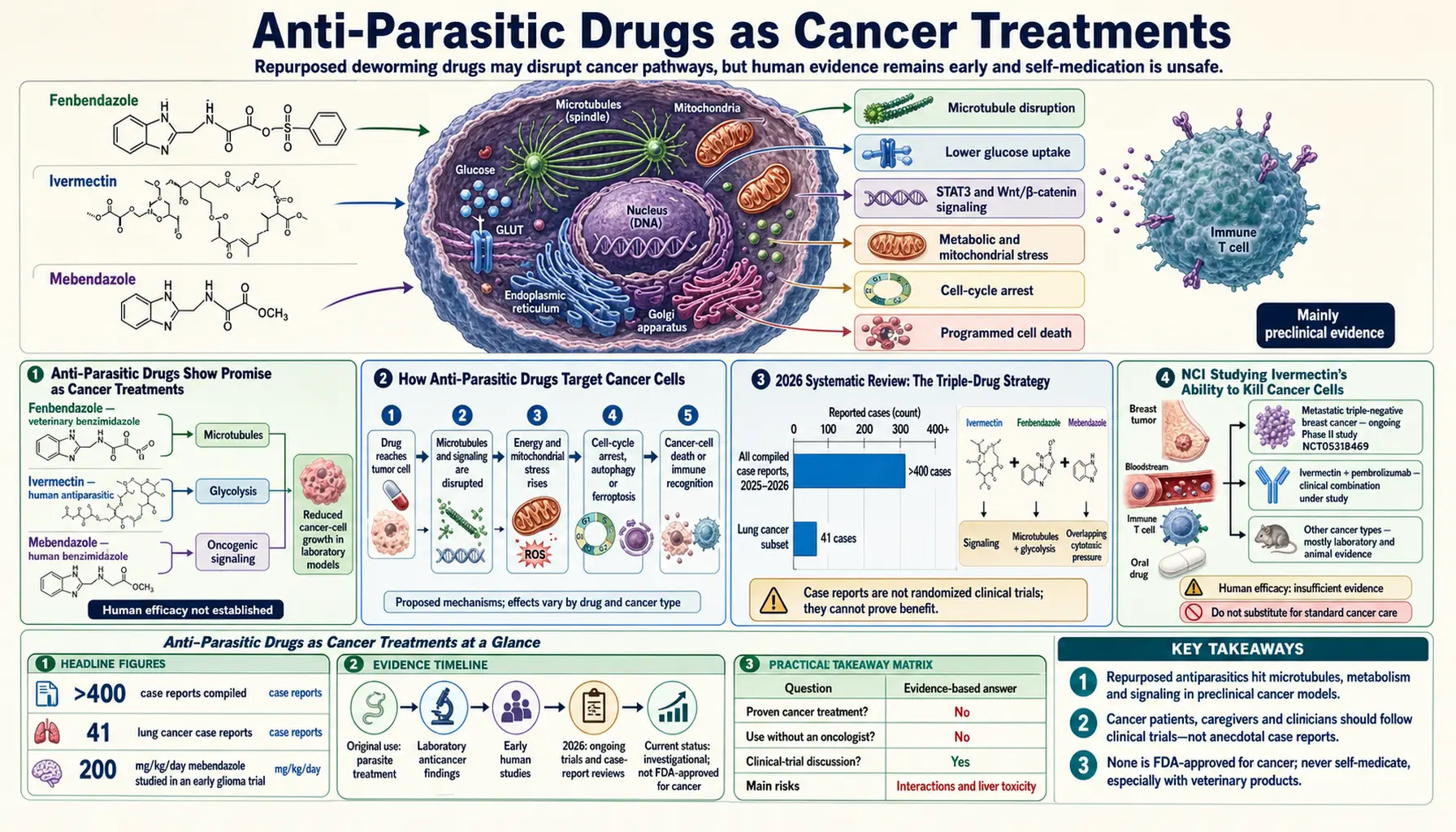
Table of Contents
- Anti-Parasitic Drugs Show Promise as Cancer Treatments
- How Anti-Parasitic Drugs Target Cancer Cells
- 2026 Systematic Review: The Triple-Drug Strategy
- NCI Studying Ivermectin's Ability to Kill Cancer Cells
- Important Caveats
- Research Papers
- Connections
- Featured Videos
Anti-Parasitic Drugs Show Promise as Cancer Treatments
A growing body of research is exploring the repurposing of common anti-parasitic drugs — originally developed to treat worm infections — as potential cancer therapies. Three drugs in particular have drawn significant scientific attention: fenbendazole, ivermectin, and mebendazole.
The Drugs Under Investigation
Fenbendazole is a veterinary dewormer belonging to the benzimidazole class. Laboratory studies have shown it disrupts microtubule dynamics in cancer cells — a mechanism similar to established chemotherapy drugs like taxanes — and inhibits glycolysis, starving cancer cells of energy. While in vitro and animal studies show promise, clinical evidence in humans remains limited. A case series published in PMC documented self-administration in three cancer patients with notable outcomes.
Ivermectin, the 2015 Nobel Prize-winning antiparasitic, has been shown to modulate oncogenic signaling pathways including STAT3 and Wnt/β-catenin in preclinical studies. An ongoing Phase I/II clinical trial is currently evaluating ivermectin combined with immunotherapy drugs (balstilimab or pembrolizumab) for patients with metastatic triple-negative breast cancer — one of the most aggressive forms of the disease.
Source: OncoDaily — Ivermectin and Immunotherapy Clinical Trials
Mebendazole has the most clinical data in human populations of all antiparasitic agents being studied for cancer. A Phase 1 clinical trial evaluated mebendazole in combination with temozolomide for patients with newly diagnosed high-grade gliomas (brain cancer), with dosing of 200 mg/kg/day tolerated by the majority of patients.
Source: Fagron Academy — Antiparasitic Drugs as Emerging Cancer Treatments
How Anti-Parasitic Drugs Target Cancer Cells
Researchers have identified multiple anticancer mechanisms shared by these antiparasitic agents:
- Microtubule disruption — Prevents cancer cells from dividing, similar to conventional chemotherapy drugs
- Ferroptosis induction — Triggers iron-dependent cancer cell death
- Autophagy regulation — Forces cancer cells to self-digest
- Mitochondrial disturbance — Disrupts energy production in tumor cells
- Immune system modulation — Enhances the body's natural anti-tumor immune response
- Metabolic pathway disruption — Interferes with the altered metabolism cancer cells rely on for growth
The overlap between parasite survival strategies and cancer cell behavior is what makes these drugs biologically plausible candidates for repurposing. Both parasites and tumors evade the immune system, hijack host metabolism, and promote abnormal cell growth.
Source: PMC — Repositioning of Antiparasitic Drugs for Tumor Treatment
2026 Systematic Review: The Triple-Drug Strategy
A February 2026 systematic review examined the emerging triple combination of ivermectin + fenbendazole + mebendazole, analyzing over 400 case reports compiled between 2025 and 2026. Reported responses were documented across multiple cancer types:
- Pancreatic cancer — Patients achieving normal CT scans
- Prostate cancer — Improvement in metastases
- Endometrial cancer — Significant metastasis shrinkage
- Breast cancer — Tumor reduction and resolution of liver metastases
- Lung cancer — 41 case reports compiled showing various responses
The review suggests that these three agents may act synergistically — fenbendazole disrupts microtubules and inhibits glycolysis, while ivermectin modulates oncogenic signaling, and mebendazole adds additional cytotoxic pressure through overlapping but distinct mechanisms.
Source: Systematic Review: Triple Combination in Cancer (February 2026)
NCI Studying Ivermectin's Ability to Kill Cancer Cells
The National Cancer Institute (NCI) has initiated studies examining ivermectin's ability to kill cancer cells, lending institutional credibility to the research. Meanwhile, an NPR report from March 2026 noted that ivermectin is making a post-pandemic comeback among cancer patients, though the article cautioned that adoption may be outpacing the scientific evidence.
Source: Cancer Therapy Advisor — NCI Studying Ivermectin
Important Caveats
While the research is promising, several important points must be considered:
- Most evidence remains preclinical (laboratory and animal studies) or based on anecdotal case reports
- Rigorous randomized controlled trials in humans are still lacking for most applications
- These drugs are used off-label for cancer — none are FDA-approved as cancer treatments
- Self-medication without medical supervision carries risks including drug interactions and liver toxicity
- Patients should always consult with a qualified physician before considering any off-label treatment
Despite these limitations, the cost-effectiveness, established safety profiles, and multi-target mechanisms of antiparasitic drugs make them compelling candidates for further clinical investigation in oncology.
Sources
- PMC — Repositioning of Antiparasitic Drugs for Tumor Treatment
- OncoDaily — Ivermectin and Immunotherapy Clinical Trials
- Fagron Academy — Antiparasitic Drugs as Emerging Cancer Treatments
- Cancer Therapy Advisor — NCI Studying Ivermectin
- NPR — Ivermectin Making a Post-Pandemic Comeback (March 2026)
- Systematic Review: Triple Combination in Cancer (February 2026)
- PMC — Fenbendazole as Anticancer Agent Case Series
- Anticancer Research — Oral Fenbendazole for Cancer Therapy
Research Papers
- Clinical trials on fenbendazole and cancer — PubMed search
- Clinical trials on ivermectin and cancer — PubMed search
- Clinical trials on mebendazole and cancer — PubMed search
- Clinical trials on benzimidazole drugs and cancer — PubMed search
- Clinical trials on drug repurposing in oncology — PubMed search
- Clinical trials on ivermectin and glioma — PubMed search