Lecithin: Dietary Phospholipids, Food Emulsifier, and Choline Source
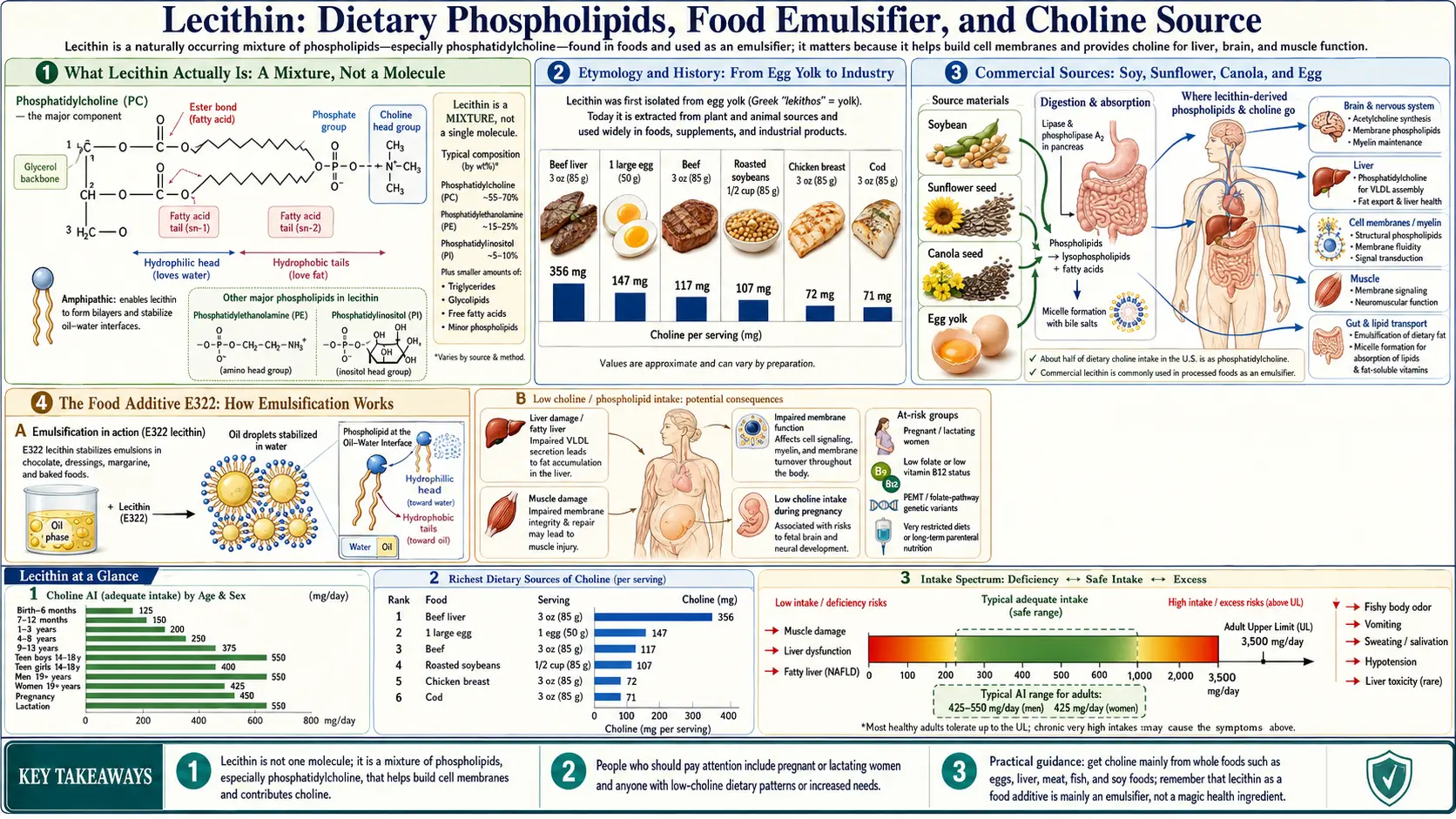
Lecithin is one of the most misunderstood words in nutrition. To a food technologist it is a workhorse emulsifier that keeps chocolate smooth and salad dressing from separating; to a supplement shopper it is a softgel promising help with cholesterol, brain fog, or clogged milk ducts; to a biochemist it is a historical name for a class of fatty molecules called phospholipids. In commerce, “lecithin” almost never means a single pure chemical. It means a mixture — mostly phospholipids, alongside oils, glycolipids, and other plant or egg residues — whose composition varies enormously from one grade and source to the next.
This page untangles those meanings. It explains what lecithin actually contains, where it comes from, how it functions as the food additive E322, how it relates to choline and phosphatidylcholine, and what the human evidence does — and does not — support for its popular health claims. Throughout, the aim is honest framing: several widely repeated benefits rest on weak or anecdotal evidence, and the gut-microbiome connection to cardiovascular risk is more nuanced than headlines suggest.
Table of Contents
- What Lecithin Actually Is: A Mixture, Not a Molecule
- Etymology and History: From Egg Yolk to Industry
- Commercial Sources: Soy, Sunflower, Canola, and Egg
- The Food Additive E322: How Emulsification Works
- Lecithin Versus Phosphatidylcholine: Why the Distinction Matters
- Lecithin as a Dietary Source of Choline
- Supplement Health Claims: An Honest Appraisal
- TMAO and Cardiovascular Risk: Mechanism and Nuance
- Allergy and Safety: Soy, Egg, and Tolerability
- Forms and Typical Dosing
- Key Research Papers
- Connections
- Featured Videos
What Lecithin Actually Is: A Mixture, Not a Molecule
In ordinary food and supplement use, “lecithin” does not refer to a single defined compound. It is the trade name for a complex, naturally occurring mixture of phospholipids together with other lipids carried along during extraction. A typical commercial lecithin contains three principal phospholipids:
- Phosphatidylcholine (PC) — historically the molecule chemists called “lecithin” in the strict sense; the choline-bearing phospholipid.
- Phosphatidylethanolamine (PE) — the ethanolamine-bearing phospholipid, often present in similar amounts to PC.
- Phosphatidylinositol (PI) — the inositol-bearing phospholipid.
Beyond these phospholipids, crude lecithin also carries triglycerides (neutral oil), glycolipids, free fatty acids, sterols, and small amounts of carbohydrate. A common rough composition for food-grade lecithin is on the order of 60% phospholipids and 40% oil and other minor components, with PC, PE, and PI each contributing roughly a fifth of the phospholipid fraction in soy lecithin. These figures are approximate and shift with the plant source and processing.
Critically, the grade of a lecithin determines its phospholipid — and therefore its choline — content:
- Crude (fluid) lecithin is the oil-rich gum recovered during seed-oil degumming; phospholipid content is lower because neutral oil is still present.
- De-oiled lecithin (often sold as granules or powder) has had most of the triglyceride oil removed, concentrating the phospholipids.
- PC-enriched fractions are further refined to raise phosphatidylcholine specifically.
Because of this, the proportion of phosphatidylcholine in a product labeled “lecithin” can range very widely — roughly from about 20% in a crude grade up to 70–90% in a deliberately PC-enriched fraction. When a label simply says “lecithin,” it tells you little about how much PC (and thus choline) you are actually getting.
Etymology and History: From Egg Yolk to Industry
The word lecithin comes from the Ancient Greek λέκιθος (lekithos), meaning “egg yolk” — a fitting name, because the substance was first obtained from yolk. The French chemist and pharmacist Théodore Nicolas Gobley isolated it from egg yolk in 1846 and, in 1850, gave it the name lécithine. Over the following decades Gobley demonstrated the presence of this material in many biological tissues — including brain, bile, blood, and fish roe — and by 1874 he had worked out the chemical structure of its principal component, the molecule now called phosphatidylcholine.
For a long time, “lecithin” in chemistry meant specifically phosphatidylcholine. As industrial processing of vegetable oils matured in the twentieth century, the term migrated to describe the commercial phospholipid mixture recovered as a by-product of oil refining — especially from soybeans. Today, the historical (single-molecule) and commercial (mixture) meanings coexist, which is a frequent source of confusion.
Commercial Sources: Soy, Sunflower, Canola, and Egg
Most commercial lecithin is recovered during the degumming step of vegetable-oil processing, when phospholipids (“gums”) are separated from the crude oil. The leading sources are:
- Soybean — by far the most common and least expensive source; the default “lecithin” in most processed foods.
- Sunflower — increasingly popular as a non-GMO, allergen-friendlier alternative; widely used where a “soy-free” label is desired.
- Rapeseed / canola — another vegetable-oil by-product source.
- Egg yolk — the original source; egg lecithin is richer in phosphatidylcholine than soy lecithin and is used in certain pharmaceutical and culinary applications, but it is more costly and is relevant to egg allergy.
The botanical or animal origin matters for fatty-acid profile, phospholipid ratios, flavor, allergen status, and regulatory labeling, even though all of these products share the same general “lecithin” designation.
The Food Additive E322: How Emulsification Works
In the food industry, lecithin is the additive with the E-number E322, used as an emulsifier, stabilizer, wetting agent, and antioxidant aid. You will find it in chocolate and confectionery, margarine and spreads, baked goods, salad dressings and mayonnaise, instant powders, and some infant formulas, among many others. In chocolate, lecithin is prized for its ability to reduce viscosity and control flow and crystallization, allowing manufacturers to use less cocoa butter and to limit fat bloom — an effect that is unusually strong for lecithin compared with other emulsifiers.
Lecithin works because its phospholipids are amphipathic (also called amphiphilic): each molecule has a water-loving (hydrophilic) phosphate “head” and two oil-loving (hydrophobic) fatty-acid “tails.” When oil and water are mixed, lecithin molecules line up at the boundary between them — tails buried in the oil droplets, heads facing the water. This molecular bridge lowers the surface tension at the oil–water interface and coats the droplets, stopping them from coalescing back into separate layers. The result is a stable emulsion: tiny oil droplets suspended evenly throughout a watery phase (or vice versa). The same surfactant behavior also lets phospholipids self-assemble in water into micelles, bilayers, and liposomes.
Lecithin Versus Phosphatidylcholine: Why the Distinction Matters
Because lecithin is rich in phosphatidylcholine, and because chemists once used “lecithin” to mean PC specifically, the two words are routinely treated as synonyms in marketing. They are not interchangeable in any quantitative sense. Phosphatidylcholine is one specific phospholipid; lecithin is the mixture that contains it, along with PE, PI, oil, and minor components.
The practical consequence is dosing precision. A “1,200 mg lecithin” softgel might be a crude grade with perhaps a fifth of its weight as PC, or a PC-enriched product with most of its weight as PC — a several-fold difference in the actual phosphatidylcholine delivered. Studies that report results for “phosphatidylcholine” cannot be assumed to apply to any arbitrary “lecithin” supplement, and vice versa. When choline content matters — for example, when someone is using a product specifically to raise choline intake — the label’s stated PC (or choline) content, not just the total lecithin weight, is what counts.
Lecithin as a Dietary Source of Choline
Choline is an essential nutrient: humans synthesize some, but generally not enough, and prolonged deficiency can lead to liver dysfunction and muscle damage. Choline reaches the body in several chemical forms — water-soluble forms (free choline, phosphocholine, glycerophosphocholine) and lipid-soluble forms (phosphatidylcholine and sphingomyelin). Because lecithin is PC-rich, it is a lipid-soluble dietary source of choline, and PC-rich foods and supplements contribute meaningfully to total choline intake.
However, the amount of choline delivered by “lecithin” depends entirely on its PC content, which (as above) varies by grade. By weight, the choline contribution of phosphatidylcholine is only a fraction of the molecule, so even pure PC delivers far less choline than an equal weight of a concentrated form such as choline bitartrate. For people relying on food, whole sources such as eggs (yolk PC), liver, and fish are among the most choline-dense options. Lecithin is best understood as one contributor to choline status rather than a high-potency choline supplement.
Supplement Health Claims: An Honest Appraisal
Lecithin is marketed for many purposes. The honest summary is that most claims are supported by limited, low-quality, or preliminary evidence, and few are firmly established. Each is worth addressing on its own terms.
Cholesterol and blood lipids
A handful of small trials suggest soy lecithin may modestly lower LDL (“bad”) cholesterol. One frequently cited open-label study reported sizeable reductions in total and LDL cholesterol after daily soy lecithin in people with high cholesterol. But such studies tend to be small, short, and methodologically weak (for example, lacking robust blinding or adequate controls), and results across the broader literature are inconsistent. The proposed mechanism — phospholipids interfering with cholesterol absorption and stimulating biliary lipid secretion — is plausible, but the overall human evidence is weak and not established. Lecithin should not be relied upon as a treatment for high cholesterol.
Recurrent plugged milk ducts and lactational mastitis
Lecithin is very widely recommended — often by lactation consultants and in parenting resources — for preventing recurrent plugged (blocked) milk ducts during breastfeeding, on the theory that it reduces milk “stickiness.” This recommendation is largely anecdotal and low-quality; rigorous trials are lacking. Importantly, the Academy of Breastfeeding Medicine’s 2022 Clinical Protocol #36 (“The Mastitis Spectrum”) reframed how clinicians think about these problems — emphasizing inflammation and ductal narrowing rather than a physical “clog,” and explicitly de-emphasizing aggressive duct “unclogging” measures (such as deep massage and over-pumping) that can worsen inflammation. Lecithin remains a popular, low-risk option that some families find helpful, but it is best framed as popular-but-unproven rather than evidence-based, and it should fit within current, gentler mastitis-spectrum management.
Cognition, liver, and athletic performance
Because PC supplies choline (a precursor of the neurotransmitter acetylcholine) and is a building block of cell membranes, lecithin is promoted for memory, brain function, liver health, and exercise performance. The human evidence for meaningful benefit in healthy people is limited and not convincing. There is genuine, important physiology connecting choline to brain and liver function — covered on the Choline page — but that does not translate into demonstrated benefits from lecithin supplements specifically. These uses should not be overclaimed.
As a choline source
The one straightforward, well-grounded role of lecithin as a supplement is as a dietary source of choline (via its PC content), as discussed above — with the caveat that potency depends on grade.
TMAO and Cardiovascular Risk: Mechanism and Nuance
One reason lecithin and phosphatidylcholine appear in cardiovascular discussions is the TMAO pathway. Gut bacteria can metabolize the choline moiety of dietary phosphatidylcholine (and free choline and carnitine) into trimethylamine (TMA). TMA is absorbed and then oxidized in the liver to trimethylamine-N-oxide (TMAO). A landmark 2011 study in Nature by Wang, Hazen, and colleagues linked dietary phosphatidylcholine, gut flora, TMAO, and atherosclerosis in animal and human data, and a 2013 study in the New England Journal of Medicine by Tang, Hazen, and colleagues reported that higher fasting plasma TMAO was associated with increased risk of major cardiovascular events in patients undergoing cardiac evaluation.
These findings deserve careful, non-alarmist framing:
- They are largely associative and mechanistic. They establish a biologically plausible pathway and a statistical association — not proof that dietary lecithin or PC causes heart disease in people.
- TMAO production depends heavily on the individual’s gut microbiome. The same choline intake can yield very different TMAO responses in different people, and germ-free conditions abolish the conversion.
- Whole foods are not shown to cause net harm. Notably, a randomized study found that eggs — despite being choline-rich — did not raise fasting TMAO in healthy people, whereas an equivalent dose of choline as a bitartrate supplement did, implying that food matrix and source matter. Fish, meanwhile, can directly contain preformed TMAO yet remains part of heart-healthy diets.
The reasonable takeaway is that the TMAO pathway is a real and interesting area of research, not a reason to fear nutrient-dense whole foods. It is a meaningful consideration mainly in the context of high-dose isolated choline or PC supplementation, particularly in people with kidney impairment, and is discussed further on the Cardiovascular and TMAO page.
Allergy and Safety: Soy, Egg, and Tolerability
Lecithin has a long history of food use and is Generally Recognized as Safe (GRAS) in the United States. For most people it is well tolerated. A few points are worth understanding:
- Soy lecithin and soy allergy. Highly refined soy lecithin contains only a very small amount of residual soy protein. Allergy organizations note that most people with soy allergy tolerate soy lecithin, and a controlled trial in soy-allergic children found no significant difference between soy lecithin and placebo. That said, laboratory studies have detected low-level IgE-binding (allergenic) proteins in soy lecithin, so it can act as a source of hidden allergen for a sensitive minority. Reading labels and exercising caution remains sensible for highly soy-allergic individuals, even though reactions are uncommon.
- Egg-derived lecithin and egg allergy. Lecithin sourced from egg yolk warrants caution for people with egg allergy and should be avoided or cleared with a clinician.
- Gastrointestinal upset. At higher supplemental doses, lecithin can cause GI symptoms such as nausea, abdominal discomfort, loose stools, or fullness.
- Sunflower lecithin is a common choice for those seeking a soy-free emulsifier.
As with any supplement, people who are pregnant, breastfeeding, taking medications, or managing a medical condition should consult a qualified clinician before using lecithin in supplemental amounts.
Forms and Typical Dosing
Lecithin supplements and food-grade products come in several forms:
- Granules / powder — de-oiled lecithin, commonly stirred into food or smoothies; sold for general use and historically used by breastfeeding parents.
- Softgels / capsules — convenient fixed doses, frequently labeled around 1,200 mg of lecithin per softgel.
- Liquid lecithin — a viscous fluid used in cooking and food manufacture.
There is no established Recommended Dietary Allowance for lecithin itself (dietary recommendations exist for choline, not lecithin). Doses used in the breastfeeding context are often cited in the range of roughly a gram or more per day, but these figures come from clinical practice and anecdote rather than rigorous dose-finding trials. Because product potency (especially PC content) varies so much by grade, the most useful information on a label is the stated phosphatidylcholine or choline amount, not the total lecithin weight. Anyone targeting a specific choline intake should plan around verified choline content and the broader guidance on the Choline page.
Key Research Papers
- Wang Z, Klipfell E, Bennett BJ, et al. Gut flora metabolism of phosphatidylcholine promotes cardiovascular disease. Nature. 2011;472(7341):57–63.
- Tang WHW, Wang Z, Levison BS, et al. Intestinal microbial metabolism of phosphatidylcholine and cardiovascular risk. New England Journal of Medicine. 2013;368(17):1575–1584.
- Wilcox J, Skye SM, Graham B, et al. Dietary choline supplements, but not eggs, raise fasting TMAO levels in participants with normal renal function: a randomized clinical trial. The American Journal of Medicine. 2021;134(9):1160–1169.e3.
- Lemos BS, Medina-Vera I, Blesso CN, Fernandez ML. Effects of egg consumption and choline supplementation on plasma choline and trimethylamine-N-oxide in a young population. Journal of the American College of Nutrition. 2018;37(8):716–723.
- Mourad AM, de Carvalho Pincinato E, Mazzola PG, Sabha M, Moriel P. Influence of soy lecithin administration on hypercholesterolemia. Cholesterol. 2010;2010:824813.
- Mitchell KB, Johnson HM, Rodríguez JM, et al. Academy of Breastfeeding Medicine Clinical Protocol #36: The Mastitis Spectrum, Revised 2022. Breastfeeding Medicine. 2022;17(5):360–376.
- Gholmie Y, Macdonald-Clarke C, Markiewicz-Keszycka M, et al. Tolerance of soya lecithin in children with non-immunoglobulin E-mediated soya allergy: a randomised, double-blind, cross-over trial. Journal of Human Nutrition and Dietetics. 2020;33(2):232–240.
- Paschke A, Zunker K, Wigotzki M, Steinhart H. Determination of the IgE-binding activity of soy lecithin and refined and non-refined soybean oils. Journal of Chromatography B. 2001;756(1–2):249–254.
- Zeisel SH, da Costa KA, Franklin PD, et al. Choline, an essential nutrient for humans. The FASEB Journal. 1991;5(7):2093–2098.
- Wiedeman AM, Barr SI, Green TJ, Xu Z, Innis SM, Kitts DD. Dietary choline intake: current state of knowledge across the life cycle. Nutrients. 2018;10(10):1513.
Connections
- All Vitamins
- Choline
- Phosphatidylcholine
- Choline Benefits
- Cardiovascular and TMAO
- Eggs
- Salmon
- Methionine
- Homocysteine