Vitamin K2 (Menaquinone): The Calcium-Directing Vitamin for Bones, Arteries, and Teeth
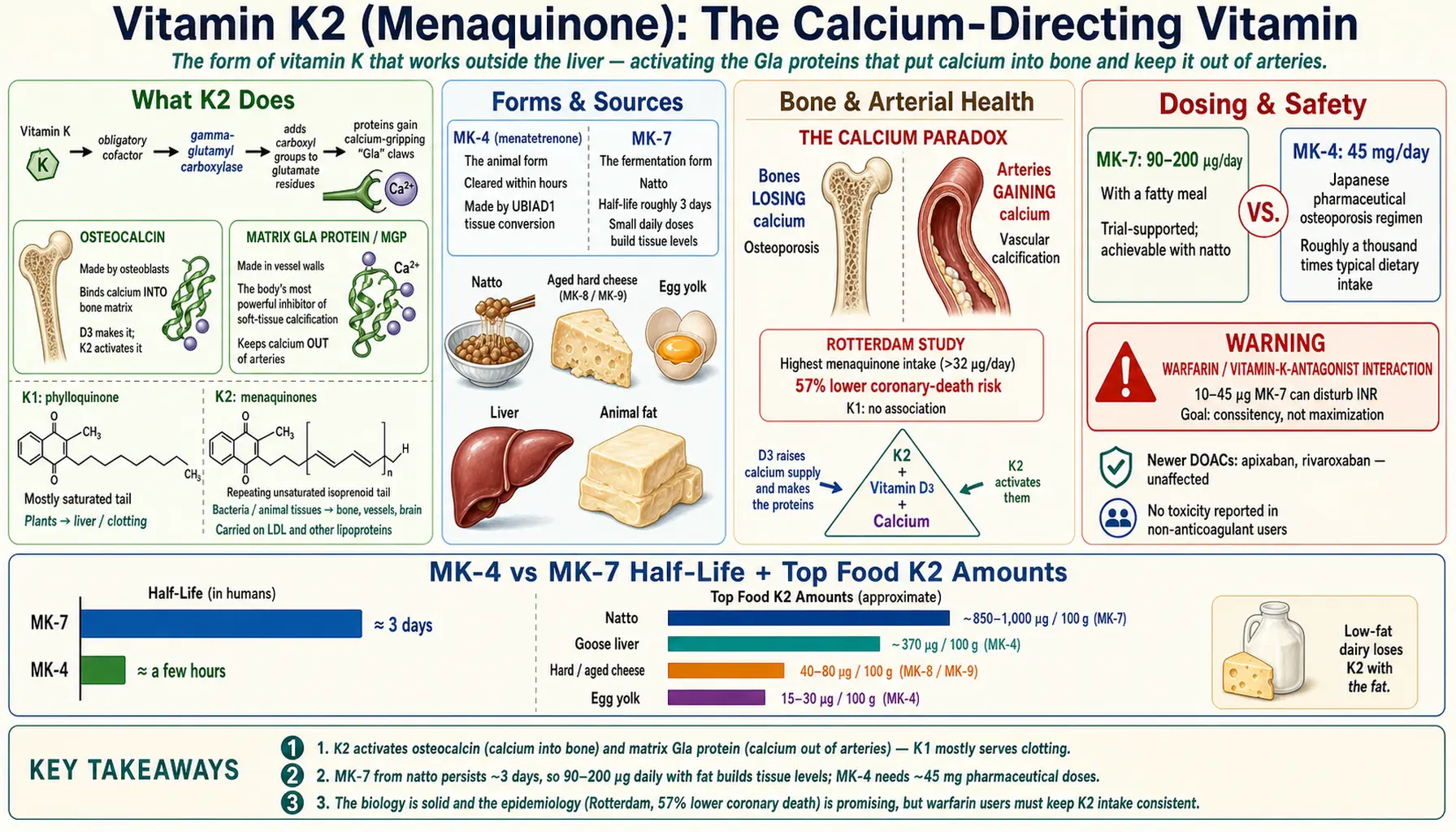
Vitamin K2 is the family of menaquinones — the form of vitamin K that does its most important work outside the liver. While vitamin K1 from leafy greens is mostly used up activating blood-clotting factors, K2 activates the proteins that decide where calcium goes: into bones and teeth, and away from artery walls. Found in natto, hard cheeses, and pastured animal foods, and produced by fermenting bacteria rather than plants, K2 is the vitamin most Western diets quietly run short of — and one of the most interesting stories in modern nutrition research.
Interactive Visualization Bone Remodeling & Calcium Balance Watch osteoclasts tunnel and osteoblasts rebuild — then drop vitamin D and see PTH quietly strip calcium out of your skeleton. Launch → Interactive Visualization How Blood Clots — and how thinners stop it Build a platelet plug, weave a fibrin mesh, then watch aspirin, warfarin and a DOAC each break a different step — with a live INR. Launch →
Table of Contents
- What Is Vitamin K2 — and How It Differs from K1
- The Menaquinone Family — MK-4 Through MK-13
- How the Body Gets K2 — Diet, Bacteria, and the UBIAD1 Conversion
- Gamma-Carboxylation — Switching On the K-Dependent Proteins
- The Calcium Paradox — Strong Bones, Clean Arteries
- Cardiovascular Evidence — The Rotterdam Study and Beyond
- Bone Evidence — From Japanese MK-4 Therapy to MK-7 Trials
- MK-4 vs MK-7 — Absorption, Half-Life, and Practical Dosing
- Vitamin K2 and Vitamin D3 — Why They Are Paired
- Teeth and the Activator X Story
- Food Sources — Natto, Cheese, and Animal Foods
- Dosage, Forms, and How Much Is Enough
- Cautions — Warfarin and Other Interactions
- Research Papers and References
- Connections
- Featured Videos
1. What Is Vitamin K2 — and How It Differs from K1
Vitamin K comes in two natural forms that share a chemical core (the naphthoquinone ring) but differ in their tails — and that tail changes almost everything about how they behave in the body. Vitamin K1 (phylloquinone) has a mostly saturated tail and comes from green plants, where it works in photosynthesis. Vitamin K2 (the menaquinones) carries a tail built from repeating unsaturated isoprenoid units and comes mainly from bacteria and animal tissues.
The practical difference is where each form ends up. After a meal, K1 is taken up efficiently by the liver, which uses it to activate clotting factors — and comparatively little is left over for the rest of the body. The long-chain menaquinones, carried on LDL and other lipoproteins, circulate for days and are delivered to extrahepatic tissues: bone, blood-vessel walls, cartilage, brain, and glands. That is why K2, not K1, dominates the conversation about bones and arteries, while K1 dominates the conversation about clotting. For the full overview of both forms and the classical coagulation story, see the parent page: Vitamin K.
One more distinction matters: dietary studies repeatedly show that K1 and K2 intakes are not interchangeable. In the landmark Rotterdam Study, coronary benefit tracked with menaquinone intake specifically — phylloquinone intake showed no such association. Whether that reflects K2's superior delivery to tissues, its longer residence time in blood, or the foods it travels in, is still being studied; but it justifies treating K2 as its own topic rather than a footnote to K1.
2. The Menaquinone Family — MK-4 Through MK-13
"Vitamin K2" is not a single molecule but a family. Each member is named MK-n, where n counts the isoprenoid units in its side chain — from MK-4 (four units) up to MK-13. The chain length determines how the molecule is absorbed, how long it stays in circulation, and which foods contain it:
- MK-4 (menatetrenone) — the "animal" menaquinone. It is the form human and animal tissues make for themselves by converting other forms of vitamin K, and the form found in meat, eggs, butter, and organ meats. It acts quickly but is cleared from the blood within hours. At pharmacological doses (45 mg/day) it has been used as an osteoporosis drug in Japan since 1995.
- MK-7 — the "fermentation" menaquinone, made famous by natto (fermented soybeans), where Bacillus subtilis produces it in extraordinary amounts. Its long tail keeps it circulating for about three days, so small daily microgram doses steadily build tissue levels. Most modern K2 supplements are MK-7 for this reason.
- MK-8 and MK-9 — produced by lactic-acid bacteria; these dominate the K2 content of fermented dairy, especially hard and semi-hard cheeses and curd cheeses.
- MK-10 through MK-13 — longer forms made by gut and food bacteria; they appear in smaller amounts and are the least studied.
When research papers, food tables, or supplement labels disagree about "vitamin K2," the explanation is almost always that they are talking about different family members. This page treats the family together and flags the differences where they matter; for a focused comparison of the two supplement forms, see MK-7 vs MK-4.
3. How the Body Gets K2 — Diet, Bacteria, and the UBIAD1 Conversion
The body has three supply lines for menaquinones, and understanding them explains several puzzles in the K2 literature.
First, direct dietary intake. Fermented foods and animal foods deliver preformed menaquinones — MK-7 from natto, MK-8/MK-9 from cheese, MK-4 from meat, eggs, and butter. In Western diets, menaquinones typically make up only about 10–25% of total vitamin K intake, which is why researchers describe K2 intake as low "by default" outside of Japan and the cheese-eating regions of Europe.
Second, tissue conversion. In 2010, Japanese researchers identified the enzyme UBIAD1, which converts vitamin K1 into MK-4 inside human tissues — the pancreas, testes, vessel walls, and brain are particularly active converters. This discovery, published in Nature, answered a long-standing riddle: why animal tissues contain MK-4 even when the diet contains none. It also set a limit on the idea that K1 can fully substitute for K2 — conversion happens, but its capacity appears modest, and circulating MK-4 barely rises after K1-rich meals.
Third, gut bacteria. The colon's microbiome synthesizes long-chain menaquinones (MK-9 through MK-13) in meaningful quantities. How much of this bacterial K2 is actually absorbed is debated — the colon is a poor site for fat-soluble vitamin absorption because bile salts are largely gone by then — but it likely provides a baseline that protects against outright clotting-level deficiency. It cannot, however, be relied on to optimize the bone and vessel proteins discussed below.
4. Gamma-Carboxylation — Switching On the K-Dependent Proteins
All forms of vitamin K share one biochemical job: they are the obligatory cofactor for the enzyme gamma-glutamyl carboxylase, which adds a carboxyl group to specific glutamate residues on certain proteins. This gamma-carboxylation gives those proteins claw-like "Gla" residues that can grip calcium ions. Without carboxylation, the proteins are made but remain inactive — present in the body yet unable to handle calcium.
About a dozen and a half vitamin K–dependent proteins are known. The liver's clotting factors (II, VII, IX, X) get first claim on available vitamin K. The proteins that matter most for the K2 story live elsewhere:
- Osteocalcin — made by osteoblasts (bone-building cells); once carboxylated, it binds calcium into the bone's mineral matrix. Vitamin D3 stimulates its production; K2 activates it.
- Matrix Gla protein (MGP) — made by vascular smooth-muscle cells and cartilage; carboxylated MGP is the body's most powerful known inhibitor of soft-tissue calcification, actively preventing calcium-phosphate crystals from forming in artery walls.
- Gas6, protein S, Gla-rich protein and others — involved in cell survival, vessel biology, and inflammation; active areas of research.
The fraction of these proteins left uncarboxylated can be measured in blood — undercarboxylated osteocalcin (ucOC) for bone, and dephospho-uncarboxylated MGP (dp-ucMGP) for vessels. These markers function as tissue-specific vitamin K "fuel gauges," and in population studies most adults outside Japan show substantial undercarboxylation — biochemical evidence that their bone and vessel proteins are running below capacity even though their clotting is normal.
5. The Calcium Paradox — Strong Bones, Clean Arteries
The "calcium paradox" describes a pattern seen in aging populations: bones losing calcium (osteoporosis) while arteries gain it (vascular calcification) — calcium in the wrong places at the same time. Vitamin K2 sits at the center of the leading mechanistic explanation, because the two proteins it activates are precisely the ones that put calcium into bone (osteocalcin) and keep it out of vessel walls (MGP).
The strongest single piece of evidence for MGP's importance comes from genetics: in Keutel syndrome, a rare condition in which MGP is defective, patients develop widespread abnormal calcification of cartilage and arteries early in life. Animal experiments tell the same story — mice engineered to lack MGP die young of massive arterial calcification, and treating rats with warfarin (which blocks vitamin K recycling and therefore MGP activation) reliably induces arterial calcification.
It is important to state what is and is not established here. The mechanism — K2 activates MGP, active MGP inhibits vascular calcification — is solid biochemistry. The clinical claim — that taking K2 will measurably slow artery calcification or prevent heart attacks in the general population — rests on observational studies and trials with surrogate endpoints (described next), not yet on large outcome trials. The honest summary: the biology is compelling, the human outcome evidence is promising but unfinished.
6. Cardiovascular Evidence — The Rotterdam Study and Beyond
The study that put K2 on the map is the Rotterdam Study (2004), which followed 4,807 Dutch adults for about ten years. Participants with the highest dietary menaquinone intake (over roughly 32 micrograms per day — mostly from cheese) had a 57% lower risk of dying from coronary heart disease and significantly less severe aortic calcification than those with the lowest intake. Vitamin K1 intake, though much larger in absolute terms, showed no such association.
Two further Dutch cohorts strengthened the pattern. The Prospect-EPIC analysis of 16,057 women (2009) found each additional 10 micrograms of daily menaquinone intake was associated with a 9% lower incidence of coronary heart disease, with the benefit attributed mainly to the longer-chain MK-7, MK-8, and MK-9 from fermented dairy. A companion study in 564 postmenopausal women found higher menaquinone intake associated with reduced coronary artery calcification on imaging.
Interventional data exist but are smaller. A three-year randomized trial of MK-7 at 180 micrograms daily in 244 healthy postmenopausal women reported improved markers of arterial stiffness (carotid-femoral pulse-wave velocity and the stiffness index) in women whose arteries were stiff at baseline, alongside a roughly 50% drop in dp-ucMGP. In hemodialysis patients — who calcify fastest of all — MK-7 lowered dp-ucMGP dose-dependently in a randomized dose-finding study, establishing the biochemical groundwork for ongoing outcome trials in kidney disease.
The fair caveats: the cohort studies are observational (cheese eaters differ from non–cheese eaters in many ways), the trials used surrogate endpoints rather than heart attacks, and at least one follow-up trial in patients with existing severe calcification (aortic valve disease) failed to slow progression. K2 is best understood today as a prevention-oriented nutrient with strong mechanistic and epidemiological support, not a proven treatment for established arterial disease. See also the deeper dive: Vitamin K2 and Arterial Calcification.
7. Bone Evidence — From Japanese MK-4 Therapy to MK-7 Trials
Japan ran the world's largest natural experiment in vitamin K2 and bones. Menatetrenone — pharmaceutical MK-4 at 45 milligrams per day, roughly a thousand times typical dietary intake — has been an approved osteoporosis treatment there since 1995. A representative randomized trial in 241 osteoporotic women found that two years of menatetrenone maintained lumbar bone mineral density and reduced new fractures compared with controls. A 2006 meta-analysis in the Archives of Internal Medicine pooling 13 trials (overwhelmingly Japanese MK-4 studies) concluded that K2 supplementation was associated with reduced vertebral and hip fractures — while honestly noting the trials' variable quality and the need for confirmation outside Japan.
Epidemiology inside Japan points the same direction at dietary doses: regions with high natto consumption (eastern Japan) have measurably higher hip-fracture-free survival and better hip bone density than low-natto regions (western Japan) — an association tracked directly to serum MK-7 levels.
For the supplement-relevant microgram doses, the key modern trial is again Knapen's three-year study: 180 micrograms of MK-7 daily in healthy postmenopausal women significantly slowed the age-related decline in bone mineral density at the lumbar spine and femoral neck and improved bone strength indices, compared with placebo. The effect sizes were modest — K2 is not a bisphosphonate — but they occurred in healthy women at a food-achievable dose with no adverse signal, which is exactly the profile you want from preventive nutrition. The deeper dive lives at Vitamin K2 and Bone Health, and the disease context at Osteoporosis.
8. MK-4 vs MK-7 — Absorption, Half-Life, and Practical Dosing
The two supplement forms behave so differently that dose numbers cannot be compared across them.
- Half-life. MK-7 remains in circulation with a half-life of roughly three days, so daily dosing builds a steady reservoir available to bone and vessels around the clock. MK-4 is cleared within a few hours.
- Absorption at label doses. In a head-to-head study in healthy women, a single 420-microgram dose of MK-4 produced no measurable rise in serum MK-4, while the same dose of MK-7 was well absorbed and detectable for days. Microgram-dose MK-4 supplements therefore have weak pharmacokinetic support; the Japanese bone results used 45 milligrams, not micrograms.
- Efficacy per microgram. Because of its persistence, MK-7 improves carboxylation status at doses of 90–200 micrograms per day — natto-range intakes — making it the form used in nearly all modern trials and most quality supplements.
Practical translation: for general bone-and-vessel support, evidence favors MK-7 at 90–200 micrograms daily with a fat-containing meal. High-dose MK-4 (45 mg/day) is a pharmaceutical strategy with its own Japanese evidence base, typically used under medical supervision for diagnosed osteoporosis. The full comparison: MK-7 vs MK-4.
9. Vitamin K2 and Vitamin D3 — Why They Are Paired
The D3+K2 pairing on supplement labels is not marketing invention; it reflects a genuine division of labor. Vitamin D3 raises calcium supply — it increases intestinal calcium absorption and stimulates cells to produce the calcium-handling proteins osteocalcin and MGP. But D3 cannot activate those proteins; that final switch is exclusively vitamin K's job. D3 without adequate K2 therefore raises both calcium and inactive calcium-binding proteins — supply without direction.
The concern is most discussed at high vitamin D doses, where animal studies show vitamin K depletion accelerates soft-tissue calcification. Human trial evidence for the combination is still limited but directionally supportive: in a three-year randomized trial in postmenopausal women, a combination of vitamin K plus vitamin D and minerals slowed the loss of carotid-artery elasticity, and combined K+D consistently outperforms either alone on carboxylation and bone-marker endpoints in small studies. Definitive combination outcome trials have not yet been done — another honest gap.
The practical takeaway most clinicians draw: anyone taking meaningful vitamin D3 doses (especially with calcium supplements) has a physiological reason to ensure K2 sufficiency, from food or a supplement. See Vitamin D3 and Calcium for the other two corners of this triangle.
10. Teeth and the Activator X Story
In the 1930s and 1940s, dentist-researcher Weston Price described a fat-soluble "Activator X" in spring butter from rapidly growing pasture, organ meats, and certain animal foods, which he associated with resistance to tooth decay and well-formed dental arches in traditional populations. Decades later, lipid researchers proposed — persuasively, though not provably at this distance — that Activator X was most likely vitamin K2 (MK-4), which concentrates exactly in the foods Price prized and rises in butterfat when cows graze fast-growing grass.
What modern science can say independently of the historical detective work: dentin contains osteocalcin and the tooth's supporting structures contain MGP, both vitamin K–dependent; saliva of K-sufficient individuals better resists mineral loss; and the same carboxylation chemistry that mineralizes bone operates in teeth. Direct clinical trials of K2 for cavity prevention have not been conducted, so the dental claim remains mechanistically plausible and historically suggestive rather than proven — we flag it because readers ask, and because it is a genuinely interesting chapter in nutrition history rather than a settled fact.
11. Food Sources — Natto, Cheese, and Animal Foods
Vitamin K2 content varies more than a hundred-fold across foods, and the form varies with the source:
- Natto (fermented soybeans) — the champion by an order of magnitude: roughly 850–1,000 micrograms of MK-7 per 100-gram serving. A single traditional 40–50 g pack supplies several times the dose used in the MK-7 clinical trials. See Natto.
- Hard and semi-hard cheeses — typically 40–80 micrograms of mostly MK-8/MK-9 per 100 g; aged Gouda, Edam, and Swiss-style cheeses rank high, and cheese was the main K2 source driving the Dutch cardiovascular cohorts. Curd cheese and certain blues are also strong. See Fermented Foods.
- Egg yolks — about 15–30 micrograms of MK-4 per 100 g, higher from pastured hens. See Eggs.
- Liver and organ meats — goose liver is famously rich (about 370 micrograms per 100 g); chicken liver and pâtés contribute meaningful MK-4.
- Meat, butter, and full-fat dairy — modest MK-4 (single-digit to low-double-digit micrograms per 100 g), higher in pasture-raised animals; these provide the steady background intake in omnivorous diets.
Two patterns worth noticing: K2 lives almost entirely in fermented and animal foods, so plant-forward diets without natto can be very low in it; and because K2 is fat-soluble, the low-fat versions of dairy foods lose much of it along with the fat.
12. Dosage, Forms, and How Much Is Enough
There is no official separate requirement for K2. The U.S. Adequate Intake for total vitamin K — 120 micrograms per day for men and 90 for women — was set from K1 intakes needed for normal clotting, before the extrahepatic functions were appreciated, and most researchers in the field regard it as silent on the bone-and-vessel question. No tolerable upper intake level has been set, and no toxicity from food or supplemental K1/K2 has been reported in people not taking vitamin K antagonist drugs.
Doses with direct trial support:
- MK-7: 90–200 micrograms daily — the range that improved bone density (180 µg) and arterial stiffness (180 µg) in the three-year trials, and that natto-eating populations achieve from food. Take with a meal containing fat; absorption depends on it.
- MK-4: 45 milligrams daily (15 mg three times daily) — the Japanese pharmaceutical regimen for osteoporosis; a medical therapy rather than a dietary supplement, appropriate under clinical supervision.
- Higher MK-7 doses (360–1,080 µg) have been used safely in dialysis-patient trials to drive down dp-ucMGP, but offer no established advantage for healthy people.
Quality notes for supplement buyers: MK-7 comes in trans and cis isomers, and only the all-trans form (the one natto makes) is biologically active — reputable brands state all-trans content. Fermentation-derived and synthetic all-trans MK-7 perform equivalently. Combined D3+K2 formulas are a reasonable convenience (see section 9) provided the K2 dose is in the trial-supported range rather than a token few micrograms.
13. Cautions — Warfarin and Other Interactions
The one serious interaction is warfarin (Coumadin) and other vitamin K antagonist anticoagulants. These drugs work precisely by blocking vitamin K recycling, and K2 — especially long-lived MK-7 — opposes them more potently per microgram than K1. Studies in warfarin-stabilized patients found that MK-7 doses as small as 10–45 micrograms per day can measurably disturb INR (the clotting-time measure warfarin is dosed against). Anyone taking a vitamin K antagonist must not start, stop, or change K2 supplements or major K2 food habits (a new natto habit counts) without their prescriber's involvement — the goal in that situation is consistency of vitamin K intake, not maximization. The newer direct-acting anticoagulants (apixaban, rivaroxaban, dabigatran) do not work through vitamin K and are not affected.
Beyond that, the safety profile is reassuringly dull: trials up to three years at 180 µg MK-7, and decades of Japanese use of 45 mg MK-4, report adverse events at placebo levels. Sensible flags remain for pregnancy and breastfeeding (food sources are unrestricted; supplement doses lack dedicated safety trials), for anyone with a fat-malabsorption condition (absorption will be poor — address the underlying issue), and for natto itself in people who must restrict soy. As always on this site: K2 is an adjunct to, not a replacement for, prescribed treatment for osteoporosis or cardiovascular disease.
14. Research Papers and References
Key peer-reviewed papers behind this article. Author, title, and journal are given as text; the year/volume/pages link opens the paper's DOI record.
- Geleijnse JM, Vermeer C, Grobbee DE, et al. Dietary intake of menaquinone is associated with a reduced risk of coronary heart disease: the Rotterdam Study. The Journal of Nutrition, 2004;134(11):3100–3105.
- Gast GCM, de Roos NM, Sluijs I, et al. A high menaquinone intake reduces the incidence of coronary heart disease. Nutrition, Metabolism and Cardiovascular Diseases, 2009;19(7):504–510.
- Beulens JWJ, Bots ML, Atsma F, et al. High dietary menaquinone intake is associated with reduced coronary calcification. Atherosclerosis, 2009;203(2):489–493.
- Knapen MHJ, Drummen NE, Smit E, Vermeer C, Theuwissen E. Three-year low-dose menaquinone-7 supplementation helps decrease bone loss in healthy postmenopausal women. Osteoporosis International, 2013;24(9):2499–2507.
- Knapen MHJ, Braam LAJLM, Drummen NE, et al. Menaquinone-7 supplementation improves arterial stiffness in healthy postmenopausal women. Thrombosis and Haemostasis, 2015;113(5):1135–1144.
- Shiraki M, Shiraki Y, Aoki C, Miura M. Vitamin K2 (menatetrenone) effectively prevents fractures and sustains lumbar bone mineral density in osteoporosis. Journal of Bone and Mineral Research, 2000;15(3):515–521.
- Cockayne S, Adamson J, Lanham-New S, et al. Vitamin K and the prevention of fractures: systematic review and meta-analysis of randomized controlled trials. Archives of Internal Medicine, 2006;166(12):1256–1261.
- Schurgers LJ, Teunissen KJF, Hamulyák K, et al. Vitamin K–containing dietary supplements: comparison of synthetic vitamin K1 and natto-derived menaquinone-7. Blood, 2007;109(8):3279–3283.
- Sato T, Schurgers LJ, Uenishi K. Comparison of menaquinone-4 and menaquinone-7 bioavailability in healthy women. Nutrition Journal, 2012;11:93.
- Nakagawa K, Hirota Y, Sawada N, et al. Identification of UBIAD1 as a novel human menaquinone-4 biosynthetic enzyme. Nature, 2010;468(7320):117–121.
- Caluwé R, Vandecasteele S, Van Vlem B, Vermeer C, De Vriese AS. Vitamin K2 supplementation in haemodialysis patients: a randomized dose-finding study. Nephrology Dialysis Transplantation, 2014;29(7):1385–1390.
- Halder M, Petsophonsakul P, Akbulut AC, et al. Vitamin K: Double bonds beyond coagulation — insights into differences between vitamin K1 and K2 in health and disease. International Journal of Molecular Sciences, 2019;20(4):896.
Live PubMed Searches
- PubMed — MK-7 supplementation randomized trials
- PubMed — Vitamin K2 and arterial calcification
- PubMed — Menatetrenone (MK-4) and osteoporosis
- PubMed — Matrix Gla protein and dp-ucMGP status
- PubMed — Natto, menaquinone, and bone health
- PubMed — Vitamin K2 + D3 combination studies
External Authoritative Resources
- NIH Office of Dietary Supplements — Vitamin K Fact Sheet for Health Professionals
- MedlinePlus — Vitamin K
- PubMed — All research on menaquinones
Connections
- All Vitamins
- How Blood Clots — interactive animation
- Bone Remodeling & Calcium Balance — interactive animation
- Vitamin K (Overview — K1 & K2)
- Vitamin K Benefits Hub
- MK-7 vs MK-4
- K2 and Arterial Calcification
- K2 and Bone Health
- K2 and Insulin Sensitivity
- Vitamin D3
- Calcium
- Magnesium
- Natto
- Nattokinase
- Fermented Foods
- Eggs
- Osteoporosis
- Atherosclerosis
- Cardiovascular Disease