GABA (Gamma-Aminobutyric Acid)
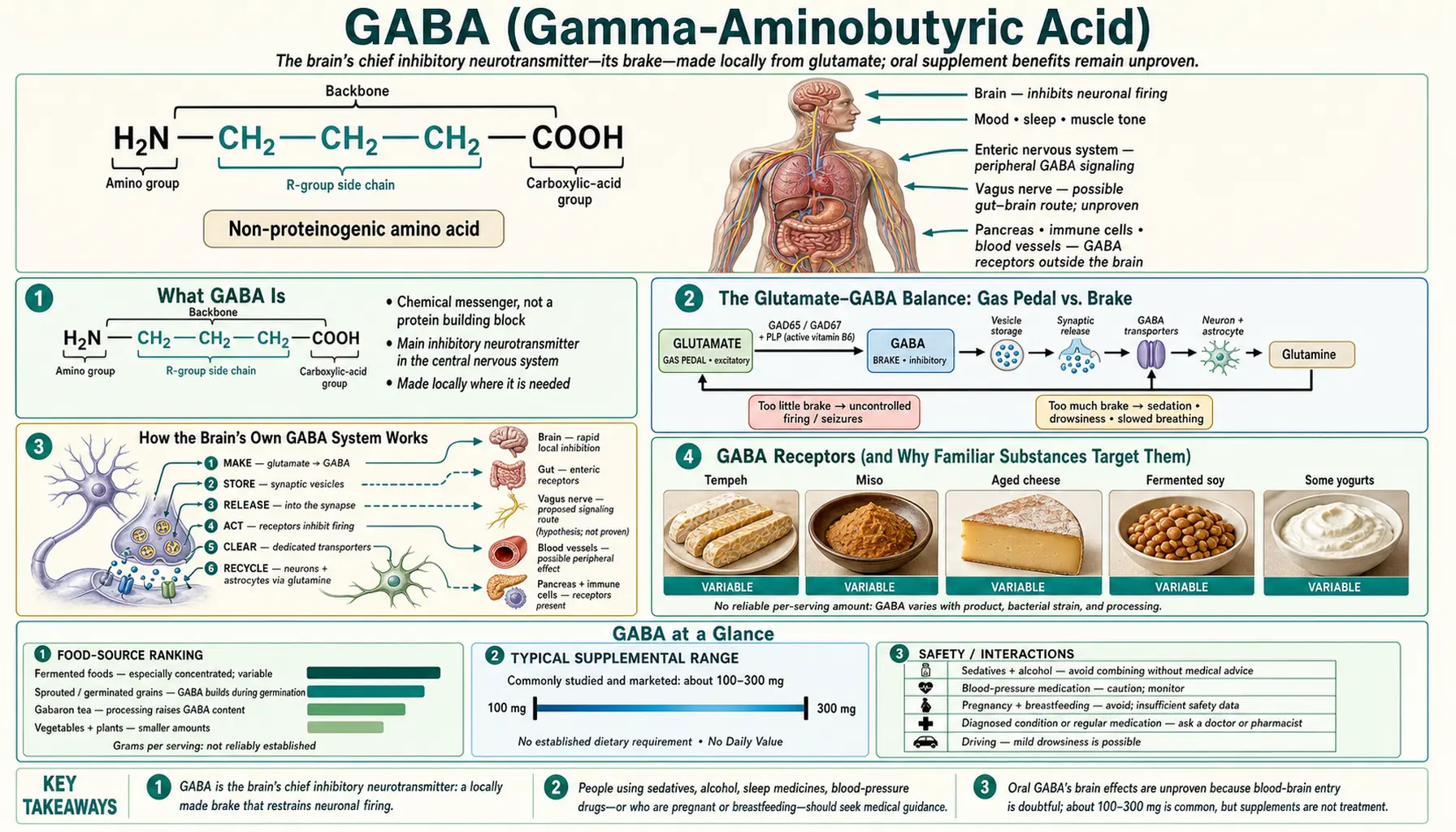
GABA — gamma-aminobutyric acid — is the main "calm-down" signal in your brain. It is an amino acid, but an unusual one: your body does not use it to build proteins the way it uses lysine or leucine. Instead, GABA has one overriding job as the brain's chief inhibitory neurotransmitter — it tells over-excited nerve cells to slow down and quiet themselves. If glutamate is the nervous system's accelerator, GABA is its brake, and the moment-to-moment balance between the two shapes everything from muscle tone to mood to whether you can fall asleep. GABA is also sold as a dietary supplement marketed for stress, relaxation, and sleep — and here the story gets genuinely complicated, because there is real scientific debate about whether the GABA you swallow can even reach your brain at all. This page explains what GABA is, how the brain's own GABA system works, and gives an honest account of what the supplement research does and does not show.
Interactive Visualization GABA, the Brain's Brake — press it with a benzo or alcohol Watch glutamate try to fire a neuron while GABA slams the chloride brake on — then add a benzodiazepine or alcohol and see the brake amplified, and why stacking them is dangerous. Launch →
Table of Contents
- What GABA Is
- The Glutamate–GABA Balance: Gas Pedal vs. Brake
- How the Brain's Own GABA System Works
- GABA Receptors (and Why Familiar Substances Target Them)
- The Central Question: Does Oral GABA Reach the Brain?
- How Might Swallowed GABA Still Have Effects?
- What the Human Studies Show
- Food Sources & Fermented Foods
- Safety & Dosing
- Research Papers
- Connections
- Featured Videos
What GABA Is
GABA is a small molecule — technically an amino acid, since it carries both an amino group and a carboxylic-acid group — but it belongs to a special category called non-proteinogenic amino acids. That simply means it is not one of the twenty building blocks your ribosomes string together to make proteins. Its role is completely different: it is a chemical messenger. First identified as a major constituent of the mammalian brain in 1950, GABA turned out to be the most widespread inhibitory neurotransmitter in the central nervous system, present at a large fraction of all the brain's synapses.
The word "inhibitory" is the key to everything that follows. Nerve cells (neurons) talk to one another by releasing neurotransmitters across tiny gaps called synapses. Some messengers excite the next cell, nudging it toward firing an electrical signal. Others inhibit it, making it less likely to fire. GABA is the workhorse of the inhibitory side. By damping down neuronal firing, it keeps the brain's electrical activity organized and controlled rather than runaway and chaotic.
Your body makes GABA itself, right where it is needed, from another amino acid you can read about on this site: glutamic acid (glutamate). A single enzyme, glutamate decarboxylase (GAD), snips a piece off glutamate to convert it into GABA. That reaction depends on an essential helper molecule — the active form of vitamin B6, called pyridoxal 5′-phosphate (PLP). This is why severe vitamin B6 deficiency can, in extreme cases, tip the brain toward seizures: without enough PLP, the enzyme that makes the brain's main brake chemical cannot keep up.
So GABA sits at an interesting crossroads. It is built from the brain's main excitatory messenger, it requires a vitamin to be produced, and it exists almost entirely to slow things down. Understanding that balance is the best way to make sense of both the biology and the supplement claims.
The Glutamate–GABA Balance: Gas Pedal vs. Brake
The single most useful mental picture for GABA is a car with an accelerator and a brake. Glutamate is the gas pedal — the brain's dominant excitatory neurotransmitter, pushing neurons to fire. GABA is the brake — the dominant inhibitory neurotransmitter, telling neurons to ease off. A healthy nervous system is not simply "calm" or "excited"; it is a continuous, finely tuned negotiation between these two forces, playing out millions of times per second across billions of connections.
This balance matters because too much of either side causes problems. If excitation runs unchecked — too much gas, too little brake — neurons can fire in uncontrolled, synchronized bursts. In the extreme, that is what a seizure is, and many anti-seizure medications work precisely by strengthening GABA's braking action or reducing glutamate's push. On the other hand, when GABA's inhibition is too strong — the brake jammed on — the result is sedation, drowsiness, slowed breathing, and, at the deepest levels used in medicine, general anesthesia.
Elegantly, glutamate and GABA are not just opposites; they are recycled into each other. Neurons release GABA, then take it back up, and supporting cells called astrocytes convert it (via the amino acid glutamine) back into glutamate, which neurons can turn into GABA again. Neuroscientists call this the glutamate/GABA–glutamine cycle, and it lets the brain keep its accelerator and brake chemicals in constant, efficient supply. It is a reminder that GABA is not an isolated "relaxation molecule" but one half of a tightly coupled system.
Because this balance underlies so much of how the brain functions, it is understandable that people hope a GABA supplement might nudge the whole system toward calm. Whether swallowing GABA can actually do that is the honest question at the heart of this page — and to answer it fairly, we first need to look at how the brain manages GABA on its own.
How the Brain's Own GABA System Works
The brain's internal GABA machinery is remarkably self-contained, and appreciating that self-sufficiency is important for judging supplement claims later on. Everything happens locally, inside the nervous system, using ingredients already on hand.
Making it. Specialized inhibitory neurons contain the enzyme glutamate decarboxylase (in two forms, usually called GAD65 and GAD67) and use it, together with the vitamin-B6-derived cofactor PLP, to manufacture GABA from glutamate on demand. Because the raw material (glutamate) is abundant everywhere in the brain, GABA can be produced right at the synapses where it is about to be used.
Storing and releasing it. Freshly made GABA is packaged into tiny bubbles (vesicles) inside the nerve terminal. When the neuron fires, these vesicles fuse with the cell membrane and dump GABA into the synapse, where it drifts across and binds to receptors on the neighboring cell.
Clearing and recycling it. Inhibition has to be brief and precise, so GABA is removed from the synapse almost immediately by dedicated transporter proteins that pump it back into neurons and astrocytes. From there it is recycled through the glutamine loop described above. Very little is wasted, and the whole cycle is contained behind the brain's protective barrier.
Two practical points fall out of this. First, the system depends on adequate vitamin B6: PLP is the cofactor that makes GABA synthesis possible, which is one reason B6 status matters for a calm, well-regulated nervous system. Second — and this is the crux — the brain does not rely on GABA arriving from the bloodstream. It grows its own, on-site, from materials it already has in plentiful supply. That self-sufficiency is exactly why it is not obvious that a GABA capsule taken by mouth would add anything to what the brain is already doing for itself.
GABA Receptors (and Why Familiar Substances Target Them)
When GABA reaches the next neuron, it acts through two families of receptors, and knowing the difference helps explain a lot of everyday pharmacology.
- GABA-A receptors are fast-acting. Each one is a channel that, when GABA binds, opens to let negatively charged chloride ions flow into the neuron. That extra negative charge makes the cell harder to excite — inhibition within milliseconds. GABA-A receptors handle the brain's rapid, moment-to-moment quieting.
- GABA-B receptors are slower and work indirectly, through internal signaling molecules, producing a more prolonged, modulating form of inhibition.
Here is the part worth understanding, offered strictly for orientation, not as any kind of endorsement or how-to: several very familiar — and in many cases tightly regulated or dangerous — substances produce their effects by acting on GABA-A receptors, essentially turning up the volume on the brain's own GABA signal. Benzodiazepines (prescription anti-anxiety and sedative drugs), barbiturates, the so-called "Z-drug" prescription sleep aids, general anesthetics, and alcohol all enhance GABA-A activity in one way or another. Their calming, sedating, anti-anxiety, and (in the case of alcohol) intoxicating effects are, in large part, the effects of amplified GABA inhibition.
This is mentioned to make one crucial point clear: those substances do not work by adding GABA molecules to your brain. They work by changing how the receptors respond to the GABA that is already there, produced by your own neurons. That is a fundamentally different mechanism from swallowing GABA itself. It also underscores why GABA-related effects are powerful and why anything genuinely acting on this system — medications especially — belongs under the care of a physician. None of this should be read as a suggestion to self-medicate, combine substances, or treat a GABA supplement as interchangeable with any of these drugs; it is background to help you understand where GABA fits.
The Central Question: Does Oral GABA Reach the Brain?
This is the honest heart of the matter, and it deserves to be foregrounded rather than buried beneath a list of benefits. GABA supplements are marketed as if swallowing GABA straightforwardly calms your brain. But there is a real, unresolved scientific problem standing in the way of that simple story: the blood-brain barrier.
The blood-brain barrier (BBB) is a highly selective wall of tightly joined cells lining the brain's blood vessels. Its entire purpose is to protect the delicate chemistry of the brain by controlling what is allowed to cross from the bloodstream into brain tissue. It lets some molecules through and firmly keeps others out. The long-standing, textbook understanding is that GABA crosses the blood-brain barrier poorly, if at all. GABA is a small but electrically charged, water-loving molecule at body pH, and molecules with that profile generally do not slip easily across the fatty membranes of the barrier.
The implication is significant. If oral GABA cannot get from your gut, into your blood, and across the barrier into brain tissue in meaningful amounts, then it is hard to see how a swallowed dose could directly boost inhibition in the brain the way the body's own locally made GABA does. This is precisely why a careful review of the evidence has framed the situation as genuinely contested: the observed relaxation effects some studies report do not obviously fit with what we know about GABA's inability to cross the barrier.
To be fair to all sides, the picture is not completely settled. Some researchers argue that the barrier may be modestly more permeable to GABA than the strict classical view holds, that certain brain regions have a leakier barrier, or that permeability could differ under stress or illness. But the mainstream position remains that oral GABA reaching the brain in functionally important quantities is doubtful and unproven. Any honest discussion of GABA supplements has to start here, not end here. It is the reason the sections below treat the reported benefits with real caution.
How Might Swallowed GABA Still Have Effects?
A fair question follows naturally: if GABA barely crosses into the brain, why do some studies nonetheless report relaxation, changes in brain-wave patterns, or better sleep after people take it? Researchers have proposed several hypotheses, and it is worth walking through them honestly — none is proven, and they are not mutually exclusive.
1. The gut's own nervous system (the "second brain"). Your digestive tract is wrapped in a dense mesh of neurons called the enteric nervous system, which uses GABA as one of its own signaling molecules and carries GABA receptors. Oral GABA might act on this peripheral system in the gut without ever needing to enter the brain, producing sensations of calm indirectly.
2. The vagus nerve and the gut–brain axis. The vagus nerve is a major communication highway running between the gut and the brain. A leading idea is that GABA acting on receptors in the gut could send signals up the vagus nerve to influence brain activity — a way to affect the brain without the GABA molecule itself having to cross the blood-brain barrier. This gut-to-brain signaling route is an active area of neuroscience research.
3. Peripheral effects outside the brain entirely. GABA and its receptors are not confined to the nervous system; they are found in organs throughout the body, including the pancreas, immune cells, and blood vessels. Some of GABA's measurable effects — for example on blood pressure — may be peripheral actions that have nothing to do with entering the brain.
4. Expectation and the placebo effect. Relaxation is highly susceptible to expectation. When someone takes a pill they believe is calming, in a quiet setting, genuine relaxation can follow for reasons that have nothing to do with the molecule. In small studies without rigorous blinding, this is a real and important alternative explanation.
The honest bottom line is that the mechanism is unresolved. It is entirely possible that oral GABA does something real through the gut, the vagus nerve, or peripheral tissues — and it is also possible that much of the reported effect is expectation. Good science does not yet let us say for certain. That uncertainty is not a reason to dismiss GABA supplements out of hand, but it is a strong reason not to oversell them.
What the Human Studies Show
With the blood-brain-barrier caveat kept firmly in view, here is what the actual human research reports. The overall body of evidence is small, preliminary, and mixed: modest studies, often with few participants, frequently funded by companies that sell GABA-containing products, and not always well blinded. None of that makes the findings worthless, but it does mean they should be read as early signals rather than established facts.
Relaxation and brain-wave (EEG) studies
The most cited early study gave volunteers GABA and recorded their brain-wave activity with EEG, reporting an increase in alpha waves (associated with a relaxed, wakeful state) and a decrease in beta waves (associated with alertness and anxiety) within about an hour, along with lower self-reported anxiety during a stressful task. Findings like these are the basis for GABA's "relaxation" marketing. The important caveats: the studies are small, some are industry-affiliated, and — crucially — an EEG change does not prove GABA entered the brain, since gut- or vagus-mediated effects could in principle alter brain-wave patterns indirectly.
Sleep-onset and insomnia studies
Several small trials have looked at sleep. One reported that oral GABA modestly shortened the time it took healthy people to fall asleep. A randomized, double-blind trial using GABA derived from fermented rice germ in people with insomnia symptoms reported improvements in sleep-onset time with a reasonable safety profile. These are encouraging but limited results — small samples, short durations, and the same unresolved question of how an oral dose would act on sleep circuitry given the barrier.
Stress and sleep, reviewed together
A systematic review that pooled the available human studies on oral GABA for stress and sleep concluded that there is limited evidence of a benefit — enough to be interesting, not enough to be conclusive — and explicitly called for larger, more rigorous trials. That measured verdict is probably the fairest one-line summary of the whole field: promising hints, weak proof.
Blood pressure
Some of the more consistent findings are actually outside the brain. Trials of fermented-milk products enriched with GABA reported small reductions in blood pressure in people with mildly elevated readings. This fits neatly with the idea of a peripheral GABA effect — on blood vessels or the nervous control of blood pressure — that does not require GABA to enter the brain at all, and it is a good illustration of why "GABA does something" and "GABA calms your brain" are not the same claim.
Taken together, the research supports a cautious, honest reading: a swallowed GABA dose may produce mild relaxation, small sleep-onset benefits, or modest blood-pressure effects in some people, quite possibly through the gut and periphery rather than the brain — but the effects are unproven, the studies are small, and expectation cannot be ruled out. GABA is not a treatment for anxiety disorders, clinical insomnia, high blood pressure, or seizure conditions, all of which need proper medical care.
Food Sources & Fermented Foods
You do not have to buy GABA in a bottle to encounter it in your diet — it occurs naturally in a range of plant foods and is especially concentrated in fermented foods, because many of the bacteria used in fermentation produce GABA as part of their own metabolism (using the same glutamate-to-GABA reaction your neurons use).
- Fermented foods — traditionally fermented items such as kimchi, miso, tempeh, certain aged cheeses, fermented soybean products, and some yogurts can accumulate meaningful amounts of GABA thanks to their lactic-acid bacteria.
- Sprouted and germinated grains — germinated brown rice (sometimes sold as "GABA rice") and other sprouted grains build up GABA during germination, and this has been deliberately exploited to create GABA-enriched foods.
- Tea — a specially processed "Gabaron" tea is manufactured under low-oxygen conditions that raise its GABA content; ordinary green tea also contains the calming amino acid L-theanine, which is a separate but related reason tea is associated with relaxation.
- Vegetables and other plants — tomatoes, potatoes, cruciferous vegetables, beans, and various sprouts contribute smaller amounts.
Two honest qualifiers apply. First, the GABA content of foods varies enormously with the specific product, the bacterial strains, and how it was processed, so there is no reliable "dose" you can count on from diet. Second, whatever benefits fermented foods offer — and they may offer several, including fiber and a diverse mix of live cultures — you should not assume those benefits come specifically from their GABA, given the same blood-brain-barrier uncertainty discussed above. Fermented foods are a sensible, whole-food part of many diets on their own merits; treat any GABA they contain as a bonus of unknown value rather than the reason to eat them.
Safety & Dosing
For healthy adults, oral GABA appears to be generally well tolerated at the modest doses sold as supplements. The amounts studied and marketed are commonly in the range of about 100–300 mg, sometimes taken before bed or during stress; some products and studies have used higher amounts. There is no established dietary requirement for GABA and no Daily Value, because your body makes its own — so there is nothing you are obligated to consume.
Reported side effects are usually mild and short-lived. The ones most often mentioned include:
- A tingling sensation (paresthesia) — some people notice a brief tingling in the face, scalp, or limbs, particularly at higher doses.
- Flushing — a transient warmth or reddening of the skin.
- Mild drowsiness — understandable given GABA's associations, and a reason not to take it before driving until you know how you respond.
- A brief shortness of breath or throat tightness has been reported at higher doses in some accounts; it typically passes quickly, but it is a reason to keep doses modest.
- Occasional stomach upset.
Some sensible cautions:
- Sedatives and alcohol. Because so many sedating substances act on the GABA system, it is prudent not to combine a GABA supplement with alcohol, prescription sedatives, sleep medications, or other calming drugs without medical advice — effects could, in principle, add up.
- Blood-pressure medication. Given the reports of mild blood-pressure lowering, anyone on antihypertensive drugs should be aware of the possibility and monitor accordingly.
- Pregnancy and breastfeeding. There is not enough safety data, so avoidance is the cautious default.
- Existing conditions. GABA supplements are not a substitute for treatment of anxiety disorders, clinical insomnia, high blood pressure, or seizure disorders. If you have a diagnosed condition or take regular medication, talk with a doctor or pharmacist before starting.
The fair summary is this: GABA is one of the most important molecules in your nervous system, but a GABA supplement is a much more modest proposition than the marketing implies. Its safety at typical doses looks reasonable; its central benefits are unproven and hampered by the blood-brain-barrier problem; and any real effects it does have may work through the gut and body rather than the brain. It is a low-risk experiment for a healthy adult curious about mild relaxation — not a treatment, and not a shortcut around the brain's own, remarkably self-sufficient, GABA system.
Research Papers
- Petroff OA. GABA and glutamate in the human brain. The Neuroscientist. 2002;8(6):562–573. doi:10.1177/1073858402238515 — A clear overview of how the brain's main inhibitory (GABA) and excitatory (glutamate) messengers are balanced, and how that balance is measured in living human brains.
- Owens DF, Kriegstein AR. Is there more to GABA than synaptic inhibition? Nature Reviews Neuroscience. 2002;3(9):715–727. doi:10.1038/nrn919 — A foundational review of GABA biology, including roles beyond simple moment-to-moment inhibition.
- Bak LK, Schousboe A, Waagepetersen HS. The glutamate/GABA–glutamine cycle: aspects of transport, neurotransmitter homeostasis and ammonia transfer. Journal of Neurochemistry. 2006;98(3):641–653. doi:10.1111/j.1471-4159.2006.03913.x — Explains the recycling loop that keeps the brain's accelerator (glutamate) and brake (GABA) chemicals in continuous supply.
- Watanabe M, Maemura K, Kanbara K, Tamayama T, Hayasaki H. GABA and GABA receptors in the central nervous system and other organs. International Review of Cytology. 2002;213:1–47. doi:10.1016/S0074-7696(02)13011-7 — Documents GABA and its receptors outside the brain (gut, pancreas, and more), the basis for possible peripheral effects of oral GABA.
- Boonstra E, de Kleijn R, Colzato LS, Alkemade A, Forstmann BU, Nieuwenhuis S. Neurotransmitters as food supplements: the effects of GABA on brain and behavior. Frontiers in Psychology. 2015;6:1520. doi:10.3389/fpsyg.2015.01520 — The key honest review; lays out the blood-brain-barrier problem and why oral GABA's central effects are genuinely uncertain.
- Abdou AM, Higashiguchi S, Horie K, Kim M, Hatta H, Yokogoshi H. Relaxation and immunity enhancement effects of gamma-aminobutyric acid (GABA) administration in humans. BioFactors. 2006;26(3):201–208. doi:10.1002/biof.5520260305 — The small, much-cited EEG study reporting increased alpha and decreased beta brain-wave activity after oral GABA.
- Yamatsu A, Yamashita Y, Pandharipande T, Maru I, Kim M. Effect of oral gamma-aminobutyric acid (GABA) administration on sleep and its absorption in humans. Food Science and Biotechnology. 2016;25(2):547–551. doi:10.1007/s10068-016-0076-9 — Reports a modest shortening of the time to fall asleep after oral GABA in a small sample.
- Byun JI, Shin YY, Chung SE, Shin WC. Safety and efficacy of gamma-aminobutyric acid from fermented rice germ in patients with insomnia symptoms: a randomized, double-blind trial. Journal of Clinical Neurology. 2018;14(3):291–295. doi:10.3988/jcn.2018.14.3.291 — A randomized, placebo-controlled trial reporting improved sleep-onset measures with a food-derived GABA preparation.
- Hepsomali P, Groeger JA, Nishihira J, Scholey A. Effects of oral gamma-aminobutyric acid (GABA) administration on stress and sleep in humans: a systematic review. Frontiers in Neuroscience. 2020;14:923. doi:10.3389/fnins.2020.00923 — Pools the human evidence and concludes benefits for stress and sleep are limited and in need of larger, more rigorous trials.
- Inoue K, Shirai T, Ochiai H, et al. Blood-pressure-lowering effect of a novel fermented milk containing gamma-aminobutyric acid (GABA) in mild hypertensives. European Journal of Clinical Nutrition. 2003;57(3):490–495. doi:10.1038/sj.ejcn.1601555 — Reports small blood-pressure reductions with a GABA-enriched fermented milk — a likely peripheral effect not requiring brain entry.
- Diana M, Quílez J, Rafecas M. Gamma-aminobutyric acid as a bioactive compound in foods: a review. Journal of Functional Foods. 2014;10:407–420. doi:10.1016/j.jff.2014.07.004 — Surveys the natural GABA content of foods and how fermentation and germination raise it.
- Sahab NRM, Subroto E, Balia RL, Utama GL. Gamma-aminobutyric acid found in fermented foods and beverages: current trends. Heliyon. 2020;6(11):e05526. doi:10.1016/j.heliyon.2020.e05526 — Reviews how lactic-acid-bacteria fermentation generates GABA in foods and beverages.
Connections
- All Amino Acids
- GABA: The Brain’s Brake — interactive animation
- Glutamic Acid — the excitatory counterpart and the direct precursor from which GABA is made.
- L-Theanine — the calming amino acid in tea, often discussed alongside GABA for relaxation.
- Glycine — the other major inhibitory neurotransmitter, dominant in the spinal cord and brainstem.
- Glutamine — the shuttle molecule in the glutamate/GABA–glutamine recycling cycle.
- Vitamin B6 — its active form (PLP) is the essential cofactor for the enzyme that makes GABA.
- Taurine — another non-proteinogenic amino acid with inhibitory, GABA-like activity in the nervous system.