Diagnosing C. diff: NAAT, Toxin Tests, and the Two-Step Testing Strategy
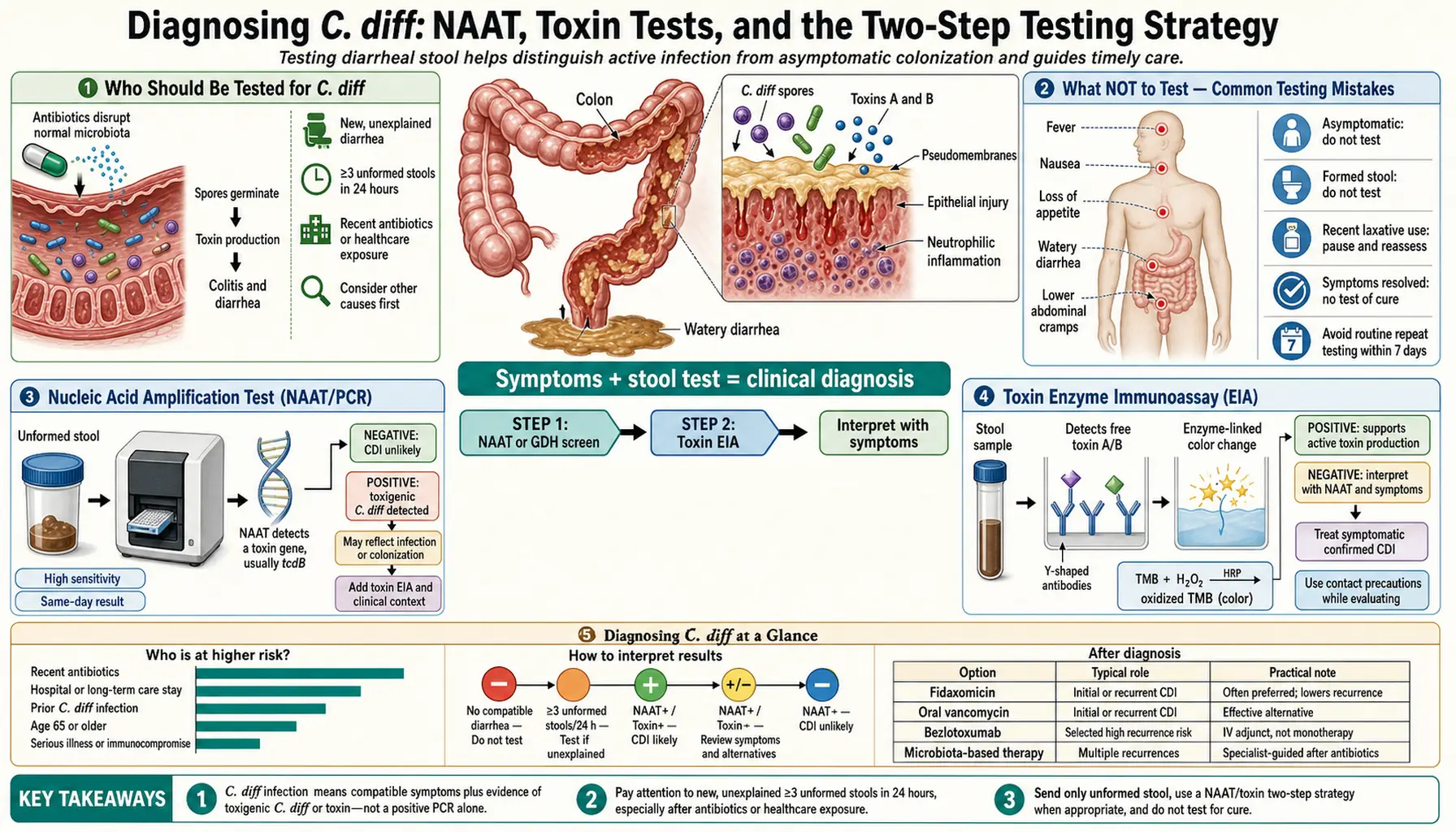
Getting a C. diff diagnosis right matters enormously — an incorrect positive leads to unnecessary treatment with antibiotics that can actually worsen your gut microbiome, while a missed diagnosis allows a dangerous infection to progress. The challenge is that Clostridioides difficile (formerly Clostridium difficile) behaves differently in different people: some carry the bacteria harmlessly in their gut while others develop severe, life-threatening colitis. This guide explains every stool test used to detect C. diff, why a single test result is rarely enough, and how modern two-step and three-step testing algorithms arrive at an accurate answer.
Table of Contents
- Who Should Be Tested for C. diff
- What NOT to Test — Common Testing Mistakes
- Nucleic Acid Amplification Test (NAAT/PCR)
- Toxin Enzyme Immunoassay (EIA)
- Glutamate Dehydrogenase (GDH) Antigen Test
- Two-Step and Three-Step Testing Algorithms
- Ct Value Interpretation in PCR Testing
- Colonoscopy and Pseudomembrane Detection
- Key Research Papers
- Connections
- Featured Videos
Who Should Be Tested for C. diff
Testing is appropriate only when a patient has symptoms that actually suggest CDI. Sending off stool samples indiscriminately wastes resources and leads to false positives that harm patients through unnecessary antibiotic exposure. The 2021 IDSA/SHEA clinical practice guidelines establish these specific criteria for when testing is indicated.
Hospitalized Patients
Test for CDI when a patient develops three or more unformed stools in a 24-hour period after being hospitalized for 48 hours or more. The 48-hour threshold distinguishes hospital-acquired C. diff from diarrhea the patient brought in from the community. Diarrhea appearing within the first two days is far more likely to have a different cause — viral gastroenteritis, dietary change, or other medications — and should generally not prompt CDI testing unless the clinical picture is compelling.
Community-Acquired CDI
Community-onset CDI has been rising steadily for two decades. Test outpatients or recently discharged patients when they present with unexplained diarrhea (three or more loose stools daily) plus a history of antibiotic use within the past 8 to 12 weeks. Fluoroquinolones, clindamycin, and broad-spectrum cephalosporins carry the highest risk. Recent hospitalization, nursing home residence, or proton pump inhibitor use are additional risk factors that strengthen the case for testing.
Immunocompromised Patients
Patients on chemotherapy, long-term corticosteroids, or biologic therapies, as well as solid organ transplant recipients and HIV patients with low CD4 counts, may develop CDI with atypical or muted symptoms. For these individuals, any unexplained diarrhea — even fewer than three stools per day — warrants testing. Their impaired immune response means CDI can progress rapidly to severe disease without the typical warning signs.
Pediatric Considerations
Testing in children under 2 years old is generally discouraged except in unusual circumstances. Asymptomatic colonization with toxigenic C. diff is extremely common in infants (up to 70% in neonates) without causing disease, so a positive test is almost always a false positive in this age group. Testing may be appropriate for children aged 2 and older who meet adult diarrhea criteria, or at any age in immunocompromised children.
What NOT to Test — Common Testing Mistakes
Knowing when not to test is just as important as knowing when to test. Several common testing scenarios reliably produce misleading results.
Formed or Solid Stool
C. diff testing on formed stool should never be done. Most laboratories will reject solid stool samples, but when they don't — or when the stool consistency assessment is wrong — the results are almost meaningless. Many healthy people carry C. diff spores in their gut without any disease. A positive PCR in someone with formed stool almost certainly represents asymptomatic colonization, not infection requiring treatment. The test should only be run on unformed, liquid, or watery stool that takes the shape of its container.
Test of Cure After Successful Treatment
Do not re-test a patient who has clinically recovered from CDI. This is one of the most common mistakes made in practice. PCR and GDH tests can remain positive for weeks to months after the infection has been successfully treated and symptoms have fully resolved, because they detect bacterial DNA and proteins rather than live, toxin-producing bacteria. A positive "test of cure" in a recovering patient does not mean treatment failed — it almost always means the test is detecting dead bacteria or residual genetic material. Re-testing after clinical resolution leads to unnecessary additional antibiotic courses that further damage the microbiome and increase recurrence risk.
Repeat Testing in the Same Episode
Repeat testing within seven days of a previous test during the same symptomatic episode rarely adds clinically useful information. If the first test is negative and symptoms persist, the more productive step is to reconsider the diagnosis rather than simply re-running the same tests. Repeat testing in the same episode primarily creates more opportunities for false positives without improving diagnostic accuracy.
Asymptomatic Healthcare Workers and Patients
Screening asymptomatic healthcare workers or patients for C. diff carriage is not recommended outside of formal outbreak investigations. Colonization rates in hospitalized adults run between 5% and 15%, and finding a carrier does not predict who will develop CDI. Treating asymptomatic carriers with antibiotics is ineffective and may paradoxically increase transmission by disrupting their colonization resistance.
Nucleic Acid Amplification Test (NAAT/PCR)
The nucleic acid amplification test — most commonly a PCR (polymerase chain reaction) — is the most sensitive single test available for C. diff. It works by detecting specific gene sequences in the stool sample, most often the tcdB gene that encodes toxin B, though some platforms also target tcdA (toxin A gene) or the binary toxin gene cdtA/cdtB.
Sensitivity and Speed
NAAT sensitivity exceeds 95% in most head-to-head comparisons, meaning fewer than 5 in 100 true CDI cases will be missed. Results are typically available within 1 to 4 hours depending on the platform, making it one of the fastest high-sensitivity diagnostic options. Platforms like the GeneXpert (Cepheid), Verigene (Luminex), and BD MAX are used widely in hospital laboratories.
The Colonization Problem
NAAT's major limitation is that it cannot distinguish between active CDI (bacteria producing toxin, causing disease) and asymptomatic colonization (bacteria present but not causing symptoms). Between 5% and 15% of hospitalized adults carry toxigenic C. diff without any diarrhea. When these colonized patients happen to have diarrhea from another cause — laxatives, tube feeding, other infections — a positive PCR will incorrectly label them as having CDI. This is why NAAT alone, without clinical context or a second test, has been criticized as a driver of CDI overdiagnosis.
Negative Predictive Value
Where NAAT truly shines is in ruling out CDI. A negative NAAT result in a patient with diarrhea makes CDI extremely unlikely (negative predictive value >99%). When NAAT is negative, clinicians can confidently look for other causes of diarrhea without further CDI workup, which is clinically very valuable in a busy hospital setting.
Toxin Enzyme Immunoassay (EIA)
The toxin enzyme immunoassay directly detects the actual C. diff toxin proteins — toxin A, toxin B, or both — present in the stool. Unlike PCR, it is measuring the disease-causing agent itself, which makes a positive result far more clinically meaningful.
High Specificity, Limited Sensitivity
Toxin EIA has specificity typically above 95% — a positive result almost always indicates true CDI, not colonization. The problem is sensitivity: most toxin EIA tests are only 50% to 75% sensitive. This means that 25% to 50% of patients with genuine CDI will test negative on toxin EIA alone. The low sensitivity is because toxin is labile (it degrades rapidly at room temperature), and because some patients with CDI produce amounts of toxin below the assay's detection threshold.
Clinical Significance of a Positive Toxin EIA
When a patient with diarrhea has a positive toxin EIA, this is highly specific for active CDI requiring treatment. This patient almost certainly has true infection, not colonization. The positive predictive value of toxin EIA in a symptomatic patient is very high, making it a reliable signal to act on.
What a Negative Toxin EIA Means
A negative toxin EIA does not reliably rule out CDI given its limited sensitivity. In the context of a two-step or three-step algorithm, a negative toxin EIA after a positive GDH screen creates a discordant result that typically prompts NAAT testing to resolve the ambiguity. In a standalone testing scenario, a negative toxin EIA in a high-clinical-suspicion patient should not end the diagnostic workup.
Glutamate Dehydrogenase (GDH) Antigen Test
The glutamate dehydrogenase test detects a metabolic enzyme — GDH — produced in high quantities by all strains of C. diff, both toxigenic and non-toxigenic. It is a rapid immunochromatographic lateral flow test, similar in format to a home pregnancy test, that returns results in 15 to 30 minutes.
Role as a First-Step Screening Test
GDH has a sensitivity above 96% for detecting the presence of C. diff organisms in stool. This high sensitivity makes it an excellent first-step screening test: a negative GDH reliably excludes CDI without the need for more expensive or time-consuming follow-up tests. Most patients with a negative GDH can be confidently ruled out for CDI, saving significant laboratory resources.
The Non-Toxigenic Limitation
The critical limitation of GDH is that it cannot differentiate between toxigenic C. diff (capable of causing CDI) and non-toxigenic strains (colonizers that do not cause disease). A positive GDH test means only that C. diff is present in the stool — it says nothing about whether that strain produces the toxins responsible for diarrhea and colitis. This is why a positive GDH always requires confirmatory testing, most commonly with a toxin EIA or NAAT.
Cost and Convenience
GDH tests are inexpensive (roughly $10–20 per test compared to $50–100+ for PCR), can be run at the point of care without specialized equipment, and provide rapid results. These attributes make GDH an ideal gateway test in high-throughput clinical settings. Many hospitals have incorporated GDH into their first-step testing protocols specifically because its high sensitivity and low cost allow rapid, low-cost triage of the many patients tested for CDI each day.
Two-Step and Three-Step Testing Algorithms
Because no single C. diff test is both highly sensitive and highly specific, most clinical microbiology laboratories and major guidelines now recommend algorithmic testing strategies that combine two or three tests to arrive at the most accurate possible diagnosis. These approaches reduce both overdiagnosis (treating colonized patients who don't need it) and underdiagnosis (missing true CDI).
The Two-Step Algorithm: GDH → Toxin EIA
The most common two-step approach uses GDH as the first-step screen followed by toxin EIA for confirmation:
- GDH negative: C. diff ruled out. No further testing needed. Investigate other causes of diarrhea.
- GDH positive + Toxin EIA positive: CDI confirmed. Treat the patient.
- GDH positive + Toxin EIA negative (discordant): Uncertain. The patient has C. diff in their stool but toxin is not detected — could be early infection, colonization, or a sensitivity limitation of the EIA. This discordant result typically prompts NAAT to resolve the question.
The Three-Step Algorithm: GDH → Toxin EIA → NAAT
The three-step algorithm adds NAAT as an arbitration step for the discordant GDH+/toxin- cases:
- GDH positive + Toxin EIA negative + NAAT positive: Toxigenic C. diff is present. Clinical judgment is required — this pattern may represent early or low-level CDI, or asymptomatic colonization in a patient whose diarrhea has another cause. The clinical picture (severity, onset timing, antibiotic history) guides the treatment decision.
- GDH positive + Toxin EIA negative + NAAT negative: Non-toxigenic C. diff colonization or GDH false positive. CDI ruled out. Investigate other causes.
NAAT-Only vs. Algorithmic Testing
Some institutions use NAAT as a standalone test without a preceding GDH screen. This approach maximizes sensitivity but has been associated with CDI overdiagnosis rates 30–60% higher than algorithmic testing, because NAAT cannot distinguish colonization from disease. The landmark Planche et al. study (Lancet Infect Dis 2013) demonstrated that patients who were PCR-positive but toxin-negative had clinical outcomes closer to CDI-negative patients than to true CDI cases, providing strong evidence that toxin detection is a better correlate of true disease burden.
IDSA/SHEA 2021 Guideline Recommendations
The 2021 IDSA/SHEA update recommends that institutions choose either NAAT alone or a multi-step algorithm using GDH plus toxin EIA with or without NAAT for discordant results. The key message is that NAAT should never be used in patients who do not meet clinical criteria for testing, and that clinical context must inform interpretation of any positive result.
Ct Value Interpretation in PCR Testing
The cycle threshold (Ct) value is a number generated during every PCR run. It represents the number of amplification cycles required before the target DNA signal becomes detectable. This single number contains information about the amount of C. diff DNA in the original stool sample — and potentially about whether a positive result reflects true CDI or asymptomatic colonization.
What Ct Values Mean
PCR amplification works by doubling the amount of target DNA with each cycle. A low Ct value (typically below 25) means the target was detected very early — there was a lot of bacterial DNA to start with, suggesting a high organism burden. A high Ct value (above 30 to 35) means many amplification cycles were needed, indicating very small amounts of DNA were present.
The Colonization vs. Disease Question
Emerging research suggests that high Ct values may identify patients who are colonized rather than actively infected. In theory, patients with true CDI — whose colon is colonized with actively multiplying, toxin-producing bacteria — should have higher organism burdens and therefore lower Ct values than asymptomatic carriers shedding small numbers of spores. Several studies have reported that patients with Ct values above 30 are more likely to have clinical outcomes consistent with colonization than with CDI, particularly when stool is formed or semi-formed.
Current Limitations and Future Role
Ct value interpretation for C. diff is not yet part of standard clinical practice. Ct values are not fully standardized across PCR platforms (a Ct of 30 on one machine may not equal a Ct of 30 on another), laboratory reporting of Ct values to clinicians is inconsistent, and prospective validation studies establishing clinically actionable cutoffs are still ongoing. However, some academic medical centers are beginning to report Ct values alongside positive PCR results as advisory information. As evidence accumulates, Ct-guided CDI interpretation may become an important tool for reducing overtreatment of colonized patients.
Colonoscopy and Pseudomembrane Detection
Stool-based laboratory tests are almost always sufficient to diagnose CDI. Colonoscopy is not needed — and generally not appropriate — as a routine diagnostic tool for C. diff. However, it plays an important role in specific clinical scenarios.
The Pathognomonic Finding: Pseudomembranes
When colonoscopy is performed in a patient with CDI, the endoscopist may see pseudomembranes — raised, yellow-white or cream-colored plaques scattered across an inflamed, friable colonic mucosa. These plaques are composed of fibrin, mucus, inflammatory cells, and necrotic epithelium, and they form because C. diff toxins disrupt tight junctions between colonocytes and trigger an intense neutrophilic inflammatory response. The presence of pseudomembranes is pathognomonic for CDI — it is essentially diagnostic on its own, without any laboratory confirmation required. This pattern is called pseudomembranous colitis.
When Colonoscopy Is Appropriate
Colonoscopy should be considered when:
- Diagnosis is uncertain despite negative stool tests in a patient with severe diarrhea, abdominal pain, and leukocytosis who is deteriorating clinically — especially if ileus is present and the colon may not be actively producing liquid stool for testing.
- Ileus is present: In severe CDI with ileus, the patient may not be producing diarrhea even though the colon is severely inflamed — stool tests will be negative simply because there is no stool flowing. Colonoscopy or flexible sigmoidoscopy can visualize pseudomembranes directly.
- An alternative diagnosis needs to be excluded: When inflammatory bowel disease (ulcerative colitis or Crohn's) is suspected as an alternative or complicating diagnosis, endoscopy with biopsy provides information stool tests cannot.
Procedural Cautions
Colonoscopy in CDI carries increased risk compared to routine procedures. The inflamed colon is fragile, with higher perforation risk. Insufflation should be minimal, and full bowel preparation with large-volume polyethylene glycol lavage may worsen electrolyte disturbances in severely ill patients. Flexible sigmoidoscopy — examining only the distal colon — is often sufficient to detect pseudomembranes and carries lower risk than full colonoscopy. In practice, when colonoscopy reveals pseudomembranes in the appropriate clinical context, treatment should be started immediately without waiting for stool test confirmation.
Key Research Papers
- Planche TD, Davies KA, Coen PG, et al. Differences in outcome according to Clostridium difficile testing method: a prospective multicentre diagnostic validation study of C. difficile infection. Lancet Infect Dis. 2013;13(11):936–945 — Search PubMed. This landmark multicenter study established that patients who were PCR-positive but toxin-EIA-negative had outcomes similar to CDI-negative patients, providing the clinical evidence base for two-step testing.
- Burnham CA, Carroll KC. Diagnosis of Clostridium difficile infection: an ongoing conundrum for clinicians and for clinical laboratories. Clin Microbiol Rev. 2013;26(3):604–630 — Search PubMed. Comprehensive review of the diagnostic landscape, test performance characteristics, and evolving laboratory algorithms.
- Tenover FC, Novak-Weekley S, Woods CW, et al. Impact of changes to testing policies for Clostridium difficile infection. J Clin Microbiol. 2010;48(9):3219–3226 — Search PubMed. Demonstrated how switching from toxin EIA to PCR-based testing significantly changed CDI incidence rates at participating institutions.
- Dubberke ER, Burnham CA. Diagnosis of Clostridium difficile infection — and some solutions. Infect Control Hosp Epidemiol. 2022;43(5):529–569 — Search PubMed. Updated SHEA compendium chapter on CDI prevention strategies including testing policies and their epidemiological consequences.
- Johnson S, Lavergne V, Skinner AM, et al. Clinical Practice Guideline by the Infectious Diseases Society of America (IDSA) and Society for Healthcare Epidemiology of America (SHEA): 2021 Focused Update Guidelines on Management of Clostridioides difficile Infection in Adults. Clin Infect Dis. 2021;73(5):e1029–e1044 — Search PubMed. The current definitive clinical practice guidelines including updated diagnostic recommendations.
- Crobach MJ, Vernon JJ, Loo VG, et al. European Society of Clinical Microbiology and Infectious Diseases: update of the diagnostic guidance document for Clostridium difficile infection. Clin Microbiol Infect. 2016;22 Suppl 4:S63–81. PMID: 27460910. European consensus guidance supporting two- and three-step diagnostic algorithms across EU healthcare systems.
- Peterson LR, Robicsek A. Does my patient have Clostridium difficile infection? Ann Intern Med. 2009;151(3):176–179 — Search PubMed. Clinician-facing summary of when to test and how to interpret results, emphasizing clinical pre-test probability.
- Ota KV, McGowan KL. Clostridium difficile testing algorithms using glutamate dehydrogenase antigen and C. difficile toxin enzyme immunoassays with the real-time polymerase chain reaction for the diagnosis of toxigenic C. difficile. J Med Microbiol. 2009;58(9):1178–1185 — Search PubMed. Early validation of multiplex PCR platforms for simultaneous detection of toxin genes and binary toxin.
- Goldenberg SD, Cliff PR, Smith S, Milner M, French GL. Two-step glutamate dehydrogenase antigen real-time polymerase chain reaction assay for detection of toxigenic Clostridium difficile. J Hosp Infect. 2010;74(1):48–54. Related citation: Goldenberg SD et al. Comparison of methods for detecting Clostridium difficile toxins. J Med Microbiol. 2010;59:1218–1224 — Search PubMed. Prospective evaluation of GDH-first algorithmic testing as an efficient and accurate diagnostic pathway.
- Surawicz CM, Brandt LJ, Binion DG, et al. Guidelines for diagnosis, treatment, and prevention of Clostridium difficile infections. Am J Gastroenterol. 2013;108(4):478–498. PMID: 23439232. ACG guidelines providing gastroenterology perspective on diagnosis including endoscopic findings and colonoscopy indications.
Connections
- All Bacteria
- C. diff (Clostridioides difficile) — Main Page
- C. diff Symptoms Hub
- C. diff: Diarrhea and Colitis
- Severe CDI and Complications
- C. diff Treatment & Prevention Hub
- Antibiotic Treatment: Vancomycin and Fidaxomicin
- Fecal Microbiota Transplant (FMT)
- Infection Control and Prevention
- Gastroenterology — All Conditions
- Lab Tests