Melanoma
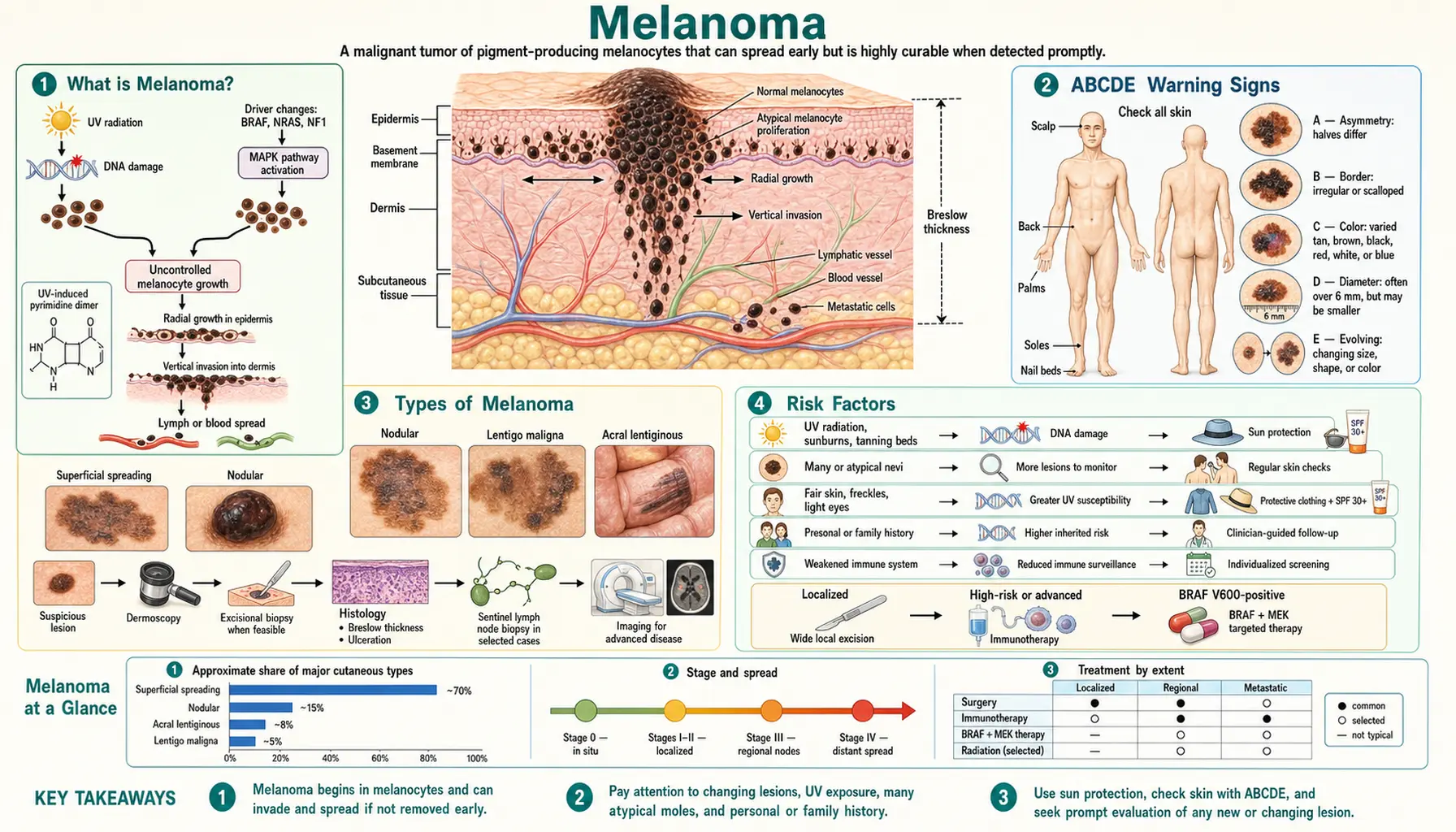
Table of Contents
- What is Melanoma?
- ABCDE Warning Signs
- Types of Melanoma
- Risk Factors
- Staging and Breslow Thickness
- Treatment by Stage
- The Immunotherapy Revolution
- Sun Protection and Prevention
- Subungual Melanoma
- Prognosis and Survival
- Research Papers
- Connections
- Featured Videos
What is Melanoma?
Melanoma is the most dangerous form of skin cancer, arising from melanocytes — the pigment-producing cells in the skin. While it accounts for only about 1% of all skin cancers, melanoma causes the vast majority of skin cancer deaths because of its strong tendency to spread (metastasize) to other organs.
Melanoma develops when UV radiation or other carcinogens cause DNA damage in melanocytes, triggering uncontrolled cell growth. The BRAF V600E mutation is present in approximately 50% of melanomas and has become one of the most important therapeutic targets in oncology. Each year, more than 200,000 new cases are diagnosed in the United States, and about 8,000 Americans die from the disease annually.
The key to surviving melanoma is early detection. Caught at Stage IA, the 5-year survival rate is 98%. At Stage IV, it drops to around 20–25% — though newer immunotherapy treatments are dramatically improving those odds. Learning to recognize melanoma early is one of the most valuable things you can do for your skin health.
ABCDE Warning Signs
Dermatologists use the ABCDE rule to help patients identify suspicious moles or spots. If you notice any of these features, see a dermatologist promptly — do not wait to see if it "goes away."
- A — Asymmetry: One half of the mole does not match the other half. Normal benign moles are round and symmetrical.
- B — Border: Edges are irregular, ragged, notched, or blurred. Melanoma borders are rarely smooth and clean.
- C — Color: Color is not uniform. Shades of brown, black, tan, red, white, or blue within the same lesion are warning signs.
- D — Diameter: The spot is larger than 6 mm (about the size of a pencil eraser), though melanomas can be smaller when first detected.
- E — Evolution: The most important criterion. Any mole that is changing in size, shape, color, or that starts to bleed, itch, or crust deserves immediate evaluation. Evolving lesions are the #1 indicator of potential melanoma.
An easy way to remember: when in doubt, get it checked out. Annual skin checks by a board-certified dermatologist are the best way to catch melanoma early.
Types of Melanoma
Superficial Spreading Melanoma
The most common type, accounting for about 70% of all melanomas. It grows horizontally across the skin surface before penetrating deeper. It often appears as a flat or slightly raised discolored area with irregular borders. Because it spreads along the surface first, there is typically a window of several years for detection.
Nodular Melanoma
Accounts for approximately 15% of melanomas but is the most aggressive subtype. It grows vertically into the skin very quickly, forming a raised, dome-shaped bump that is often dark blue or black. It may look like a blood blister. Because it skips the horizontal growth phase, it is often deeper at diagnosis and carries a worse prognosis.
Lentigo Maligna Melanoma
Develops on chronically sun-damaged skin, typically in older adults on the face, ears, or neck. It starts as lentigo maligna (a pre-invasive in-situ lesion) and can be present for years before becoming invasive. It tends to be large and flat, with irregular color variations from tan to dark brown to black.
Acral Lentiginous Melanoma
Arises on the palms, soles, or under fingernails and toenails (subungual). It is the most common type of melanoma in people with darker skin tones (African, Asian, and Hispanic populations), who are otherwise at lower overall risk for melanoma. Bob Marley's death from acral lentiginous melanoma under his toenail raised public awareness of this subtype. It is often diagnosed late because of its unusual location.
Risk Factors
- Fair skin (Fitzpatrick type I/II): Less melanin means less natural UV protection. People who burn easily and rarely tan are at highest risk.
- Family history: Having a first-degree relative with melanoma increases your risk 2–3 fold. Familial melanoma genes include CDKN2A and CDK4.
- Large number of moles (>50): More moles means more melanocytes and more opportunities for mutation.
- Dysplastic (atypical) nevi: Irregular, large moles that are not yet cancer but look unusual under a microscope. A single dysplastic nevus doubles melanoma risk; multiple increase risk 10-fold or more.
- Prior melanoma: A person who has had melanoma once has a 5–9% lifetime risk of developing a second primary melanoma.
- Immunosuppression: Organ transplant recipients and people on long-term immunosuppressive medications have significantly elevated risk.
- Severe sunburns: Blistering sunburns — especially in childhood — dramatically increase lifetime risk. A history of five or more blistering sunburns doubles melanoma risk.
- Tanning beds: Use of indoor tanning beds increases melanoma risk by 47–75%. The risk rises with each use. Tanning beds are classified as Group 1 carcinogens by the International Agency for Research on Cancer (IARC).
- Xeroderma Pigmentosum (XP): A rare genetic condition that impairs DNA repair — these individuals are extremely susceptible to UV-induced skin cancers.
Staging and Breslow Thickness
Melanoma staging is primarily determined by Breslow thickness — how deep the tumor has grown into the skin, measured in millimeters from the top of the granular layer to the deepest tumor cell.
- T1: ≤1 mm thick — generally excellent prognosis
- T2: 1–2 mm thick
- T3: 2–4 mm thick
- T4: >4 mm thick — higher risk of spread
For tumors thicker than 0.8 mm, or thinner tumors with certain high-risk features (ulceration, high mitotic rate), a sentinel lymph node biopsy (SLNB) is recommended to determine if cancer has spread to nearby lymph nodes. The sentinel node is the first lymph node that drains the tumor site — if it is negative, the remaining nodes are almost certainly negative too.
Overall staging combines T (tumor depth), N (node involvement), and M (metastasis):
- Stage I–II: Localized to the skin
- Stage III: Spread to regional lymph nodes
- Stage IV: Distant metastases (most commonly to lung, liver, brain, bone)
Treatment by Stage
Stage I–II: Wide Local Excision
Surgery is the primary treatment. The melanoma is removed along with a surrounding margin of healthy skin (wide local excision). Margin width is guided by Breslow thickness:
- In situ: 0.5–1 cm margin
- ≤1 mm thick: 1 cm margin
- 1–2 mm thick: 1–2 cm margin
- >2 mm thick: 2 cm margin
For Stage IIB/IIC disease (thick tumors without node involvement), adjuvant immunotherapy (pembrolizumab) has been shown to reduce recurrence risk by about 35%.
Stage III: Node-Positive Disease
When melanoma has spread to lymph nodes, treatment includes wide local excision of the primary tumor and lymph node evaluation/dissection. Adjuvant systemic therapy is strongly recommended:
- BRAF/MEK inhibitors (dabrafenib + trametinib) for BRAF V600E/K-mutant tumors — reduce recurrence by 53%
- PD-1 inhibitors (pembrolizumab or nivolumab) for all Stage III regardless of BRAF status — reduce recurrence by 35–43%
Stage IV: Metastatic Disease
Treatment of Stage IV melanoma has been transformed by two drug classes:
- PD-1/PD-L1 checkpoint inhibitors: Pembrolizumab and nivolumab block the PD-1 pathway that tumors use to hide from the immune system. Nivolumab + ipilimumab (dual checkpoint blockade) produces objective responses in 57% of patients.
- BRAF/MEK inhibitors: For BRAF V600E mutant melanoma, dabrafenib + trametinib combination therapy achieves rapid tumor shrinkage in 70% of patients.
- Brain metastases: Stereotactic radiosurgery (Gamma Knife) combined with immunotherapy for brain involvement. Historically a death sentence, immunotherapy has produced durable brain responses in some patients.
The Immunotherapy Revolution
Before 2011, metastatic melanoma had a median survival of just 6–9 months. Virtually no patient with Stage IV melanoma lived 5 years. The introduction of ipilimumab (an anti-CTLA-4 antibody) in 2011, followed by nivolumab and pembrolizumab (anti-PD-1 antibodies) in 2014, fundamentally changed this disease.
PD-1 checkpoint inhibitors achieve durable remission in 40–50% of Stage IV patients — meaning those patients are still alive and responding to treatment at 5+ years, which was essentially unheard of before. The 5-year overall survival for Stage IV melanoma treated with nivolumab + ipilimumab is now around 52% — a transformation from single-digit historical rates.
Key immunotherapy concepts:
- Checkpoint proteins (PD-1, CTLA-4): Normal "off switches" for the immune system that melanoma cells exploit to evade immune attack
- Checkpoint inhibitors: Block these off switches, allowing T cells to recognize and attack the tumor
- Immune-related adverse events (irAEs): The unleashed immune system can attack normal tissues — colitis, pneumonitis, hepatitis, endocrinopathies. Management requires steroids and sometimes discontinuation of therapy.
- Tumor mutational burden (TMB): Melanoma has one of the highest mutation rates of any cancer (due to UV damage), which makes it especially responsive to immunotherapy
Sun Protection and Prevention
Most melanomas are caused or worsened by UV exposure, which makes melanoma one of the most preventable cancers. Key protective measures:
- Broad-spectrum SPF 30+ sunscreen daily: Apply 30 minutes before sun exposure and reapply every 2 hours. Broad-spectrum means protection against both UVA (aging/deep penetration) and UVB (burning/cancer).
- Protective clothing: UPF-rated clothing, wide-brimmed hats, and UV-blocking sunglasses provide more reliable protection than sunscreen alone.
- Avoid tanning beds completely: There is no "safe" tanning bed. Even occasional use increases melanoma risk by 47%. Use before age 35 increases risk by 75%.
- Seek shade: UV is strongest between 10 am and 4 pm.
- Annual skin checks: A full-body skin examination by a board-certified dermatologist every year. Monthly self-examinations between visits using a mirror for hard-to-see areas (back, scalp, soles of feet).
- Vitamin D supplementation: Since sun avoidance reduces vitamin D synthesis, most dermatologists recommend supplemental vitamin D rather than sun exposure for vitamin D needs.
Subungual Melanoma
Melanoma can arise under the fingernails or toenails — a presentation called subungual melanoma. It often appears as a dark streak running the length of the nail (longitudinal melanonychia). While many nail streaks are benign (especially in people with darker skin tones), the key danger sign is:
- Hutchinson sign: Pigmentation extending from the nail onto the surrounding skin (the nail fold or cuticle). This is highly suspicious for subungual melanoma and requires urgent biopsy.
- A streak that widens over time, becomes darker, or develops multiple colors is also suspicious.
- Subungual melanoma is disproportionately common in people with darker skin tones (African, East Asian, and Hispanic populations), because these individuals are less likely to develop UV-related melanoma elsewhere but share equal risk for acral sites.
Bob Marley famously refused amputation of a toe with subungual melanoma for religious reasons. The cancer eventually spread and contributed to his death at age 36. His story underscores that this form of melanoma, though visually unimpressive, can be fatal if ignored.
Prognosis and Survival
Survival from melanoma has improved dramatically over the past 15 years due to immunotherapy and targeted therapy, but stage at diagnosis remains the most important determinant of outcome:
- Stage IA: 5-year survival ~98% (very thin, localized melanoma)
- Stage IIA: 5-year survival ~80%
- Stage IIIB: 5-year survival ~50–60%
- Stage IV (with modern immunotherapy): 5-year survival ~20–25% overall; ~52% with combination nivolumab + ipilimumab
Factors that worsen prognosis: deeper Breslow thickness, ulceration, high mitotic rate, lymph node involvement, elevated LDH (when metastatic), brain metastases. Factors associated with better immunotherapy response: high tumor mutational burden, PD-L1 expression on tumor cells, intact immune function.
Follow-up after treatment is crucial. Most recurrences happen within the first 3 years. Standard monitoring includes skin exams every 3–6 months and imaging for higher-stage disease.
Research Papers
Key peer-reviewed studies on melanoma biology, diagnosis, and treatment. Each PMID link opens the study on PubMed.
- Balch CM, et al. Final version of 2009 AJCC melanoma staging and classification. J Clin Oncol. 2009;27(36):6199-6206. — Search PubMed
- Robert C, et al. Pembrolizumab versus ipilimumab in advanced melanoma. N Engl J Med. 2015;372(26):2521-2532. PMID 25399551
- Larkin J, et al. Combined nivolumab and ipilimumab or monotherapy in untreated melanoma. N Engl J Med. 2015;373(1):23-34. — Search PubMed
- Long GV, et al. Dabrafenib plus trametinib versus dabrafenib monotherapy in patients with metastatic BRAF V600E/K-mutant melanoma. Lancet Oncol. 2014;15(11):1249-1258. — Search PubMed
- Siegel RL, Miller KD, Jemal A. Cancer statistics, 2020. CA Cancer J Clin. 2020;70(1):7-30. — Search PubMed
- Eggermont AMM, et al. Adjuvant pembrolizumab versus placebo in resected stage III melanoma. N Engl J Med. 2018;378(19):1789-1801. — Search PubMed
- Curtin JA, et al. Distinct sets of genetic alterations in melanoma. N Engl J Med. 2005;353(20):2135-2147. — Search PubMed
- Chapman PB, et al. Improved survival with vemurafenib in melanoma with BRAF V600E mutation. N Engl J Med. 2011;364(26):2507-2516. — Search PubMed
- Wolchok JD, et al. Nivolumab plus ipilimumab in advanced melanoma. N Engl J Med. 2013;369(2):122-133. — Search PubMed
- Weber J, et al. Adjuvant nivolumab versus ipilimumab in resected stage III or IV melanoma. N Engl J Med. 2017;377(19):1824-1835. — Search PubMed
Curated PubMed topic searches:
- PubMed: Melanoma immunotherapy
- PubMed: BRAF targeted therapy
- PubMed: Melanoma early detection
- PubMed: Sentinel node biopsy
- PubMed: Acral lentiginous melanoma
- PubMed: UV/tanning bed risk
- PubMed: Staging and prognosis
- PubMed: Adjuvant therapy Stage III
Connections
- Dermatology
- Sunburn, Tanning & What UV Does to Your Skin — interactive animation
- How Your DNA Is Repaired — and Why It Fails in Cancer — interactive animation
- Skin Cancer
- Psoriasis
- Eczema
- Acne
- Rosacea
- Vitiligo
- Seborrheic Dermatitis
- Contact Dermatitis
- Oncology
- Vitamin D3
- Lupus
- Sun Exposure
- Uveal Melanoma