Ankle Sprain
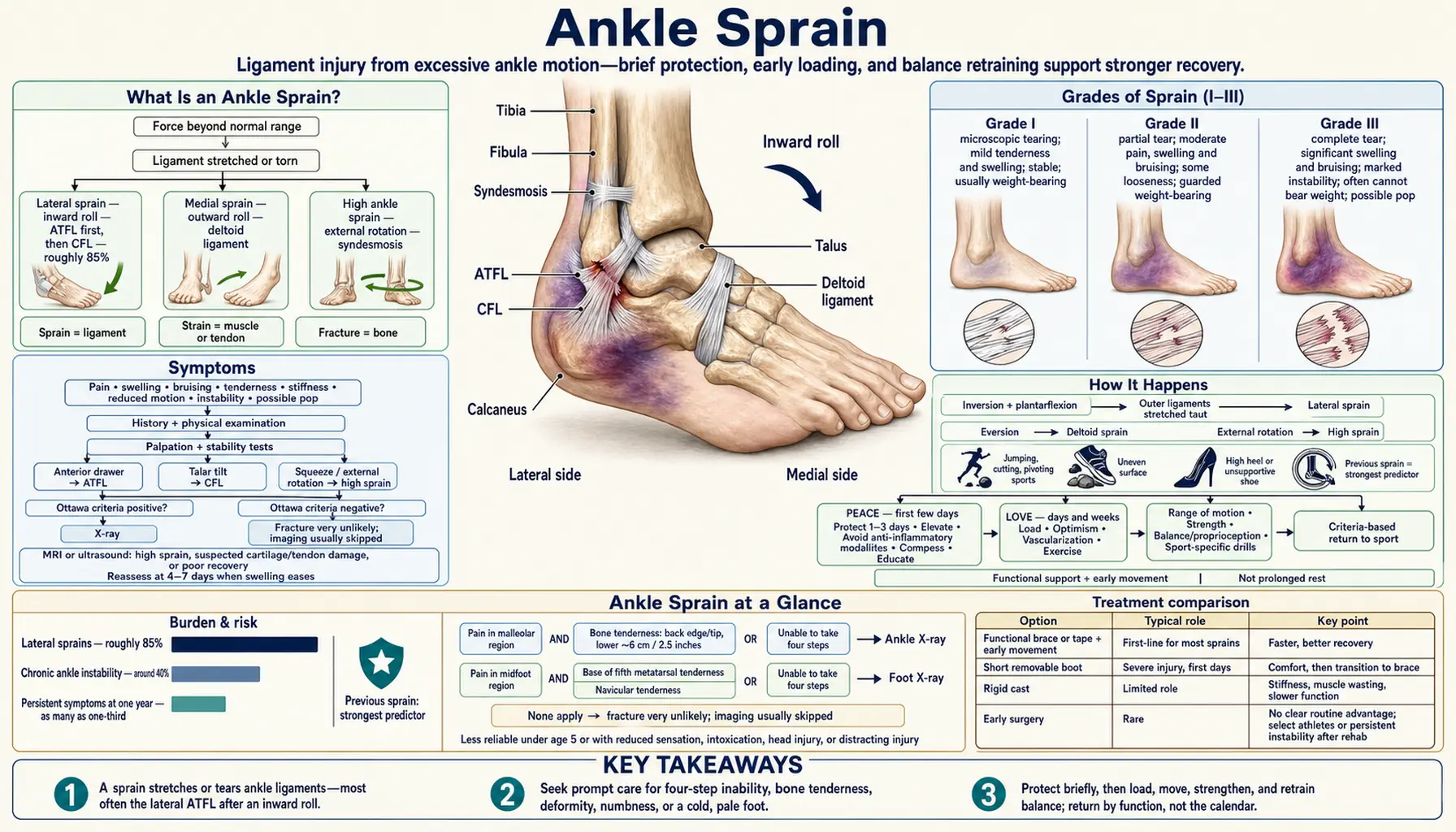
A sprained ankle is the single most common musculoskeletal injury in the world — roughly one happens every second somewhere on earth — and yet it is one of the most poorly rehabilitated. Most people roll an ankle, wince, limp home, prop it up with a bag of frozen peas, and wait for it to "get better on its own." Often it does settle down enough to walk on. But the old advice to simply rest it turns out to be one of the most persistent myths in sports medicine. Ankles that are protected briefly and then loaded early, moved deliberately, and retrained for balance heal stronger and re-injure less often than ankles that are wrapped in a cast and babied for weeks. As many as a third of people who sprain an ankle still have pain, swelling, or a sense of "giving way" a year later — not because the injury was so severe, but because the rehabilitation stopped at "the swelling went down." This page explains what actually tears, how to tell a sprain from a fracture (including the simple bedside rule that tells you whether you even need an X-ray), and the modern, active-recovery approach that gets ankles back to full function.
Table of Contents
- What Is an Ankle Sprain?
- Grades of Sprain (I–III)
- Symptoms
- How It Happens
- When to Get an X-ray: The Ottawa Ankle Rules
- Diagnosis
- Treatment: PEACE & LOVE, Not Prolonged Rest
- Rehabilitation & Return to Sport
- Preventing Re-Sprain & Chronic Ankle Instability
- When to See a Doctor
- Key Research Papers
- Connections
- Featured Videos
What Is an Ankle Sprain?
An ankle sprain is an injury to one or more of the ligaments that hold the ankle joint together. Ligaments are tough, slightly elastic bands of collagen that connect bone to bone and act as the joint's internal seatbelts, limiting how far it can move. A sprain occurs when the ankle is forced beyond its normal range of motion and those ligaments are stretched or torn. This is different from a strain (which involves muscle or tendon), and different again from a fracture (a break in the bone itself) — though a bad sprain and a small fracture can feel almost identical, which is why sorting them out matters.
Ankle sprains come in three main flavors, defined by which ligaments are damaged:
- Lateral ankle sprain (the classic "rolled ankle"). By far the most common — roughly 85% of all ankle sprains. It affects the ligaments on the outer side of the ankle, most often the anterior talofibular ligament (ATFL), which is the weakest of the group and the first to give way. The calcaneofibular ligament (CFL) is the next most commonly involved. These are injured when the foot rolls inward underneath you.
- Medial (deltoid) sprain. Much less common because the deltoid ligament on the inner side of the ankle is broad and very strong. It is injured when the foot rolls outward. Because it takes a lot of force, a deltoid injury is more likely to come with a fracture and deserves a careful look.
- High ankle sprain (syndesmotic sprain). This one is different and often missed. It injures the syndesmosis — the fibrous connection between the two lower leg bones (the tibia and fibula) just above the ankle joint. It usually comes from a twisting, external-rotation force, is common in cutting and collision sports, hurts higher up the leg, and characteristically takes considerably longer to heal than a standard lateral sprain.
Grades of Sprain (I–III)
Clinicians grade ankle sprains by how much ligament tissue is damaged. The grade guides expectations for recovery time, though modern practice treats even severe sprains functionally rather than surgically in most cases.
- Grade I (mild). The ligament is overstretched with only microscopic tearing of fibers. There is mild tenderness and swelling, no meaningful joint instability, and you can usually still bear weight and walk, albeit with a limp. Recovery is typically days to a couple of weeks.
- Grade II (moderate). A partial tear of the ligament. Expect more pronounced swelling and bruising, moderate pain, some looseness in the joint on examination, and painful, guarded weight-bearing. Recovery commonly runs a few weeks with proper rehabilitation.
- Grade III (severe). A complete tear (rupture) of the ligament. There is significant swelling and bruising, marked instability, and often an inability to bear weight at first — some people describe a "pop" at the moment of injury. Counter-intuitively, even most grade III lateral sprains do not require surgery; a period of functional support followed by structured rehab produces excellent results for the majority.
Symptoms
The hallmark symptoms of an ankle sprain appear quickly — often within minutes to a few hours — and their severity roughly tracks the grade of injury:
- Pain, especially on the outer side of the ankle, and worse when you put weight on it or try to move the joint.
- Swelling, which can develop rapidly. A quick, egg-shaped swelling on the outside of the ankle is common.
- Bruising (ecchymosis), sometimes not appearing until a day or two later and often tracking down toward the toes and heel as gravity pulls the blood downward.
- Tenderness to touch directly over the injured ligaments.
- Stiffness and reduced range of motion.
- A feeling of instability or that the ankle might "give way," which is more common with moderate-to-severe sprains.
- A "pop" or tearing sensation at the instant of injury, more typical of a complete (grade III) tear.
Warning signs that point beyond a simple sprain — inability to take even a few steps, numbness or tingling, a cold or pale foot, obvious deformity, or bone (not ligament) tenderness — are covered in the Ottawa rules and when to see a doctor sections below.
How It Happens
The overwhelming majority of ankle sprains happen by inversion — the sole of the foot rolls inward and the foot turns under the leg, usually while the ankle is also pointed downward (plantarflexed). In that position the outer ligaments are stretched taut and take the full force. This is the classic sequence of stepping on the edge of a curb, landing on another player's foot in basketball, catching a heel in a pothole, or simply missing a step on the stairs.
Common scenarios include:
- Sports that involve jumping, cutting, and pivoting — basketball, volleyball, soccer, and running on uneven ground are repeat offenders. Landing on someone else's foot is a leading cause in court sports.
- Uneven surfaces — a misjudged step off a curb, a hidden hole in the grass, loose gravel, or a rug edge.
- Footwear — high heels raise the center of gravity and pre-position the ankle for an inversion roll; worn-out or unsupportive shoes also contribute.
- A previous sprain — the single strongest predictor of a future sprain is having had one before, because ligament laxity and dulled balance reflexes persist unless deliberately retrained.
Medial (eversion) sprains and high ankle sprains follow different mechanics — typically an outward roll or a forceful twisting/external-rotation of the planted foot, respectively — and both take more force than the everyday inversion sprain.
When to Get an X-ray: The Ottawa Ankle Rules
Most sprained ankles do not need an X-ray. To avoid irradiating and billing millions of people unnecessarily, emergency physicians in Ottawa, Canada developed a simple bedside checklist — the Ottawa Ankle Rules — that reliably identifies who is at risk of a fracture and who is not. Systematic reviews have found the rules highly sensitive: a "negative" result makes a clinically important fracture very unlikely, and applying them cuts unnecessary X-rays by roughly a third without missing meaningful breaks. Here are the rules, in plain language.
You need an X-ray of the ANKLE only if there is pain in the ankle-bone (malleolar) region AND at least one of the following:
- Bone tenderness along the back edge or tip of the outer ankle bone (the lower ~6 cm / 2.5 inches of the fibula — the lateral malleolus), or
- Bone tenderness along the back edge or tip of the inner ankle bone (the lower ~6 cm of the tibia — the medial malleolus), or
- Inability to bear weight both right after the injury and at the time of examination — specifically, being unable to take four steps (limping counts as bearing weight).
You need an X-ray of the FOOT only if there is pain in the mid-foot region AND at least one of the following:
- Bone tenderness at the base of the fifth metatarsal (the bony bump on the outer edge of the mid-foot), or
- Bone tenderness over the navicular bone (on the inner arch), or
- Inability to bear weight for four steps, both immediately and during examination.
If none of these apply, a fracture is very unlikely and imaging can usually be skipped — you can safely treat it as a sprain. A few cautions: the rules are validated for adults and are less reliable in young children (roughly under age 5), and they can be thrown off by intoxication, a head injury, other distracting injuries, or reduced sensation in the leg. When in doubt, or if pain is severe and persistent, get it checked.
Diagnosis
Diagnosis is primarily clinical — a good history and physical examination tell most of the story. A clinician will ask how the injury happened, whether you heard a pop, and whether you could walk afterward, then examine the ankle for the location of tenderness, the degree of swelling and bruising, and joint stability.
- Palpation. Pressing systematically over each ligament and bony landmark localizes the injury and applies the Ottawa rules.
- Stability tests. The anterior drawer test assesses the ATFL; the talar tilt test assesses the CFL. For a suspected high ankle sprain, the squeeze test and external-rotation test are used. These are often most informative a few days later, once the initial pain and guarding have settled.
- X-ray. Ordered only when the Ottawa rules indicate a fracture risk, or when pain fails to improve as expected.
- MRI or ultrasound. Not needed for routine sprains. They are reserved for high ankle sprains, suspected cartilage or tendon damage, or sprains that are not recovering despite good rehabilitation.
It is worth remembering that a fresh, swollen ankle is genuinely hard to examine, so a follow-up assessment at 4–7 days — when swelling has eased — often gives the clearest picture of ligament integrity.
Treatment: PEACE & LOVE, Not Prolonged Rest
Treatment of ankle sprains has shifted dramatically over the past two decades, and the headline is this: prolonged rest and rigid immobilization are usually the wrong approach. The old mnemonic RICE (Rest, Ice, Compression, Elevation) gave way to POLICE (Protection, Optimal Loading, Ice, Compression, Elevation) precisely because the evidence showed that controlled, early loading — not rest — drives better ligament repair. The current framework, proposed by Dubois and Esculier, is PEACE & LOVE, which spans the whole recovery arc.
PEACE — for the first few days after injury:
- P — Protect. Unload and restrict movement for a short 1–3 days; let pain guide you. Brief, not prolonged.
- E — Elevate. Raise the leg above heart level to help drain swelling.
- A — Avoid anti-inflammatory modalities. The framework advises against routinely reaching for anti-inflammatory drugs (and heavy icing), on the reasoning that the inflammatory response is part of how tissue heals. This is the most debated element — many clinicians still use ice and short-course medication for pain control — but the shift away from aggressively suppressing all inflammation is deliberate.
- C — Compress. An elastic bandage or taping helps limit swelling.
- E — Educate. Understand that an active recovery beats passive treatments, and that the body does not need endless scans and gadgets to heal a sprain.
LOVE — in the days and weeks that follow:
- L — Load. Return to normal activity as symptoms allow. Mechanical stress, applied gradually and guided by pain, is what tells the ligament to rebuild strong, well-aligned collagen.
- O — Optimism. Confidence and a positive outlook genuinely improve outcomes; fear and catastrophizing slow recovery.
- V — Vascularization. Pain-free cardiovascular activity (a stationary bike, swimming) boosts blood flow to the healing tissue and preserves fitness.
- E — Exercise. Restore range of motion, strength, and — crucially — balance and proprioception (see the next section).
Bracing versus casting
For the great majority of sprains, functional support — a lace-up brace, a semi-rigid stirrup brace, or taping — combined with early movement produces faster, better recovery than being placed in a rigid cast. Cochrane reviews of functional versus immobilization treatment support this consistently: a cast may briefly ease pain in a severe sprain but at the cost of stiffness, muscle wasting, and slower return to function. A short spell in a removable walker boot is sometimes used for comfort in the first days of a severe injury, then transitioned to a functional brace.
Is surgery ever needed?
Rarely, at least up front. A landmark body of evidence, including a Cochrane review of surgical versus conservative treatment of acute lateral ligament injuries, found no clear routine advantage to early surgery for the average patient; conservative functional treatment is the standard first-line approach even for complete tears. Surgical repair is reserved for select high-level athletes or for people who develop persistent instability that does not respond to a thorough course of rehabilitation.
Rehabilitation & Return to Sport
Rehabilitation is where good outcomes are won or lost. The reason so many "healed" ankles keep rolling is that people stop rehab once the pain and swelling resolve — but the injury also blunts proprioception, the ankle's sense of its own position in space. A sprained ankle with normal strength but dulled proprioception is an ankle that will not react in time the next time the foot lands awkwardly.
A structured, progressive program typically moves through overlapping phases:
- Early motion & swelling control. Gentle ankle circles, alphabet tracing with the foot, and pain-free range-of-motion work begun within the first days.
- Strengthening. Resistance-band exercises in all four directions, with particular attention to the peroneal muscles on the outside of the leg that actively defend against inversion; progressing to calf raises and standing work.
- Balance and proprioception — the key ingredient. Single-leg balance drills, progressing to eyes-closed, then to unstable surfaces such as a wobble board, cushion, or BOSU. This is the element most strongly linked to preventing re-injury.
- Functional and sport-specific training. Hopping, jumping, cutting, and agility drills that rehearse the exact movements the ankle failed at.
Return to sport should be criteria-based, not calendar-based. Rather than "come back in six weeks," the safer benchmarks are: full, pain-free range of motion; strength roughly equal to the uninjured side; confident single-leg balance; and the ability to hop, cut, and complete sport-specific drills without pain or apprehension. Wearing a brace or taping the ankle during the first weeks back reduces the odds of re-injury while the tissue and reflexes finish maturing.
Preventing Re-Sprain & Chronic Ankle Instability
Around 40% of people go on to develop some degree of chronic ankle instability (CAI) after a first significant sprain — a frustrating cycle of repeated sprains, a persistent sense of the ankle "giving way," and lingering pain or swelling. CAI has two intertwined parts: mechanical instability (ligaments that healed loose) and functional instability (impaired balance, strength, and neuromuscular control). The good news is that the functional component — which is the larger driver for most people — is highly trainable.
Evidence-based strategies to break the cycle:
- Balance/proprioception training. Controlled trials of wobble-board and balance-board programs show meaningful reductions in recurrent sprains, especially in athletes with a prior sprain. This is the best-supported single intervention.
- Neuromuscular and strength programs. Structured warm-up and conditioning programs reduce ankle-sprain rates in sport.
- External support during high-risk activity. Lace-up braces and taping reduce recurrence, particularly in those who have already sprained the ankle; braces are generally more durable than tape, which loosens during play.
- Finish your rehab. The most common preventable cause of re-injury is quitting rehabilitation the moment the ankle feels "good enough." Complete the balance and strength progression.
- Address the basics. Supportive, well-fitting footwear; caution on uneven terrain; and maintaining general lower-limb strength all help.
If instability persists despite a genuine, completed rehabilitation program, that is the point to revisit a clinician — for advanced physiotherapy, imaging to assess the ligaments, or, in a minority, surgical reconstruction.
When to See a Doctor
Many ankle sprains can be managed at home, but certain features warrant prompt medical assessment. Seek care — often urgently — if you have:
- Inability to bear weight or take four steps, either right after the injury or now — a red flag under the Ottawa rules.
- Bone tenderness over the ankle bones or specific mid-foot points described in the Ottawa rules.
- Obvious deformity, a joint that looks out of place, or a snap/pop with immediate severe swelling and instability.
- Numbness, tingling, or a cold, pale foot — possible nerve or blood-vessel involvement.
- Severe or rapidly worsening swelling and pain in the calf, or pain out of proportion to the injury — to rule out a blood clot or (rarely) compartment syndrome.
- Fever, spreading redness, or warmth, especially over a break in the skin — possible infection.
- No improvement after about 5–7 days of appropriate care, or an ankle that keeps giving way (chronic instability) after previous sprains.
Children with ankle injuries deserve a lower threshold for evaluation, because their growth plates can be injured in ways that mimic a sprain.
Key Research Papers
- Stiell IG, Greenberg GH, McKnight RD, et al. Decision rules for the use of radiography in acute ankle injuries: refinement and prospective validation. JAMA. 1993;269(9):1127-1132.
- Bachmann LM, Kolb E, Koller MT, Steurer J, ter Riet G. Accuracy of Ottawa ankle rules to exclude fractures of the ankle and mid-foot: systematic review. BMJ. 2003;326(7386):417.
- van Rijn RM, van Os AG, Bernsen RMD, et al. What is the clinical course of acute ankle sprains? A systematic literature review. The American Journal of Medicine. 2008;121(4):324-331.
- Doherty C, Delahunt E, Caulfield B, et al. The incidence and prevalence of ankle sprain injury: a systematic review and meta-analysis of prospective epidemiological studies. Sports Medicine. 2014;44(1):123-140.
- Doherty C, Bleakley C, Delahunt E, Holden S. Treatment and prevention of acute and recurrent ankle sprain: an overview of systematic reviews with meta-analysis. British Journal of Sports Medicine. 2017;51(2):113-125.
- Kerkhoffs GMMJ, Handoll HHG, de Bie R, Rowe BH, Struijs PAA. Surgical versus conservative treatment for acute injuries of the lateral ligament complex of the ankle in adults. Cochrane Database of Systematic Reviews. 2007;(2):CD000380.
- Bleakley CM, O'Connor SR, Tully MA, et al. Effect of accelerated rehabilitation on function after ankle sprain: randomised controlled trial. BMJ. 2010;340:c1964.
- Kaminski TW, Hertel J, Amendola N, et al. National Athletic Trainers' Association position statement: conservative management and prevention of ankle sprains in athletes. Journal of Athletic Training. 2013;48(4):528-545.
- Verhagen E, van der Beek A, Twisk J, Bouter L, Bahr R, van Mechelen W. The effect of a proprioceptive balance board training program for the prevention of ankle sprains. The American Journal of Sports Medicine. 2004;32(6):1385-1393.
- Vuurberg G, Hoorntje A, Wink LM, et al. Diagnosis, treatment and prevention of ankle sprains: update of an evidence-based clinical guideline. British Journal of Sports Medicine. 2018;52(15):956.
- Herzog MM, Kerr ZY, Marshall SW, Wikstrom EA. Epidemiology of ankle sprains and chronic ankle instability. Journal of Athletic Training. 2019;54(6):603-610.
- Dubois B, Esculier JF. Soft-tissue injuries simply need PEACE and LOVE. British Journal of Sports Medicine. 2020;54(2):72-73.
Live PubMed Searches
- Ankle sprain treatment — PubMed
- Lateral ankle ligament injury — PubMed
- Chronic ankle instability — PubMed
- Ottawa ankle rules — PubMed
- Balance & proprioception training — PubMed
- High (syndesmotic) ankle sprain — PubMed
- Ankle sprain prevention — PubMed
Connections
- Orthopedics
- All Conditions
- ACL Tear
- Achilles Tendinopathy
- Plantar Fasciitis
- Stress Fracture
- Meniscus Tear
- Tendinitis
- Bursitis
- Osteoarthritis
- Compartment Syndrome
- Gout
- Edema (Swelling)
- Exercise & Rehabilitation
- Vitamin C (Collagen Synthesis)
- Turmeric