PMS and PMDD
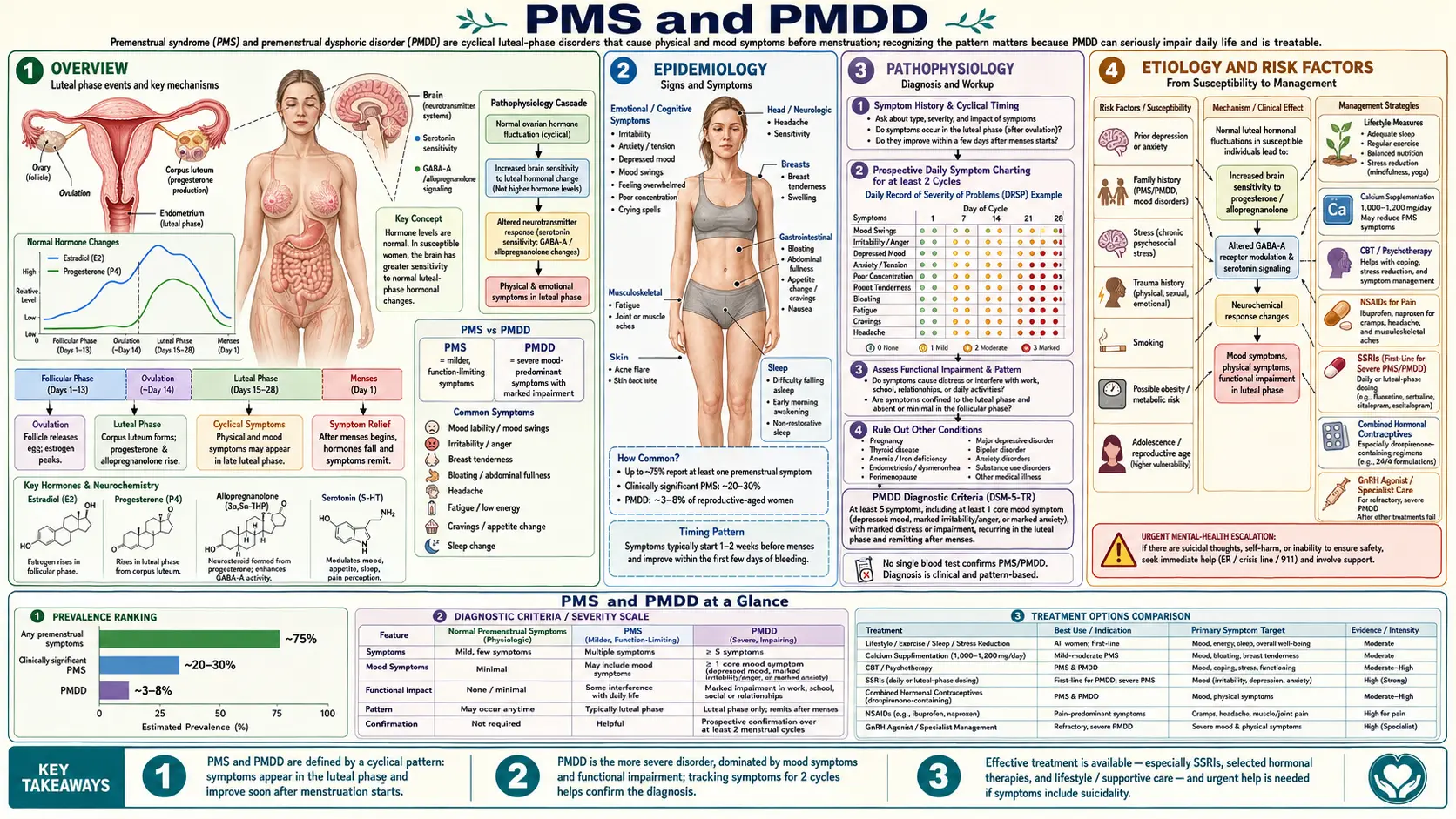
If your mood reliably falls apart in the week or two before your period — and then lifts within a day or two of bleeding starting — you are not imagining it, and you are not weak. This page is about premenstrual syndrome (PMS) and its severe, distinct cousin premenstrual dysphoric disorder (PMDD). PMDD in particular is real, it is recognized in the psychiatric diagnostic manual, and it can be genuinely disabling. Far too many people are told it is “just PMS” or “all in your head.” It is neither. The encouraging part is that the timing that makes these conditions so frustrating — their predictability — is also what makes them diagnosable and treatable.
Table of Contents
- Overview
- Epidemiology
- Pathophysiology
- Etiology and Risk Factors
- Clinical Presentation
- Diagnosis
- Treatment
- Complications
- Prognosis
- Prevention
- Recent Research and Advances
- References & Research
- Research Papers
- Connections
- Featured Videos
1. Overview
Premenstrual syndrome (PMS) describes a cluster of physical and emotional symptoms that appear in the luteal phase — the roughly two weeks after ovulation and before a period — and ease off once bleeding begins. Mild premenstrual symptoms are extremely common; depending on how broadly you define it, up to about three-quarters of menstruating people notice some premenstrual change. For most, it is a nuisance: a few bloated, irritable, tender days. That is normal physiology, not a disease.
Premenstrual dysphoric disorder (PMDD) is different in kind, not just degree. It is a distinct mood disorder formally listed in the DSM-5 (the standard psychiatric diagnostic manual, where it was added as its own category in 2013) and in the WHO’s ICD-11. PMDD affects an estimated 3–8% of menstruating people, and the defining word is disabling: the premenstrual mood symptoms are severe enough to damage relationships, derail work or school, and — at its worst — produce perimenstrual suicidal thoughts. People with PMDD often describe feeling like a different, frightening version of themselves for a predictable stretch each month, then snapping back to baseline. That is not weakness of character. It is a biological vulnerability.
The single most important fact on this page: what makes PMS and PMDD recognizable is timing, not the symptoms themselves. The symptoms appear in the luteal phase and remit within a few days of the period starting, leaving a symptom-free stretch in the follicular phase (the days after a period). This cyclical on-off pattern is the fingerprint of the disorder. It is also why a depression or anxiety condition that persists all month is a different diagnosis — and why tracking your symptoms across at least two cycles is the key that unlocks the right diagnosis and the right treatment.
2. Epidemiology
Premenstrual symptoms of some sort are nearly universal across the reproductive years. Clinically meaningful PMS — symptoms troublesome enough to interfere with daily life — affects an estimated 20–30% of menstruating people at some point. PMDD, the severe form, affects roughly 3–8%. A large international study by Halbreich and colleagues estimated that PMDD’s burden — the number of healthy years lost to impairment — rivals that of major depressive disorder, which gives a sense of how seriously it deserves to be taken.
Symptoms typically begin in the late teens to twenties and often persist or worsen across the reproductive years. They tend to peak in the thirties and forties and frequently intensify during the perimenopausal transition, when hormone fluctuations become more erratic, before resolving completely at menopause once cycling stops. PMS and PMDD are conditions of the reproductive years specifically because they are driven by the hormonal events of the cycle — they do not occur before puberty, during pregnancy, or after menopause.
3. Pathophysiology
Here is the part that has changed dramatically — and that explains why old “hormone imbalance” explanations were wrong. People with PMDD do not have abnormal hormone levels. If you measure estrogen and progesterone in someone with PMDD and someone without it, the numbers look the same. For decades this was a puzzle, and it fed the unfair conclusion that the problem must be psychological.
The modern understanding, anchored by elegant experiments from the National Institute of Mental Health, is that the problem is one of abnormal sensitivity to normal hormone changes. In a landmark study, Schmidt and colleagues used a drug to shut off the ovaries (eliminating the cycle), which made PMDD symptoms vanish. They then added back estrogen or progesterone — and only in people with PMDD did the symptoms come roaring back. The hormone levels were identical in everyone; the difference was how the brain responded to them. A follow-up study showed it is specifically the change in hormone level, not a steady high or low level, that triggers symptoms.
What is the brain reacting to? The leading culprit is allopregnanolone, a metabolite (breakdown product) of progesterone. Progesterone rises in the luteal phase, and the body converts some of it to allopregnanolone, which acts on the brain’s GABA system — the main calming, anti-anxiety signaling network (the same target alcohol and anti-anxiety medications hit). In most people allopregnanolone is soothing. In people with PMDD, the GABA receptors appear to respond paradoxically — rather than calming, the system becomes destabilized as allopregnanolone rises and falls. The serotonin system is also involved, which is why serotonin-boosting medications work so well and so fast (more on that below). In plain terms: it is not that the hormones are wrong, it is that a vulnerable brain mis-reads a normal hormonal signal. This is a neurobiological condition, full stop.
4. Etiology and Risk Factors
Because the core mechanism is a sensitivity rather than a deficiency, the “cause” is best understood as who is vulnerable to that sensitivity. Known and suspected risk factors include:
- Genetics. PMDD runs in families, and twin studies suggest a substantial heritable component. Research has identified genetic differences in how cells regulate their response to estrogen and progesterone (notably in the ESC/E(Z) gene complex), supporting the idea that the vulnerability is partly hard-wired.
- A personal or family history of mood disorders — depression, anxiety, or postpartum depression — raises the risk, though many people with PMDD have no other psychiatric history at all.
- A history of trauma or chronic stress. Early-life adversity and high stress are associated with higher PMDD risk, likely through their effects on the stress-response and GABA systems.
- Smoking has been linked in large cohort studies to a higher risk of developing PMS.
- Lower intake of calcium and vitamin D. In the Nurses’ Health Study, women with higher dietary calcium and vitamin D intake had a lower risk of developing PMS — a clue that ties into the calcium evidence for treatment below.
What does not cause it: being “dramatic,” lacking willpower, or having a bad attitude. These framings are not only inaccurate — they actively delay diagnosis and treatment.
5. Clinical Presentation
Symptoms cluster into emotional/behavioral and physical categories, and they appear in the luteal phase and resolve with menstruation. For a PMDD diagnosis, the mood symptoms must dominate and must be severe.
Mood and behavioral symptoms (the core of PMDD):
- Irritability and anger — often the most prominent feature; sudden, intense, sometimes frightening to the person experiencing it.
- Depressed mood, hopelessness, feelings of worthlessness or self-criticism.
- Anxiety, tension, feeling on edge or keyed up.
- Mood lability — abrupt tearfulness, sensitivity to rejection, feeling suddenly overwhelmed.
- Difficulty concentrating, feeling out of control, withdrawal from relationships and activities.
Physical and other symptoms (common in both PMS and PMDD):
- Bloating and a sensation of weight gain.
- Breast tenderness or swelling.
- Fatigue and low energy.
- Sleep changes — insomnia or sleeping too much.
- Appetite changes and food cravings, often for carbohydrates or sweets.
- Headaches, joint or muscle aches.
The presentation that should never be brushed aside is perimenstrual suicidal thinking. Some people with PMDD feel actively suicidal only in the luteal phase, and then the feeling lifts entirely with their period. Because it comes and goes, it is sometimes dismissed — that is dangerous. Cyclical suicidal ideation is a recognized, serious feature of PMDD and a reason to seek help urgently (see Complications).
6. Diagnosis
There is no blood test for PMS or PMDD — remember, hormone levels are normal. The diagnosis rests on one thing above all: prospective daily symptom tracking across at least two menstrual cycles. “Prospective” means you rate your symptoms as they happen, day by day, rather than trying to recall them later (memory is unreliable and tends to either exaggerate or minimize). This is the diagnostic key, and it is worth doing carefully because it does three things at once: it confirms the cyclical timing, it rules out other conditions, and it gives you a baseline to measure treatment against.
The most widely used tool is the Daily Record of Severity of Problems (DRSP), a simple daily checklist of symptoms rated by severity. A more rigorous scoring framework, the Carolina Premenstrual Assessment Scoring System (C-PASS), was developed by Eisenlohr-Moul and colleagues to make DRSP-based PMDD diagnosis reliable and reproducible. The pattern that confirms PMDD is a clear rise in symptom severity in the luteal phase and a clear drop — back to baseline — in the follicular week after the period.
The most important thing tracking rules out is premenstrual exacerbation (PME) of another condition. If you have depression, anxiety, or another disorder all month that simply gets worse before your period, that is PME — not PMDD. The distinction matters because the treatment is different: PME is treated by treating the underlying condition, while PMDD has its own targeted, often intermittent, strategies. The only way to tell them apart is to see whether there are symptom-free days in the follicular phase. If symptoms never fully clear, it is not PMDD. This is exactly why a one-visit, “how have you been feeling?” assessment can’t make the diagnosis — and why so many people get dismissed until they bring in two cycles of data.
7. Treatment
The good news that surprises most people: PMS and especially PMDD are highly treatable, and several of the best treatments work quickly. Treatment is matched to severity — lifestyle measures for milder PMS, and medication for moderate-to-severe PMS and PMDD.
SSRIs — first-line for PMDD (and they can be taken just part of the month)
Selective serotonin reuptake inhibitors (SSRIs) — medications such as sertraline, fluoxetine, escitalopram, and paroxetine — are the first-line treatment for PMDD, with strong evidence behind them. A Cochrane systematic review (Marjoribanks and colleagues) confirmed they significantly reduce both mood and physical symptoms. Two features surprise people:
- They can be taken luteal-phase only. Unlike when SSRIs are used for depression (where they’re taken daily and take weeks to work), for PMDD they can be taken only during the luteal phase — roughly the 14 days before your period — and stopped during menstruation. This intermittent dosing works because the mechanism in PMDD is different. Continuous daily dosing is also an option, especially if symptoms are present more of the month.
- They work fast. The original landmark trial (Steiner and colleagues, fluoxetine for premenstrual dysphoria) and subsequent studies show relief within days, not the weeks expected when SSRIs are used for depression — another sign that PMDD is mechanistically distinct.
SSRIs are real, evidence-based medicine for a real biological condition. Taking one for PMDD is not a comment on your character any more than taking insulin is.
Combined oral contraceptives
Certain combined oral contraceptives (COCs) can help by smoothing out the hormonal fluctuations that trigger symptoms. The best evidence is for pills containing drospirenone (e.g., the drospirenone/ethinyl-estradiol combination studied by Yonkers and colleagues), often taken in a continuous or extended cycle (skipping or shortening the placebo week) so there is less hormonal up-and-down. A Cochrane review (Lopez and colleagues) supports drospirenone-containing pills for PMDD symptoms. As with any estrogen-containing contraceptive, the small increased risk of blood clots should be discussed with a clinician, especially for smokers and those with clotting risk factors.
For severe, refractory cases
When standard treatments fail and symptoms are disabling, more aggressive options exist:
- GnRH agonists with “add-back” therapy. These medications temporarily switch off the ovaries, creating a reversible “medical menopause” that abolishes the cycle and therefore the trigger. Because shutting down estrogen causes menopausal symptoms and bone loss, low-dose estrogen and progesterone (“add-back”) are given alongside. This is a specialist treatment used for confirmed, severe, treatment-resistant PMDD.
- Surgery (oophorectomy, removal of the ovaries) is a permanent last resort, considered only rarely, in severe refractory PMDD, after a GnRH-agonist trial has confirmed that turning off the ovaries truly resolves the symptoms, and with hormone replacement planned afterward.
Lifestyle and supplements — the honest evidence
These help most for milder PMS, and several are worth trying. We’ll be straight about the strength of the evidence:
- Exercise. Regular aerobic exercise improves premenstrual mood and physical symptoms in multiple studies. Reasonable evidence; very safe; good first step.
- Calcium (about 1,200 mg/day). This has the strongest supplement evidence. A randomized controlled trial by Thys-Jacobs and colleagues found calcium carbonate meaningfully reduced premenstrual symptoms, and the Nurses’ Health Study linked higher calcium intake to lower PMS risk. A genuinely evidence-supported option. See Calcium.
- Vitamin B6 (pyridoxine). A BMJ systematic review (Wyatt and colleagues) found a modest benefit for PMS symptoms. Keep doses to around 50–100 mg/day — high doses can cause nerve damage. Modest, real, but limited. See Vitamin B6.
- Chasteberry (Vitex agnus-castus). Unusually for a herbal remedy, this has some randomized-trial support: a placebo-controlled BMJ study by Schellenberg found it improved several PMS symptoms. The evidence is for PMS rather than full PMDD, quality is mixed, and it shouldn’t be combined with hormonal treatments without advice — but it is honestly more than we can say for most supplements.
- Magnesium, complex carbohydrates, consistent sleep, and stress reduction are reasonable and low-risk. Magnesium has limited, mixed evidence; carbohydrate-rich evening snacks may help via serotonin; sleep and stress management help mood generally. See Magnesium.
- Cognitive behavioral therapy (CBT) can reduce premenstrual distress and is a good non-drug option, alone or alongside medication.
Debunking the overhyped: evening primrose oil is popular but the evidence does not support it for PMS mood symptoms (it may modestly help breast tenderness). Many “hormone balance” supplements, “detox” protocols, and progesterone creams marketed for PMS are not supported by good evidence — and the progesterone-cream idea runs directly against the science, since it is sensitivity to progesterone’s metabolites that drives PMDD in the first place. Spend your effort on the options that actually have trials behind them.
8. Complications
The most serious complication of PMDD is its effect on safety and mental health. PMDD is associated with elevated rates of suicidal ideation and suicide attempts, often concentrated in the luteal phase. Because the suicidal feelings come and go with the cycle, they are sometimes minimized — by patients themselves and by clinicians. Do not minimize them. Cyclical suicidal thoughts are a real, treatable feature of PMDD, not a passing mood, and they warrant urgent help.
Other consequences flow from the monthly disruption: strained relationships (partners and children often bear the brunt of the irritability, which then fuels guilt), lost work and school days, and a cumulative toll on self-esteem from feeling that one “loses control” every month. There is also frequent overlap with depression and anxiety disorders, and a higher likelihood of postpartum depression — both reflecting a shared sensitivity to hormonal change.
If you are having perimenstrual thoughts of harming yourself, please treat it as urgent. In the U.S., call or text 988 (Suicide and Crisis Lifeline). Tell a clinician specifically that the thoughts track with your cycle — that information points directly toward effective treatment.
9. Prognosis
The outlook is genuinely good. With accurate diagnosis and appropriate treatment, most people with PMDD achieve substantial relief. SSRIs alone help a majority, and many of the rest respond to hormonal treatment or a combination. Because the conditions are driven by ovarian cycling, symptoms resolve completely at menopause once cycling permanently stops — though the perimenopausal transition just before that often brings a temporary worsening as hormones fluctuate more erratically.
Pregnancy also suspends the cycle and usually relieves PMDD during gestation, though the postpartum period — another time of dramatic hormonal change — carries a higher risk of mood symptoms. The biggest obstacle to a good outcome is not the biology; it is delayed diagnosis. People often suffer for years before someone takes the cyclical pattern seriously. The faster the pattern is recognized and treated, the better the trajectory.
10. Prevention and Management
You cannot prevent the underlying sensitivity, but you can substantially manage the impact. The foundation is the same tool that makes the diagnosis: tracking.
- Track your cycle and symptoms. A daily app or simple log shows you the pattern, lets you anticipate the hard days, and gives your clinician the data they need. It is the single most empowering thing you can do — it turns an unpredictable monthly ambush into something you can plan around.
- Exercise regularly — the best-supported lifestyle measure.
- Use the evidence-based options: calcium (~1,200 mg/day), reasonable sleep, stress management, and — when symptoms warrant — an SSRI (continuous or luteal-only) or a drospirenone-containing continuous-cycle pill, decided with a clinician.
- Plan around the luteal week. Knowing the hard days are coming, you can schedule lighter commitments, warn the people close to you, and be gentler with yourself. This is not avoidance — it is the same accommodation anyone makes for a known, recurring medical condition.
- Seek help if symptoms impair your life — and seek help urgently for perimenstrual suicidal thoughts. You do not have to white-knuckle through this.
11. Recent Research and Advances
The biggest shift has been the reframing of PMDD as a disorder of hormone sensitivity, cemented by the NIMH work of Schmidt and colleagues showing that symptoms are triggered by hormonal change rather than abnormal levels — and by molecular work pointing to differences in how cells regulate their response to estrogen and progesterone. This has moved PMDD firmly into the realm of recognized neurobiology and away from outdated psychological framings.
Treatment research is now targeting allopregnanolone and the GABA system directly. A class of neuroactive steroid modulators — drugs that adjust how the brain responds to allopregnanolone rather than altering hormone levels — is under active investigation; the related compound brexanolone (an allopregnanolone formulation) is already approved for postpartum depression, validating the broader idea that targeting this pathway can treat hormone-linked mood disorders. Investigational agents that selectively dampen the brain’s response to luteal-phase allopregnanolone are in clinical trials specifically for PMDD. Alongside the biology, the field has invested in better diagnosis — the C-PASS scoring system standardized DSM-5 PMDD diagnosis from daily-rating data — and in raising awareness so that fewer patients are dismissed. The direction of travel is clear: PMDD is being treated as the legitimate neuroendocrine condition it is.
12. References & Research
Historical Background
The first formal medical description came from neurologist Robert Frank in 1931, who coined the term “premenstrual tension” to describe the cyclical irritability and distress he observed in his patients — an early, sympathetic attempt to medicalize what had long been dismissed. The broader term “premenstrual syndrome” came into use in the 1950s. The severe form was studied for decades under various research labels (“late luteal phase dysphoric disorder” in the DSM appendix) before premenstrual dysphoric disorder (PMDD) was finally recognized as a full diagnostic category in the DSM-5 in 2013 — a milestone that legitimized it for patients and clinicians alike. In parallel, neuroscience uncovered the role of allopregnanolone, the progesterone metabolite acting on GABA receptors, transforming PMDD from a presumed hormonal imbalance into a recognized disorder of neurosteroid sensitivity.
Key Research Papers
- Schmidt PJ, Nieman LK, Danaceau MA, et al. Differential behavioral effects of gonadal steroids in women with and in those without premenstrual syndrome. New England Journal of Medicine. 1998;338(4):209–216.
- Schmidt PJ, Martinez PE, Nieman LK, et al. Premenstrual dysphoric disorder symptoms following ovarian suppression: triggered by change in ovarian steroid levels but not continuous stable levels. American Journal of Psychiatry. 2017;174(10):980–989.
- Epperson CN, Steiner M, Hartlage SA, et al. Premenstrual dysphoric disorder: evidence for a new category for DSM-5. American Journal of Psychiatry. 2012;169(5):465–475.
- Eisenlohr-Moul TA, Girdler SS, Schmalenberger KM, et al. Toward the reliable diagnosis of DSM-5 premenstrual dysphoric disorder: the Carolina Premenstrual Assessment Scoring System (C-PASS). American Journal of Psychiatry. 2017;174(1):51–59.
- Halbreich U, Borenstein J, Pearlstein T, et al. The prevalence, impairment, impact, and burden of premenstrual dysphoric disorder (PMS/PMDD). Psychoneuroendocrinology. 2003;28(Suppl 3):1–23.
- Yonkers KA, O’Brien PMS, Eriksson E. Premenstrual syndrome. The Lancet. 2008;371(9619):1200–1210.
- Hantsoo L, Epperson CN. Premenstrual dysphoric disorder: epidemiology and treatment. Current Psychiatry Reports. 2015;17(11):87.
- Steiner M, Steinberg S, Stewart D, et al. Fluoxetine in the treatment of premenstrual dysphoria. New England Journal of Medicine. 1995;332(23):1529–1534.
- Marjoribanks J, Brown J, O’Brien PMS, et al. Selective serotonin reuptake inhibitors for premenstrual syndrome. Cochrane Database of Systematic Reviews. 2013;(6):CD001396.
- Yonkers KA, Brown C, Pearlstein TB, et al. Efficacy of a new low-dose oral contraceptive with drospirenone in premenstrual dysphoric disorder. Obstetrics & Gynecology. 2005;106(3):492–501.
- Lopez LM, Kaptein AA, Helmerhorst FM. Oral contraceptives containing drospirenone for premenstrual syndrome. Cochrane Database of Systematic Reviews. 2012;(2):CD006586.
- Thys-Jacobs S, Starkey P, Bernstein D, et al. Calcium carbonate and the premenstrual syndrome: effects on premenstrual and menstrual symptoms. American Journal of Obstetrics and Gynecology. 1998;179(2):444–452.
- Bertone-Johnson ER, Hankinson SE, Bendich A, et al. Calcium and vitamin D intake and risk of incident premenstrual syndrome. Archives of Internal Medicine. 2005;165(11):1246–1252.
- Wyatt KM, Dimmock PW, Jones PW, et al. Efficacy of vitamin B-6 in the treatment of premenstrual syndrome: systematic review. BMJ. 1999;318(7195):1375–1381.
- Schellenberg R. Treatment for the premenstrual syndrome with agnus castus fruit extract: prospective, randomised, placebo controlled study. BMJ. 2001;322(7279):134–137.
Research Papers
Explore the current peer-reviewed literature on premenstrual syndrome and PMDD through these live PubMed searches. Each link opens current results in a new tab.
- Premenstrual dysphoric disorder
- Premenstrual syndrome treatment
- Allopregnanolone and premenstrual symptoms
- SSRI luteal-phase dosing for PMDD
- Drospirenone oral contraceptive for PMDD
- PMDD, GABA, and progesterone sensitivity
- Calcium for premenstrual syndrome (RCTs)
- Vitex agnus-castus (chasteberry) for PMS
- GnRH agonist with add-back for PMDD
- PMDD and perimenstrual suicidal ideation
- Daily Record of Severity of Problems (DRSP)
- PMDD and the perimenopausal transition
Connections
- Reproductive Medicine
- Perimenopause — the transition when PMS/PMDD often temporarily worsens.
- Menopause & HRT — PMS and PMDD resolve once cycling permanently stops.
- Endometriosis — another cyclical, often-dismissed gynecologic condition.
- Infertility — reproductive-health overlap and shared hormonal pathways.
- PCOS — a hormonal condition of the reproductive years with mood overlap.
- Thyroid Disorders — thyroid problems can mimic or worsen premenstrual symptoms.
- Depression — distinct from PMDD, but shares the serotonin pathway and can co-occur.
- Anxiety — commonly co-occurs and can be premenstrually exacerbated.
- Insomnia — sleep disruption is a frequent luteal-phase symptom.
- Migraine — menstrual migraine follows the same cyclical hormone pattern.
- Calcium — ~1,200 mg/day has the strongest supplement evidence for PMS.
- Magnesium — low-risk option with limited, mixed evidence for premenstrual symptoms.
- Vitamin B6 — modest evidence for PMS; keep doses at 50–100 mg/day.