Yeast Infections
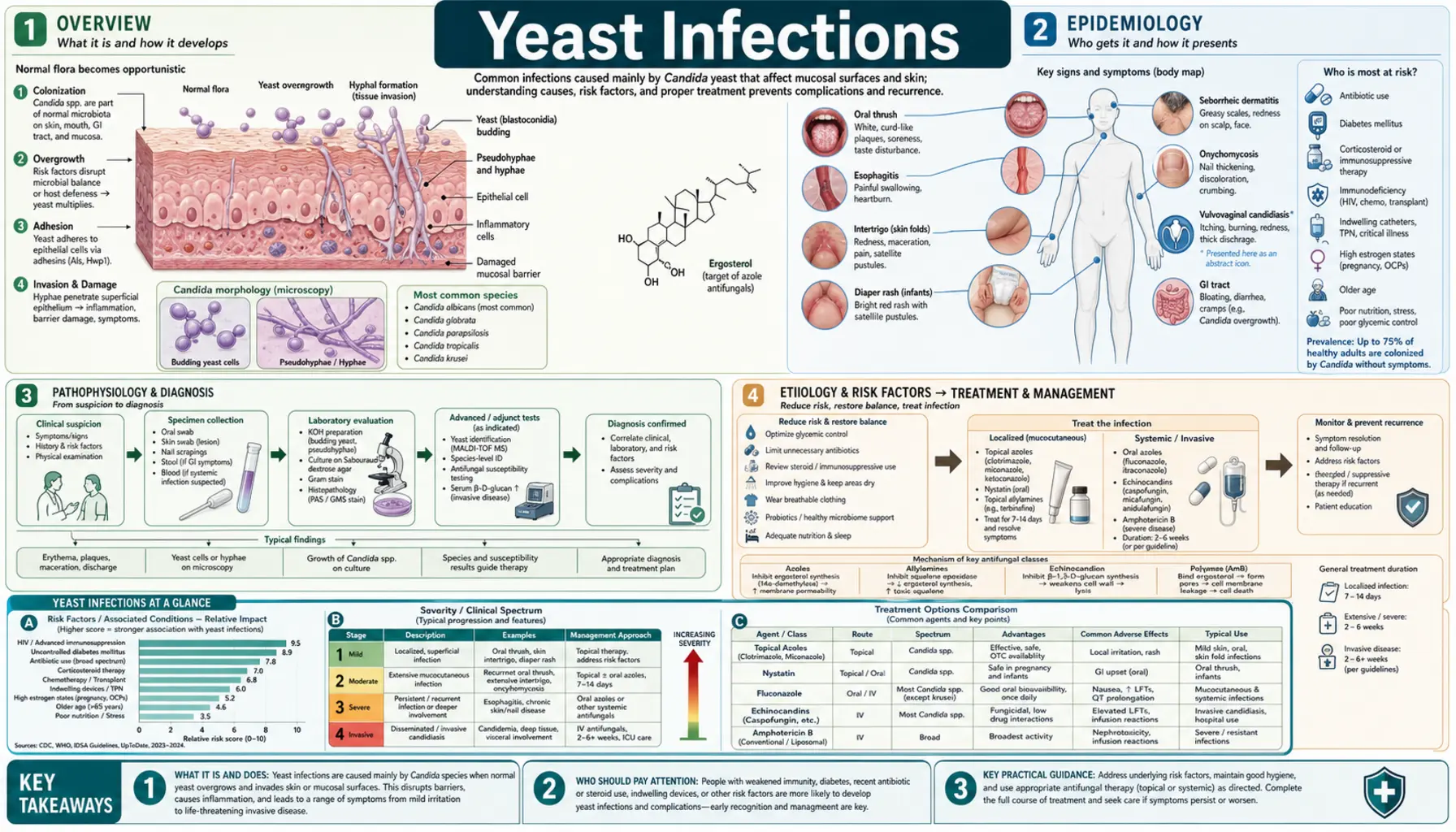
Table of Contents
- Overview
- Epidemiology
- Pathophysiology
- Etiology and Risk Factors
- Clinical Presentation
- Diagnosis
- Treatment
- Complications
- Prognosis
- Prevention
- Recent Research and Advances
- Research Papers
- Connections
- Featured Videos
1. Overview
A vaginal yeast infection — the medical term is vulvovaginal candidiasis (VVC) — is one of the most common reasons women see a clinician for vaginal symptoms. It is an overgrowth of a yeast, almost always Candida albicans, that produces the familiar trio of intense itching, burning, and a thick white discharge. It is so common that an estimated three out of four women will have at least one yeast infection in their lifetime, and many will have more than one.
Two facts are worth stating up front, because they push back on a lot of shame and misinformation. First, a yeast infection is not a sexually transmitted infection (STI). You do not "catch" it from a partner the way you catch chlamydia or gonorrhea. Second, it is not a sign that you are dirty or that you have poor hygiene — if anything, over-washing and scented products make things worse. Candida is a normal resident of the vagina, gut, and skin in many healthy people. A yeast infection happens when the local ecosystem shifts and that normally quiet yeast multiplies past the point your body tolerates it. You did not do anything wrong to cause it.
The good news is that yeast infections are generally easy to treat and respond well to short courses of antifungal medication. The trickier part — and a major theme of this page — is making sure that itching and discharge are actually caused by yeast and not by something else, because several other conditions produce overlapping symptoms and need entirely different treatment.
2. Epidemiology
Vulvovaginal candidiasis is extraordinarily common. Roughly 70–75% of women experience at least one episode during their reproductive years, and about 40–50% have a second episode. A smaller but important group — estimated at around 5–8% of women of reproductive age — develop recurrent vulvovaginal candidiasis (RVVC), defined as four or more culture-confirmed episodes in a year. A 2018 systematic review and global modeling study estimated that recurrent VVC affects approximately 138 million women worldwide each year, with annual losses in productivity that run into the billions of dollars.
Candidiasis is overwhelmingly a condition of the reproductive years. It is uncommon before puberty and becomes less frequent after menopause, because Candida thrives in the estrogen-rich, glycogen-rich vaginal environment of women who are menstruating. It becomes common again in postmenopausal women who take estrogen therapy. The single most consistent demographic finding is simply that exposure to estrogen, antibiotics, and uncontrolled blood sugar — not personal hygiene — drives the numbers.
3. Pathophysiology
To understand a yeast infection, picture the vagina as a tiny, balanced ecosystem. In health it is dominated by beneficial bacteria called Lactobacillus, which produce lactic acid and keep the vaginal pH acidic (usually below 4.5). This acidity, along with other defenses, holds Candida in check. Candida can live there quietly as a commensal — a harmless tenant — in 20% or more of healthy women without causing any symptoms at all.
Trouble starts when Candida shifts from its rounded, budding yeast form to an invasive, thread-like hyphal (filamentous) form. These hyphae burrow between and into the surface cells of the vaginal lining. Importantly, the misery of a yeast infection — the itching, swelling, and redness — is driven less by the yeast itself than by the immune system's inflammatory response to it. White blood cells flood the area and release signaling molecules, producing the heat, swelling, and intense itch. This is why two women with the same amount of yeast can have very different symptoms: it is the immune reaction, not the raw fungal count, that you feel.
Unlike bacterial vaginosis, where Lactobacillus is lost and pH rises, in a classic yeast infection the Lactobacillus and the acidic pH are usually preserved. That single fact — normal pH — is one of the most useful clues for telling yeast apart from other causes of vaginitis.
4. Etiology and Risk Factors
About 85–90% of yeast infections are caused by Candida albicans. The remainder are caused by non-albicans species — most often Candida glabrata (now also called Nakaseomyces glabratus), and less often C. krusei, C. tropicalis, or C. parapsilosis. This distinction matters for treatment, because non-albicans species are often less responsive to the standard azole antifungals.
Several well-established factors tip the balance toward overgrowth:
- Recent antibiotics — the classic trigger. Broad-spectrum antibiotics kill off protective Lactobacillus along with the bacteria they were meant to treat, opening space for yeast. Many women recognize the pattern: a sinus or urinary infection, a course of antibiotics, then a yeast infection a week later.
- Uncontrolled diabetes — high blood sugar feeds yeast. Repeated or stubborn yeast infections, especially in someone not previously known to be diabetic, are a legitimate reason to have blood sugar checked. A recurrent yeast infection can occasionally be the first clue to undiagnosed or poorly controlled diabetes.
- Pregnancy — high estrogen and increased vaginal glycogen make pregnancy a high-risk state for VVC.
- Estrogen exposure — high-dose combined oral contraceptives, estrogen therapy, and the natural estrogen surge of the menstrual cycle all favor yeast.
- Immunosuppression — HIV infection, organ-transplant medications, chemotherapy, and high-dose corticosteroids all weaken the local immune defenses.
- Recent corticosteroid use, including inhaled or oral steroids for asthma or autoimmune disease.
Some factors that get blamed are not strongly supported by evidence — routine sexual activity, tight clothing, and tampon use are weak or inconsistent associations. And again: yeast infections are not classified as an STI. Treating a male partner does not prevent a woman's recurrences and is generally not recommended.
5. Clinical Presentation
The hallmark of a yeast infection is itching — often intense, sometimes maddening — of the vulva and vaginal opening. Other typical symptoms include:
- Burning, especially during urination (as urine passes over inflamed skin) or during sex.
- Thick, white, clumpy discharge classically described as resembling cottage cheese. Crucially, this discharge is odorless or nearly so.
- Redness and swelling of the vulva, sometimes with small cracks (fissures) or a scattered rash extending onto the surrounding skin.
- Soreness and pain with intercourse (dyspareunia) and discomfort with urination (external dysuria).
How yeast differs from bacterial vaginosis and STIs
This is where many women (and a fair number of clinicians) go wrong. The three big causes of vaginal symptoms — yeast, bacterial vaginosis (BV), and trichomoniasis (an STI) — overlap but have telling differences:
- Yeast: very itchy, thick white "cottage cheese" discharge, no fishy odor, normal (acidic) pH below 4.5.
- Bacterial vaginosis: thin, gray-white discharge with a distinct fishy odor (especially after sex), elevated pH above 4.5, and usually less itching. BV is an imbalance of bacteria, not a yeast.
- Trichomoniasis: a sexually transmitted parasite that can cause frothy yellow-green discharge, odor, and irritation, with elevated pH; it requires oral prescription treatment and partner treatment.
For a careful side-by-side comparison of yeast versus BV — including the "whiff test," pH paper, and what each discharge looks like — see our dedicated Bacterial Vaginosis page. The one-line summary: fishy odor and high pH point away from yeast; intense itch with normal pH and no odor points toward it.
The over-the-counter pitfall (read this before you buy)
Here is a practical, money-saving point that the box of antifungal cream will never tell you: most women who self-diagnose a yeast infection are wrong. In a landmark 2002 study, women buying over-the-counter antifungals at the pharmacy were examined and tested — only about one-third actually had a yeast infection. The rest had bacterial vaginosis, trichomoniasis, a mix of conditions, or no infection at all. Repeatedly buying antifungal creams for symptoms that aren't yeast wastes your money, doesn't fix the real problem, and can delay correct diagnosis for weeks.
OTC antifungals are reasonable for a woman who has had a doctor-confirmed yeast infection before and recognizes the identical symptoms returning. But you should get tested rather than self-treat if:
- This is your first-ever episode of these symptoms.
- Symptoms are severe, or include fever, pelvic pain, or foul-smelling discharge.
- You are pregnant.
- Symptoms are recurrent (this keeps happening).
- You've already tried an OTC antifungal and it didn't work.
6. Diagnosis
Proper diagnosis is quick, inexpensive, and worth it. A clinician typically does the following:
- Examination of the vulva and vagina, looking for redness, swelling, fissures, and the characteristic discharge.
- Vaginal pH testing with a strip of pH paper. A normal, acidic pH (below 4.5) is consistent with yeast and helps rule out BV and trichomoniasis, which raise the pH.
- Microscopy — a sample of discharge is examined under the microscope. Adding potassium hydroxide (KOH) to the slide dissolves cells and debris, making the budding yeast and branching hyphae (pseudohyphae) easier to see. Seeing hyphae confirms active infection.
- Fungal culture — reserved for cases that are recurrent, complicated, or not responding to treatment. Culture identifies the exact species (important for spotting C. glabrata and other azole-resistant non-albicans yeasts) and can guide which drug to use.
Newer molecular (PCR/NAAT) panels can detect Candida and distinguish it from BV and trichomoniasis from a single swab; they are sensitive and increasingly available, though microscopy and culture remain the workhorses. A key caveat: a positive culture or PCR alone, in a woman with no symptoms, does not mean she needs treatment — Candida is a normal commensal, and treating colonization without symptoms is unnecessary.
7. Treatment
Uncomplicated yeast infections
For a typical, uncomplicated yeast infection caused by C. albicans, short-course azole antifungals work very well, with cure rates of roughly 80–90%. You have two equally effective routes, and the choice mostly comes down to your preference:
- Topical azoles — over-the-counter miconazole or clotrimazole creams or suppositories, available as 1-day, 3-day, or 7-day regimens. Longer regimens are often gentler on already-inflamed tissue. These act locally and are safe in pregnancy.
- Oral fluconazole — a single 150 mg pill by prescription. Its efficacy is equivalent to topical treatment, and many women prefer the convenience of one tablet over several days of cream. Fluconazole is not used in pregnancy (see below).
For more severe inflammation, clinicians sometimes use two doses of fluconazole 150 mg three days apart, or a longer 7–14 day topical course.
Non-albicans species (C. glabrata)
If symptoms persist after standard treatment, a culture may reveal Candida glabrata or another non-albicans species. These yeasts are frequently less responsive to azoles. Options include a longer course of intravaginal therapy, intravaginal boric acid suppositories (600 mg nightly for about 2 weeks), or, in resistant cases, prescription nystatin or compounded flucytosine cream prescribed by a specialist.
Recurrent vulvovaginal candidiasis (≥4 per year)
Recurrent VVC is treated as a two-phase problem: first knock the infection down (induction), then keep it down (maintenance/suppression). A landmark 2004 trial published in the New England Journal of Medicine by Sobel and colleagues established the modern standard: after induction, weekly oral fluconazole (150 mg) for six months dramatically reduced recurrences while women stayed on it. The catch, honestly reported, is that recurrences often return after maintenance stops — suppression controls the disease but does not cure the underlying tendency. The widely used European "ReCiDiF" regimen uses a tapering, individualized fluconazole schedule built on the same induction-then-maintenance logic.
Two newer oral antifungals are now approved specifically for recurrent VVC, and it is worth describing them accurately:
- Oteseconazole (brand Vivjoa) is a selective fungal CYP51 inhibitor. In the phase 3 program reported by Martens and colleagues in 2022, it reduced recurrences over a year compared with placebo. Because it has a very long half-life and theoretical reproductive-toxicity signals in animals, it is approved only for women who cannot become pregnant.
- Ibrexafungerp (brand Brexafemme) is a first-in-class oral triterpenoid (a glucan synthase inhibitor) approved for treating acute VVC and for reducing recurrences. The VANISH trials reported by Sobel and colleagues showed it outperformed placebo for acute episodes.
These are useful additions, especially for azole-resistant or refractory disease, but they are not magic bullets and are considerably more expensive than generic fluconazole.
Probiotics, diet, and the "candida cleanse" myth
It is fair to ask whether Lactobacillus probiotics or dietary changes can prevent or cure yeast infections. The honest answer is: the evidence is limited and mixed, and it is easy to oversell. A 2017 Cochrane systematic review found that probiotics, added on to conventional antifungals, might modestly improve short-term cure rates, but the studies were small and of low-to-moderate quality, so the result is far from conclusive. A randomized trial by Pirotta and colleagues (BMJ, 2004) testing oral and vaginal Lactobacillus to prevent post-antibiotic yeast infections found no benefit. Probiotics are generally safe and low-risk to try, but they should not replace proven antifungal treatment, and you should not expect dramatic results.
A more important point: please be skeptical of the popular online idea of "systemic candida overgrowth" — the claim that a body-wide yeast burden causes fatigue, brain fog, bloating, and dozens of other vague symptoms, curable by a restrictive "candida cleanse" or "candida diet." This concept is not supported by medical evidence. Localized infections (vaginal, oral thrush, skin folds) are real and treatable; true invasive, bloodstream candidiasis is a serious hospital illness in profoundly immunocompromised people, not something an otherwise-healthy person treats with a juice cleanse. The danger of the "candida cleanse" framing is that it sends people on expensive, restrictive diets and supplement regimens while their actual cause of symptoms — which may be something entirely different — goes undiagnosed. Your symptoms are real; the "systemic candida" explanation usually is not.
Boric acid suppositories
Intravaginal boric acid (typically 600 mg in a gelatin capsule, inserted nightly) has the best evidence as a second-line option for recurrent or non-albicans infections that don't respond to azoles. A 2011 review by Iavazzo and colleagues found mycologic cure rates of roughly 40–100% across studies, supporting its use when standard treatment fails. Two safety points are non-negotiable: boric acid is for vaginal use only — it is toxic if swallowed, so it must be kept away from children and never taken by mouth — and it is not used in pregnancy.
Pregnancy
Yeast infections are common in pregnancy and should be treated, but the approach changes: use topical azole creams (such as clotrimazole or miconazole, typically a 7-day course) and avoid oral fluconazole. High-dose oral fluconazole in early pregnancy has been associated with possible birth defects, and even low doses carry uncertainty, so the prudent, guideline-endorsed choice in pregnancy is topical therapy only. Boric acid is likewise avoided in pregnancy.
When the itching isn't yeast at all
If antifungals keep failing, step back: persistent vulvar itching is often not yeast. Several skin conditions mimic it and need very different care:
- Lichen sclerosus — a chronic inflammatory skin condition causing itching, whitening, and thinning of vulvar skin; it needs prescription steroid ointment and ongoing follow-up, and is not treated by antifungals.
- Eczema and contact/irritant dermatitis — often triggered by scented soaps, wipes, pads, or the antifungal creams themselves. See Eczema.
- Atrophic vaginitis in postmenopausal women, from low estrogen.
The practical rule: if you've treated "yeast" two or three times without lasting relief, stop self-treating and see a clinician for an exam — ideally during symptoms, so they can test rather than guess.
8. Complications
For most women, an uncomplicated yeast infection is uncomfortable but not dangerous and causes no lasting harm. The most common "complications" are really consequences of mistreatment: recurrent symptoms, repeated wasted spending on OTC products, irritation from over-treatment, and the emotional toll of an undiagnosed problem. Severe inflammation can cause painful fissures and broken skin, which occasionally allow a secondary bacterial infection.
In profoundly immunocompromised people — advanced HIV/AIDS, transplant recipients, those on chemotherapy — candidiasis can be more severe, more frequent, and harder to clear, and a small minority can develop invasive disease. This is the exception, not the rule, and does not apply to otherwise-healthy women with ordinary yeast infections. Recurrent or stubborn infections also warrant a check for undiagnosed diabetes — see Diabetes and Insulin Resistance.
9. Prognosis
The outlook for yeast infections is excellent. Uncomplicated episodes clear with a single short course of antifungal medication in the large majority of women, with relief often beginning within a day or two. The chief challenge is not the individual infection but the minority of women with recurrent disease, for whom maintenance therapy controls symptoms well during treatment but recurrences may return when it stops. Even so, recurrent VVC is a manageable, long-term condition, not a progressive or life-threatening one. With accurate diagnosis (testing rather than guessing), most women achieve good, durable control.
10. Prevention
Some risk factors are modifiable; many are not, and it's worth being honest about the limits of control. Reasonable, evidence-aligned steps include:
- Avoid unnecessary antibiotics. The single most actionable step. Don't push for antibiotics for viral colds; when you genuinely need them, know a yeast infection may follow and be ready to treat it.
- Manage diabetes and blood sugar. Good glycemic control reduces yeast overgrowth and recurrences.
- Avoid douching and scented products. Douches, scented soaps, "feminine washes," sprays, and scented pads disrupt the protective Lactobacillus balance and irritate the skin. Wash the vulva with plain water; the vagina cleans itself.
- Breathable underwear. Cotton underwear and changing out of wet swimsuits or sweaty workout clothes are commonly recommended — the evidence is modest, but they are harmless and may help some women.
What you should not do is blame yourself or chase elaborate "anti-candida" diets and cleanses. For most women, yeast infections are an occasional, treatable nuisance driven by hormones, antibiotics, and blood sugar — factors that are often only partly within your control. A recurrence is not a personal failing.
11. Recent Research and Advances
Several active research directions are reshaping how recurrent and resistant yeast infections are managed. The two recently approved oral antifungals — oteseconazole (a long-acting, fungus-selective CYP51 inhibitor) and ibrexafungerp (a first-in-class oral glucan synthase inhibitor) — give clinicians genuinely new mechanisms for recurrent and azole-resistant disease, an area where treatment had stagnated for two decades. Their real-world value, cost-effectiveness, and durability beyond the trial period are still being worked out.
A second major theme is antifungal resistance, particularly among non-albicans species such as C. glabrata, which has driven renewed interest in older agents (boric acid, flucytosine) and in stewardship to avoid overusing azoles. A third is the role of the vaginal microbiome and the host immune response: research increasingly frames symptomatic VVC as an immune-driven condition (an exaggerated inflammatory response to a normal commensal) rather than simply "too much yeast," which may eventually lead to immune-modulating or microbiome-based therapies. For now, the practical advances that benefit patients most are unglamorous: accurate testing instead of self-diagnosis, recognizing non-albicans species, and not mistaking skin conditions or the "candida cleanse" myth for a yeast infection.
12. References & Research
Historical Background
Vaginal candidiasis has been recognized for well over a century, but effective oral therapy is relatively recent. The systematic study of recurrent disease began in the 1980s, when Sobel's prospective work in the New England Journal of Medicine (1986) defined recurrent vulvovaginal candidiasis as a distinct clinical entity. The introduction of the azole antifungals, and especially the single-dose oral fluconazole regimen, transformed treatment in the 1990s by offering a convenience equivalent in efficacy to topical creams. The pivotal 2004 NEJM maintenance-fluconazole trial then established the modern induction-plus-suppression strategy for recurrent disease. Most recently, the 2021 CDC guidelines and the approval of oteseconazole and ibrexafungerp (2021–2022) opened the first new mechanistic options for recurrent and resistant infections in a generation.
Key Research Papers
- Sobel JD. Vulvovaginal candidosis. The Lancet, 2007;369(9577):1961–1971.
- Sobel JD, Wiesenfeld HC, Martens M, et al. Maintenance Fluconazole Therapy for Recurrent Vulvovaginal Candidiasis. New England Journal of Medicine, 2004;351(9):876–883.
- Sobel JD. Recurrent Vulvovaginal Candidiasis: A Prospective Study of the Efficacy of Maintenance Ketoconazole Therapy. New England Journal of Medicine, 1986;315(23):1455–1458.
- Martens MG, Maximos B, Degenhardt T, et al. Phase 3 study evaluating the safety and efficacy of oteseconazole in the treatment of recurrent vulvovaginal candidiasis and acute vulvovaginal candidiasis infections. American Journal of Obstetrics and Gynecology, 2022;227(6):880.e1–880.e11.
- Sobel JD, Donders G, Degenhardt T, et al. Efficacy and Safety of Oral Ibrexafungerp in Subjects with Vulvovaginal Candidiasis: A Global Phase 3 Study (VANISH 306). American Journal of Obstetrics and Gynecology, 2022;226(6):880.e1–880.e11.
- Pirotta M, Gunn J, Chondros P, et al. Effect of lactobacillus in preventing post-antibiotic vulvovaginal candidiasis: a randomised controlled trial. BMJ, 2004;329(7465):548.
- Xie HY, Feng D, Wei DM, et al. Probiotics for vulvovaginal candidiasis in non-pregnant women. Cochrane Database of Systematic Reviews, 2017;(11):CD010496.
- Iavazzo C, Gkegkes ID, Zarkada IM, Falagas ME. Boric Acid for Recurrent Vulvovaginal Candidiasis: The Clinical Evidence. Journal of Women's Health, 2011;20(8):1245–1255.
- Ferris DG, Nyirjesy P, Sobel JD, et al. Over-the-Counter Antifungal Drug Misuse Associated With Patient-Diagnosed Vulvovaginal Candidiasis. Obstetrics & Gynecology, 2002;99(3):419–425.
- Workowski KA, Bachmann LH, Chan PA, et al. Sexually Transmitted Infections Treatment Guidelines, 2021. MMWR Recommendations and Reports, 2021;70(4):1–187.
- Gonçalves B, Ferreira C, Alves CT, et al. Vulvovaginal candidiasis: Epidemiology, microbiology and risk factors. Critical Reviews in Microbiology, 2016;42(6):905–927.
- Blostein F, Levin-Sparenberg E, Wagner J, Foxman B. Recurrent vulvovaginal candidiasis. Annals of Epidemiology, 2017;27(9):575–582.e3.
- Denning DW, Kneale M, Sobel JD, Rautemaa-Richardson R. Global burden of recurrent vulvovaginal candidiasis: a systematic review. The Lancet Infectious Diseases, 2018;18(11):e339–e347.
Research Papers
Explore current, peer-reviewed literature on vulvovaginal candidiasis and yeast infections through these live PubMed topic searches. Each link opens the latest indexed studies in a new tab.
- Vulvovaginal candidiasis
- Recurrent vulvovaginal candidiasis
- Candida albicans vaginitis
- Candida glabrata vaginitis treatment
- Fluconazole vulvovaginal candidiasis
- Boric acid vaginal candidiasis
- Oteseconazole
- Ibrexafungerp vulvovaginal candidiasis
- Probiotics and vulvovaginal candidiasis
- Diabetes and vulvovaginal candidiasis
- Vaginal microbiome and Candida
- Azole resistance in Candida vaginitis
Connections
- Reproductive Medicine
- Bacterial Vaginosis — the most common look-alike; side-by-side comparison of yeast vs. BV.
- Infertility — related reproductive-health topic and vaginal-health context.
- Urinary Tract Infections — another common cause of burning and discomfort, often confused with yeast.
- Diabetes — high blood sugar feeds yeast; recurrent infections can be a clue to check it.
- Insulin Resistance — the metabolic precursor to diabetes and elevated glucose.
- Fungal Infections — the broader family of Candida and other fungal infections.
- Eczema — irritant/contact dermatitis that can mimic persistent vulvar itching.
- HIV / AIDS — immunosuppression that makes candidiasis more frequent and severe.
- SIBO — another condition wrongly blamed on "systemic yeast" in popular health claims.
- Probiotics — the honest evidence on Lactobacillus for vaginal health.
- Yogurt — a dietary source of Lactobacillus often suggested for vaginal balance.
- Garlic — a folk antifungal remedy; useful context on what the evidence does and doesn't support.
- All Conditions — the full health-conditions index.