Rheumatoid Arthritis
Deep-Dive Articles
Rheumatoid Arthritis in the Shoulder
Why the glenohumeral joint is affected later but disables more, how RA shoulder pain differs from a rotator cuff tear or frozen shoulder, injections, and when reverse shoulder replacement is the right operation.
Omega-3 and Fish Oil
What the randomised trials actually show, the dose that separates the positive trials from the null ones, how long it takes to work, and the honest limits of what fish oil can do.
Diet and Rheumatoid Arthritis
Mediterranean-diet trials, the fasting studies, the gut-microbiome hypothesis, and why body weight changes both disease activity and how well treatment works.
DMARDs and Biologics
Methotrexate, biologics and JAK inhibitors explained in plain language, plus why the first months of treatment decide how much joint damage becomes permanent.
Exercise and Joint Protection
Why resting an inflamed joint was wrong, safe shoulder work including pendulums and cuff strengthening, pacing through a flare, and the warning signs that mean stop.
Herbs and Supplements
Curcumin, boswellia, cat's claw, white peony and thunder god vine, each with an explicit evidence tier and its documented harms stated beside the claim.
Table of Contents
- Deep-Dive Articles
- Overview
- Epidemiology
- Pathophysiology
- Etiology and Risk Factors
- Clinical Presentation
- Diagnosis
- Treatment
- Complications
- Prognosis
- Prevention
- Recent Research and Advances
- Research Papers
- Herbs Used for This Condition
- Connections
- Featured Videos
1. Overview
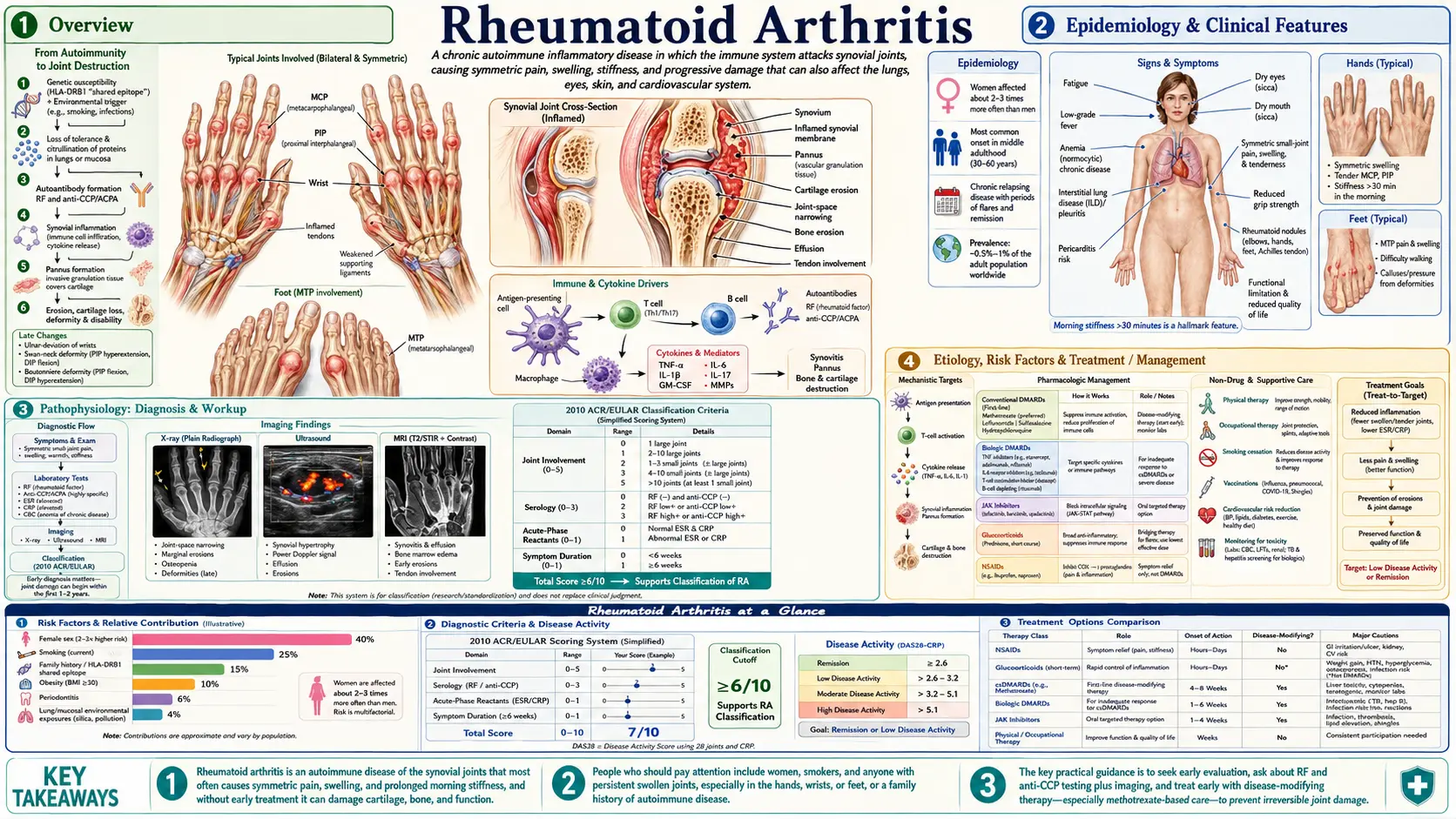
Rheumatoid arthritis (RA) is a chronic autoimmune disease in which the immune system — the same defense system that normally fights infections — mistakenly attacks the lining of your own joints. The result is inflammation that, left untreated, gradually damages cartilage and bone. RA is not the “wear-and-tear” arthritis that comes with age. That is osteoarthritis, a different disease driven by mechanical breakdown of cartilage. RA is driven by inflammation, and that distinction changes everything about how it is treated. If you are reading this because you or someone you love was just diagnosed, here is the single most important fact: RA today is a very different disease than it was thirty years ago. Most people who start treatment early now reach low disease activity or remission and live full, active lives.
RA is a systemic disease, meaning it affects the whole body, not just the joints. It commonly causes profound fatigue, can inflame the lungs, eyes, and blood vessels, and roughly doubles the risk of heart disease. The classic pattern is symmetric — if your right hand hurts, your left usually does too — and it favors the small joints of the hands, wrists, and feet, with morning stiffness lasting more than an hour. Understanding RA as an inflammatory, body-wide disease (rather than a local joint problem) is the key to understanding why early, aggressive treatment of the inflammation — not just pain relief — is what protects your joints and your life.
For a broader comparison of all the major arthritis types — osteoarthritis, gout, psoriatic arthritis, and more — see our arthritis overview. This page focuses specifically on rheumatoid arthritis.
2. Epidemiology
Rheumatoid arthritis affects roughly 1.3–1.5 million adults in the United States and somewhere between 0.5% and 1% of adults worldwide. It is one of the most common autoimmune diseases. The lifetime risk of developing RA is estimated at about 3.6% for women and 1.7% for men.
Women are affected two to three times more often than men. This sex difference is real and consistent across populations, and it points toward a role for sex hormones in how the disease begins and behaves, though the exact mechanism is still being worked out. RA can begin at any age, but onset most often peaks between the ages of 40 and 60. A subset of children develop a related condition, juvenile idiopathic arthritis, which is managed differently.
RA occurs in every part of the world but with notably higher rates in some Indigenous North American populations and lower rates in parts of rural Africa and Asia. These geographic differences reflect a mix of genetic background and environmental exposures — especially smoking, which is discussed below as the single most important modifiable risk factor.
3. Pathophysiology
To understand RA, picture the inside of a healthy joint. The joint is wrapped in a thin membrane called the synovium, which produces a slippery fluid that lubricates movement. In RA, the immune system attacks this synovium. White blood cells flood in, the membrane thickens dramatically, and it transforms into an aggressive, invasive tissue called pannus. This pannus behaves almost like a slow-growing tumor of inflammation: it creeps over the cartilage and bone at the joint margins and chemically dissolves them. The bone damage it causes shows up on X-rays as erosions — and once bone is eroded, it does not grow back. This is why stopping the inflammation early matters so much.
What drives the immune system to attack in the first place? A central piece of the puzzle is a chemical process called citrullination. Normally, certain proteins in your body contain an amino acid called arginine. Under conditions of inflammation, an enzyme converts arginine into a slightly different molecule called citrulline. In most people this is harmless. But in people genetically primed for RA, the immune system sees these citrullinated proteins as foreign invaders and makes antibodies against them — the anti-citrullinated protein antibodies (ACPAs), measured in the clinic as the anti-CCP antibody test. A second antibody, rheumatoid factor (RF), is also commonly present. Once these antibodies form, they fuel a self-sustaining cycle of inflammation.
The inflammation itself is carried out by signaling molecules called cytokines — especially tumor necrosis factor (TNF), interleukin-6 (IL-6), and interleukin-1. These are the messengers that tell immune cells to keep attacking. The fact that we can now block these specific cytokines with drugs is the reason RA treatment was revolutionized.
It is important to know that seronegative RA exists. Roughly a quarter of people with genuine, erosive RA have negative blood tests for both anti-CCP and rheumatoid factor. A negative antibody test does not rule out RA. The diagnosis is made by the whole clinical picture, not by a single lab value.
4. Etiology and Risk Factors
RA arises from a collision between genes and the environment. Neither alone is usually enough; it is the combination that triggers disease. Understanding this is genuinely empowering, because one of the two main ingredients is something you can change.
Genetics. The strongest genetic risk comes from a group of variants in the HLA-DRB1 gene known collectively as the shared epitope. These variants shape how your immune system presents proteins to itself. They do not cause RA on their own — plenty of people carry them and never get the disease — but they set the stage. Family history matters: having a first-degree relative with RA raises your risk several-fold.
Smoking — the major modifiable risk. This is the most important thing in this section. Cigarette smoking is, by a wide margin, the leading preventable environmental cause of RA. And the mechanism is now understood with unusual clarity. Smoking promotes citrullination of proteins in the lungs. In people who carry the HLA-DRB1 shared epitope, this citrullination is exactly the signal that triggers the immune system to make anti-CCP antibodies. In other words, smoking and the shared-epitope gene multiply each other's effect — this is what scientists call a gene–environment interaction. The landmark study by Klareskog and colleagues showed that people who both smoke and carry two copies of the shared epitope have a dramatically elevated risk of anti-CCP-positive RA, far higher than either factor alone. The empowering corollary: quitting smoking lowers your risk, and in people who already have RA, stopping smoking improves how well the disease responds to treatment. It is never too late.
Gum disease and Porphyromonas gingivalis. There is a real, biologically plausible link between chronic periodontal (gum) disease and RA. The bacterium Porphyromonas gingivalis, a major cause of gum disease, is unusual: it carries its own citrullinating enzyme. Wegner and colleagues showed it can citrullinate human proteins directly — potentially creating the very targets the RA immune system attacks. This does not mean gum disease “causes” RA in any simple way, but it makes good dental care a reasonable, low-risk part of caring for yourself.
The gut microbiome. Research into the trillions of bacteria living in the gut has identified an expansion of one species, Prevotella copri, in many people with new-onset, untreated RA. This is genuinely exciting and biologically suggestive — but it is still early science. It points to a possible origin of the immune misfire outside the joints, but it is not yet something that changes treatment, and no probiotic has been proven to treat RA. We mention it honestly: promising, real, not yet actionable.
Other factors. Female sex, family history, obesity, and possibly silica dust exposure raise risk. Moderate alcohol intake and a higher intake of oily fish have been associated with slightly lower risk in some studies, though these associations are weaker.
5. Clinical Presentation
RA usually begins gradually over weeks to months, though it can occasionally come on suddenly. The hallmark features are worth knowing because they help distinguish RA from other joint problems.
Symmetric small-joint involvement. RA characteristically affects the same joints on both sides of the body — both wrists, the same knuckles on both hands, the balls of both feet. The most commonly involved joints are the MCP joints (where fingers meet the hand), the PIP joints (the middle knuckles), the wrists, and the small joints of the feet. The very last joints at the fingertips (the DIP joints) are usually spared in RA — involvement there points more toward osteoarthritis.
Morning stiffness lasting more than an hour. This is one of the most useful clues. People with RA wake up stiff and gel-like, and it takes more than an hour — often several hours — for the joints to loosen up. In contrast, the morning stiffness of osteoarthritis typically resolves in under 30 minutes. Prolonged morning stiffness reflects active inflammation.
Fatigue is a real, systemic symptom — not in your head. Many people with RA describe a bone-deep exhaustion that no amount of sleep fixes. This is biologically real: the same inflammatory cytokines that attack joints act on the brain and body to produce profound fatigue. It is one of the symptoms patients rate as most disabling, and it deserves to be taken seriously by your care team.
Other features include warm, swollen, tender joints; low-grade fever; weight loss; and a general feeling of being unwell. Over time, untreated RA can produce the classic hand deformities — ulnar deviation, swan-neck and boutonnière deformities — but with modern early treatment, these are increasingly rare. Seeing them today is a sign of disease that was caught or treated too late, not an inevitable outcome.
6. Diagnosis
There is no single test that says “yes, this is RA.” The diagnosis is a clinical judgment built from your symptoms, a physical exam, blood tests, and imaging. Rheumatologists often use the 2010 ACR/EULAR classification criteria as a framework. In plain terms, these criteria add up points based on four things:
- How many and which joints are involved — more small joints, and more joints overall, score higher.
- Blood antibody tests — a positive anti-CCP or rheumatoid factor, especially at high levels, scores higher.
- Inflammation markers — an elevated ESR or CRP (simple blood tests for inflammation).
- Duration — symptoms lasting six weeks or more.
A total score above a threshold supports the diagnosis. The point of the criteria is to catch RA early, before joint damage occurs.
About the antibody tests. The anti-CCP antibody is highly specific for RA — meaning a positive result strongly points to RA and away from look-alike conditions. It can also appear in the blood years before any joint symptoms (see the pre-RA window below). Rheumatoid factor is useful but less specific; it can be positive in other conditions and even in some healthy people, especially with age. Remember: a person can have negative antibodies and still have real, erosive RA (seronegative RA).
Imaging. Plain X-rays may be normal early on, since erosions take time to appear. Ultrasound and MRI are far more sensitive: ultrasound can detect active synovial inflammation and early erosions before they show on X-ray, and it can spot inflammation a physical exam might miss. Increasingly, rheumatologists use ultrasound to confirm active disease and guide treatment decisions.
7. Treatment
Modern RA treatment rests on one transformative idea, so important it has its own name.
The window of opportunity. There is a critical early period — the first few months after symptoms begin — during which starting effective treatment can fundamentally change the course of the disease. Treat early, and you can often halt or even prevent joint damage. Wait, and the pannus quietly erodes bone that never grows back. This is why rheumatologists push so hard for prompt referral and early treatment, and why “let's wait and see if it gets better on its own” is the wrong approach for inflammatory arthritis. Waiting destroys joints.
Treat-to-target. The guiding strategy, supported by the landmark TICORA trial (Grigor et al.), is to set a clear target — remission or, failing that, low disease activity — measure disease activity regularly, and intensify treatment relentlessly until the target is reached. TICORA showed that patients managed with tight, objective monitoring did dramatically better than those treated more loosely, with no extra cost. The principle is now standard of care: don't accept “a little better.” Aim for remission.
Methotrexate — the cornerstone. For most people, the first and most important drug is methotrexate (MTX). It has anchored RA treatment for decades because it works, it is inexpensive, and we understand it well. Key practical points:
- It is taken once a week, not daily. This is the most dangerous point of confusion in all of RA care — accidentally taking methotrexate daily can be life-threatening. Same day each week, every week.
- Take folic acid (a B vitamin) as prescribed. It substantially reduces the most common side effects — mouth sores, nausea, and abnormal liver tests — without reducing how well the methotrexate works.
- Side effects can include nausea, fatigue the day after dosing, mouth ulcers, and changes in blood counts or liver enzymes, which is why regular blood monitoring is routine. Switching to an injectable form often helps with nausea.
- Alcohol. Historically patients were told to avoid alcohol entirely because both methotrexate and alcohol can stress the liver. The current view is more nuanced — evidence suggests light, moderate drinking (within general low-risk limits) does not meaningfully raise liver risk for most people on methotrexate — but this is genuinely debated, and the right answer depends on your liver health and your doctor's judgment. Discuss your specific situation rather than assuming.
Biologic DMARDs. When methotrexate alone is not enough, the next step is usually a biologic — a precisely engineered drug that blocks a specific part of the immune attack. The first and best-known class are the TNF inhibitors (such as adalimumab, etanercept, and infliximab). The infliximab-plus-methotrexate combination, proven in the ATTRACT trial (Maini et al.), helped launch the biologic era in 1998–1999 and showed that you could not just relieve symptoms but actually halt structural joint damage. Other biologics target different parts of the immune system: IL-6 blockers (tocilizumab), B-cell depletion (rituximab, proven effective by Edwards et al.), and T-cell co-stimulation blockade (abatacept). Biologics are given by injection or infusion and do raise infection risk, so screening for tuberculosis and hepatitis before starting is standard.
JAK inhibitors — and an honest safety note. A newer class, the JAK inhibitors (tofacitinib, baricitinib, upadacitinib), are taken as pills rather than injections, which many patients prefer, and they work well — the baricitinib RA-BEAM trial (Taylor et al.) showed it could outperform an established TNF inhibitor. But honesty requires flagging a real safety signal. The large post-marketing ORAL Surveillance trial (Ytterberg et al.) compared tofacitinib against TNF inhibitors in older patients with cardiovascular risk factors and found higher rates of serious heart events, blood clots, cancer, and death with tofacitinib. As a result, regulators recommend JAK inhibitors generally be used after a TNF inhibitor has failed, and used with extra caution in people over 65, current or past smokers, and those with heart-disease or clot risk. They remain valuable drugs — this is about choosing the right patient, not abandoning the class.
Steroids — for bridging only. Corticosteroids (prednisone) work fast and are excellent for calming a flare or covering the weeks before a DMARD kicks in — this is called bridging. But they are not a long-term solution. Chronic steroid use causes bone loss (osteoporosis), weight gain, high blood sugar, cataracts, infections, and more. The goal is always to use the lowest dose for the shortest time and taper off.
Tapering in remission. Good news worth knowing: people who reach sustained, deep remission can sometimes carefully reduce their medication under close supervision. This is done gradually and with monitoring, because stopping abruptly risks a flare — but the possibility of dialing back treatment is real and a sign of how far RA care has come.
What about diet and natural approaches? An honest assessment. Diet is not a substitute for DMARDs — no diet, supplement, or natural remedy has ever been shown to stop the joint destruction of RA, and choosing food over medication risks irreversible damage. Say it plainly: diet supports treatment; it does not replace it. That said, the evidence for diet as an adjunct is real and worth using:
- Mediterranean diet. A controlled trial by Sköldstam and colleagues found a Mediterranean-style diet (olive oil, fish, vegetables, whole grains, little red meat) produced modest but measurable reductions in disease activity and pain over three months. It is also excellent for the heart — a real benefit given RA's cardiovascular risk.
- Omega-3 fatty acids. Fish-oil omega-3s have dose-dependent anti-inflammatory effects; a meta-analysis by Goldberg and Schwartz found meaningful pain reduction at higher doses (often around 2.7 g/day of EPA+DHA). Dietary sources include salmon and sardines.
- Fasting then vegetarian diet. A notable controlled trial by Kjeldsen-Kragh and colleagues found that a 7–10 day fast followed by a year of a vegetarian diet produced lasting improvement in some patients — modest, real, and not a cure, but a genuine signal.
- Turmeric (curcumin) has anti-inflammatory properties and some small supportive trials, but it is an adjunct, not a DMARD.
Pregnancy planning. This is critical: methotrexate is teratogenic — it can cause serious birth defects and miscarriage — and must be stopped well before conception (typically a few months ahead) by both prospective mothers and fathers' guidance discussed with the care team. The encouraging news is that many women's RA naturally improves during pregnancy, likely due to immune changes, though it often flares again after delivery. Pregnancy-compatible medications (such as certain TNF inhibitors, hydroxychloroquine, and sulfasalazine) exist, so RA does not preclude a healthy pregnancy — it simply requires planning. Anyone with RA who is considering pregnancy should discuss medication timing with their rheumatologist before trying to conceive.
8. Complications
Because RA is a systemic inflammatory disease, its reach extends well beyond the joints. Knowing about these complications is not meant to frighten you — it is meant to explain why controlling the inflammation protects far more than your hands.
Cardiovascular disease — the leading cause of death in RA. RA roughly doubles the risk of heart attack and stroke. The reason is mechanistic and important: the same inflammation that attacks your joints also inflames your arteries, accelerating the plaque buildup that causes heart disease. This is why controlling RA inflammation is, in part, heart protection — and why the heart-healthy Mediterranean diet does double duty. See cardiovascular disease.
Interstitial lung disease (ILD). RA can inflame and scar the lung tissue, a serious complication called RA-associated interstitial lung disease. Bongartz and colleagues documented its real incidence and impact on survival. Smoking strongly raises this risk — another reason quitting matters. Persistent cough or breathlessness in someone with RA should always be evaluated.
Sjögren's overlap and eye involvement. Many people with RA develop dry eyes and dry mouth, sometimes amounting to secondary Sjögren's syndrome. RA can also directly inflame the eye (scleritis), which causes deep, aching eye pain and needs prompt attention.
Rheumatoid nodules. Firm lumps under the skin, typically over pressure points like the elbows, occur in some patients (more often those who are antibody-positive and smoke). They are usually harmless but are a marker of more active disease.
Anemia. Chronic inflammation suppresses red-blood-cell production, so many people with active RA develop anemia of chronic disease, contributing to fatigue. It usually improves when the RA is controlled.
Osteoporosis. Both the inflammation itself and the steroids used to treat flares accelerate bone loss, raising fracture risk. See osteoporosis. Bone-protective steps (calcium, vitamin D, weight-bearing exercise, and limiting steroid use) are part of good RA care.
9. Prognosis
Here is the most hopeful section, and it is true. The prognosis of RA has been transformed since the 1990s. In earlier eras, RA was a progressive, disabling, joint-destroying disease for a large fraction of patients. Today, thanks to early diagnosis, treat-to-target strategies, methotrexate, and biologics, most patients now reach low disease activity or remission and avoid the deformities that once defined the disease.
The factors that predict a tougher course — high levels of anti-CCP and rheumatoid factor, early erosions on imaging, many involved joints, and continued smoking — are useful precisely because they tell your rheumatologist to treat more aggressively, earlier. The factors that predict a better course include early treatment, achieving remission quickly, and quitting smoking.
RA still modestly shortens average life expectancy, driven mainly by cardiovascular disease, but that gap is narrowing as inflammation control improves. The clear, evidence-based message: the earlier and more completely the inflammation is controlled, the better the long-term outcome — for your joints, your heart, and your life.
10. Prevention
You cannot change your genes, but RA is one of the few autoimmune diseases with a genuinely modifiable risk factor, which means real prevention is possible for some people.
Don't smoke — or quit. This is the single most powerful lever. Because smoking drives the citrullination–antibody process that triggers RA (especially in people with the shared-epitope gene), not smoking meaningfully lowers risk. For people who already have RA, quitting improves treatment response and lowers the risk of lung disease and heart disease.
Take care of your gums. Given the P. gingivalis link, regular dental care and treating periodontal disease is a reasonable, low-risk step.
Eat for your immune system and heart. A Mediterranean-style diet rich in oily fish, olive oil, vegetables, and whole grains supports lower inflammation and protects the heart.
The pre-RA window — the future of prevention. One of the most striking findings in RA research is that anti-CCP and rheumatoid factor antibodies can appear in the blood years before any joint symptoms — demonstrated in the classic study by Nielen and colleagues using stored blood samples. This means there is a silent “pre-RA” phase during which the disease is brewing but the joints are still fine. Researchers are now testing whether treating high-risk antibody-positive people before symptoms start can prevent RA from ever developing. This is active, cutting-edge prevention science — not yet routine practice, but a glimpse of where the field is heading.
11. Recent Research and Advances
RA research is moving quickly, and several directions are genuinely promising:
- Prevention trials in pre-RA. Building on the pre-RA window, trials are testing whether short courses of immune-modulating drugs in antibody-positive at-risk people can delay or prevent the onset of clinical RA. Early results suggest the disease can at least be delayed.
- Precision medicine and biomarkers. Researchers are working to predict which drug will work for which patient, using genetic, antibody, and synovial-tissue analysis — moving away from trial-and-error prescribing toward matching the right biologic to the right person from the start.
- The microbiome. Following the Prevotella copri findings (Scher et al.), scientists are exploring whether modifying the gut microbiome could influence RA risk or activity. This remains early-stage but is an active frontier.
- New targets and difficult-to-treat RA. A meaningful minority of patients have “difficult-to-treat” RA that resists multiple drugs. New mechanisms — including novel cytokine targets and cell-based therapies — are in development specifically for them.
- Tapering and drug-free remission. Studies are defining who can safely reduce or even stop medication after sustained remission — an attempt to move from lifelong treatment toward true, durable disease control.
The overarching theme is a shift from reacting to established RA toward predicting, preventing, and personalizing — the natural next chapter after the biologic revolution that already transformed the disease.
12. References & Research
Historical Background
Rheumatoid arthritis was first clearly described in 1800 by the French physician Augustin Jacob Landré-Beauvais, who distinguished it from gout in patients (mostly women) at the Salpêtrière hospital in Paris — though the name “rheumatoid arthritis” was coined later, by Alfred Garrod in the 1850s. For much of the twentieth century, treatment was limited and often toxic: gold salts became a mainstay in the 1920s–1930s despite significant side effects. A landmark moment came in 1948–1949 when Philip Hench and colleagues at the Mayo Clinic discovered that cortisone dramatically relieved RA symptoms, work that earned the 1950 Nobel Prize in Physiology or Medicine — though the long-term harms of steroids soon became apparent. The next leap was the repurposing of methotrexate, a chemotherapy drug, for RA in the 1980s, establishing the anchor drug still used today. Finally, the 1998 approval of the first TNF inhibitor launched the biologic era, fundamentally changing RA from a disease of inevitable disability into one that can usually be controlled — the transformation reflected throughout this page.
Key Research Papers
- Smolen JS, Aletaha D, McInnes IB. Rheumatoid arthritis. The Lancet. 2016;388(10055):2023-2038.
- McInnes IB, Schett G. The pathogenesis of rheumatoid arthritis. New England Journal of Medicine. 2011;365(23):2205-2219.
- Aletaha D, Neogi T, Silman AJ, et al. 2010 rheumatoid arthritis classification criteria: an American College of Rheumatology/European League Against Rheumatism collaborative initiative. Arthritis & Rheumatism. 2010;62(9):2569-2581.
- Klareskog L, Stolt P, Lundberg K, et al. A new model for an etiology of rheumatoid arthritis: smoking may trigger HLA-DR (shared epitope)-restricted immune reactions to autoantigens modified by citrullination. Arthritis & Rheumatism. 2005;54(1):38-46.
- Schellekens GA, de Jong BAW, van den Hoogen FHJ, et al. Citrulline is an essential constituent of antigenic determinants recognized by rheumatoid arthritis-specific autoantibodies. Journal of Clinical Investigation. 1998;101(1):273-281.
- Nielen MMJ, van Schaardenburg D, Reesink HW, et al. Specific autoantibodies precede the symptoms of rheumatoid arthritis: a study of serial measurements in blood donors. Arthritis & Rheumatism. 2004;50(2):380-386.
- Wegner N, Wait R, Sroka A, et al. Peptidylarginine deiminase from Porphyromonas gingivalis citrullinates human fibrinogen and α-enolase: implications for autoimmunity in rheumatoid arthritis. Arthritis & Rheumatism. 2010;62(9):2662-2672.
- Scher JU, Sczesnak A, Longman RS, et al. Expansion of intestinal Prevotella copri correlates with enhanced susceptibility to arthritis. eLife. 2013;2:e01202.
- Weinblatt ME, Coblyn JS, Fox DA, et al. Efficacy of low-dose methotrexate in rheumatoid arthritis. New England Journal of Medicine. 1985;312(13):818-822.
- Maini R, St Clair EW, Breedveld F, et al. Infliximab (chimeric anti-tumour necrosis factor α monoclonal antibody) versus placebo in rheumatoid arthritis patients receiving concomitant methotrexate (ATTRACT). The Lancet. 1999;354(9194):1932-1939.
- Edwards JCW, Szczepański L, Szechiński J, et al. Efficacy of B-cell-targeted therapy with rituximab in patients with rheumatoid arthritis. New England Journal of Medicine. 2004;350(25):2572-2581.
- Taylor PC, Keystone EC, van der Heijde D, et al. Baricitinib versus placebo or adalimumab in rheumatoid arthritis. New England Journal of Medicine. 2017;376(7):652-662.
- Ytterberg SR, Bhatt DL, Mikuls TR, et al. Cardiovascular and cancer risk with tofacitinib in rheumatoid arthritis (ORAL Surveillance). New England Journal of Medicine. 2022;386(4):316-326.
- Grigor C, Capell H, Stirling A, et al. Effect of a treatment strategy of tight control for rheumatoid arthritis (the TICORA study): a single-blind randomised controlled trial. The Lancet. 2004;364(9430):263-269.
- Smolen JS, Aletaha D, Bijlsma JWJ, et al. Treating rheumatoid arthritis to target: recommendations of an international task force. Annals of the Rheumatic Diseases. 2010;69(4):631-637.
- Kjeldsen-Kragh J, Haugen M, Borchgrevink CF, et al. Controlled trial of fasting and one-year vegetarian diet in rheumatoid arthritis. The Lancet. 1991;338(8772):899-902.
- Sköldstam L, Hagfors L, Johansson G. An experimental study of a Mediterranean diet intervention for patients with rheumatoid arthritis. Annals of the Rheumatic Diseases. 2003;62(3):208-214.
- Goldberg RJ, Katz J. A meta-analysis of the analgesic effects of omega-3 polyunsaturated fatty acid supplementation for inflammatory joint pain. Pain. 2007;129(1):210-223.
- Bongartz T, Nannini C, Medina-Velasquez YF, et al. Incidence and mortality of interstitial lung disease in rheumatoid arthritis: a population-based study. Arthritis & Rheumatism. 2010;62(6):1583-1591.
- Smolen JS, Landewé RBM, Bergstra SA, et al. EULAR recommendations for the management of rheumatoid arthritis with synthetic and biological disease-modifying antirheumatic drugs: 2022 update. Annals of the Rheumatic Diseases. 2023;82(1):3-18.
Research Papers
The links below run live searches on PubMed, the U.S. National Library of Medicine's database of biomedical literature. Use them to explore the latest peer-reviewed research on each aspect of rheumatoid arthritis.
- Rheumatoid arthritis pathogenesis
- Anti-CCP antibodies in RA
- Smoking and shared epitope in RA
- Methotrexate treatment of RA
- TNF inhibitors in RA
- JAK inhibitor safety in RA
- Treat-to-target strategy in RA
- RA and cardiovascular risk
- RA-associated interstitial lung disease
- Gut microbiome and RA
- Diet and inflammation in RA
- Remission and drug tapering in RA
Herbs Traditionally Used for Rheumatoid Arthritis
The coloured half of every capsule shows how much human evidence supports that herb for this condition. None of these replace a diagnosis, and the marked cautions are there because the harm is documented.
Connections
- Rheumatology
- Deep Dives: Rheumatoid Arthritis in the Shoulder · Omega-3 and Fish Oil · Diet and Rheumatoid Arthritis · DMARDs and Biologics · Exercise and Joint Protection · Herbs and Supplements
- Autoimmunity: When Defence Turns on You — interactive animation
- Inflammation & How It Resolves — interactive animation
- Immune Response — interactive animation
- Arthritis (Overview)
- Osteoarthritis
- Lupus
- Sjögren's Syndrome
- Ankylosing Spondylitis
- Raynaud's Disease
- Gout
- Osteoporosis
- Fibromyalgia
- Interstitial Lung Disease
- Cardiovascular Disease
- Anemia
- Turmeric (Curcumin)
- Salmon (Omega-3)
- Sardines (Omega-3)
- Gum Disease
- Dry Eye Disease
- Frozen Shoulder
- Cryotherapy for Pain, Arthritis and Inflammation
- Arthritis: History and Discovery