Vitamin B12 Toxicity: What the Evidence Shows
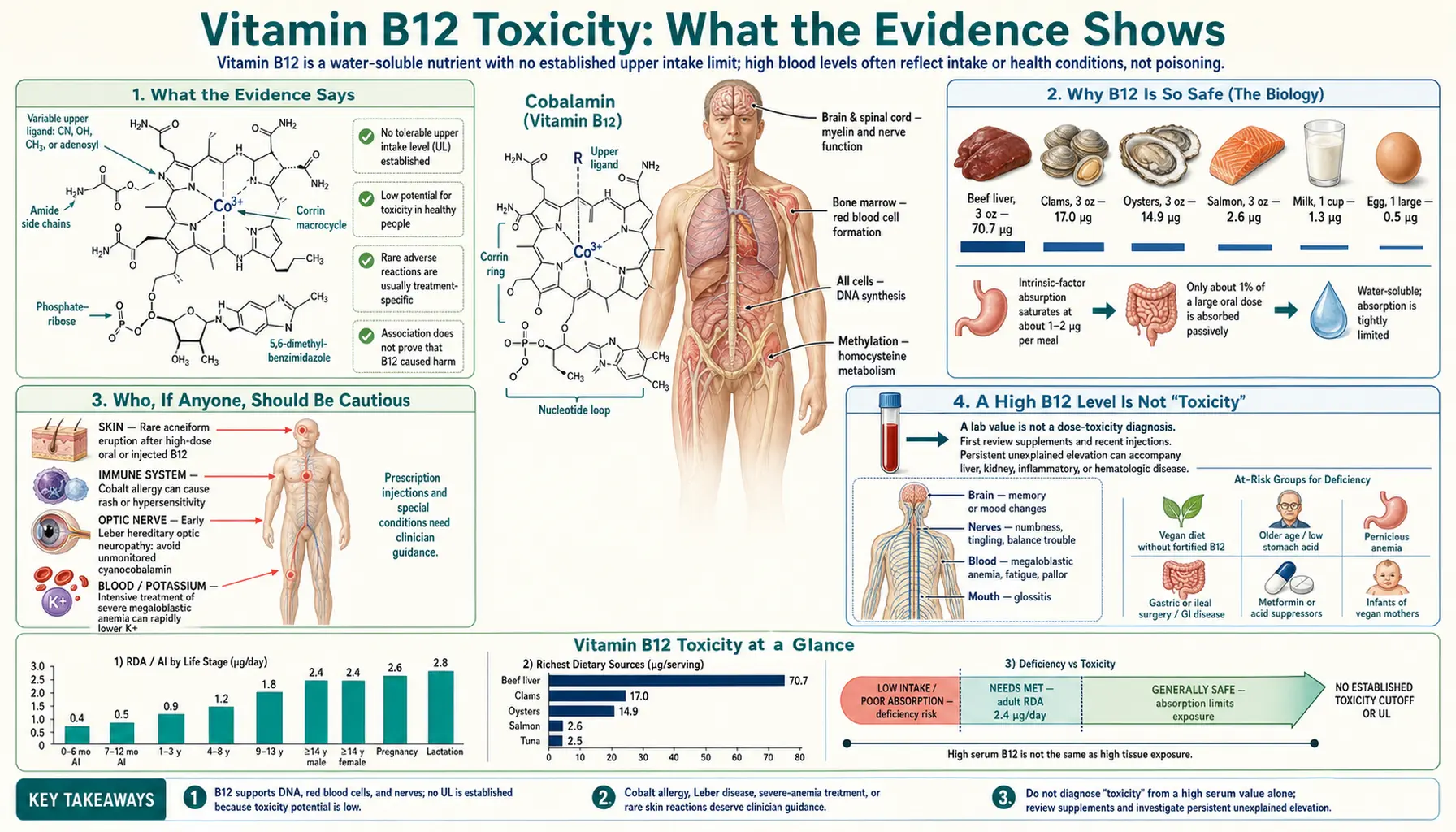
Here is the honest bottom line, stated up front so you do not have to read far to find it: vitamin B12 (cobalamin) has no established toxicity in people. It is a water-soluble vitamin, your gut can only absorb so much of it at once, and your kidneys clear away whatever extra ends up in the blood. That is exactly why doctors give very large oral doses — and large injections — to treat deficiency without worrying about overdose. Neither the U.S. Institute of Medicine nor the European Food Safety Authority has been able to set a Tolerable Upper Intake Level for B12, because the data needed to define a harmful dose simply do not exist. There are only a few honest caveats worth knowing, and none of them describe a real "B12 poisoning": a handful of reports of acne-like skin breakouts with very high doses (usually B12 combined with B6), the fact that a high B12 blood level is not toxicity at all but can be a clue to some other illness worth investigating, and a narrow medical situation involving one specific form of B12 that has nothing to do with vitamins you take at home. This page lays out what the evidence actually says, why the biology makes B12 so safe, the rare edge cases, and the calm, practical takeaway. It is correct — not a gap — that this page is short and reassuring: B12 toxicity is not a recognized clinical problem.
Interactive Visualization Vitamin B12’s Impossible Journey Five stages, two carrier proteins, a working stomach and one specific stretch of gut. Break any link — a PPI, metformin, pernicious anaemia — and absorption collapses. Launch →
Table of Contents
- What the Evidence Says
- Why B12 Is So Safe (The Biology)
- Who, If Anyone, Should Be Cautious
- A High B12 Level Is Not "Toxicity"
- What to Do (Practical Takeaways)
- Related Pages and Topics
- Key Research Papers
- Connections
- Featured Videos
What the Evidence Says
When people hear that a vitamin can be "toxic," they are usually thinking of the fat-soluble vitamins — A, D, E, and K — which the body stores and which genuinely can build up to harmful levels if you take too much. Vitamin B12 is not like that. It belongs to the water-soluble family of B vitamins, and for B12 specifically the evidence for harm from high intake is essentially absent. This is not a case of "we are not sure" — it is that, after decades of giving people large amounts of B12 to treat deficiency, no consistent pattern of toxicity has emerged.
The clearest signal comes from the agencies whose job is to set safety limits. In the United States, the Institute of Medicine (now the National Academy of Medicine), which publishes the Dietary Reference Intakes, reviewed B12 and did not set a Tolerable Upper Intake Level (UL). A UL is the highest daily amount considered unlikely to cause harm; setting one requires evidence of harm at some dose. For B12, the panel concluded that no adverse effects had been credibly associated with excess B12 from food or supplements in healthy people, so there was no basis on which to draw a line. The European Food Safety Authority (EFSA) reached the same conclusion independently and likewise set no UL for B12. When the two major regulatory bodies on either side of the Atlantic both decline to name a dangerous dose, that is about as strong a statement of safety as nutrition science offers.
Everyday clinical practice tells the same story. The Recommended Dietary Allowance for adults is only about 2.4 micrograms (mcg) per day, yet:
- Common over-the-counter B12 supplements contain 500 to 1,000 mcg — hundreds of times the RDA — and are taken daily for years without a recognized toxicity syndrome.
- Standard medical treatment for B12 deficiency uses 1,000 mcg by mouth daily, or 1,000 mcg injections given repeatedly. Systematic reviews of these high-dose regimens report them as effective and well tolerated — the documented problems are about the needle (injection-site soreness) or cost, not about cobalamin poisoning.
- The reason such large doses are used at all is precisely because the body absorbs only a small fraction of an oral dose; flooding the system with B12 is how clinicians get enough across when the normal absorption route is broken.
So the honest summary is this: there is no recognized B12 toxicity syndrome from food, from ordinary supplements, or even from the high-dose oral and injectable B12 used as medicine. The few real caveats — described in the sections below — are narrow and specific, and none of them amount to "you took too much B12 and it poisoned you."
Why B12 Is So Safe (The Biology)
The remarkable safety of B12 is not luck — it falls directly out of how the body handles it. Three built-in mechanisms work together so that "too much" B12 quietly goes nowhere harmful.
1. It dissolves in water, so the body can flush the excess. Fat-soluble vitamins are stored in fatty tissue and the liver, which is why they can accumulate to toxic levels. Water-soluble vitamins like B12 dissolve in the watery part of the blood, and the kidneys are very good at filtering water-soluble substances out into the urine. Picture the difference between a drop of oil and a spoonful of sugar in a glass of water: the oil clings and lingers, but the sugar simply disperses and washes away. When blood B12 rises above what the body's transport proteins can hold, the surplus is filtered by the kidneys and excreted. The body does keep a genuine store of B12 in the liver — enough to last years — but that store is tightly regulated and does not spiral upward the way vitamin A or D stores can.
2. The gut can only let so much in at once. This is the elegant part. To be absorbed normally, B12 must first bind to a protein called intrinsic factor, made by the stomach, and this intrinsic-factor route can only carry a limited amount of B12 across the gut wall per meal — it saturates at roughly 1.5 to 2 mcg per dose. Think of intrinsic factor as a shuttle bus with a fixed number of seats: once the seats are full, extra passengers simply wait or leave. So even if you swallow a 1,000 mcg tablet, only a small, capped fraction is absorbed through this controlled door. (A second, much less efficient route — simple passive diffusion — lets about 1% of a large oral dose slip through, which is exactly why high-dose oral B12 works as a treatment, but even this trickle does not produce harm.) The result is a natural ceiling on how much B12 can enter the body from food or pills.
3. It is involved in only two well-defined jobs, with no "overdose" pathway. Inside the body, B12 is a cofactor for just two enzymes — one that helps recycle the amino acid homocysteine into methionine, and one that helps process certain fats and proteins. These enzyme systems use the B12 they need and are not driven into harmful overdrive by an excess supply. Unlike some minerals (iron, for instance) that can generate damaging reactive chemistry when they pile up, surplus B12 is essentially inert: it sits in the blood bound to transport proteins until the kidneys clear it.
Put together — a capped front door, an open back door, and no toxic chemistry in between — these three features explain why decades of high-dose B12 use have failed to reveal a poisoning syndrome.
Who, If Anyone, Should Be Cautious
Because B12 itself is so safe, this is a short list — and importantly, most items on it are not examples of B12 being harmful. They are narrow, specific situations worth naming honestly so you have the full picture.
- Acne-like skin breakouts with very high doses. This is the one genuine, if uncommon, skin effect linked to B12. There are credible case reports of an acneiform eruption — a sudden crop of small, monomorphic, acne- or rosacea-like bumps, often on the face — in people taking very high doses of B vitamins, most often B12 combined with B6. It is thought to be a reaction in the skin's oil glands rather than true toxicity, it is not dangerous, and it typically settles within weeks once the high-dose supplement is stopped. If you develop a new acne-like rash after starting a high-dose B-complex or B12 product, this is worth mentioning to a clinician — but it is a cosmetic, reversible nuisance, not poisoning. (For the conditions it can mimic, see Acne and Rosacea.)
- People with significant kidney impairment. Since the kidneys are the route by which excess B12 is cleared, people with advanced kidney disease can have higher circulating B12 levels. This is a reason their blood B12 reading may be hard to interpret — not evidence that B12 harms the kidneys or that they will be "poisoned." There is no established need to restrict dietary or supplemental B12 in kidney disease for safety reasons; decisions there belong with the treating clinician. (See Kidney Disease.)
- A separate, hospital-only caution about one specific B12 form — do not confuse it with the vitamin you take. Hydroxocobalamin, one chemical form of B12, is used intravenously in emergency medicine as an antidote for cyanide poisoning (for example, after smoke inhalation), where it works by binding cyanide to form cyanocobalamin, which is then excreted. In that intensive-care setting it is given in grams — thousands of times a nutritional dose — and it can cause harmless but dramatic temporary effects such as deep red discoloration of the skin and urine, and it can interfere with certain lab measurements. This has nothing to do with B12 supplements or B12 injections for deficiency. It is a specialized antidote used by emergency physicians, and the "caution" is about lab interference and dosing in critical care, not about everyday B12 being toxic. We mention it only so the two are never conflated.
- A theoretical note on smoking and the cyano- form. Most cheap supplements use cyanocobalamin, which releases a tiny amount of cyanide when the body converts it to active B12. The amounts are minuscule and harmless for essentially everyone; the only place this is even discussed is whether people with certain rare metabolic or eye conditions, or very heavy smokers, might prefer the methylcobalamin or hydroxocobalamin forms. This is a preference question, not a toxicity warning — cyanocobalamin has a long, safe track record.
Notice what is not on this list: there is no recognized organ damage, no dose at which ordinary B12 becomes dangerous, and no need for the kind of "upper limit" anxiety that applies to vitamins A or D.
A High B12 Level Is Not "Toxicity"
This is the single most important idea on the page, and it surprises many people: a high vitamin B12 reading on a blood test is not a sign that B12 is harming you. B12 in the blood does not turn toxic at high concentrations. But a high level can still be medically meaningful — not because the B12 is dangerous, but because it can be a marker that points toward some other condition worth looking into. In medicine this is called hypercobalaminemia (high blood cobalamin), and the right response is not to treat the number but to ask why it is high.
The most common explanation is the obvious one: you are taking B12 supplements or recently had a B12 injection. If so, a high level is expected and meaningless — it simply reflects the dose, and no action is needed. This accounts for the majority of high readings and is entirely benign.
When a high B12 turns up in someone who is not supplementing, however, clinicians take it as a prompt to look for an underlying cause, because elevated cobalamin has been associated with several conditions. These associations are real but should be read calmly — a high B12 is a clue, not a diagnosis:
- Liver disease. The liver stores B12 and releases it (along with B12-binding proteins) when liver cells are damaged, so conditions like hepatitis, cirrhosis, or liver injury can raise the blood level. (See Liver Disease and the Liver Function Tests.)
- Kidney disease. As noted above, reduced clearance can leave more B12 in the blood.
- Certain blood disorders. Some conditions of the bone marrow and blood — particularly the myeloproliferative disorders — raise the B12-binding proteins and so the measured level.
- Some cancers. Studies have found that an unexplained high B12 is statistically associated with a higher likelihood of an underlying cancer (especially of the liver) being found in the following months. This is an association used to decide whether to investigate further — it is emphatically not a statement that B12 causes cancer, and it does not apply to people whose high level is explained by supplements.
The practical upshot is straightforward and reassuring at the same time. If your B12 is high and you take a supplement, that is the explanation and there is nothing to fear. If your B12 is high and you are not supplementing, the level itself is harmless, but it is sensible for a clinician to consider whether something else — often involving the liver, kidneys, or blood — deserves a look. Either way, the conclusion is the same: you treat the cause, never the number, because the high B12 is the messenger, not the problem.
What to Do (Practical Takeaways)
Given all of the above, the practical advice is refreshingly low-key. There is no "safe upper dose" to fret about and no toxicity to guard against, so this section is mostly about common sense rather than caution.
- Do not worry about overdosing on B12 from food. B12 comes almost entirely from animal foods — meat, fish, eggs, and dairy. There is no amount of these foods that delivers a harmful B12 dose. (For where B12 actually comes from, see Vitamin B12 Sources.)
- Ordinary supplements are fine, but match the dose to a real need. Taking a 500–1,000 mcg B12 supplement is safe, but "more" is not "better" if you do not need it — the body simply excretes the surplus, so a giant dose mostly enriches your urine. If you are correcting a deficiency or are at risk (for example, on a vegan diet, older, or taking acid-suppressing or metformin medicines), supplementing makes sense; if your level is already normal and you eat animal foods, you may not need a supplement at all. (See the Vitamin B12 Deficiency hub.)
- If you start a high-dose B-complex and break out, consider the supplement. A new crop of acne-like bumps after starting high-dose B12 (especially with B6) is worth pausing the product to see if it clears, and worth mentioning to a clinician. It is reversible.
- Do not chase a high B12 reading with alarm. If a blood test shows high B12, the first question is simply whether you take a supplement. If you do, that is your answer. If you do not, ask your clinician whether it warrants any follow-up — calmly, knowing the number itself is not harming you.
- Tell whoever orders your blood tests that you take B12. Because supplements raise the level, your clinician needs to know in order to interpret a B12 result correctly — and, separately, a recent B12 dose can mask a true deficiency on a standard test, which is why a normal or high reading in someone with deficiency symptoms is sometimes checked further. (See Vitamin B12 Test and the Active B12 (holotranscobalamin) test.)
If you want to know about the other direction — the far more clinically important problem of B12 running too low, which is genuinely common and can cause anemia and nerve damage — that is covered in detail on the Vitamin B12 Deficiency hub.
Related Pages and Topics
Because B12 toxicity is not a clinical entity, the most useful related reading is about the topics this page naturally touches — how B12 works, the deficiency that genuinely matters, and the lab tests involved.
- The bigger B12 picture. The main Vitamin B12 page covers what B12 does, its forms (cyanocobalamin, methylcobalamin, hydroxocobalamin, adenosylcobalamin), and its sources.
- The problem that actually matters — deficiency. Far more people are harmed by too little B12 than could ever be harmed by too much. The Vitamin B12 Deficiency hub explains the anemia, fatigue, and nerve symptoms, who is at risk, and how it is corrected.
- Measuring B12. The Vitamin B12 Test and the more specific Active B12 (holotranscobalamin) test, plus Homocysteine as a functional marker, are how status is assessed.
- For comparison — a B vitamin that can cause harm. Unlike B12, vitamin B6 has a recognized toxicity (nerve symptoms at high chronic doses). The Vitamin B6 Toxicity page is a useful contrast for understanding why B12 is different.
Key Research Papers
- Institute of Medicine, Food and Nutrition Board (1998). Dietary Reference Intakes for Thiamin, Riboflavin, Niacin, Vitamin B6, Folate, Vitamin B12, Pantothenic Acid, Biotin, and Choline. Washington, DC: National Academies Press. — DOI: 10.17226/6015
- Stabler SP (2013). Vitamin B12 Deficiency. New England Journal of Medicine;368(2):149-160. — DOI: 10.1056/NEJMcp1113996
- Green R (2017). Vitamin B12 deficiency from the perspective of a practicing hematologist. Blood;129(19):2603-2611. — DOI: 10.1182/blood-2016-10-569186
- Hunt A, Harrington D, Robinson S (2014). Vitamin B12 deficiency. BMJ;349:g5226. — DOI: 10.1136/bmj.g5226
- Andrès E, Zulfiqar AA, Serraj K, et al. (2018). Systematic Review and Pragmatic Clinical Approach to Oral and Nasal Vitamin B12 (Cobalamin) Treatment in Patients with Vitamin B12 Deficiency Related to Gastrointestinal Disorders. Journal of Clinical Medicine;7(10):304. — DOI: 10.3390/jcm7100304
- Vidal-Alaball J, Butler CC, Cannings-John R, et al. (2005). Oral vitamin B12 versus intramuscular vitamin B12 for vitamin B12 deficiency. Cochrane Database of Systematic Reviews;(3):CD004655. — DOI: 10.1002/14651858.cd004655
- Ermens AAM, Vlasveld LT, Lindemans J (2003). Significance of elevated cobalamin (vitamin B12) levels in blood. Clinical Biochemistry;36(8):585-590. — DOI: 10.1016/j.clinbiochem.2003.08.004
- Arendt JFB, Nexo E (2013). Cobalamin related parameters and disease patterns in patients with increased serum cobalamin levels. European Journal of Clinical Investigation;43(8):825-832. — DOI: 10.1111/eci.12076
- Sherertz EF (1991). Acneiform eruption due to "megadose" vitamins B6 and B12. Cutis;48(2):119-120. — PubMed
PubMed Topic Searches
- PubMed — Vitamin B12: safety, upper intake level, and adverse effects
- PubMed — High-dose oral B12: efficacy and tolerability
- PubMed — Elevated cobalamin (hypercobalaminemia): clinical significance
- PubMed — High B12 as a marker of cancer and liver disease
- PubMed — Hydroxocobalamin as a cyanide antidote
Connections
- All Vitamins
- Vitamin B12’s Impossible Journey — interactive animation
- Vitamin B12 Overview
- Vitamin B12 Deficiency Hub
- Vitamin B12 Benefits Hub
- Vitamin B12 Sources
- Vitamin B12 Test
- Active B12 (Holotranscobalamin) Test
- Homocysteine Test
- Vitamin B6 Toxicity (for contrast)
- Liver Disease
- Kidney Disease
- Liver Function Tests
- Acne
- Rosacea