Folate (Vitamin B9) Deficiency: Megaloblastic Anemia and Fatigue
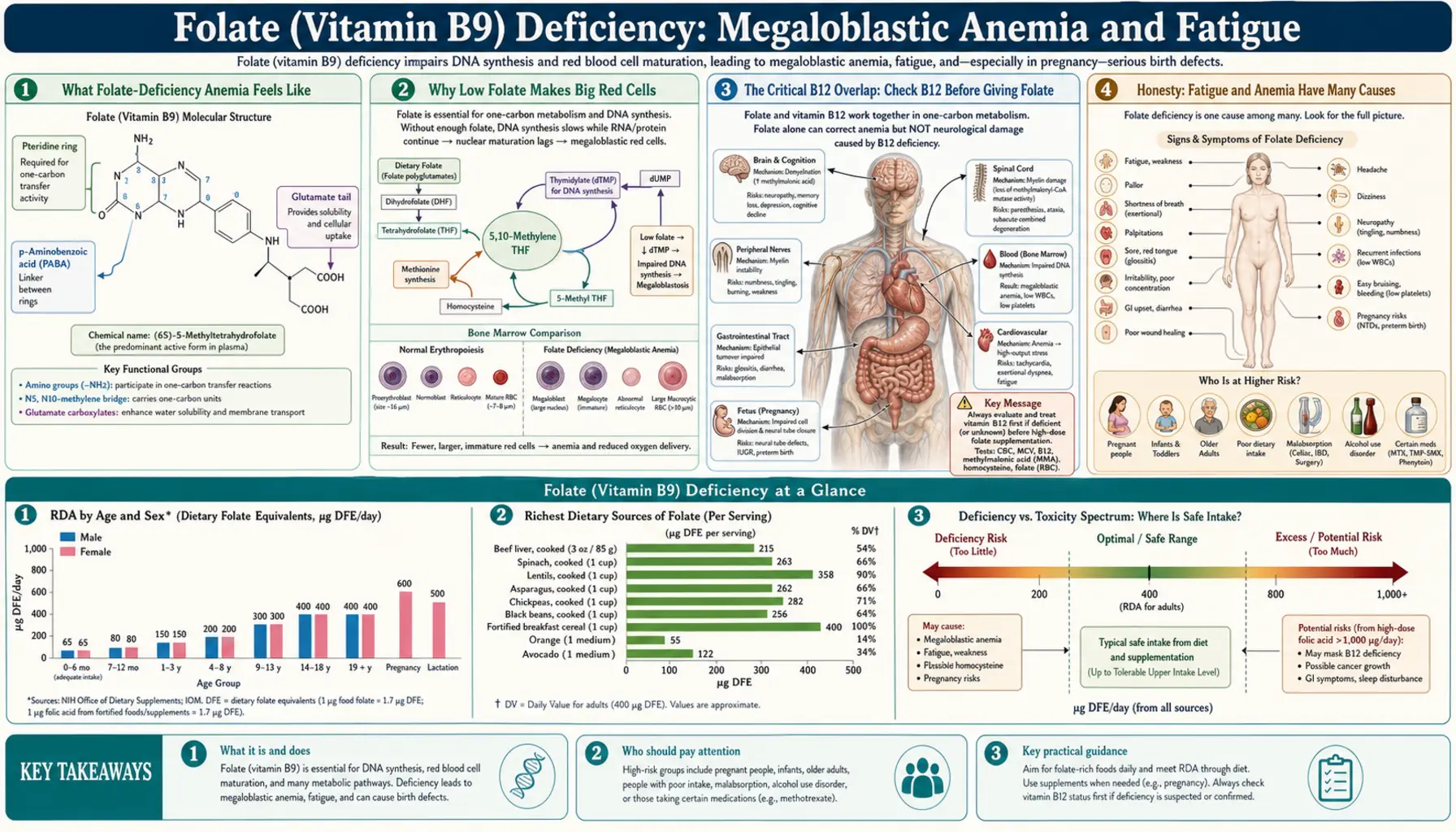
When folate runs low, the most common consequence is a particular kind of anemia — one in which the bone marrow keeps trying to build red blood cells but cannot finish them properly, so it turns out fewer, larger, and more fragile cells than normal. Doctors call these oversized cells macrocytes and the picture megaloblastic anemia. The result you actually feel is fatigue — a deep, persistent tiredness that doesn't lift with sleep — often alongside paleness, breathlessness on exertion, a pounding heart, and dizziness. This page explains why a folate shortage produces large red cells, why that makes you so tired, and one rule that matters more than any other on this page: folate deficiency and vitamin B12 deficiency cause an identical-looking anemia, so B12 must be checked before folate is given — otherwise treating with folate alone can hide a B12 problem while nerve damage quietly progresses.
Table of Contents
- What Folate-Deficiency Anemia Feels Like
- Why Low Folate Makes Big Red Cells
- The Critical B12 Overlap: Check B12 Before Giving Folate
- Honesty: Fatigue and Anemia Have Many Causes
- Clues That Point to Folate
- What Causes Low Folate
- Getting Tested
- Correcting Folate Safely
- When to Seek Care / Red Flags
- Key Research Papers
- Connections
- Featured Videos
What Folate-Deficiency Anemia Feels Like
Anemia simply means there is not enough hemoglobin — the iron-rich protein inside red blood cells that carries oxygen — to meet the body's needs. Because every working tissue depends on that oxygen delivery, the symptoms of folate-deficiency anemia are the symptoms of cells running a little short of fuel. They tend to come on slowly, over weeks to months, which is exactly why people so often miss them or chalk them up to stress, age, or simply being busy.
- Fatigue and weakness — the hallmark. This is a heavy, all-day tiredness that sleep doesn't fix. Tasks that used to be easy — a flight of stairs, a walk to the mailbox, an afternoon of chores — leave you wiped out.
- Pallor — an unusual paleness, most visible in the face, the inside of the lower eyelids, the palms, and the nail beds. Friends or family sometimes notice it before you do.
- Shortness of breath — especially with exertion. With fewer oxygen-carrying cells in circulation, even mild activity can leave you winded.
- A fast or pounding heartbeat (palpitations) — the heart compensates for thin blood by pumping faster and harder, which you may feel as a racing or thumping pulse, particularly when you move.
- Lightheadedness or dizziness — from reduced oxygen reaching the brain, sometimes worse on standing.
- Headache, poor concentration, and a general “foggy” feeling — the brain is an oxygen-hungry organ and notices the shortfall.
Some people with folate deficiency also notice a smooth, sore, red tongue (glossitis) and mouth soreness, and many describe low mood or irritability — covered on the mood and cognitive page. This page focuses on the anemia itself: the large red cells, the fatigue, the pallor, and the breathlessness.
One important practical point: because the anemia develops gradually, the body adapts as it goes. People can walk around with a strikingly low hemoglobin and feel “just a bit tired,” because they have had months to get used to it. That is precisely why folate-deficiency anemia is so often discovered by accident on a routine blood test rather than because the symptoms forced a visit.
Why Low Folate Makes Big Red Cells
To understand why a folate shortage produces large red cells, it helps to know what folate does. Folate (vitamin B9) is essential for making DNA — specifically, it donates the one-carbon building block needed to manufacture thymidine, one of the four letters of the DNA alphabet. Without enough folate, a cell cannot copy its DNA fast enough to divide.
Now consider where that matters most. The body's most rapidly dividing factory is the bone marrow, which churns out roughly two million new red blood cells every second. Each developing red cell normally goes through several rounds of division, shrinking and condensing its nucleus as it matures, before finally ejecting the nucleus and entering the bloodstream as a small, flexible disc.
When folate is scarce, the marrow hits a roadblock. The cell can keep growing and building hemoglobin and other proteins in its cytoplasm — those processes don't need folate — but it cannot replicate its DNA quickly enough to divide on schedule. The result is a cell whose insides keep maturing while its nucleus lags behind: a large cell with an immature-looking nucleus. Hematologists call this nuclear–cytoplasmic asynchrony, and the oversized precursor cells in the marrow are the megaloblasts that give the condition its name. The mature red cells that do make it out are abnormally big — macrocytes — which is why the giveaway on a blood test is a high MCV (mean corpuscular volume, the average red-cell size).
An analogy. Picture an assembly line building cars, where folate is the supply of chassis frames. The paint shop, the upholstery, and the engine assembly all keep running at full speed — but with too few frames, the line can't actually finish and roll out new cars on time. What emerges is a smaller number of oversized, overstuffed vehicles, hastily assembled and prone to breaking down. In the marrow, many of these defective cells are so abnormal they are destroyed before they ever leave (a process called ineffective erythropoiesis), and the ones that escape into the blood are fragile and short-lived. Fewer cells, each carrying oxygen for less time, equals anemia — and the tiredness, pallor, and breathlessness that come with it.
Because folate is needed for all rapidly dividing tissues, the same DNA-synthesis bottleneck explains the other classic signs: the lining of the mouth and gut turns over quickly too, which is why a sore, smooth tongue and mouth ulcers often accompany the anemia.
The Critical B12 Overlap: Check B12 Before Giving Folate
This is the single most important section on the page, and it is the reason a doctor never simply prescribes folate for a macrocytic anemia without checking one more thing.
Folate deficiency and vitamin B12 deficiency produce an identical-looking megaloblastic anemia. The reason is that folate and B12 work together in the very same chemical step. To make DNA, folate has to be in a particular active form, and converting it into that form depends on vitamin B12 acting as a partner enzyme cofactor. When B12 is missing, folate gets stuck in the wrong form — a problem nicknamed the “folate trap.” The marrow then behaves exactly as if folate were low, even when folate is plentiful: the same big macrocytes, the same high MCV, the same fatigue and pallor. Under the microscope and on a basic blood count, the two are indistinguishable.
Here is where the danger lies. Vitamin B12 deficiency does something folate deficiency does not: it damages the nervous system. B12 is needed to maintain the protective myelin sheath around nerves, and a prolonged shortage causes numbness and tingling in the hands and feet, balance problems, and — if it goes on long enough — a serious, sometimes irreversible spinal-cord disorder called subacute combined degeneration. Folate deficiency does not cause this nerve damage.
Now put the two facts together. If someone actually has a B12 deficiency but is given folic acid alone, something deceptively reassuring happens: the folic acid partly bypasses the B12 roadblock in the marrow, so the anemia improves — the red cells get smaller, the hemoglobin rises, the patient feels less tired. But B12 is still missing in the nerves, where folate cannot substitute for it. The visible warning sign (the anemia) is silenced while the nerve damage continues to advance unchecked. This is the phenomenon clinicians mean when they say folate can “mask” B12 deficiency, and it is exactly why guidelines insist on the order of operations.
The rule: in any macrocytic or megaloblastic anemia, vitamin B12 is measured before folate is replaced. If B12 is also low, B12 is corrected first (or both are given together) — never folate by itself. For an individual person this is the most important takeaway on the page: do not self-treat a suspected folate problem with high-dose folic acid supplements without first having B12 checked, because in doing so you could be hiding a treatable nerve disorder until it is no longer fully treatable. The dedicated B12 deficiency diagnosis page covers how B12 status is confirmed, and the B12 and the nervous system page explains the neurological stakes.
Honesty: Fatigue and Anemia Have Many Causes
It would be a disservice to suggest that tiredness, pallor, or even anemia automatically means low folate. They do not. Fatigue is one of the most common symptoms in all of medicine, and most fatigue is not caused by folate at all. Honesty about this matters, because chasing a folate diagnosis while the real cause goes unaddressed is its own kind of harm.
Other very common explanations for these same symptoms include:
- Iron deficiency — the world's most common cause of anemia. Crucially, iron-deficiency anemia produces small red cells (a low MCV, microcytic), the opposite of folate's large cells — which is one reason the red-cell size on a blood count is so informative. See iron deficiency and its shortness of breath and pallor page.
- Vitamin B12 deficiency — the look-alike discussed above; it produces the same large cells as folate.
- Thyroid disease — an underactive thyroid (hypothyroidism) is a classic cause of fatigue and can itself raise the MCV.
- Chronic kidney disease, chronic inflammation, and chronic illness — all can blunt red-cell production.
- Alcohol use — alcohol both depletes folate and independently enlarges red cells, so heavy drinkers can have a high MCV from several overlapping causes at once.
- Blood loss — from heavy periods or the gut — and many medications, sleep disorders, depression, and other conditions.
The honest bottom line: a high MCV on a blood count narrows the field considerably and rightly puts folate and B12 near the top of the list — but the diagnosis is confirmed by measuring folate and B12 (and usually iron and thyroid), not by assuming. Fatigue alone, without anemia, is rarely due to folate.
Clues That Point to Folate
Certain features make folate a more likely culprit and help separate it from its look-alikes:
- A high MCV (macrocytic anemia) on the blood count — large red cells point toward folate or B12, and away from iron deficiency (small cells). This is the first and biggest clue.
- A clear dietary or situational reason for low folate — a diet very low in leafy greens, legumes, and fruit; heavy alcohol use; recent or ongoing pregnancy; or a gut condition that impairs absorption (see causes below).
- A sore, smooth, red tongue and mouth ulcers alongside the fatigue — the rapidly dividing mouth lining shows folate (and B12) shortage early; see the mouth sores and sore tongue page.
- Normal B12 but low folate on testing — the combination that confirms folate, rather than B12, is the issue.
- The absence of new neurological symptoms — numbness, tingling, or balance trouble shift suspicion strongly toward B12 instead, because folate deficiency does not damage nerves.
None of these is proof on its own — the laboratory test settles it — but together they tell a clinician whether folate belongs at the center of the picture or off to the side. Mood changes and brain fog can accompany folate deficiency too, but those are non-specific; the mood and cognitive page handles them in detail.
What Causes Low Folate
Unlike B12, the body stores only a modest amount of folate — enough for a few months, not years — so a sustained shortfall in intake or absorption shows up relatively quickly. The usual causes fall into a few groups:
- Poor dietary intake — a diet low in folate-rich foods (the name comes from foliage): leafy greens, lentils and beans, asparagus, broccoli, citrus, and fortified grains. Overcooking destroys folate (it is heat-sensitive), so a diet of heavily processed, overcooked food can be low even when it looks varied. See the folate food sources page.
- Increased demand — pregnancy and breastfeeding dramatically raise folate needs because the rapidly growing fetus and placenta consume it; this is also why folate matters so much for preventing neural tube defects. Infancy and any condition with rapid cell turnover (such as certain chronic hemolytic anemias) also increase requirements.
- Alcohol use — one of the most common causes. Alcohol reduces folate intake, impairs its absorption, and interferes with its storage and metabolism, all at once.
- Malabsorption — folate is absorbed in the upper small intestine, so celiac disease, inflammatory bowel disease, and other gut disorders can cause deficiency even with adequate intake.
- Medications — some drugs interfere with folate. Methotrexate (used for cancer, rheumatoid arthritis, and psoriasis) blocks folate metabolism directly; sulfasalazine and the antibiotic trimethoprim can reduce folate; and some older anti-seizure medicines (such as phenytoin) lower folate levels.
Often more than one factor stacks up — for example, an older adult eating little fresh produce, drinking regularly, and taking a folate-affecting medication. Identifying the cause matters, because the fix differs: a dietary gap is corrected with food and supplements, whereas malabsorption or a drug effect calls for treating the underlying problem too.
Getting Tested
Confirming folate-deficiency anemia is inexpensive and starts with one of the most routine blood tests there is.
- Complete Blood Count (CBC). The CBC measures hemoglobin (to confirm anemia) and the MCV (average red-cell size). A high MCV — macrocytosis — is the flag that points toward folate or B12 and prompts the next tests.
- Serum folate and red-cell (RBC) folate. A serum folate reflects recent intake and can dip after just a few days of poor eating; RBC folate reflects longer-term, tissue-level stores and is often the more reliable measure of true deficiency. Many labs and guidelines now favor RBC folate when the serum level is borderline.
- Vitamin B12 — always, before treating. As emphasized above, B12 is checked alongside folate every time, so a B12 deficiency isn't accidentally masked. The B12 deficiency diagnosis page covers how that is confirmed.
- A blood smear. Looking at the cells under the microscope can reveal large red cells and characteristic hypersegmented neutrophils (white cells with extra nuclear lobes) — a tell-tale sign of megaloblastic anemia from either folate or B12.
- Supporting tests. Homocysteine rises in both folate and B12 deficiency (another reactant, methylmalonic acid, rises only in B12 deficiency, which helps tell them apart). An iron panel and thyroid tests are often added, since iron deficiency and thyroid disease are common alternative or coexisting causes of fatigue and anemia.
The practical takeaway: a single CBC both confirms the anemia and, by showing the red-cell size, points the workup in the right direction — and folate is essentially never replaced without a B12 result in hand.
Correcting Folate Safely
Once a B12 deficiency has been ruled out or is being treated alongside, folate deficiency is one of the more satisfying problems to fix — it usually responds quickly and completely.
- Confirm B12 status first. This bears repeating because it is the safety step that defines this whole topic: replace B12 first (or treat both together) whenever B12 is also low — never folate alone in someone who might be B12 deficient.
- Food first, for prevention and mild cases. A folate-rich diet is the foundation: leafy greens, lentils and beans, asparagus, broccoli, citrus, and fortified breakfast cereals and grains. Because cooking destroys folate, lighter cooking (steaming rather than prolonged boiling) preserves more of it. The adult RDA for folate is 400 micrograms of dietary folate equivalents (DFE) per day, rising to 600 mcg DFE in pregnancy. See the folate food sources page.
- Folic acid (or folate) supplements — the standard treatment for established deficiency, prescribed and monitored by a clinician, often at higher doses for a defined course until stores are rebuilt and the blood count normalizes. The response is usually rapid: a surge of new young red cells (reticulocytes) appears within about a week, and the anemia typically corrects over roughly one to two months.
- Treat the cause. Replacing folate without addressing why it dropped — poor diet, heavy alcohol use, untreated celiac disease, or a folate-blocking drug — only buys time. (People on methotrexate, for instance, are often given folic or folinic acid deliberately to offset its folate-blocking effect, on a schedule set by their prescriber.)
- A note on fortification. Many countries (including the United States) fortify flour and grain products with folic acid, which has sharply reduced folate-deficiency anemia and neural tube defects at the population level. It also means most people get a baseline of folate from food without thinking about it.
A word of caution that ties back to the central rule: high-dose folic acid is generally well tolerated, but its main hazard is not toxicity — it is the masking of B12 deficiency. That is why folic acid is taken at the dose and for the purpose a clinician advises, with B12 status known, rather than as an open-ended high-dose self-treatment for fatigue.
When to Seek Care / Red Flags
Mild folate-deficiency anemia is corrected calmly with diet, a clinician's guidance, and a confirmed B12 result. But certain features mean seek medical care promptly, and a few mean urgent or emergency care:
- Chest pain, severe breathlessness at rest, or fainting — signs that the anemia may be severe enough to strain the heart. Treat these as an emergency and call for help.
- A very fast or irregular heartbeat — marked palpitations with an anemia warrant prompt evaluation.
- New numbness, tingling, pins-and-needles, or unsteadiness/balance problems — these point toward B12-related nerve damage, not folate, and are a reason not to start folic acid on your own. They deserve a prompt B12 workup.
- Confusion, marked weakness, or symptoms that come on rapidly — a fast-developing anemia is less well tolerated than a slow one and should be assessed without delay.
- Anemia plus weight loss, blood in the stool, or black stools — this combination needs evaluation for bleeding or malabsorption, not just a folate prescription.
- Pregnancy with suspected deficiency — folate needs are high in pregnancy; any concern there should be raised with a maternity provider rather than self-managed.
The reassuring flip side is that uncomplicated folate-deficiency anemia, once B12 has been checked, is highly treatable and usually resolves fully. The reason to see a clinician is not that folate is dangerous — it is to confirm the diagnosis, rule out the B12 look-alike and other causes, and make sure the fatigue and pallor really are coming from a folate shortage and nothing more serious.
Key Research Papers
- Devalia V, Hamilton MS, Molloy AM; British Committee for Standards in Haematology (2014). Guidelines for the diagnosis and treatment of cobalamin and folate disorders. British Journal of Haematology;166(4):496-513. — DOI: 10.1111/bjh.12959
- Carmel R (2003). Update on Cobalamin, Folate, and Homocysteine. Hematology (American Society of Hematology Education Program);2003(1):62-81. — DOI: 10.1182/asheducation-2003.1.62
- Stabler SP (2013). Vitamin B12 Deficiency. New England Journal of Medicine;368(2):149-160. — DOI: 10.1056/NEJMcp1113996
- Green R, Allen LH, Bjørke-Monsen AL, et al. (2017). Vitamin B12 deficiency. Nature Reviews Disease Primers;3:17040. — DOI: 10.1038/nrdp.2017.40
- Hunt A, Harrington D, Robinson S (2014). Vitamin B12 deficiency. BMJ;349:g5226. — DOI: 10.1136/bmj.g5226
- Reynolds E (2006). Vitamin B12, folic acid, and the nervous system. The Lancet Neurology;5(11):949-960. — DOI: 10.1016/S1474-4422(06)70598-1
- Stabler SP, Allen RH (2004). Vitamin B12 deficiency as a worldwide problem. Annual Review of Nutrition;24:299-326. — DOI: 10.1146/annurev.nutr.24.012003.132440
- Jacques PF, Selhub J, Bostom AG, Wilson PWF, Rosenberg IH (1999). The Effect of Folic Acid Fortification on Plasma Folate and Total Homocysteine Concentrations. New England Journal of Medicine;340(19):1449-1454. — DOI: 10.1056/NEJM199905133401901
- De-Regil LM, Peña-Rosas JP, Fernández-Gaxiola AC, Rayco-Solon P (2015). Effects and safety of periconceptional oral folate supplementation for preventing birth defects. Cochrane Database of Systematic Reviews;2015(12):CD007950. — DOI: 10.1002/14651858.CD007950.pub3
- Bailey RL, et al. Biomarkers of folate status (review of serum vs. red-cell folate). PubMed search. — PubMed
- Aslinia F, Mazza JJ, Yale SH. Megaloblastic anemia and other causes of macrocytosis. PubMed search. — PubMed
- Hesdorffer CS, Longo DL. Drug-Induced Megaloblastic Anemia / megaloblastic anemias review. PubMed search. — PubMed
PubMed Topic Searches
- PubMed — Folate deficiency and megaloblastic anemia
- PubMed — Folic acid masking B12 deficiency / neuropathy
- PubMed — Macrocytosis and elevated MCV evaluation
- PubMed — Serum vs. red-cell folate in diagnosing deficiency
- PubMed — Alcohol, folate deficiency, and anemia
Connections
- All Vitamins
- Folate Deficiency Hub
- Mouth Sores & Sore Tongue
- Folate, Mood & Cognitive Symptoms
- Neural Tube Defects in Pregnancy
- Vitamin B9 (Folate) Overview
- Folate Food Sources
- Vitamin B12
- B12 Deficiency Diagnosis
- B12 and the Nervous System
- Anemia
- Iron Deficiency
- Iron Deficiency: Breathlessness & Pallor
- Complete Blood Count (CBC)
- Homocysteine Test
- Iron Panel
- Spinach
- Lentils