Folate (Vitamin B9) Deficiency: Symptoms, Causes, and Recovery
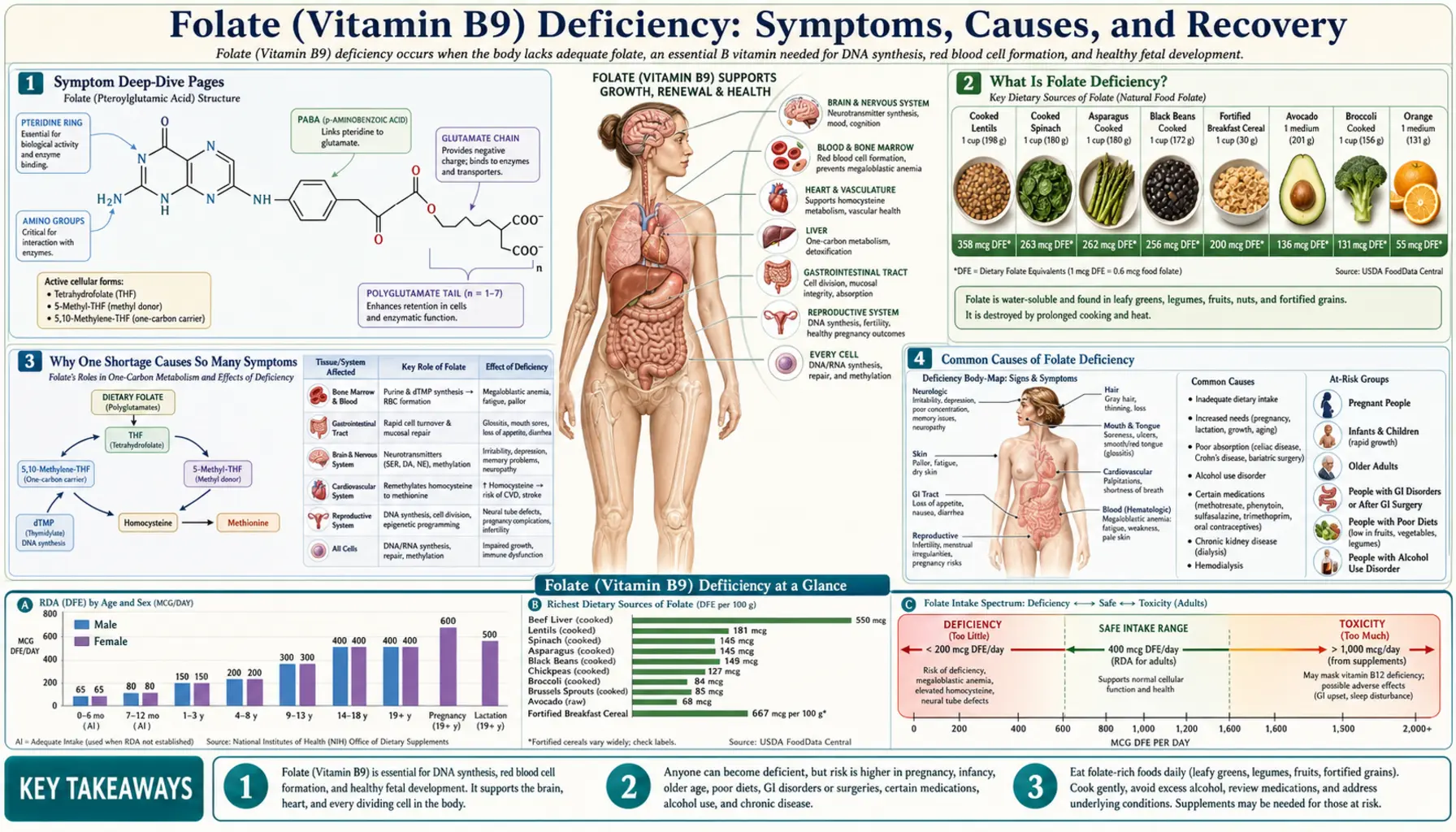
Folate is vitamin B9 — the B vitamin your body uses to build DNA and make new cells, which is why a shortage hits the tissues that renew themselves fastest. The classic result is megaloblastic anemia, in which the bone marrow turns out a smaller-than-normal number of oversized, immature red blood cells, leaving you tired, pale, and short of breath. But folate deficiency rarely stops at the blood: it can inflame and redden the tongue, raise mouth ulcers, dampen mood and concentration, and — most consequentially — during early pregnancy it sharply raises the risk of serious birth defects of the baby's brain and spine. The good news is that folate deficiency is one of the more straightforward vitamin problems to find on a blood test and to correct, usually with food or inexpensive supplements. The one rule that matters most: folate deficiency and vitamin B12 deficiency look almost identical in the blood, and they must be told apart before treatment, because giving folate alone to someone who is actually low in B12 can mask the anemia while nerve damage quietly worsens. This hub explains what folate deficiency is, why one shortage causes such varied symptoms, what commonly causes it, and how it is diagnosed and corrected — with deep-dive pages for each major effect.
Symptom Deep-Dive Pages
Megaloblastic Anemia & Fatigue
Why low folate makes the bone marrow build large, fragile red cells, and how that translates into deep fatigue, pallor, breathlessness, and a pounding heart — the most common way folate deficiency shows itself.
Neural Tube Defects (Pregnancy)
The most consequential effect of folate shortage: how a deficit in the first weeks of pregnancy raises the risk of spina bifida and anencephaly, and why folic acid before conception is one of medicine's clearest prevention wins.
Mouth Sores & Sore Tongue
Why a smooth, red, sore tongue (glossitis), cracks at the corners of the mouth, and recurrent mouth ulcers can be early, easy-to-miss signs that folate (or a related B vitamin) is running low.
Mood & Cognitive
The link between low folate, low mood, and foggy thinking — what the evidence does and does not support, and why folate status is worth checking when depression is hard to treat.
Table of Contents
- Symptom Deep-Dive Pages
- What Is Folate Deficiency?
- Why One Shortage Causes So Many Symptoms
- Common Causes of Folate Deficiency
- Who Is Most at Risk
- Why Folate Must Be Distinguished From B12
- How Folate Deficiency Is Diagnosed
- How Folate Deficiency Is Corrected
- When to Seek Care / Red Flags
- Key Research Papers
- Connections
- Featured Videos
What Is Folate Deficiency?
Folate is vitamin B9, a water-soluble B vitamin. "Folate" is the umbrella term for the forms found naturally in food (the name comes from folium, Latin for leaf, because leafy greens are rich in it), while folic acid is the stable, manufactured form used in supplements and in fortified flour, bread, and cereal. Folate deficiency simply means the body does not have enough of this vitamin to keep up with its single most important job: making and copying DNA so that cells can divide.
Because every dividing cell needs folate, the deficiency shows up first and most clearly in tissues that turn over quickly — above all the bone marrow, which produces billions of new blood cells every day. When folate runs short, marrow cells try to divide but cannot finish copying their DNA on schedule. The result is the hallmark of folate deficiency: megaloblastic anemia, in which red cells are produced in reduced numbers and are abnormally large (the word macrocytic means "large cell"). On a routine blood count this appears as a low hemoglobin together with a raised mean corpuscular volume (MCV) — the average size of a red cell.
The clinical picture spans a spectrum:
- Subclinical / early — Blood folate is low but the blood count is still normal or only borderline. There may be no symptoms at all, or only vague tiredness. This stage is common and is exactly the situation that matters most in a woman who could become pregnant, because the baby's brain and spine begin forming before she would know anything is wrong.
- Established deficiency — The anemia is now measurable. People feel tired and weak, look pale, become short of breath on exertion, and may notice a pounding or racing heart as it works harder to move oxygen with fewer red cells. A sore, smooth, red tongue (glossitis), cracks at the corners of the mouth, and mouth ulcers often appear. Some people report low mood, irritability, or difficulty concentrating.
- Severe — Profound anemia can cause marked breathlessness, chest discomfort, and exhaustion, and in pregnancy a severe early deficiency is linked to neural tube defects in the baby. Because the same marrow defect can also lower white cells and platelets, a very severe, prolonged deficiency can in rare cases affect the whole blood count.
A crucial point to carry through this hub: the blood picture of folate deficiency is essentially identical to that of vitamin B12 deficiency. Both cause a macrocytic, megaloblastic anemia. Telling them apart is not a formality — it changes treatment and, with B12, prevents irreversible nerve damage. That is why every good work-up checks both, a theme we return to below.
Why One Shortage Causes So Many Symptoms
It can seem strange that one missing vitamin produces problems as different as anemia, a sore tongue, low mood, and a birth defect. The explanation is that folate is not a specialist hormone aimed at one organ — it is a basic raw material for building life's most fundamental molecule, DNA. Wherever cells must divide, folate is needed; so a shortage is felt most in the places that divide fastest.
In everyday language: folate's central role is to carry and hand off "one-carbon" units — small chemical building blocks — that the body uses to assemble the bases of DNA (especially thymidine) and to recycle certain amino acids. Think of folate as a fleet of delivery vans shuttling these parts to the cellular factories that copy DNA. When the fleet is short, the factories stall: cells grow but cannot finish dividing.
That single bottleneck ripples outward through the body's fastest-renewing tissues:
- Bone marrow (red blood cells) — the fastest cell factory of all stalls first, producing fewer, oversized red cells. This is the megaloblastic anemia and fatigue that defines the deficiency, and it underlies the pallor, breathlessness, and palpitations.
- The lining of the mouth and gut — these surfaces also renew constantly. When they cannot keep up, the tongue becomes smooth, red, and sore and mouth ulcers form — see mouth sores and sore tongue.
- The developing nervous system of an embryo — in the first weeks after conception the neural tube (which becomes the brain and spinal cord) closes through a burst of rapid cell division. If folate is short at that exact moment, the tube can fail to close, causing neural tube defects such as spina bifida. This is why timing — before and around conception — matters so much.
- The brain's chemistry — folate also feeds the one-carbon pathway that makes the methyl groups used to build neurotransmitters and to keep homocysteine (an amino acid) from rising. Low folate raises homocysteine and may affect mood and thinking, which is the basis for the link explored on the mood and cognitive page.
So the scattered symptoms are not a coincidence: they are different windows onto the same problem — cells that cannot divide properly because a basic building-block delivery has slowed. Restore folate and, as the marrow and linings catch up, most symptoms reverse together, often within weeks.
Common Causes of Folate Deficiency
Unlike vitamin B12, the body stores only a modest amount of folate — enough for roughly a few months. That means folate can run low relatively quickly when intake drops, losses rise, or demand surges. Most real-world cases come down to one of a handful of patterns, and they often combine.
- Low dietary intake — the most common cause worldwide. Diets short on leafy greens, beans, and fruit, or built largely around processed foods, may not supply enough. Cooking matters too: folate is fragile and a large share is destroyed by prolonged boiling or reheating, so even a "reasonable" diet can fall short if vegetables are overcooked. In countries that do not fortify flour, dietary deficiency is more frequent.
- Alcohol use — a classic and important cause. Heavy or chronic drinking lowers folate on several fronts at once: people often eat poorly, alcohol interferes with how folate is absorbed in the gut and reabsorbed by the kidneys, and it disrupts the vitamin's storage and recycling in the liver. Folate deficiency is one of the most common nutritional problems in people with heavy alcohol use.
- Malabsorption — celiac disease and other gut disorders — folate is absorbed mainly in the upper small intestine (the jejunum). When that lining is damaged or inflamed — as in celiac disease, inflammatory bowel disease, or after certain bowel surgeries — folate (and other nutrients) is poorly taken up. Newly diagnosed celiac disease is a frequent and easily missed reason for an unexplained low folate.
- Medications that interfere with folate — several common drugs lower folate or block how the body uses it:
- Methotrexate — used for rheumatoid arthritis, psoriasis, and some cancers, it directly blocks the enzyme that activates folate; folic or folinic acid is often prescribed alongside it deliberately to limit side effects.
- Anticonvulsants — long-term phenytoin, phenobarbital, and some other seizure medicines are well documented to lower folate and cause macrocytosis.
- Sulfasalazine and trimethoprim — can interfere with folate absorption or metabolism.
- Increased demand — pregnancy and rapid growth — pregnancy roughly doubles folate requirements because the placenta and growing baby demand huge amounts of new DNA. Breastfeeding, infancy, and adolescence also raise needs. This is why pregnancy is both a top cause of deficiency and the situation where deficiency carries the highest stakes.
- States of very high cell turnover — chronic hemolytic anemias (such as sickle cell disease), where red cells are destroyed and replaced rapidly, and some skin conditions like severe psoriasis, can outpace folate supply and produce deficiency.
- Dialysis — folate is small and water-soluble and is removed during hemodialysis, so people on dialysis are routinely supplemented.
A practical note, echoed throughout medicine: these causes stack. A person who drinks heavily, eats few vegetables, and takes an anticonvulsant can become folate-deficient from the sum of several modest pushes in the same direction — and the fix usually has to address each one, not just hand out a pill.
Who Is Most at Risk
Anyone can become folate-deficient, but certain groups deserve special attention because either their risk is high, the consequences are serious, or both.
- Women who are pregnant or could become pregnant — the single most important group. Because the neural tube closes in the first 28 days — often before a pregnancy is recognized — public-health bodies (including the U.S. Preventive Services Task Force and the CDC) advise all women capable of becoming pregnant to take 400 micrograms of folic acid daily, not only those actively trying. Women who have had a previous pregnancy affected by a neural tube defect need a much higher dose under medical guidance.
- People with heavy alcohol use — for the multiple reasons above, this is one of the highest-risk groups for dietary and metabolic folate deficiency.
- People with malabsorption — undiagnosed or active celiac disease, Crohn's disease and ulcerative colitis, and those who have had bowel-shortening surgery.
- People on folate-interfering medications — long-term users of methotrexate, phenytoin and other anticonvulsants, sulfasalazine, or trimethoprim.
- Older adults and people eating poorly — especially those who are isolated, have limited diets, or eat few fresh vegetables and fruit. (In older adults it is especially important to also check B12, which is more often the culprit in that age group.)
- People with high red-cell turnover — for example sickle cell disease and other chronic hemolytic anemias.
- People on dialysis.
One reassuring caveat: in countries that fortify grain products with folic acid — the United States has done so since 1998 — severe dietary folate deficiency has become much less common in the general population. Fortification dramatically reduced both low folate levels and neural tube defects (see the Research section). Risk is now concentrated in the groups listed above rather than spread across everyone.
Why Folate Must Be Distinguished From B12 Before Treating
This deserves its own section because it is the most important safety rule in the whole topic. Folate deficiency and vitamin B12 deficiency produce the same blood picture — a large-cell (macrocytic), megaloblastic anemia — because the two vitamins work together in the very same DNA-building pathway. Looking at the blood count alone, you usually cannot tell which one is missing.
Here is why mixing them up is dangerous. Vitamin B12 has a second, separate job that folate cannot do: it helps maintain the protective myelin sheath around nerves. When B12 is low, people can develop progressive, sometimes irreversible nerve damage — numbness and tingling, balance and gait problems, and in severe cases a condition called subacute combined degeneration of the spinal cord. Crucially, giving folate to a person who is actually B12-deficient can partly correct the anemia — the obvious, visible problem — while doing nothing for the nerves, allowing the silent neurological damage to keep advancing. Treating the blood and missing the nerves is the classic, feared error. For the nerve side of B12 deficiency, see Vitamin B12 and the Nervous System.
The practical consequence is simple and firm: before treating a macrocytic anemia as folate deficiency, vitamin B12 must be checked and excluded (or treated first). In practice clinicians measure both vitamins together. If both are low, B12 is generally replaced before or alongside folate, never folate alone. Major hematology guidelines (such as the BCSH guideline by Devalia and colleagues) build this rule directly into the recommended approach.
The two deficiencies also share several causes — poor diet, alcohol, and malabsorption from gut disease — so finding one low makes it sensible to check the other. The bottom line: folate deficiency is easy and safe to treat once you are sure it is folate and not B12. Learn more on the Vitamin B12 overview and its B12 deficiency diagnosis page.
How Folate Deficiency Is Diagnosed
Folate deficiency is usually straightforward to detect with blood tests, and the work-up almost always begins with two simple ones.
- Complete blood count (CBC) — the starting point. It shows whether anemia is present and, importantly, the mean corpuscular volume (MCV), the average red-cell size. A high MCV (macrocytosis) is the signature clue that points toward a folate or B12 problem and steers the rest of the work-up. For what each number means, see the Complete Blood Count page.
- Serum folate — a direct blood measurement of the vitamin. It is the usual first folate test. Its main limitation is that it reflects recent intake and can rise after a single folate-rich meal or fall briefly with poor intake, so it can occasionally over- or under-call true tissue status.
- Red blood cell (RBC) folate — folate measured inside red cells, which reflects longer-term, tissue-level stores over the preceding months and is less swayed by the last meal. Some clinicians use it when the serum result is borderline or doesn't fit the picture, though serum folate is sufficient in many cases.
- Vitamin B12 — always measured alongside. For the reasons in the section above, B12 is checked at the same time so the two are never confused. See the Vitamin B12 blood test.
When the simple tests are equivocal, two further blood markers help confirm a true functional deficiency and distinguish folate from B12:
- Homocysteine — this amino acid rises when either folate or B12 is low, so a normal level argues against significant deficiency, while a high level confirms a real functional shortage. See the Homocysteine test page.
- Methylmalonic acid (MMA) — this one is the tie-breaker: MMA rises in B12 deficiency but stays normal in pure folate deficiency. So a high homocysteine with a normal MMA points to folate, whereas a high MMA points to B12. This pairing is how the two are separated when the routine levels are unclear.
Once a deficiency is confirmed, the next question is why. Depending on the person, a clinician may look for the underlying cause — reviewing diet and alcohol use, screening for celiac disease with blood tests, and reviewing medications such as methotrexate or anticonvulsants. Finding and fixing the cause is as important as replacing the vitamin.
How Folate Deficiency Is Corrected
Correcting folate deficiency is usually easy and inexpensive. The principles are: first make sure it is folate and not B12 (and treat B12 too if it is low), then replace folate — with food when the shortage is mild, with supplements when it is established — and finally address the underlying cause so it does not return.
- Food first for mild shortfalls. Folate is abundant in everyday foods, and a richer diet both raises the level and improves overall health. Excellent sources include leafy greens such as spinach, broccoli and other dark vegetables, lentils, chickpeas and beans, avocado, beef liver (one of the single richest sources), citrus fruit, and — in fortified countries — enriched bread, cereal, and pasta. A practical tip: because folate is destroyed by heat and leaches into cooking water, steam or lightly cook vegetables rather than boiling them for a long time. For the full picture of dietary folate, see the folate food sources page. The adult RDA is 400 micrograms of dietary folate equivalents per day, rising to 600 mcg in pregnancy.
- Oral folic acid for established deficiency. When food alone is not enough, the standard treatment is oral folic acid, commonly 1 to 5 mg per day for a period of weeks to months until stores are replenished and the blood count normalizes. Folic acid is well absorbed, very safe, and cheap. The anemia typically begins to improve within a week or two, and the blood count usually returns to normal within about two months.
- Treat the cause, not just the level. Replacing folate without fixing why it dropped simply resets the clock. That might mean reducing alcohol, treating newly diagnosed celiac disease with a gluten-free diet (which restores absorption), adjusting an offending medication where possible, or prescribing folic/folinic acid deliberately alongside a drug like methotrexate.
- Prevention in pregnancy is its own priority. Because neural tube defects form so early, prevention is about timing, not just treatment: 400 mcg of folic acid daily for any woman who could become pregnant, started before conception, and a much higher dose (commonly 4–5 mg, under a doctor's care) for women who have had a previously affected pregnancy or who are at higher risk. See the deep-dive on neural tube defects.
- The one firm caution. As stressed above, do not treat a macrocytic anemia with folate alone until B12 has been checked. High-dose folic acid can correct the blood while masking an untreated B12 deficiency and its progressing nerve damage. If both are low, B12 is replaced first or together.
For most people the outlook is excellent: once folate (and B12, if needed) is replaced and the cause is handled, the fatigue, pallor, sore tongue, mouth ulcers, and low mood resolve, and the anemia clears over a couple of months.
When to Seek Care / Red Flags
Most symptoms of folate deficiency — tiredness, a sore tongue, mild breathlessness on exertion — are uncomfortable rather than emergencies, and the right step is a non-urgent visit to your doctor for a blood count and folate (and B12) level. But certain situations need prompt or urgent attention:
- Severe breathlessness, chest pain, or fainting — signs that anemia may be severe enough to strain the heart. Chest pain or breathlessness at rest is an emergency.
- A rapid or pounding heartbeat with marked fatigue and pallor — the body compensating for a low red-cell count; this warrants prompt evaluation.
- Numbness, tingling, pins-and-needles, balance or walking problems, or memory changes — these point toward vitamin B12 deficiency rather than folate, and they matter because B12-related nerve damage can become permanent. Do not self-treat with folic acid supplements if you have these symptoms; get B12 checked first. See Vitamin B12 and the Nervous System.
- You are pregnant or trying to conceive and have not been taking folic acid — speak with your clinician promptly about starting it; the timing window is early.
- Unexplained weight loss, diarrhea, or signs of malabsorption alongside a low folate — worth investigating for celiac disease or other gut conditions.
People at higher risk — those who drink heavily, have a gut condition, take folate-interfering medications, or are pregnant — should have a lower threshold for getting checked. A simple blood test settles the question quickly, and treatment, once the B12 question is answered, is safe and effective. For the underlying anemia, see Anemia.
Key Research Papers
- Devalia V, Hamilton MS, Molloy AM; British Committee for Standards in Haematology (2014). Guidelines for the diagnosis and treatment of cobalamin and folate disorders. British Journal of Haematology;166(4):496-513. — DOI: 10.1111/bjh.12959
- Stabler SP (2013). Vitamin B12 Deficiency. New England Journal of Medicine;368(2):149-160. — DOI: 10.1056/nejmcp1113996
- Aslinia F, Mazza JJ, Yale SH (2006). Megaloblastic Anemia and Other Causes of Macrocytosis. Clinical Medicine & Research;4(3):236-241. — DOI: 10.3121/cmr.4.3.236
- MRC Vitamin Study Research Group (1991). Prevention of neural tube defects: results of the Medical Research Council Vitamin Study. The Lancet;338(8760):131-137. — DOI: 10.1016/0140-6736(91)90133-a
- Czeizel AE, Dudás I, Vereczkey A, Bánhidy F (2013). Folate Deficiency and Folic Acid Supplementation: The Prevention of Neural-Tube Defects and Congenital Heart Defects. Nutrients;5(11):4760-4775. — DOI: 10.3390/nu5114760
- Honein MA, Paulozzi LJ, Mathews TJ, Erickson JD, Wong LY (2001). Impact of Folic Acid Fortification of the US Food Supply on the Occurrence of Neural Tube Defects. JAMA;285(23):2981-2986. — DOI: 10.1001/jama.285.23.2981
- Stover PJ (2004). Physiology of Folate and Vitamin B12 in Health and Disease. Nutrition Reviews;62(6 Pt 2):S3-S12. — DOI: 10.1111/j.1753-4887.2004.tb00070.x
- Bailey LB, Stover PJ, McNulty H, Fenech MF, Gregory JF, et al. (2015). Biomarkers of Nutrition for Development—Folate Review. The Journal of Nutrition;145(7):1636S-1680S. — DOI: 10.3945/jn.114.206599
- Coppen A, Bolander-Gouaille C (2005). Treatment of depression: time to consider folic acid and vitamin B12. Journal of Psychopharmacology;19(1):59-65. — DOI: 10.1177/0269881105048899
- Stover PJ, Field MS (2011). Trafficking of Intracellular Folates. Advances in Nutrition;2(4):325-331. — DOI: 10.3945/an.111.000596
PubMed Topic Searches
- PubMed — Folate deficiency: diagnosis and management
- PubMed — Folate vs. B12 deficiency and megaloblastic anemia
- PubMed — Folic acid and neural tube defect prevention
- PubMed — Folate deficiency, celiac disease, and malabsorption
- PubMed — Folate, depression, and cognition
Connections
- All Vitamins
- Folate Deficiency: Megaloblastic Anemia & Fatigue
- Folate Deficiency: Neural Tube Defects (Pregnancy)
- Folate Deficiency: Mouth Sores & Sore Tongue
- Folate Deficiency: Mood & Cognitive
- Vitamin B9 (Folate) Overview
- Folate (B9) Toxicity / Excess
- Folate Food Sources
- Folate and Pregnancy
- Folate and Mental Health
- Vitamin B12
- Vitamin B12 Deficiency Diagnosis
- Vitamin B12 and the Nervous System
- Vitamin B6
- Complete Blood Count
- Vitamin B12 Blood Test
- Homocysteine Test
- Anemia
- Celiac Disease
- Inflammatory Bowel Disease
- Depression
- Spinach
- Lentils
- Chickpeas
- Broccoli