Vitamin C Deficiency (Scurvy): Fatigue and Joint Pain
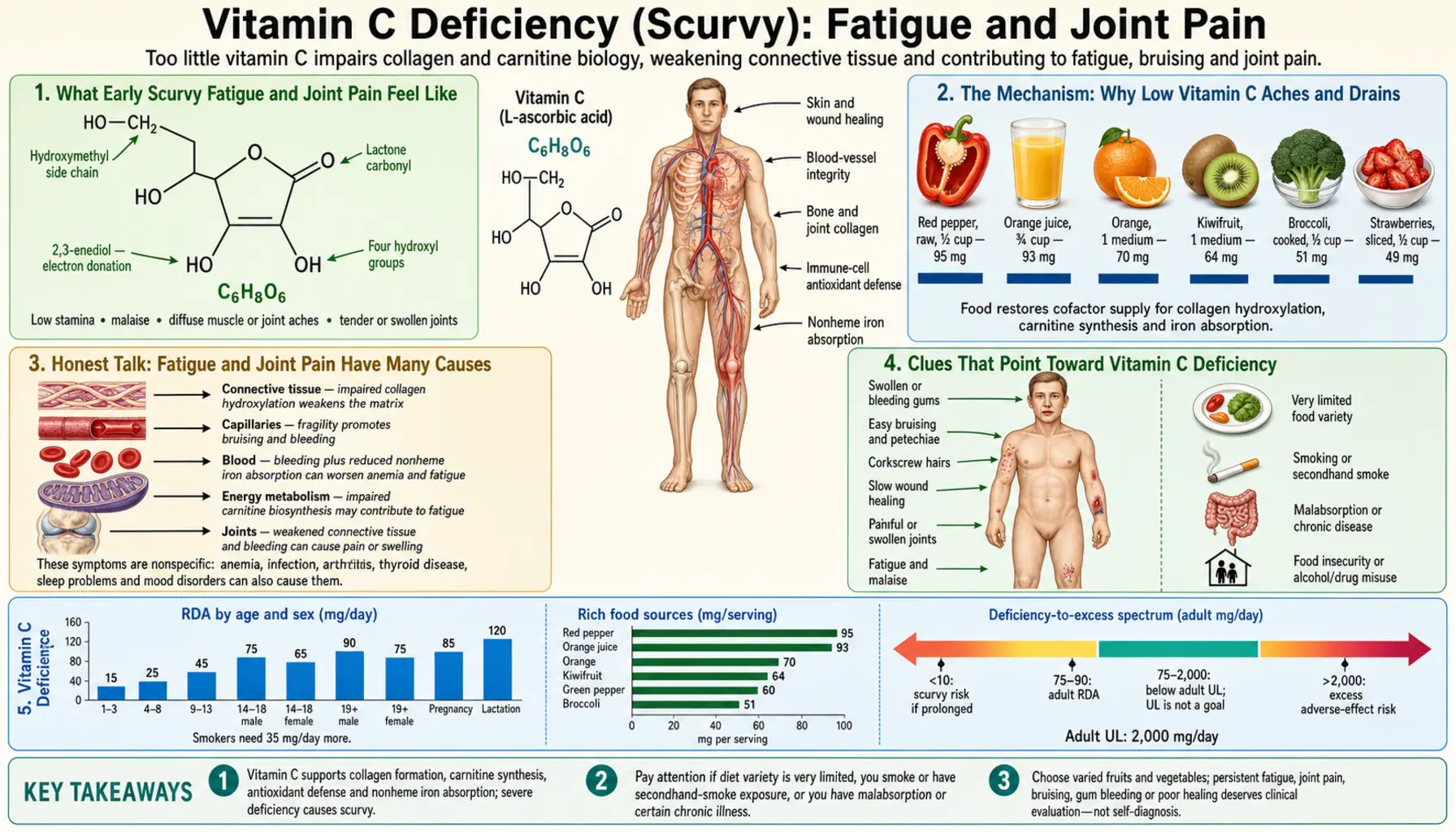
Long before the dramatic bleeding gums that most people picture when they hear the word “scurvy,” the earliest signs of vitamin C deficiency are quiet and easy to dismiss: a deep, dragging tiredness that sleep doesn't fix, and a dull, achy pain in the legs and joints that can make a flight of stairs feel daunting. These two symptoms — fatigue and aching limbs — are often the very first thing the body does when its vitamin C runs out, sometimes weeks before any classic sign appears. This page explains why a lack of one small molecule produces such heavy legs and weariness, how to tell when these everyday complaints might be pointing at scurvy, and how quickly — often within days — they reverse once vitamin C is restored.
Interactive Visualization Vitamin C, Collagen & Why Sailors Fell Apart Zip three protein chains into the strongest rope in biology — then take the vitamin C away and watch the helix unravel, and old healed scars split back open. Launch →
Table of Contents
- What Early Scurvy Fatigue and Joint Pain Feel Like
- The Mechanism: Why Low Vitamin C Aches and Drains
- Honest Talk: Fatigue and Joint Pain Have Many Causes
- Clues That Point Toward Vitamin C Deficiency
- What Causes Vitamin C to Run This Low
- Getting Tested and Diagnosed
- Correcting It: How Fast the Aches Lift
- When to Seek Care / Red Flags
- Key Research Papers
- Connections
- Featured Videos
What Early Scurvy Fatigue and Joint Pain Feel Like
The first stage of vitamin C deficiency is famously vague. People rarely walk into a clinic saying “I think I have scurvy.” Instead they describe a cluster of soft, creeping complaints that they have usually been putting up with for weeks:
- A heavy, bone-deep tiredness — not the pleasant sleepiness of a long day, but a flat, unrefreshing exhaustion. People say they feel wrung out, that ordinary tasks take more effort than they should, and that a full night's sleep makes little difference.
- Aching, tender legs — a dull, deep ache, often worst in the thighs and shins, that can make walking and especially stair-climbing feel like wading uphill. Children with early scurvy may limp, refuse to walk, or cry when their legs are touched.
- Sore, swollen joints — the knees and ankles can ache and stiffen, occasionally with visible swelling. The discomfort is frequently described as “arthritis that came out of nowhere.”
- A low, flat mood and irritability — listlessness, low motivation, and a short fuse commonly travel alongside the physical tiredness, and they tend to lift together once vitamin C is replaced.
What ties these together is that they are early. The textbook picture of scurvy — bleeding, spongy gums, easy bruising, corkscrew hairs, and wounds that won't close — tends to arrive later, after one to three months of near-zero intake. Fatigue and limb pain frequently come first, which is exactly why they get blamed on overwork, aging, or “just getting old” rather than on a nutrient the body has quietly run out of.
The leg pain of scurvy has a particular cause worth flagging early: as the deficiency deepens, tiny blood vessels become fragile and can leak under the lining of the bones (the periosteum) and into the joints. That bleeding into and around bone is intensely painful and is the reason a child with scurvy may hold a leg still in a frog-like position and scream if it is moved — a sign clinicians call pseudoparalysis, because the limb looks paralyzed but is simply being guarded against pain.
The Mechanism: Why Low Vitamin C Aches and Drains
To understand why a missing vitamin makes the legs ache and the body sag, it helps to know the two very different jobs vitamin C (ascorbic acid) does in the body.
Job one: vitamin C is the helper that lets the body build collagen. Collagen is the body's structural protein — the scaffolding of skin, tendons, ligaments, cartilage, blood-vessel walls, and the framework of bone. Two enzymes (prolyl hydroxylase and lysyl hydroxylase) have to chemically modify the raw collagen strands so they can twist together into the strong, rope-like triple helix that gives tissue its tensile strength. Those enzymes cannot do their job without vitamin C, which keeps the iron at their core in the working (reduced) state. When vitamin C runs out, the enzymes stall, and the collagen the body makes is weak and under-built — it cannot hold the rope together. Researchers showed decades ago that without ascorbate, cells fail to properly hydroxylate and secrete procollagen, so the new collagen is defective.
This single failure explains the aching legs and joints. Blood-vessel walls held together by faulty collagen become leaky and rupture, so blood seeps into muscles, under the lining of bone, and into joint spaces — producing deep limb pain, tender swelling, and the joint aches of early scurvy. The cartilage and connective tissue of the joints, also collagen-dependent, weaken at the same time. An analogy: collagen is the rebar inside the concrete of your tissues. Vitamin C is the worker who ties the rebar together. Take the worker away and no new rebar gets tied — so the walls of your smallest blood vessels start to crumble first, and they bleed, and that bleeding into legs and joints is what hurts.
Job two: vitamin C helps make the molecule that turns fat into usable energy. Separately from collagen, vitamin C is required to build carnitine, a small molecule that shuttles fatty acids into the mitochondria — the cell's power plants — where they are burned for fuel. Two enzymes in the carnitine assembly line depend on vitamin C. When vitamin C is scarce, carnitine production falls, and muscles (which lean heavily on fat for steady energy) are left short of fuel. The result is the early, characteristic fatigue and weakness of scurvy: a body that has trouble converting fat into energy feels tired, and the muscles tire quickly. Vitamin C also helps the body make norepinephrine, a brain chemical involved in alertness and mood, which is part of why the tiredness of deficiency so often comes bundled with low mood and irritability.
So the two flagship early symptoms have two clean explanations: the aching legs and joints come mostly from failing collagen and the fragile, leaky blood vessels it leaves behind, while the fatigue and low mood come largely from the energy- and brain-chemical side of vitamin C's job. Both reverse when vitamin C returns, which is why recovery can be so striking.
Honest Talk: Fatigue and Joint Pain Have Many Causes
It is important to be straight about this: fatigue and joint pain are two of the most common complaints in all of medicine, and the overwhelming majority of them are not scurvy. Vitamin C deficiency is a real and under-recognized cause — but it is far from the usual one, and assuming it without evidence can delay the diagnosis of something more common. Tiredness and aching limbs can come from a long list of conditions, including:
- Iron-deficiency anemia — one of the most common causes of fatigue worldwide, and one that overlaps with vitamin C because vitamin C boosts iron absorption; the two deficiencies can occur together.
- Thyroid disease (an underactive thyroid causes fatigue, low mood, and muscle aches), vitamin D deficiency, and vitamin B12 deficiency.
- Depression and chronic stress, which produce exactly the flat tiredness and low motivation seen in early scurvy.
- Inflammatory joint disease — conditions seen in rheumatology, such as rheumatoid arthritis or other autoimmune arthritis — and ordinary osteoarthritis.
- Poor sleep, viral illness, and the aftermath of infections, all of which can leave the body achy and drained for weeks.
Because the list is so long, fatigue and joint pain on their own should never be taken as proof of vitamin C deficiency. The honest framing is the reverse: scurvy is a cause worth considering and testing for — especially when the right risk factors are present (see below) — precisely because it is so often overlooked, cheap to confirm, and dramatically easy to fix once found.
Clues That Point Toward Vitamin C Deficiency
So when should fatigue and aching legs raise the question of scurvy rather than something more common? A few features shift the odds:
- A genuinely fruit- and vegetable-poor diet. Humans cannot make vitamin C; we must eat it, and the body's stores run dry after roughly one to three months of near-zero intake. A history of living on processed, packaged, or “beige” food with virtually no fresh produce is the single biggest clue.
- The aches and tiredness travel with other connective-tissue signs. When the leg pain is joined by easy bruising or wounds that won't heal, by swollen, bleeding gums, by tiny red dots around hair follicles, or by curly, corkscrew body hairs, the picture starts pointing firmly at vitamin C.
- The classic distribution of pain. Pain centered in the legs — especially in a child who suddenly won't bear weight or holds the legs rigid — is a recognized early scurvy pattern, because bleeding under the lining of the long bones happens there.
- It improves remarkably fast with vitamin C. Although a trial of treatment is not a substitute for testing, the speed of recovery is itself a clue: the fatigue and aches of true scurvy often begin to ease within a few days of replacing vitamin C, faster than most other causes of these symptoms respond to anything.
One symptom never makes the diagnosis on its own. But fatigue plus aching legs, in someone whose plate has been free of fresh produce for a month or more — particularly alongside any bruising or gum changes — is the combination that should prompt a simple blood test rather than a shrug.
What Causes Vitamin C to Run This Low
Because the body keeps only a small reserve of vitamin C and cannot manufacture any, deficiency develops whenever intake stays very low for weeks. In wealthy countries scurvy is uncommon but not rare, and it clusters in particular situations:
- Very limited or selective diets. This is the main driver: diets built almost entirely from processed and packaged foods with little or no fresh fruit and vegetables. It is seen in people living alone with little cooking, in poverty or food insecurity, in those with alcohol-use disorder, in severe eating disorders, and in highly restricted “picky” eating — including some autistic children whose food range is narrow.
- Smoking and heavy alcohol use. Smokers metabolize vitamin C faster and need substantially more of it; alcohol use both displaces a good diet and impairs intake and absorption.
- Malabsorption and gut disease. Crohn's disease, ulcerative colitis, celiac disease, and the after-effects of some weight-loss (bariatric) surgery can all reduce how much vitamin C the body takes in.
- Higher demand and certain conditions. Pregnancy and breastfeeding, dialysis, serious illness, and some chronic diseases raise requirements or losses. Older adults living alone are a classically under-recognized group.
- Infants on the wrong milk. Babies fed boiled cow's milk or unsupplemented formula (heat destroys vitamin C) can develop infantile scurvy — historically called Barlow disease — which often shows up first as leg pain and refusal to move.
The recommended intake for adults is modest — about 75 mg/day for women and 90 mg/day for men, with smokers advised to add roughly 35 mg — and even a single orange, kiwi, or serving of peppers easily covers it. It takes a sustained near-absence of produce, not just an occasional low day, to drain the body's stores far enough to cause symptoms.
Getting Tested and Diagnosed
Confirming vitamin C deficiency is straightforward, and clinicians usually rely on the combination of a suggestive diet, the clinical picture, and a blood test — with a fast response to treatment serving as confirmation.
- Plasma (serum) vitamin C level. A blood test measures ascorbic acid directly. Levels are generally considered deficient below about 11 µmol/L (roughly 0.2 mg/dL) and adequate above about 23 µmol/L. It is the most accessible test, though the level reflects recent intake more than long-term tissue stores, and it should be drawn before treatment begins because even one dose can normalize it.
- Tests to rule out the common look-alikes. Because fatigue and aches have so many causes, the work-up often includes a Complete Blood Count and iron studies (to find anemia), thyroid tests, and a Comprehensive Metabolic Panel. Vitamin C deficiency and iron deficiency in particular often coexist, since vitamin C aids iron absorption.
- Imaging, in children. When scurvy is suspected in a child with leg pain, X-rays of the long bones can show characteristic changes, and MRI can reveal the bleeding under the periosteum that causes the pain — findings that can otherwise be mistaken for infection, leukemia, or even non-accidental injury.
A key practical point: many clinicians, faced with a strongly suggestive diet and picture, will check the level and then start vitamin C without waiting, because the response itself is so confirmatory. A diagnosis that resolves within days of replacing one vitamin is, in retrospect, hard to argue with.
Correcting It: How Fast the Aches Lift
Few deficiencies are as satisfying to treat. Once vitamin C is replaced, recovery is rapid and predictable, and the order in which symptoms heal is itself a hallmark of scurvy.
- Replacement doses. Treatment uses doses well above the daily requirement for a short period — commonly on the order of 300–1000 mg per day for adults (and weight-appropriate doses for children) for several weeks until stores are rebuilt and symptoms resolve. Vitamin C is taken by mouth in nearly all cases; it is inexpensive and very safe.
- How fast you feel it. The subjective symptoms — fatigue, low mood, and irritability — often begin to lift within 24 to 48 hours, sometimes startlingly so. Limb and joint pain and the leg tenderness usually ease over a few days to a couple of weeks as bleeding stops and new, normal collagen is laid down. Bruising and gum changes resolve over a few weeks; full healing of bone and connective tissue takes a bit longer.
- Food first, for the long run. Once stores are restored, the goal is simply to keep them full with everyday food. Excellent sources include kiwifruit, citrus fruit, strawberries, bell peppers, and broccoli. Because heat and prolonged cooking destroy vitamin C, raw or lightly cooked produce delivers the most. See the Vitamin C food sources page for a fuller list.
- Fix what caused it. Lasting recovery means addressing the underlying reason — broadening a restricted diet, supporting someone with food insecurity or alcohol-use disorder, treating gut disease, or correcting an infant's feeding — so the deficiency does not simply return.
The remarkable speed of recovery is part of what makes recognizing scurvy worthwhile: a person who has felt exhausted and achy for weeks can feel meaningfully better within days, on a treatment that costs very little.
When to Seek Care / Red Flags
Early scurvy is treated calmly and on a normal timeline, but some features mean you should be seen by a clinician promptly rather than waiting to see whether things improve on their own:
- A child who refuses to walk, won't bear weight, or screams when a leg is moved — the “pseudoparalysis” of infantile scurvy needs prompt medical assessment, both to treat it and to distinguish it from infection or injury.
- Bleeding gums, blood blisters in the mouth, or loose teeth, or bruises and skin bleeding appearing without injury — signs the deficiency has reached the bleeding stage.
- Severe or worsening fatigue, breathlessness, a racing heart, or fainting — these can signal significant anemia or, in advanced untreated scurvy, more serious internal bleeding, and warrant urgent evaluation.
- Joint pain with fever, marked redness, or a hot swollen joint — this points away from simple scurvy and toward infection or inflammatory arthritis, which need their own urgent work-up.
- Symptoms that do not improve after a week or two of vitamin C — a lack of the expected rapid response means the diagnosis should be reconsidered and the common causes of fatigue and joint pain pursued.
Untreated scurvy is, even today, a potentially fatal disease — advanced cases can bleed dangerously. But caught at the fatigue-and-joint-pain stage, it is one of the most fixable conditions in medicine. The sensible path is to take persistent, unexplained tiredness and aching legs seriously, especially when the diet has been poor, and to ask for the simple blood test that settles the question.
Key Research Papers
- Gandhi M, Elfeky O, Ertugrul H, et al. (2023). Scurvy: Rediscovering a Forgotten Disease. Diseases;11(2):78. — DOI: 10.3390/diseases11020078
- Fain O (2005). Musculoskeletal manifestations of scurvy. Joint Bone Spine;72(2):124-128. — DOI: 10.1016/j.jbspin.2004.01.007
- Olmedo JM, Yiannias JA, Windgassen EB, Gornet MK (2006). Scurvy: a disease almost forgotten. International Journal of Dermatology;45(8):909-913. — DOI: 10.1111/j.1365-4632.2006.02844.x
- Peterkofsky B (1991). Ascorbate requirement for hydroxylation and secretion of procollagen: relationship to inhibition of collagen synthesis in scurvy. The American Journal of Clinical Nutrition;54(6):1135S-1140S. — DOI: 10.1093/ajcn/54.6.1135s
- Rebouche CJ (1991). Ascorbic acid and carnitine biosynthesis. The American Journal of Clinical Nutrition;54(6):1147S-1152S. — DOI: 10.1093/ajcn/54.6.1147s
- Levine M, Conry-Cantilena C, Wang Y, et al. (1996). Vitamin C pharmacokinetics in healthy volunteers: evidence for a recommended dietary allowance. Proceedings of the National Academy of Sciences;93(8):3704-3709. — DOI: 10.1073/pnas.93.8.3704
- Levine M, Wang Y, Padayatty SJ, Morrow J (2001). A new recommended dietary allowance of vitamin C for healthy young women. Proceedings of the National Academy of Sciences;98(17):9842-9846. — DOI: 10.1073/pnas.171318198
- Schleicher RL, Carroll MD, Ford ES, Lacher DA (2009). Serum vitamin C and the prevalence of vitamin C deficiency in the United States: 2003-2004 National Health and Nutrition Examination Survey (NHANES). The American Journal of Clinical Nutrition;90(5):1252-1263. — DOI: 10.3945/ajcn.2008.27016
- Carr AC, Maggini S (2017). Vitamin C and Immune Function. Nutrients;9(11):1211. — DOI: 10.3390/nu9111211
PubMed Topic Searches
- PubMed — Scurvy, joint pain, and musculoskeletal symptoms
- PubMed — Vitamin C deficiency and fatigue
- PubMed — Pediatric scurvy, limp, and pseudoparalysis
- PubMed — Ascorbic acid and collagen hydroxylation
- PubMed — Vitamin C deficiency diagnosis and treatment in adults
Connections
- All Vitamins
- Vitamin C, Collagen & Why Sailors Fell Apart — interactive animation
- Vitamin C Deficiency (Scurvy) Hub
- Bleeding Gums & Tooth Loss
- Bruising & Poor Wound Healing
- Weakened Immunity
- Vitamin C Overview
- Vitamin C and Collagen Synthesis
- Vitamin C and Iron Absorption
- Vitamin C Food Sources
- Vitamin C History
- Iron Deficiency
- Anemia
- Rheumatology (Joint Disease)
- Comprehensive Metabolic Panel
- Complete Blood Count
- Kiwifruit
- Broccoli