Vitamin C Deficiency (Scurvy): Symptoms, Causes, and Recovery
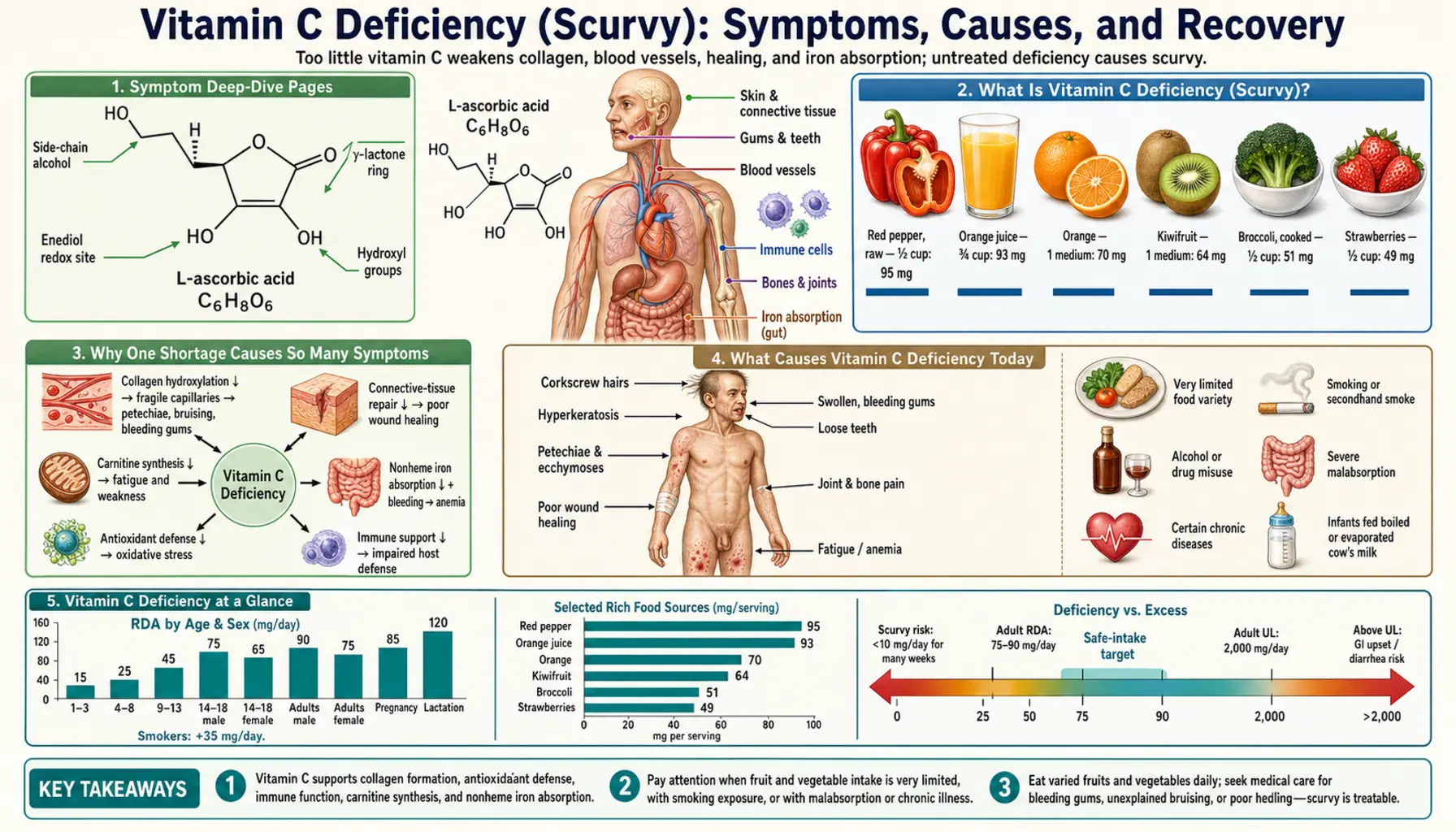
Vitamin C deficiency, when severe and long-lasting, causes scurvy — one of the oldest diseases known to medicine and the one that gave vitamins their name. It sounds like a relic of sailing ships and long sea voyages, but scurvy still appears today in people whose diets contain almost no fruit or vegetables for weeks or months at a time. The symptoms can be baffling because they seem unrelated: gums that swell and bleed, bruises that bloom from nowhere, corkscrew-shaped body hairs ringed by tiny red dots, wounds that refuse to heal, aching legs and joints, and a heavy, bone-deep tiredness. The reason they cluster together is that vitamin C does one essential job — it is the helper your body needs to build and repair collagen, the protein scaffolding that holds skin, blood vessels, gums, and connective tissue together. Without it, that scaffolding quietly weakens everywhere at once. The hopeful part of the story is that scurvy is both preventable and, once recognized, dramatically reversible: a return of vitamin C from food or supplements can turn the symptoms around within days. This hub explains what vitamin C deficiency is, why a single shortage produces such scattered symptoms, what causes it today, who is most at risk, how it is diagnosed, and exactly how it is corrected — with deep-dive pages for each of the major symptoms.
Symptom Deep-Dive Pages
Bleeding Gums & Tooth Loss
The classic and often earliest sign of scurvy — swollen, spongy, purple gums that bleed at a touch, and in advanced cases teeth that loosen and fall out. What it feels like, why collagen failure makes gum tissue fragile, and how quickly it heals once vitamin C returns.
Bruising & Poor Wound Healing
Why low vitamin C makes blood vessels leak — producing easy bruising, the tell-tale red dots around hair follicles (perifollicular hemorrhage), and cuts that will not close. The collagen connection explained in plain language.
Fatigue & Joint Pain
The vague, easily missed early symptoms — deep tiredness, low mood, irritability, and aching joints and legs that can mimic arthritis. Why these often come first, weeks before the bleeding signs, and what they point to.
Weakened Immunity
How vitamin C supports the immune system, why a deficiency can leave you more prone to infections and slower to recover, and an honest look at what the evidence does — and does not — say about vitamin C and everyday colds.
Interactive Visualization Vitamin C, Collagen & Why Sailors Fell Apart Zip three protein chains into the strongest rope in biology — then take the vitamin C away and watch the helix unravel, and old healed scars split back open. Launch →
Table of Contents
- Symptom Deep-Dive Pages
- What Is Vitamin C Deficiency (Scurvy)?
- Why One Shortage Causes So Many Symptoms
- What Causes Vitamin C Deficiency Today
- Who Is Most at Risk
- How Vitamin C Deficiency Is Diagnosed
- How Vitamin C Deficiency Is Corrected
- When to Seek Care / Red Flags
- Key Research Papers
- Connections
- Featured Videos
What Is Vitamin C Deficiency (Scurvy)?
Vitamin C (ascorbic acid) is an essential nutrient, which means your body cannot make it — you must get it from food or supplements every few days. Unusually among mammals, humans, other primates, and guinea pigs lost the ability to synthesize vitamin C far back in evolution, which is exactly why we are vulnerable to running out. Vitamin C deficiency is the state in which body stores of ascorbic acid fall too low to support its normal jobs; when the shortage is severe and prolonged, the resulting disease is called scurvy. The word itself comes from the medieval Latin scorbutus, and the disease's grip on history is hard to overstate — it killed more sailors during the age of exploration than storms and combat combined, until a British naval surgeon, James Lind, showed in 1747 that citrus fruit cured and prevented it.
It helps to think of vitamin C as a tank that is constantly being drained and refilled. A healthy adult body holds a pool of roughly 1,500 mg of vitamin C. When intake stops, that pool falls steadily; symptoms of scurvy do not appear until the body pool drops below about 300–400 mg, which typically takes one to three months of near-zero intake. This long buffer is why scurvy is a disease of sustained dietary deprivation rather than a single bad week, and it is why the early warning signs are subtle and slow.
How depleted you are tends to fall along a spectrum, and the symptoms scale with it:
- Marginal deficiency (hypovitaminosis C) — Stores are low but not yet at the scurvy threshold. There may be no obvious symptoms at all, or only vague ones such as tiredness, low mood, and a general sense of being run down. Studies suggest marginal vitamin C status is more common than people assume, particularly among smokers, heavy drinkers, and those eating very few fruits and vegetables. (Deep dive: Fatigue & Joint Pain.)
- Early scurvy — The first definite signs appear, and they are easy to miss or misattribute: fatigue, irritability, loss of appetite, aching legs and joints, and small skin changes. Because none of these scream "vitamin deficiency," early scurvy is frequently mistaken for depression, arthritis, a blood disorder, or simply getting older.
- Established scurvy — The hallmark signs emerge: swollen, bleeding gums (in people who still have teeth), easy bruising, the distinctive corkscrew (coiled) body hairs surrounded by tiny pinpoint bleeds (perifollicular hemorrhage), poor wound healing with old wounds even re-opening, and small red-to-purple spots on the skin (petechiae). (Deep dives: Bleeding Gums & Tooth Loss, Bruising & Poor Wound Healing.)
- Advanced scurvy — Left uncorrected, the disease becomes dangerous: deep bleeding into joints and muscles, severe anemia, bleeding around the bones (especially painful and growth-disrupting in children), tooth loss, and in historical accounts, eventual death from bleeding or infection. It is entirely treatable at any stage, but the further it goes, the more it costs the body.
The two facts to carry forward are these. First, scurvy is fundamentally a collagen-failure disease — almost every sign traces back to weak connective tissue (more on that in the next section). Second, although it is rare in well-fed populations, it has not vanished: case reports continue to surface in modern hospitals, usually in people with very restricted diets, and scurvy is often diagnosed late precisely because clinicians do not expect to see a "historical" disease.
Why One Shortage Causes So Many Symptoms
At first glance, the symptom list of scurvy looks random — what could bleeding gums, easy bruising, slow-healing wounds, corkscrew hairs, joint pain, and exhaustion possibly have in common? The answer is a single molecule and a single job. Vitamin C is the essential helper (cofactor) that your body needs to build collagen, and collagen is the structural protein that quite literally holds the body together. When the helper runs out, collagen production falters in every tissue at once, so the body's scaffolding weakens everywhere — and it shows up first wherever that scaffolding is under the most stress.
Here is the mechanism in everyday language. Collagen is made of long protein strands that must be twisted together into a strong, rope-like triple helix. For those strands to lock into a stable rope, certain building blocks within them (the amino acids proline and lysine) must first be chemically modified — a step called hydroxylation. The enzymes that perform this step (prolyl and lysyl hydroxylase) cannot work without vitamin C to keep them running. Peterkofsky's classic work described exactly this: without ascorbate, the hydroxylation step stalls, the collagen strands cannot form a proper helix, and the defective collagen is poorly secreted and unstable. The result is collagen that is too weak to do its job — like trying to build with rope that keeps unraveling.
Because collagen is the common ingredient in so many structures, one shortage ripples outward into seemingly unrelated symptoms:
- Blood vessel walls — Tiny blood vessels (capillaries) rely on collagen to stay strong and sealed. When that collagen weakens, the vessels become fragile and leaky, so blood escapes into the tissues with little or no trauma. This produces the easy bruising, the pinpoint bleeds around hair follicles, and the petechiae of scurvy. (Deep dive: Bruising & Poor Wound Healing.)
- Gums — The gum tissue around teeth is rich in collagen and under constant mechanical stress from chewing, making it one of the first places weak collagen and fragile vessels show. The gums swell, turn spongy and purple, and bleed easily; in advanced disease the structures anchoring the teeth fail and teeth loosen. (Deep dive: Bleeding Gums & Tooth Loss.)
- Skin and wounds — Healing a wound means laying down fresh collagen to knit the edges together. Without vitamin C the body cannot build that new collagen, so cuts heal slowly or not at all, and previously healed scars can even break down. The skin also develops the characteristic corkscrew hairs, because the hair shaft, deprived of normal protein structure, coils instead of growing straight. (Deep dive: Bruising & Poor Wound Healing.)
- Joints, bones, and connective tissue — Cartilage, tendons, ligaments, and the protein framework of bone all depend on collagen. As it weakens, people develop aching joints and legs, and bleeding can occur into the joints and beneath the bone's surface — intensely painful, and in children a cause of stalled growth and bone changes. (Deep dive: Fatigue & Joint Pain.)
Vitamin C has two further roles that round out the picture. It is a powerful antioxidant that protects cells from damage, and it helps make several signaling molecules and hormones (such as norepinephrine and carnitine) that the brain and muscles use for energy and mood — which helps explain the profound fatigue, low mood, and irritability of early deficiency, before any bleeding sign appears. It also plays a supporting role across the immune system, so deficiency can blunt the body's defenses (deep dive: Weakened Immunity). And separately, vitamin C dramatically improves the absorption of iron from plant foods, which is why long-standing deficiency often travels with anemia. For the deeper physiology of how this nutrient builds connective tissue, see Vitamin C and Collagen.
The unifying theme to carry into the symptom pages is simple: scurvy is not a collection of unrelated problems but a single structural failure — weak collagen — expressed in many tissues at once.
What Causes Vitamin C Deficiency Today
The root cause of scurvy is always the same: not enough vitamin C reaching the body for long enough. Because the body holds a buffer that lasts weeks to months, deficiency is essentially a disease of sustained low intake, not an occasional poor day. In modern life that prolonged shortage tends to come from one of a few recognizable situations, and they often overlap.
- A diet almost devoid of fruit and vegetables — This is the central cause. Vitamin C comes overwhelmingly from produce, so a pattern of eating that leaves it out for weeks — for example, a diet of mostly processed, packaged, or take-out food, "tea and toast" eating in isolated older adults, or extremely picky eating — will eventually drain the tank. Importantly, the amount needed to prevent scurvy is small (only about 10 mg per day staves off symptoms), so this requires a genuinely impoverished diet, not just an imperfect one.
- Cooking and food handling losses — Vitamin C is one of the most fragile nutrients. It is destroyed by heat, dissolves into cooking water, and degrades with prolonged storage and exposure to air. Someone whose few vegetables are always boiled to death, canned long ago, or left sitting may take in far less than the food labels suggest.
- Smoking — Smokers have lower vitamin C levels and need an estimated 35 mg more per day than non-smokers, because tobacco smoke increases oxidative stress and the metabolic turnover of vitamin C. Heavy smoking combined with a poor diet is a classic recipe for deficiency.
- Heavy alcohol use — Alcohol use disorder is one of the most common settings for modern scurvy. It combines several pushes in the same direction: alcohol often replaces nourishing food, it impairs how the gut absorbs nutrients, and it increases vitamin C losses. People with alcohol dependence are frequently also low in other vitamins at the same time.
- Malabsorption and gut disease — Conditions that impair nutrient absorption — inflammatory bowel disease (Crohn's and ulcerative colitis), celiac disease, chronic diarrhea, and the after-effects of some bariatric (weight-loss) surgeries — can cause deficiency even when the diet contains some vitamin C.
- Highly restrictive diets and disordered eating — Fad diets that exclude whole food groups, very limited "elimination" diets followed too long without guidance, food avoidance from sensory or psychiatric conditions (including autism-related restricted eating and ARFID), and eating disorders can all strip vitamin C from the diet for months.
- Increased needs and losses — Some states raise the body's requirement: serious infection, major surgery, severe burns, trauma, and critical illness all increase vitamin C turnover, and pregnancy and breastfeeding modestly raise needs. On a background of marginal intake, these can tip a person into deficiency.
- Iron overload (a less obvious cause) — In conditions where iron accumulates in the body, the excess iron accelerates the breakdown of vitamin C, which can lower levels independently of diet.
A practical point worth emphasizing: in most real cases these causes stack. The textbook patient is not a healthy person who simply chose not to eat oranges, but someone in whom several factors line up — for instance, an older man living alone who smokes, drinks, cooks little, and eats almost no fresh produce. Recognizing the pattern is often what finally leads to the diagnosis.
Who Is Most at Risk
Scurvy is uncommon in the general population of well-fed countries, but it is far from extinct — and it concentrates in specific, identifiable groups. Knowing who is at risk is what turns a baffling set of symptoms into an "aha" diagnosis. The people most likely to develop vitamin C deficiency include:
- People with very restricted or impoverished diets — Those experiencing food insecurity, homelessness, or poverty; people who are socially isolated; and anyone whose habitual diet contains almost no fruit or vegetables. This is the single largest risk group.
- Older adults living alone — Limited mobility, fixed incomes, dental problems that make produce hard to eat, reduced appetite, and the "tea and toast" eating pattern combine to make scurvy a recurring — and frequently overlooked — finding in geriatric medicine.
- Heavy drinkers and people who smoke — For all the reasons above, alcohol use disorder and heavy smoking are among the most common modern settings for clinical scurvy, especially when they occur together with a poor diet.
- People with mental illness or restrictive eating patterns — Depression, dementia, severe anxiety, eating disorders, and conditions such as autism and ARFID can all narrow the diet enough, for long enough, to cause deficiency. Children and adults with very limited "safe food" lists are a recognized at-risk group.
- People with malabsorption or after bariatric surgery — Inflammatory bowel disease, celiac disease, chronic diarrhea, and some weight-loss operations reduce how much vitamin C the body can take in or hold.
- Infants fed unsupplemented or improper diets — Historically, scurvy in babies followed feeding heat-treated (boiled) cow's milk with no source of vitamin C. It remains a (rare) risk in infants given highly restricted or inappropriate diets, and it can be mistaken for child abuse because of the bone bleeding it causes.
- Pregnant and breastfeeding women — Requirements rise modestly during pregnancy and lactation; a woman already eating a marginal diet is more vulnerable during these times.
- People undergoing dialysis or with serious chronic illness — Dialysis removes water-soluble vitamins, including vitamin C, and the increased turnover of serious or critical illness can deplete stores.
If you or someone you care for falls into one of these groups and has unexplained fatigue, bruising, bleeding gums, leg pain, or wounds that will not heal, vitamin C deficiency is worth raising directly with a doctor — it is cheap to check and easy to treat, yet routinely missed because it is not the first thing most people think of.
How Vitamin C Deficiency Is Diagnosed
The most important step in diagnosing scurvy is simply thinking of it. Because it is considered a "historical" disease, the diagnosis is frequently delayed for weeks or months while clinicians chase look-alikes — a bleeding disorder, vasculitis, arthritis, or even, in children, suspected abuse. In practice, scurvy is usually a clinical diagnosis: the picture of characteristic symptoms (bleeding gums, perifollicular bruising, corkscrew hairs, poor healing, leg pain) in a person with an obvious dietary risk factor is often enough to make the call and start treatment.
Several investigations support and confirm the diagnosis:
- Plasma (serum) vitamin C level — A blood test that measures circulating ascorbic acid is the most direct confirmation. A level below about 11 micromol/L (roughly 0.2 mg/dL) is considered deficient and consistent with scurvy. One caveat: the plasma level reflects recent intake and can be temporarily raised by a single vitamin-C-rich meal or dose, so it must be interpreted alongside the clinical picture. (A leukocyte/white-cell vitamin C level better reflects tissue stores but is mostly a research test and not widely available.)
- Complete blood count and iron studies — Anemia is common in scurvy and can have several causes (blood loss from bleeding, the iron-absorption role of vitamin C, and overlapping folate deficiency). A Complete Blood Count and an Iron Panel help characterize it. For the wider picture, see Anemia.
- Tests to rule out look-alikes — Because easy bruising and bleeding raise the question of a clotting problem, doctors often check coagulation and platelet tests, which in scurvy are characteristically normal — an important clue that the problem is the vessel wall (weak collagen), not the blood's ability to clot.
- Imaging in children — In suspected childhood scurvy, X-rays of the long bones can show changes typical of the disease (such as a dense white line at the growth plate and signs of bleeding beneath the bone covering), which can help distinguish it from other causes of bone pain.
- The diagnostic-treatment trial — Perhaps the most telling test of all: when vitamin C is given to someone with scurvy, the response is rapid and unmistakable. Fatigue and bleeding gums begin improving within days, and a clear response strongly confirms the diagnosis.
For everyday self-awareness rather than self-diagnosis: if you have several of the hallmark signs together with a diet very low in fruits and vegetables, ask a clinician specifically about scurvy and request a vitamin C level — it is a question that often gets to the answer faster than another round of broad testing.
How Vitamin C Deficiency Is Corrected
Of all the nutritional deficiency diseases, scurvy may be the most satisfying to treat, because the turnaround is so fast and so complete. The guiding principles are: replace the vitamin C promptly, prefer food where possible but use supplements to refill stores quickly, and fix the underlying reason so the deficiency does not simply return.
- Supplemental vitamin C to refill the tank. When scurvy is established, doctors typically give a defined course of supplemental vitamin C to restore the body pool rapidly — commonly on the order of a few hundred milligrams to about 1 gram per day for one to two weeks, then a lower maintenance dose, with exact regimens varying by source and severity (and adjusted in children). The response is dramatic: fatigue, mood, and bleeding gums often begin improving within 24–72 hours, bruising and skin signs resolve over a few weeks, and even the corkscrew hairs eventually normalize. Full recovery of all tissues, including healing of bone and joint changes, takes longer but is the rule rather than the exception.
- Food first for prevention and long-term health. Once the immediate deficiency is corrected, lasting protection comes from diet. The amount needed is genuinely small — the U.S. recommended dietary allowance is 90 mg/day for men and 75 mg/day for women (with an extra 35 mg/day for smokers, and somewhat more in pregnancy and breastfeeding), and Levine's landmark pharmacokinetic work showed that intakes in roughly the 100–200 mg/day range fully saturate the body's tissues in healthy adults. That is easily met by a varied diet. Excellent sources include citrus fruits, strawberries, kiwifruit, broccoli and other cruciferous vegetables, bell peppers, tomatoes, and potatoes. To minimize losses, favor raw or lightly cooked produce, since heat and boiling destroy much of the vitamin. See the Vitamin C food sources page for a fuller list and practical amounts.
- Food vs. synthetic: they work the same. A common question is whether the vitamin C from a tablet is inferior to the kind in an orange. For the molecule itself, the answer is no — Carr and Vissers reviewed the evidence and found synthetic and food-derived ascorbic acid to be equally bioavailable. The real advantage of getting vitamin C from whole foods is everything else that comes with it (fiber, potassium, other antioxidants), not the ascorbic acid itself.
- Treat the cause so it does not recur. Refilling the tank without addressing why it emptied just resets the clock. That might mean dietary counseling and practical help with food access for an isolated older adult, support for alcohol use or smoking cessation, managing an underlying gut disease that limits absorption, or arranging ongoing supplementation for someone whose diet cannot easily be changed (for example, certain restrictive-eating or dialysis situations).
- How much is too much? Vitamin C is water-soluble and the body excretes the excess, so it has a wide safety margin and high doses are not part of treating ordinary deficiency. The main downside of very large doses (well above the tolerable upper intake level of about 2,000 mg/day for adults) is gastrointestinal — loose stools, cramps, and, in susceptible people, a higher risk of kidney stones. The full picture of excess intake is covered on the companion Vitamin C Toxicity hub.
For nearly everyone, the outlook is excellent: scurvy is fully reversible, and once vitamin C is restored and the underlying cause is handled, the symptoms — even the alarming ones — melt away.
When to Seek Care / Red Flags
Most early signs of vitamin C deficiency — tiredness, mild gum bleeding, the odd unexplained bruise — are not emergencies, and the right step is a non-urgent appointment with your doctor to discuss your diet and request a vitamin C level, especially if you smoke, drink heavily, live with limited access to fresh food, or eat very few fruits and vegetables. That said, certain features mean the deficiency is advanced or that something more serious needs to be ruled out. Seek prompt medical care if you have any of the following:
- Heavy or persistent bleeding — gums that bleed profusely, blood in the urine or stool, coughing or vomiting blood, or any bleeding that will not stop.
- Severe, spreading bruising or large blood-filled swellings — especially if they appear without injury, which can signal bleeding deep into muscles or joints.
- Sudden, severe leg or joint pain with swelling — particularly in a child who refuses to bear weight or stops walking, which warrants urgent evaluation.
- Signs of significant anemia — marked breathlessness, chest pain, a racing heart, fainting, or extreme weakness, which mean the blood count may be dangerously low.
- Wounds that are breaking down or becoming infected — old scars re-opening, or new wounds that will not heal and show signs of infection (spreading redness, warmth, pus, fever).
- Any bleeding or bruising you cannot explain — because easy bruising and bleeding have other important causes (clotting disorders, low platelets, certain cancers), unexplained symptoms should always be assessed by a clinician rather than assumed to be scurvy.
The encouraging context is that even advanced scurvy responds quickly to treatment, so seeking care is never futile — it is the fastest route to feeling better. When in doubt, a simple conversation about your diet plus a blood test usually settles the question. For related symptoms, see Fatigue, Gum Disease, and Anemia.
Key Research Papers
- Hirschmann JV, Raugi GJ (1999). Adult scurvy. Journal of the American Academy of Dermatology;41(6):895-910. — DOI: 10.1016/S0190-9622(99)70244-6
- Velandia B, Centor RM, McConnell V, Shah M (2008). Scurvy Is Still Present in Developed Countries. Journal of General Internal Medicine;23(8):1281-1284. — DOI: 10.1007/s11606-008-0577-1
- Levine M, Conry-Cantilena C, Wang Y, Welch RW, Washko PW, et al. (1996). Vitamin C pharmacokinetics in healthy volunteers: evidence for a recommended dietary allowance. Proceedings of the National Academy of Sciences;93(8):3704-3709. — DOI: 10.1073/pnas.93.8.3704
- Peterkofsky B (1991). Ascorbate requirement for hydroxylation and secretion of procollagen: relationship to inhibition of collagen synthesis in scurvy. The American Journal of Clinical Nutrition;54(6):1135S-1140S. — DOI: 10.1093/ajcn/54.6.1135S
- Pullar JM, Carr AC, Vissers MCM (2017). The Roles of Vitamin C in Skin Health. Nutrients;9(8):866. — DOI: 10.3390/nu9080866
- Carr AC, Maggini S (2017). Vitamin C and Immune Function. Nutrients;9(11):1211. — DOI: 10.3390/nu9111211
- Padayatty SJ, Levine M (2016). Vitamin C: the known and the unknown and Goldilocks. Oral Diseases;22(6):463-493. — DOI: 10.1111/odi.12446
- Carr AC, Pullar JM, Bozonet SM, Vissers MCM (2016). Marginal Ascorbate Status (Hypovitaminosis C) Results in an Attenuated Response to Vitamin C Supplementation. Nutrients;8(6):341. — DOI: 10.3390/nu8060341
- Carr AC, Vissers MCM (2013). Synthetic or Food-Derived Vitamin C — Are They Equally Bioavailable? Nutrients;5(11):4284-4304. — DOI: 10.3390/nu5114284
PubMed Topic Searches
- PubMed — Scurvy and adult vitamin C deficiency
- PubMed — Vitamin C, collagen synthesis, and hydroxylation
- PubMed — Scurvy: diagnosis and clinical features
- PubMed — Hypovitaminosis C and marginal vitamin C status
- PubMed — Childhood (pediatric) scurvy and restricted diets
Connections
- All Vitamins
- Vitamin C, Collagen & Why Sailors Fell Apart — interactive animation
- Scurvy: Bleeding Gums & Tooth Loss
- Scurvy: Bruising & Poor Wound Healing
- Scurvy: Fatigue & Joint Pain
- Scurvy: Weakened Immunity
- Vitamin C Toxicity (Excess)
- Vitamin C Overview
- Vitamin C Benefits Hub
- Vitamin C Food Sources
- Vitamin C History
- Vitamin C and Collagen
- Vitamin C and Immune Defense
- Vitamin C and Iron Absorption
- Iron
- Anemia
- Gum Disease
- Fatigue
- Complete Blood Count
- Iron Panel
- Strawberries
- Kiwifruit
- Broccoli
- Tomatoes