Pycnogenol (French Maritime Pine Bark Extract)
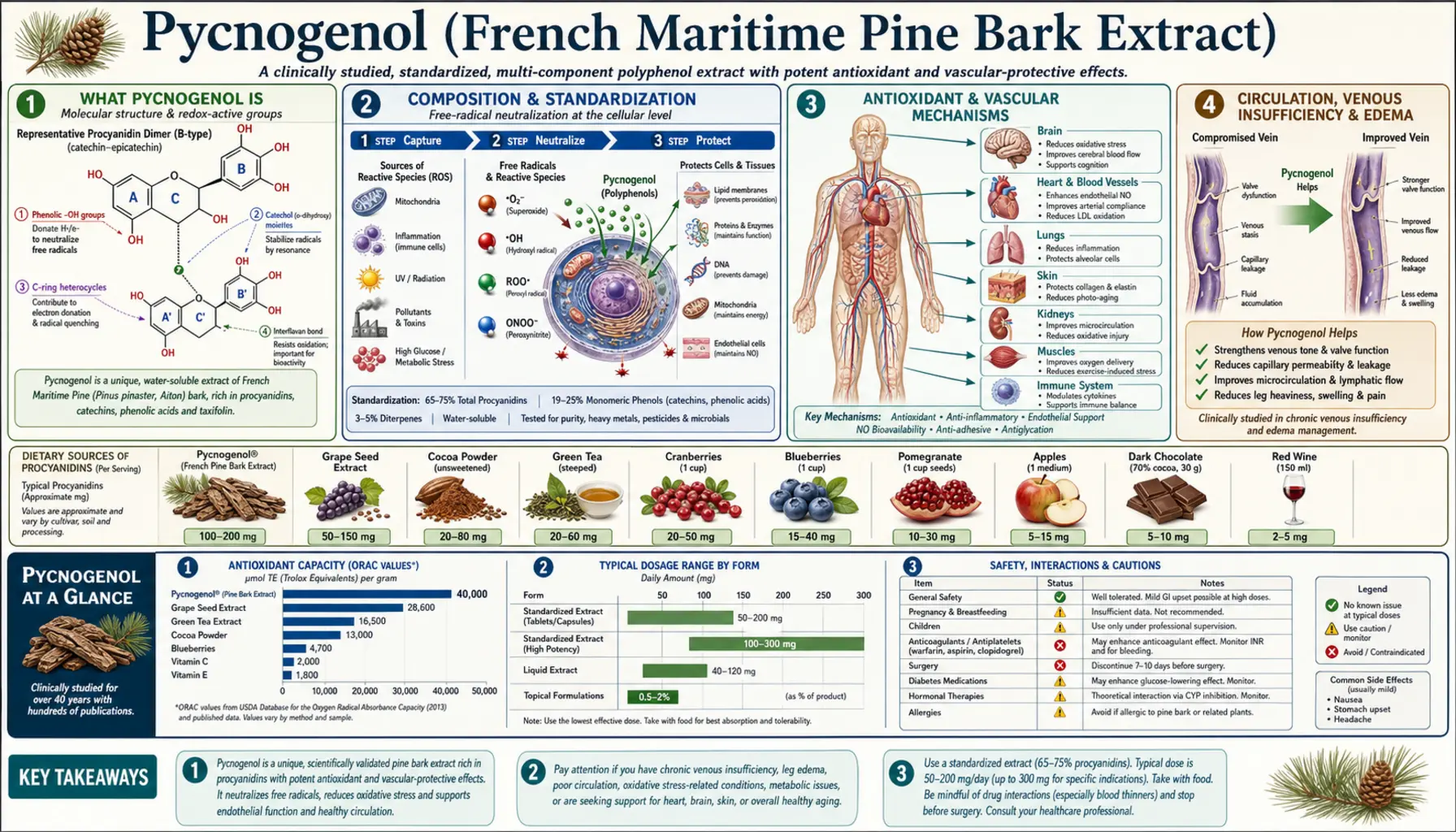
Pycnogenol is a patented, standardized extract of the bark of the French maritime pine (Pinus pinaster ssp. atlantica) grown in the Les Landes de Gascogne forest of southwestern France. Roughly 65–75% of the extract is procyanidins (oligomeric proanthocyanidins, OPCs) — chains of catechin and epicatechin units — alongside polyphenolic monomers and phenolic acids. It is one of the most heavily researched botanical extracts in the world, with over 160 clinical trials and a consistent signature: potent free-radical scavenging, enhanced endothelial nitric oxide production, binding to and protection of collagen and elastin, and broad anti-inflammatory activity. The strongest evidence is in chronic venous insufficiency and edema, endothelial and blood-pressure support, skin photoprotection, and attention/cognition (including pediatric ADHD).
Table of Contents
- What Pycnogenol Is
- Composition & Standardization
- Antioxidant & Vascular Mechanisms
- Circulation, Venous Insufficiency & Edema
- Blood Pressure & Endothelial Function
- Skin Health & UV Photoprotection
- Cognition, Attention & ADHD
- Joint Health & Osteoarthritis
- Metabolic, Diabetic & Other Effects
- Pycnogenol vs Grape Seed Extract
- Forms & Standardization Quality
- Recommended Dosage
- Cautions and Contraindications
- Key Research Papers
- Connections
- Featured Videos
What Pycnogenol Is
Pycnogenol is a registered trademark (held by Horphag Research) for a specific water-based extract of the bark of the French maritime pine, Pinus pinaster. The trees are a single-species, single-origin monoculture grown without pesticides in the Les Landes coastal forest of Gascony, France. Because the source material, harvesting, and extraction are tightly controlled, every batch of Pycnogenol is standardized to a defined polyphenol profile — which is the central reason its clinical literature is so reproducible compared with generic, unstandardized "pine bark" supplements.
It is important to be precise about the terminology, because it is a frequent point of confusion:
- Pycnogenol IS pine bark extract. "Pine bark extract" is the generic category; "Pycnogenol" is the trademarked, standardized, clinically tested version of it. The two terms are often used interchangeably, but only material made by the patented Horphag process and meeting the United States Pharmacopeia (USP) monograph specification can legally be called Pycnogenol.
- Pycnogenol is not the same as "pycnogenols" (lowercase). In older biochemical literature the word "pycnogenols" was used generically by French researcher Jacques Masquelier for the OPC class of compounds (which also occur in grape seed, pine bark, and many other plants). The capitalized, trademarked Pycnogenol refers specifically to the French maritime pine bark product.
- It is a close chemical cousin of grape seed extract. Both are OPC-rich extracts built from the same catechin/epicatechin building blocks, and Masquelier originally isolated OPCs from pine bark (1947) before turning to grape seed. The two are the canonical "OPC siblings" in the antioxidant world.
The history is notable: French chemist Jacques Masquelier identified the oligomeric proanthocyanidin (OPC) compounds in 1947, later turned to French maritime pine bark as his source, and patented a pine-bark extraction in 1951, from which the standardized, trademarked Pycnogenol product was eventually built — the fuller story is told in the dedicated History & Discovery article.
Composition & Standardization
Pycnogenol is a complex but well-defined mixture of polyphenols. The USP monograph and Horphag's specification define it as containing approximately 65–75% procyanidins by weight, with the remainder consisting of polyphenolic monomers and phenolic acids. The main constituent classes are:
- Procyanidins (OPCs) — oligomers and polymers of catechin and epicatechin units, ranging from dimers up to chains of seven or more units. These are the dominant fraction and the principal antioxidant/vascular actors.
- Monomeric flavonoids — (+)-catechin, (−)-epicatechin, and taxifolin (dihydroquercetin).
- Phenolic acids — ferulic acid, caffeic acid, p-hydroxybenzoic acid, gallic acid, vanillic acid, and others, often present as glucosides.
An important pharmacological point is that the large procyanidin polymers are not absorbed intact. After ingestion, gut microbiota metabolize them into smaller, absorbable metabolites — most notably δ-(3,4-dihydroxyphenyl)-γ-valerolactone (M1) and related valerolactones. These microbial metabolites, rather than the parent polymers, are thought to be responsible for much of Pycnogenol's in-vivo activity, which helps explain why effects can vary with an individual's gut flora and why benefits typically build over weeks rather than appearing immediately.
The standardization is what separates Pycnogenol from generic pine bark. Because Horphag controls a single-origin raw material and a fixed extraction, batch-to-batch polyphenol composition is consistent. Generic "pine bark extract" products vary widely in OPC content, source species, and processing — so clinical results from Pycnogenol trials cannot be assumed to transfer to an arbitrary pine bark supplement.
Antioxidant & Vascular Mechanisms
Pycnogenol acts through several interlocking mechanisms that together explain its vascular and anti-inflammatory effects:
- Direct free-radical scavenging. The catechol and pyrogallol hydroxyl groups on its procyanidins donate hydrogen atoms to quench superoxide, hydroxyl radicals, peroxyl radicals, and singlet oxygen. Pycnogenol also chelates transition metals (iron, copper) that catalyze the formation of damaging hydroxyl radicals via Fenton chemistry.
- Glutathione and antioxidant-enzyme support. Pycnogenol helps regenerate oxidized vitamin C and vitamin E and supports endogenous antioxidant capacity, sparing the body's own glutathione system — conceptually overlapping with glutathione and NAC.
- Endothelial nitric oxide (NO) enhancement. One of the best-characterized actions: Pycnogenol increases the activity of endothelial nitric oxide synthase (eNOS), raising NO production. NO relaxes vascular smooth muscle, improving blood flow and lowering vascular resistance. It also protects existing NO from destruction by superoxide, preserving its vasodilatory and anti-platelet effects.
- Collagen and elastin binding. OPCs bind avidly to collagen and elastin fibers in vessel walls, skin, and connective tissue. This binding both physically stabilizes the protein matrix against enzymatic degradation (inhibiting collagenase and elastase) and protects it from oxidative cross-linking — the structural basis for Pycnogenol's effects on capillary fragility, edema, and skin elasticity.
- Anti-inflammatory signaling. Pycnogenol inhibits the activation of nuclear factor-kappa B (NF-κB) and downregulates pro-inflammatory enzymes and mediators (COX-2, iNOS, matrix metalloproteinases, and adhesion molecules such as VCAM-1 and ICAM-1). This dampens the leukocyte-adhesion cascade that drives chronic vascular inflammation.
- Platelet and capillary effects. It reduces excessive platelet aggregation (an antithrombotic action distinct from aspirin's COX mechanism) and decreases capillary permeability, reducing the leakage of fluid into tissues that produces edema.
The unifying theme is the blood-vessel wall. Whether the clinical target is leg swelling, blood pressure, retinal microcirculation, or skin, the common pathway is improved endothelial function, protected connective tissue, and reduced oxidative and inflammatory damage to the microvasculature.
Circulation, Venous Insufficiency & Edema
Chronic venous insufficiency (CVI) — the condition behind aching, heavy, swollen legs, varicose veins, and (in advanced cases) skin changes and ulcers — is Pycnogenol's flagship indication and the area with the most robust trial data.
In randomized controlled trials, Pycnogenol at 150–360 mg/day for 4–8 weeks significantly reduced leg heaviness, swelling, and subcutaneous edema, and improved venous microcirculation measured by laser Doppler flowmetry and by the reduction in ankle/calf circumference. A Cochrane systematic review of pine bark extract for CVI found that, across the available randomized trials, Pycnogenol reduced edema and pain compared with placebo, while noting that the trials were generally small and methodologically heterogeneous.
Comparative work is striking: in a controlled study, Pycnogenol outperformed micronized diosmin/hesperidin (a standard prescription venotonic in Europe) for reducing CVI symptoms and edema over 8 weeks. Pycnogenol has also been studied for closely related microvascular problems:
- Travel-related (economy-class) leg edema and deep-vein thrombosis risk — in trials of long-haul flights, Pycnogenol reduced ankle/leg edema and lowered the incidence of flight-associated superficial thrombotic events compared with placebo.
- Diabetic microangiopathy and retinopathy — by reducing capillary leakage and improving retinal blood flow, Pycnogenol slowed the progression of early diabetic retinopathy and improved visual acuity in controlled studies.
- Hemorrhoids — both oral and topical Pycnogenol reduced bleeding and symptom scores in acute hemorrhoidal flares, consistent with its capillary-stabilizing action.
The mechanistic story is coherent: Pycnogenol's collagen/elastin binding strengthens vessel walls, its reduction of capillary permeability limits fluid leakage, and its NO-mediated improvement of microcirculation enhances tissue perfusion and clearance — exactly the combination needed to address venous edema.
Blood Pressure & Endothelial Function
Through its eNOS-enhancing, NO-preserving action, Pycnogenol produces modest reductions in blood pressure, most clearly in people with mild hypertension or endothelial dysfunction. A 2020 meta-analysis of randomized controlled trials concluded that Pycnogenol supplementation significantly lowered systolic blood pressure (on the order of a few mmHg) and improved several markers of vascular function, with effects most evident in studies of longer duration.
Beyond office blood pressure, Pycnogenol has been shown to improve flow-mediated dilation (FMD) — the gold-standard ultrasound measure of endothelial health — in patients with coronary artery disease, and to allow reduction in the required dose of the calcium-channel blocker nifedipine in mild hypertensives. These effects place Pycnogenol alongside other endothelium-supporting antioxidants such as CoQ10 and dietary nitrate as a vascular-support agent rather than a primary antihypertensive drug.
Pycnogenol also favorably affects the lipid and platelet environment of the vasculature: trials report reductions in LDL cholesterol and in oxidized-LDL, and a reduction in smoking-induced platelet aggregation. Because it protects LDL particles from oxidation — an early step in plaque formation — it is relevant to anyone tracking ApoB or working to limit vascular oxidative damage.
Skin Health & UV Photoprotection
Pycnogenol's combination of antioxidant capacity and collagen/elastin binding makes the skin a natural target, and the dermatological evidence is among its most interesting.
- UV photoprotection. In a controlled study, oral Pycnogenol raised the minimal erythema dose (the UV exposure needed to produce sunburn) — meaning supplemented skin tolerated more UV before burning. The mechanism is suppression of the UV-triggered NF-κB inflammatory cascade and scavenging of UV-generated reactive oxygen species, reducing the inflammation and matrix breakdown that drive photoaging. It is an oral adjunct to, not a replacement for, topical sunscreen.
- Skin elasticity and hydration. A 2012 clinical study in postmenopausal women found that 12 weeks of oral Pycnogenol significantly improved skin elasticity and hydration, with increased expression of genes for hyaluronic acid synthase and collagen type I — i.e., it acted at the level of the skin's own matrix-building machinery, not just as a surface antioxidant.
- Melasma. In an open trial, Pycnogenol reduced the area and pigment intensity of melasma (hyperpigmentation), plausibly through reduced oxidative and inflammatory drive to melanocytes.
- Wound healing and microcirculation. Both topical and oral Pycnogenol have been shown to speed healing of diabetic and venous ulcers, consistent with improved skin microcirculation and matrix support.
This positions Pycnogenol alongside other skin-supportive antioxidants — vitamin C (a collagen cofactor), astaxanthin (a leading oral photoprotectant), and curcumin — in the "ingestible skincare" category.
Cognition, Attention & ADHD
Pycnogenol has a sizeable literature in cognition and attention, much of it built on the same vascular logic: better cerebral microcirculation and reduced oxidative stress support neuronal function.
Attention-deficit/hyperactivity disorder (ADHD)
The most cited work is a 2006 randomized, double-blind, placebo-controlled trial in children with ADHD (Trebatická et al., European Child & Adolescent Psychiatry). One month of Pycnogenol at 1 mg/kg/day significantly reduced hyperactivity and improved attention, concentration, and visual-motor coordination compared with placebo, with symptoms relapsing about a month after the extract was stopped. A companion paper from the same group reported that Pycnogenol normalized oxidized-glutathione and total antioxidant status in these children, and a further analysis linked the clinical improvement to a reduction in urinary catecholamine excess. The trials are small and the effect modest, but the consistency of the oxidative-stress signal is notable.
Cognition and mental performance in adults
Controlled and observational studies have reported that Pycnogenol improves sustained attention, working memory, decision-making, and mood in healthy students, professionals under occupational stress, and older adults, typically over 8–12 weeks at 100–150 mg/day. In a study of older normal subjects, Pycnogenol improved cognitive-function scores and reduced oxidative-stress markers over a year. Pilot work has also explored Pycnogenol in mild cognitive impairment and in the cognitive complaints that follow certain illnesses, generally pointing to small benefits tied to improved microcirculation and lower oxidative burden.
As with all of Pycnogenol's CNS data, the trials are smaller and shorter than pharmaceutical-grade evidence, and the effect sizes are modest; it is best framed as a low-risk adjunct rather than a primary treatment.
Joint Health & Osteoarthritis
Pycnogenol's NF-κB inhibition and matrix-metalloproteinase suppression give it a plausible role in osteoarthritis, where inflammatory enzymes degrade joint cartilage.
In a randomized, double-blind, placebo-controlled trial (Belcaro et al., Phytotherapy Research, 2008) of patients with knee osteoarthritis, 100–150 mg/day of Pycnogenol for 3 months reduced the overall WOMAC osteoarthritis score, decreased pain and stiffness, improved physical function, and reduced reliance on NSAID analgesics compared with placebo. A separate mechanistic study found that Pycnogenol taken before knee-replacement surgery lowered inflammatory markers (and matrix-metalloproteinase activity) measured directly in the removed cartilage and synovial fluid — biochemical confirmation that orally ingested Pycnogenol metabolites reach and act within the joint.
The effect is most useful as part of a broader anti-inflammatory joint strategy alongside agents such as curcumin and omega-3 fatty acids rather than as a stand-alone cure.
Metabolic, Diabetic & Other Effects
Several additional areas have controlled or suggestive evidence:
- Glycemic control. In type-2 diabetics, Pycnogenol (100–200 mg/day) modestly lowered fasting glucose and HbA1c in placebo-controlled trials, partly by inhibiting intestinal α-glucosidase (slowing carbohydrate absorption) and improving endothelial function in the diabetic microvasculature.
- Erectile function. Pycnogenol combined with the amino acid L-arginine (a nitric-oxide precursor) improved erectile function in men with mild-to-moderate erectile dysfunction, a synergy that follows directly from the shared NO mechanism.
- Menstrual and menopausal symptoms. Controlled studies report reductions in menstrual pain (dysmenorrhea) and endometriosis-associated pain, and improvement in a range of menopausal symptoms, with the vascular and anti-inflammatory actions as the proposed basis.
- Asthma and allergy. Small trials suggest Pycnogenol can improve asthma control scores and reduce the need for rescue inhalers, consistent with its anti-inflammatory and leukotriene-modulating activity.
- Tinnitus and inner-ear circulation. By improving cochlear microcirculation, Pycnogenol reduced the intensity of tinnitus and improved inner-ear blood flow in controlled studies of patients with Meniere-type symptoms.
Across these indications the recurring biological theme is the same vascular/anti-inflammatory mechanism applied to a different tissue bed.
Pycnogenol vs Grape Seed Extract
Pycnogenol and grape seed extract are the two best-known OPC supplements, and the comparison is worth understanding because they are frequently used interchangeably.
- Shared chemistry. Both are dominated by oligomeric proanthocyanidins built from catechin and epicatechin, and both were pioneered by the same researcher (Jacques Masquelier). Their core antioxidant, NO-enhancing, and collagen-binding actions are largely the same.
- Source and profile differ. Pycnogenol comes from a single species of French maritime pine bark with a fixed, USP-defined polyphenol profile and a notable content of phenolic acids (ferulic, caffeic). Grape seed extract comes from Vitis vinifera seeds and tends to be richer in certain galloylated procyanidins; its standardization (often expressed as "≥95% OPCs") varies by manufacturer.
- Evidence base. Pycnogenol, because it is a single standardized product, has a deeper and more reproducible body of brand-specific clinical trials (venous insufficiency, ADHD, skin, endothelial function). Grape seed extract has strong evidence for blood pressure and antioxidant capacity but a more fragmented, less brand-consistent literature.
- Practical takeaway. For the specific indications studied with Pycnogenol (CVI/edema, ADHD, photoprotection, retinal microcirculation), the trademarked extract is the better-validated choice. For general antioxidant and cardiovascular support at lower cost, a well-standardized grape seed extract is a reasonable, chemically similar alternative.
Forms & Standardization Quality
- Trademarked Pycnogenol (Horphag). The only material legally called Pycnogenol; standardized to 65–75% procyanidins and meeting the USP monograph. Clinical-trial results apply specifically to this product. Look for the "Pycnogenol" name and trademark on the label.
- Generic maritime pine bark extract. Often standardized to a stated OPC percentage (commonly "95% proanthocyanidins"), but source species, processing, and exact polyphenol profile vary. Cheaper, but clinical equivalence to Pycnogenol cannot be assumed.
- Capsules and tablets. The dominant oral form, typically 25–100 mg per unit. The water-soluble extract does not require fat for absorption (unlike fat-soluble antioxidants such as CoQ10), though spreading the dose across the day is reasonable given the relatively short residence of its active metabolites.
- Topical formulations. Creams, gels, and serums (often 0.5–2%) used for hemorrhoids, wound healing, melasma, and anti-aging, sometimes paired with oral dosing.
- Combination products. Pycnogenol is frequently combined with L-arginine (erectile function), vitamin C, or other vascular-support nutrients; check that the Pycnogenol dose itself is within the studied range rather than a token "fairy-dust" amount.
Practical guidance: Because almost the entire clinical literature is on the standardized trademarked extract, paying for genuine Pycnogenol (not generic pine bark) is the safer choice when the goal is to reproduce a specific studied benefit.
Recommended Dosage
- General antioxidant / vascular support — 50–100 mg/day, often as 25–50 mg twice daily.
- Chronic venous insufficiency / leg edema — 150–360 mg/day for 4–8 weeks; many trials used 150–200 mg/day.
- Blood pressure / endothelial support — 100–200 mg/day for at least 8–12 weeks before assessing effect.
- Skin elasticity / photoprotection — 75–125 mg/day for 8–12 weeks (one skin-elasticity study used 75–100 mg/day; photoprotection studies used roughly 1.1–1.7 mg/kg/day).
- ADHD (children) — 1 mg/kg/day (the dose used in the pediatric trials), under clinician supervision.
- Adult cognition / mental performance — 100–150 mg/day for 8–12 weeks.
- Osteoarthritis — 100–150 mg/day for at least 3 months.
- Type-2 diabetes (adjunct) — 100–200 mg/day, alongside standard glycemic management and monitoring.
- Erectile dysfunction — 60–120 mg/day Pycnogenol combined with L-arginine, per the published protocols.
Timing & expectations. Pycnogenol is water-soluble and can be taken with or without food. Because its active compounds are largely gut-microbial metabolites of the parent procyanidins, benefits build gradually — most trials assess outcomes at 4–12 weeks, not days. Splitting larger daily doses (for example 50 mg three times daily) is a reasonable way to maintain steadier metabolite levels.
Cautions and Contraindications
Pycnogenol has an excellent safety record across more than 160 clinical trials, with side effects typically no different from placebo. Important considerations:
- Mild GI and other effects. The most common adverse effects are minor: gastrointestinal discomfort, dizziness, headache, or nausea, usually mild and transient. Taking it with food often helps.
- Antiplatelet / anticoagulant interaction. Pycnogenol reduces platelet aggregation and may have a mild blood-thinning effect. Combined with anticoagulants (warfarin, DOACs), antiplatelet drugs (aspirin, clopidogrel), or high-dose fish oil, it could theoretically increase bleeding risk. Use cautiously and discontinue before surgery (commonly 2 weeks ahead).
- Blood-pressure and diabetes medications. Its mild blood-pressure–lowering and glucose-lowering effects can add to antihypertensive and antidiabetic drugs; monitor blood pressure and blood glucose when starting, and watch for additive effects.
- Immune-modulating context. Because Pycnogenol can modulate immune signaling, people with autoimmune conditions or those taking immunosuppressants should use it under medical guidance.
- Pregnancy and breastfeeding. Although a few studies have used Pycnogenol in late pregnancy (for pelvic/venous pain), there is not enough safety data to recommend routine use; pregnant or breastfeeding women should avoid it unless directed by a clinician.
- Hepatitis / immune-stimulation caution. Older guidance advises caution in active hepatitis given the immune-modulating activity; coordinate with a physician.
- Product identity. The safety and efficacy record applies specifically to standardized Pycnogenol; generic pine bark products of uncertain composition do not carry the same evidence.
Key Research Papers
The following are peer-reviewed clinical and review papers on French maritime pine bark extract (Pycnogenol). Author names, titles, and journals are plain text; the linked year/volume/pages resolves to the DOI or PubMed record.
- Rohdewald P. A review of the French maritime pine bark extract (Pycnogenol), a herbal medication with a diverse clinical pharmacology. International Journal of Clinical Pharmacology and Therapeutics. 2002;40(4):158–168.
- Gulati OP. Pycnogenol in chronic venous insufficiency and related venous disorders. Phytotherapy Research. 2014;28(3):348–362.
- Schoonees A, Visser J, Musekiwa A, Volmink J. Pycnogenol (extract of French maritime pine bark) for the treatment of chronic disorders (Cochrane systematic review). Cochrane Database of Systematic Reviews. 2012;(4):CD008294.
- Belcaro G, Cesarone MR, Errichi BM, et al. Variations in the venous microcirculation and edema with Pycnogenol in chronic venous insufficiency. Clinical and Applied Thrombosis/Hemostasis. 2006;12(2):205–212.
- Liu X, Wei J, Tan F, et al. Antidiabetic effect of Pycnogenol French maritime pine bark extract in patients with type 2 diabetes. Life Sciences. 2004;75(21):2505–2513.
- Liu X, Wei J, Tan F, et al. Pycnogenol, French maritime pine bark extract, improves endothelial function of hypertensive patients. Life Sciences. 2004;74(7):855–862.
- Trebatická J, Kopasová S, Šuba J, et al. Treatment of ADHD with French maritime pine bark extract, Pycnogenol. European Child & Adolescent Psychiatry. 2006;15(6):329–335.
- Marini A, Grether-Beck S, Jaenicke T, et al. Pycnogenol effects on skin elasticity and hydration coincide with increased gene expressions of collagen type I and hyaluronic acid synthase. Skin Pharmacology and Physiology. 2012;25(2):86–92.
- Saliou C, Rimbach G, Moini H, et al. Solar ultraviolet-induced erythema in human skin and nuclear factor-kappa-B–dependent gene expression in keratinocytes are modulated by a French maritime pine bark extract. Free Radical Biology and Medicine. 2001;30(2):154–160.
- Belcaro G, Cesarone MR, Errichi S, et al. Treatment of osteoarthritis with Pycnogenol: the SVOS (San Valentino Osteoarthritis Study). Phytotherapy Research. 2008;22(4):518–523.
- Liu X, Zhou HJ, Rohdewald P. French maritime pine bark extract Pycnogenol dose-dependently lowers glucose in type 2 diabetic patients. Diabetes Care. 2004;27(3):839.
- Hosseini S, Lee J, Sepulveda RT, et al. A randomized, double-blind, placebo-controlled, prospective, 16-week crossover study to determine the role of Pycnogenol in modifying blood pressure in mildly hypertensive patients. Nutrition Research. 2001;21(9):1251–1260.
Live PubMed Searches
- PubMed: Pycnogenol maritime pine bark extract
- PubMed: Pycnogenol chronic venous insufficiency
- PubMed: Pycnogenol blood pressure & endothelial
- PubMed: Pycnogenol skin & UV photoprotection
- PubMed: Pycnogenol ADHD & attention
- PubMed: Pycnogenol osteoarthritis & joint
- PubMed: Pycnogenol diabetes & glucose
- PubMed: proanthocyanidins (pine bark & grape seed)
External Authoritative Resources
- NCCIH — Herbs and Supplements at a Glance
- MedlinePlus — Maritime Pine (Pycnogenol)
- PubMed — All research on Pycnogenol
Connections
- All Antioxidants
- Grape Seed Extract (sibling OPC)
- CoQ10
- Alpha Lipoic Acid
- Quercetin
- Astaxanthin
- Curcumin
- Glutathione
- NAC (Glutathione Precursor)
- Oxidative Stress
- Cardiovascular Disease
- Hypertension
- Type 2 Diabetes
- Osteoarthritis
- Dermatology & Skin Health
- Vitamin C (collagen cofactor)
- Vitamin E
- L-Arginine (NO precursor)
- Omega-3 Fatty Acids
- Apolipoprotein B
- Lipid Panel
- Hemoglobin A1c