Antioxidants
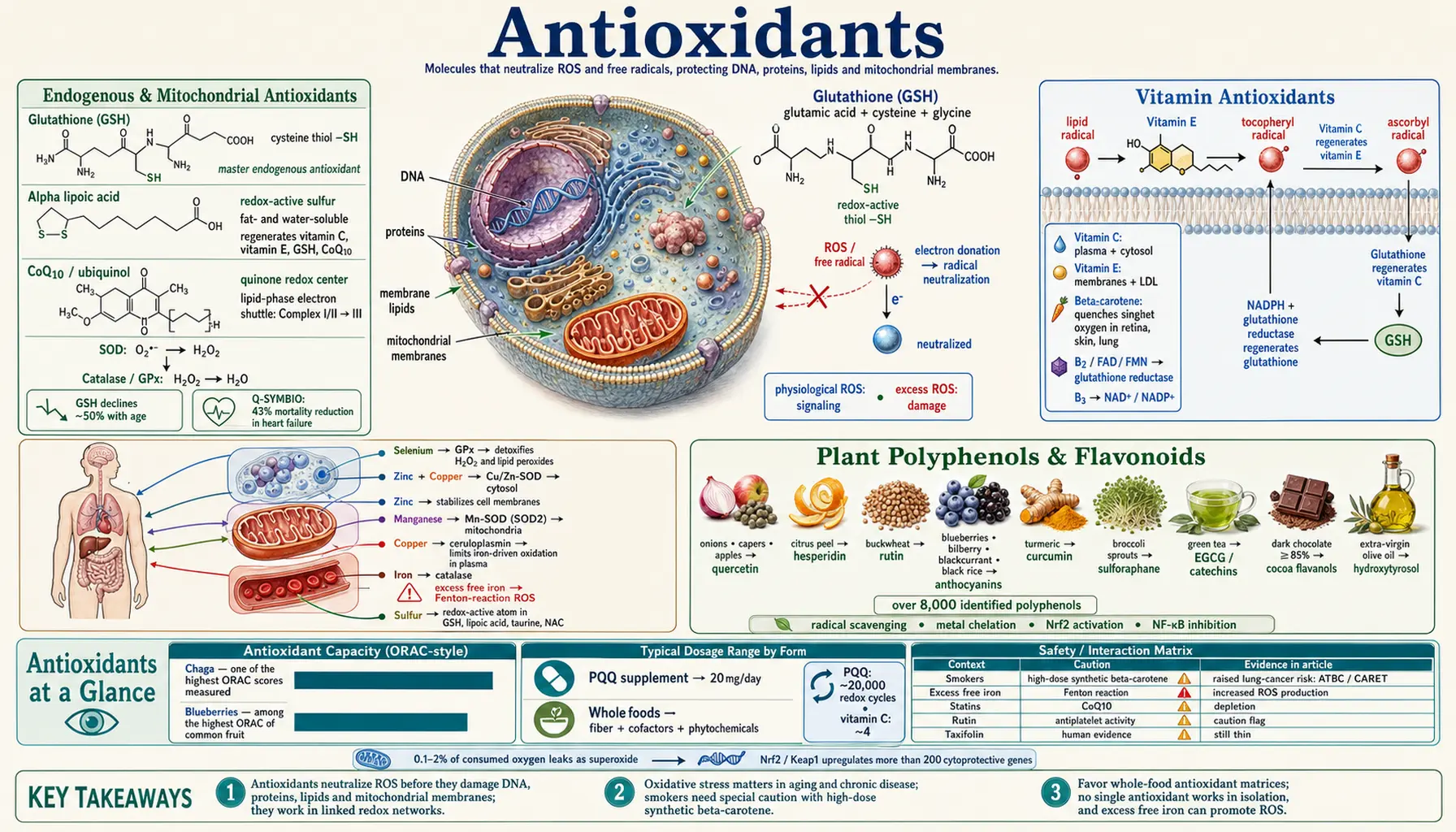
Antioxidants are molecules that neutralize reactive oxygen species (ROS) and free radicals before they can damage DNA, proteins, lipids, and mitochondrial membranes. Some are synthesized by the body, others must come from food and supplements, and many work in linked networks — one antioxidant regenerating another in a continuous redox cycle. Oxidative stress underlies aging, cardiovascular disease, neurodegeneration, diabetes, cancer initiation, and most chronic illness, which is why antioxidant biochemistry sits at the center of integrative and functional medicine.
Interactive Visualization Free Radicals & Your Antioxidant Network Follow one superoxide radical down the whole relay — SOD, catalase, glutathione, vitamin E, vitamin C, NADPH — then release free iron and watch a membrane tear itself apart. Launch →
Table of Contents
- Endogenous & Mitochondrial Antioxidants
- Vitamin Antioxidants
- Mineral Cofactors
- Plant Polyphenols & Flavonoids
- Herbal Antioxidants
- Amino Acid Antioxidants
- Mushrooms, Algae & Marine Sources
- Antioxidant-Rich Foods
- How Antioxidants Work
- Connections
- Featured Videos
Endogenous & Mitochondrial Antioxidants
These are the molecules the body either synthesizes itself or relies on to keep the mitochondrial electron transport chain leak-free. They form the inner ring of the antioxidant network — the molecules that protect ATP production at its source.
- Alpha Lipoic Acid (ALA / R-LA) — the only antioxidant that is both fat- and water-soluble; functions as a cofactor in pyruvate dehydrogenase and α-ketoglutarate dehydrogenase; regenerates vitamin C, vitamin E, glutathione, and CoQ10; the most clinically validated treatment for diabetic peripheral neuropathy
- N-Acetylcysteine (NAC) — the rate-limiting precursor for glutathione synthesis; replenishes intracellular cysteine when oxidative demand exceeds supply
- NAD+ & NMN — not antioxidants themselves but essential cofactors for sirtuins and DNA-repair enzymes that defend against oxidative aging
- Methylene Blue — an alternative electron acceptor that bypasses damaged Complex I/IV in mitochondria, reducing electron leak and ROS production
- Glutathione (GSH) — the master endogenous antioxidant; tripeptide of cysteine, glycine, and glutamic acid; rate-limited by cysteine availability (which is why NAC works); declines ~50% with age
- Coenzyme Q10 (CoQ10 / Ubiquinol) — mitochondrial electron shuttle between Complexes I/II and Complex III; lipid-phase antioxidant; statins deplete it; 43% mortality reduction in the Q-SYMBIO heart failure trial
- PQQ (Pyrroloquinoline Quinone) — the only nutritional antioxidant that drives mitochondrial biogenesis (creates new mitochondria via PGC-1α / TFAM); cycles through ~20,000 redox cycles without breakdown vs vitamin C's ~4; improves cognition, sleep, and inflammation at 20 mg/day
- Melatonin — the body's master mitochondrial antioxidant; synthesized inside mitochondria, scavenges radicals directly and through a self-amplifying cascade (AFMK/AMK) while upregulating glutathione and SOD; declines sharply with age
- Ergothioneine — the "longevity vitamin"; a diet-derived thiol concentrated into mitochondria by a dedicated transporter (OCTN1); mushrooms are the richest source
- Superoxide Dismutase (SOD) — the body's first-line antioxidant enzyme; converts superoxide radicals into hydrogen peroxide using zinc, copper, and manganese cofactors
- Catalase — the peroxisomal enzyme that rapidly breaks hydrogen peroxide into water and oxygen (the fizz on a cut) — one of the fastest enzymes known
- Glutathione Peroxidase (GPx) — the selenium-dependent enzyme that neutralizes peroxides using glutathione; the main reason selenium is an antioxidant mineral
Vitamin Antioxidants
Several vitamins double as antioxidants. They occupy different physical compartments — water-soluble vitamins work in plasma and cytosol; fat-soluble vitamins protect cell membranes and lipoproteins.
- Vitamin C (Ascorbic Acid) — the primary water-phase antioxidant in plasma; donates electrons to neutralize ROS and regenerates oxidized vitamin E at the membrane interface
- Vitamin E (Tocopherols & Tocotrienols) — the principal lipid-soluble antioxidant; protects polyunsaturated fatty acids in cell membranes and LDL particles from peroxidation
- Tocotrienols — the “other” half of vitamin E (from annatto, palm, and rice bran); more mobile in membranes than tocopherols and studied for cholesterol, brain, and vascular health
- Vitamin A & Beta-Carotene — carotenoids quench singlet oxygen in the retina, skin, and lung tissue
- Vitamin K2 (MK-7) — protects mitochondrial membranes via gamma-carboxylated proteins and quinone redox cycling
- Vitamin B2 (Riboflavin) — FAD/FMN cofactor for glutathione reductase, the enzyme that regenerates reduced glutathione
- Vitamin B3 (Niacin) — precursor to NAD+ and NADP+, the redox currencies that drive every antioxidant enzyme
Mineral Cofactors
The body's three major antioxidant enzymes — glutathione peroxidase, superoxide dismutase, and catalase — cannot function without specific mineral cofactors. Deficiency in any of these collapses the enzymatic antioxidant defense even when dietary antioxidants are plentiful.
- Selenium — essential for glutathione peroxidase (GPx), the enzyme that detoxifies hydrogen peroxide and lipid peroxides; selenoprotein synthesis
- Zinc — cofactor for cytosolic copper-zinc superoxide dismutase (Cu/Zn-SOD); also stabilizes cell membranes against oxidative attack
- Copper — second cofactor for Cu/Zn-SOD and for ceruloplasmin (a plasma ferroxidase that prevents iron-driven oxidation)
- Manganese — cofactor for mitochondrial Mn-SOD (SOD2), the front-line defense against superoxide leaking from the electron transport chain
- Iron — needed for catalase, but excess free iron drives Fenton-reaction ROS production — iron homeostasis is itself an antioxidant strategy
- Sulfur — the redox-active atom in glutathione, lipoic acid, taurine, NAC, and the methionine cycle
Plant Polyphenols & Flavonoids
Polyphenols are the most diverse antioxidant class — over 8,000 identified compounds. They work by direct radical scavenging, by chelating pro-oxidant metals (iron, copper), and increasingly through epigenetic and signaling pathways (Nrf2 activation, NF-κB inhibition).
- Quercetin — flavonoid with anti-histamine, mast-cell-stabilizing, and zinc-ionophore properties; abundant in onions, capers, apples
- Hesperidin — the major citrus flavanone (orange and lemon peel); the classic "vitamin P" bioflavonoid for venous tone, capillary integrity, and endothelial function
- Rutin — quercetin-3-rutinoside from buckwheat; a capillary-strengthening flavonol glycoside with antiplatelet activity
- Taxifolin (Dihydroquercetin) — the dihydro form of quercetin, extracted from Siberian larch; a metal-chelating antioxidant with a long Russian “diquertin” history for microcirculation, though human evidence is still thin
- Luteolin — dietary flavone (celery, parsley, chamomile); studied for neuroinflammation, microglial calming, and mast-cell stabilization
- Apigenin — chamomile flavone; a GABA-A-binding calming and sleep agent and CD38 inhibitor that helps preserve NAD+
- Anthocyanins — the red-purple flavonoid pigments in blueberries, bilberry, blackcurrant, and black rice; eye, brain, and vascular antioxidants
- Curcumin — potent Nrf2 activator and NF-κB inhibitor; the most studied polyphenol for inflammation (concentrated extract of turmeric)
- Resveratrol — stilbene; sirtuin (SIRT1) activator; caloric-restriction mimetic (supplement source: Japanese knotweed)
- Sulforaphane — broccoli-sprout isothiocyanate; the most potent natural Nrf2 inducer, switching on the body's own antioxidant enzymes
- Fisetin — flavonol; senolytic compound that clears senescent cells
- Spermidine — polyamine that induces autophagy and protects against oxidative protein damage
- Grape Seed Extract — oligomeric proanthocyanidins (OPCs); vascular, blood-pressure, and skin antioxidant
- Pycnogenol — standardized French maritime pine bark OPC extract; endothelial nitric-oxide support
- Bilberry — anthocyanin-rich blueberry relative; eye and microcirculation antioxidant
- Berberine — isoquinoline alkaloid; AMPK activator that improves mitochondrial function and reduces oxidative stress in metabolic disease
- EGCG (Epigallocatechin Gallate) — the dominant green tea catechin and among the most potent direct radical scavengers in the plant kingdom; a powerful Nrf2 activator
- Cocoa Flavanols — epicatechin improves endothelial nitric oxide bioavailability
- Catechins — the green-tea and cocoa flavan-3-ol family (catechin, epicatechin, EGCG); vascular nitric-oxide support and the class EGCG belongs to
- Ellagic Acid — polyphenol from pomegranate, raspberries, and walnuts; gut bacteria convert its ellagitannins into the mitochondrial compound urolithin A
- Ferulic Acid — hydroxycinnamic acid from rice bran and whole grains; stabilizes vitamins C and E in topical skin photoprotection
- Hydroxytyrosol — the premier olive-oil polyphenol behind the EU health claim for protecting LDL cholesterol from oxidation
Carotenoids
Fat-soluble pigments that quench singlet oxygen with unmatched efficiency and concentrate in the tissues most exposed to light and oxygen — the eye, skin, and vasculature.
- Astaxanthin — the "king of carotenoids" from Haematococcus microalgae; spans the cell membrane, crosses the blood-brain and blood-retinal barriers, and never turns pro-oxidant
- Beta-Carotene — provitamin-A carotenoid and singlet-oxygen quencher (food sources are safe; high-dose synthetic raised lung-cancer risk in smokers in ATBC/CARET)
- Lutein — macular xanthophyll; filters blue light and protects the retina (AREDS2)
- Zeaxanthin — lutein's partner, concentrated in the central fovea for high-acuity vision
- Lycopene — the red tomato carotenoid and most efficient singlet-oxygen quencher; cooking and dietary fat boost absorption
Herbal Antioxidants
Many traditional medicinal herbs owe their effects to a combined polyphenol-triterpenoid-saponin profile that delivers antioxidant action plus modulation of stress, immune, and detoxification pathways.
- Astragalus — isoflavones (formononetin, calycosin) plus astragalosides; cardioprotective and renal-protective antioxidant
- Milk Thistle (Silymarin) — flavonolignan complex that protects hepatocyte membranes and increases intracellular glutathione
- Rosemary — carnosic acid and rosmarinic acid; Nrf2 activation and neuroprotection
- Ashwagandha — withanolides; adaptogenic antioxidant for stress-related oxidative load
- Bacopa Monnieri — bacosides; brain-targeted antioxidant for cognition and memory
- Ginkgo Biloba — ginkgolides and flavone glycosides; microcirculation and neuronal antioxidant defense
- Schisandra — lignans (schizandrin); liver-targeted antioxidant and adaptogen
- Holy Basil (Tulsi) — eugenol and ursolic acid; reduces cortisol-driven oxidative stress
Amino Acid Antioxidants
Sulfur-containing amino acids and the precursors to glutathione synthesis form the foundation of intracellular redox defense.
- Cysteine — the rate-limiting amino acid for glutathione synthesis; supplied therapeutically as NAC
- Glycine — second amino acid in the glutathione tripeptide; often deficient in older adults and limits GSH synthesis
- Glutamine — supplies the glutamate backbone of glutathione and supports gut-barrier antioxidant defense
- Methionine — sulfur donor that feeds the transsulfuration pathway to cysteine and ultimately glutathione
- Taurine — the most abundant free amino acid in tissue; scavenges hypochlorite (HOCl) and protects mitochondrial tRNA
- Histidine — precursor to carnosine, a dipeptide that quenches reactive carbonyls and singlet oxygen in muscle and brain
- Carnosine — the β-alanyl-L-histidine dipeptide itself; a potent anti-glycation agent (blocks AGE formation), carbonyl scavenger, and pH buffer concentrated in muscle and brain
- Arginine — substrate for nitric oxide; required for balanced redox signaling at the endothelium
Mushrooms, Algae & Marine Sources
Fungi and aquatic organisms produce unique antioxidant chemistries — ergothioneine, fucoxanthin, astaxanthin, and beta-glucans — that terrestrial plants do not.
- Chaga Mushroom — one of the highest ORAC scores ever measured; melanin and betulinic acid content
- Reishi Mushroom — triterpenes and beta-glucans; liver and immune antioxidant
- Turkey Tail — PSK and PSP polysaccharopeptides; integrative-oncology mainstay
- Lion's Mane — hericenones and erinacines; neurotrophic antioxidant for cognition
- Spirulina — phycocyanin; potent COX-2 inhibitor and direct radical scavenger
- Chlorella — chlorophyll and CGF (chlorella growth factor); heavy-metal binding
- Sea Moss — carrageenans and trace minerals; iodine and selenium delivery
- Omega-3 Fatty Acids (EPA/DHA) — not antioxidants themselves but reduce inflammatory oxidative damage and pair with vitamin E
Antioxidant-Rich Foods
Whole foods deliver antioxidants in their natural matrix — fiber, cofactors, and accompanying phytochemicals that supplements cannot fully replicate.
- Blueberries — anthocyanins; among the highest ORAC of any common fruit
- Pomegranate — punicalagins and ellagic acid; cardiovascular and prostate protection
- Tomatoes — lycopene; lipid-soluble carotenoid concentrated in prostate and skin
- Broccoli & cruciferous vegetables — sulforaphane; the most potent natural Nrf2 inducer
- Spinach & Kale — lutein and zeaxanthin; macular pigment antioxidants
- Beets — betalains; unique antioxidant-anti-inflammatory phytonutrients
- Green Tea & Coffee — polyphenols and chlorogenic acids; among the largest dietary sources for most adults
- Extra-Virgin Olive Oil — hydroxytyrosol and oleocanthal; Mediterranean-diet antioxidant signature
- Dark Chocolate (≥85%) — flavanols and theobromine
- Walnuts — ellagitannins, alpha-linolenic acid, and melatonin
How Antioxidants Work
Reactive oxygen species (ROS) are a normal byproduct of mitochondrial respiration — roughly 0.1–2% of all oxygen consumed leaks from the electron transport chain as superoxide (O&sub2;−). Additional ROS arise from immune-cell respiratory burst, peroxisomal beta-oxidation, ionizing radiation, environmental toxins, and inflammation. At physiological levels ROS serve as signaling molecules; in excess they damage lipids (lipid peroxidation), proteins (carbonyl formation), DNA (8-OHdG adducts), and mitochondrial membranes.
The body's defense operates in three coordinated layers:
- Enzymatic defense — superoxide dismutase converts O&sub2;− to H&sub2;O&sub2;; catalase and glutathione peroxidase convert H&sub2;O&sub2; to water. These enzymes require selenium, zinc, copper, manganese, and iron as cofactors.
- Small-molecule antioxidants — vitamin C, vitamin E, glutathione, alpha lipoic acid, CoQ10, uric acid, bilirubin, and carotenoids donate electrons to neutralize free radicals directly. They operate in a redox-cycling network — each regenerates the others.
- Signaling and induction — the Nrf2/Keap1 pathway senses oxidative stress and upregulates more than 200 cytoprotective genes (glutathione synthesis, NQO1, HO-1, glutathione-S-transferases). Phytochemicals like sulforaphane, curcumin, and rosmarinic acid are powerful Nrf2 activators.
The redox-cycling network means that no single antioxidant works in isolation. Vitamin E quenches a lipid radical and becomes the tocopheryl radical — vitamin C donates an electron to regenerate vitamin E and becomes the ascorbyl radical — glutathione donates an electron to regenerate vitamin C — NADPH regenerates glutathione via glutathione reductase. Alpha lipoic acid uniquely participates in every step of this cycle and is the only antioxidant that can regenerate all of the others, which is why deficiencies anywhere in the network produce systemic oxidative load.
See the Oxidative Stress hub page for the full clinical picture and mechanistic detail.
Connections
- Longevity & Healthy Aging — the cross-section hub built on these compounds
- Free Radicals & Your Antioxidant Network — interactive animation
- Alpha Lipoic Acid
- Coenzyme Q10 (CoQ10)
- Catechins
- Ellagic Acid
- Ferulic Acid
- Hydroxytyrosol
- Molecular Hydrogen
- Oxidative Stress
- NAC (N-Acetylcysteine)
- NAD+ & NMN
- Methylene Blue
- Detox Protocols
- Liver Cleansing
- Longevity Protocols
- Vitamin C
- Vitamin E
- Vitamin A
- Vitamin B2 (Riboflavin)
- Selenium
- Zinc
- Copper
- Manganese
- Sulfur
- Cysteine
- Glycine
- Glutamine
- Methionine
- Taurine
- Astragalus
- Milk Thistle
- Turmeric (Curcumin)
- Rosemary
- Ashwagandha
- Ginkgo Biloba
- Bacopa Monnieri
- Japanese Knotweed (Resveratrol)
- Quercetin
- Fisetin
- Spermidine
- EGCG (Green Tea Catechin)
- Anthocyanins
- Hesperidin
- Rutin
- Luteolin
- Apigenin
- Chaga Mushroom
- Spirulina
- Chlorella
- Blueberries
- Pomegranate
- Broccoli (Sulforaphane)
- Green Tea (EGCG)
- Dark Chocolate
- Olive Oil (Hydroxytyrosol)
- Diabetes
- Peripheral Neuropathy
- Cancer
- Cardiovascular Disease