Gnathostoma (Gnathostomiasis)
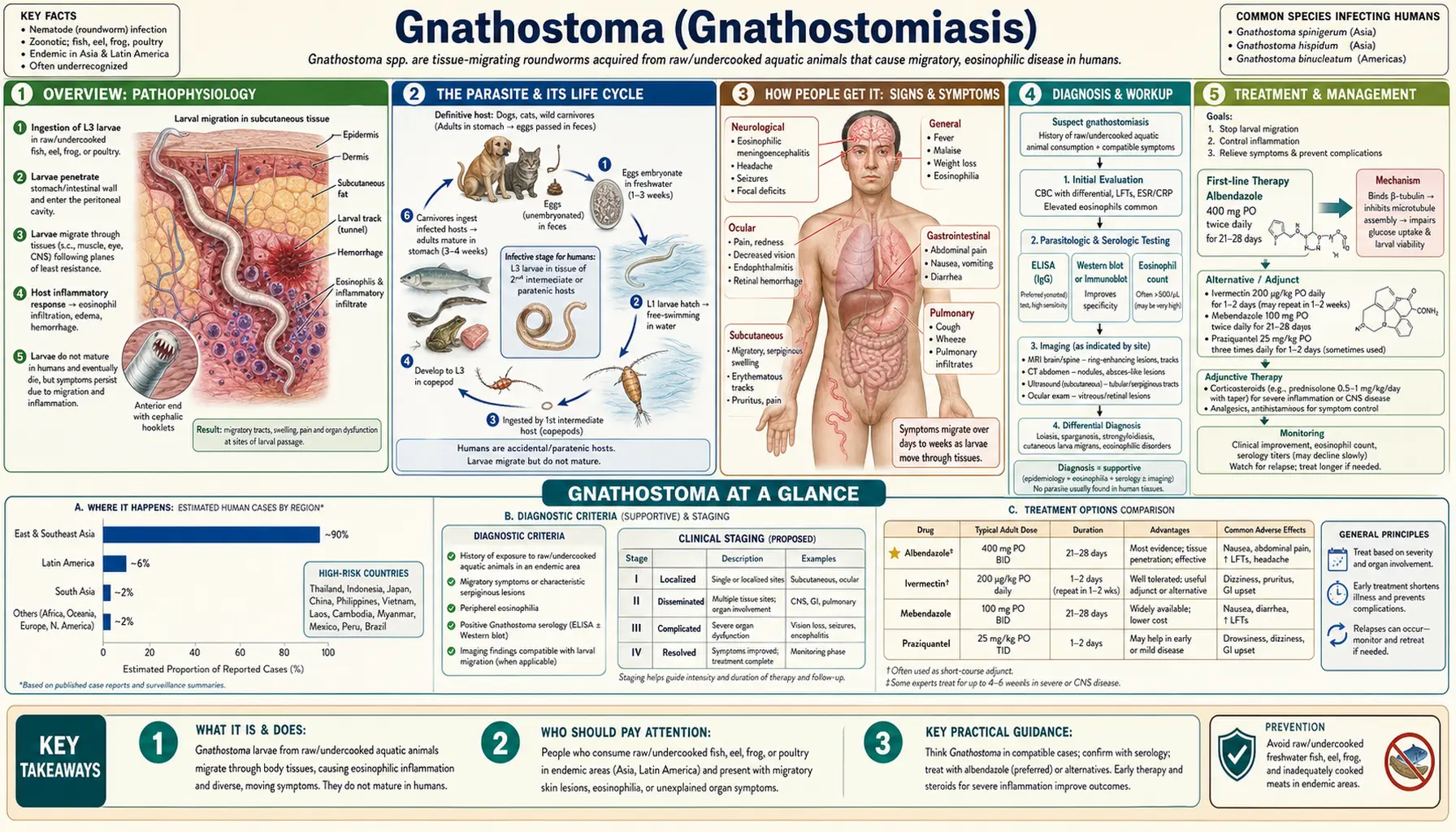
Gnathostoma is a parasitic roundworm whose immature larva — swallowed in a bite of raw or undercooked freshwater fish, eel, frog, or other animal — causes the disease gnathostomiasis. Humans are the wrong host for this worm: the larva cannot grow up inside us, so instead of settling down it wanders through the body's tissues, sometimes for years. Most often that wandering shows up as strange, migratory swellings under the skin that appear, fade, and reappear somewhere else. But the same restless larva can also burrow into far more dangerous places — the nerves, spinal cord, and brain, or the eye — and those forms are medical emergencies. Gnathostomiasis is a classic problem of Thailand and Southeast Asia, Japan, and Latin America, and it now turns up in travelers who ate a local raw-fish dish. This page explains, in plain language, what the parasite is, how people catch it, the swellings and the far more serious complications, and how it is diagnosed, treated, and prevented.
Table of Contents
- Overview
- The Parasite & Its Life Cycle
- How People Get It
- Symptoms & Disease
- The Serious Forms: Brain & Eye
- Who's at Risk & Geography
- Diagnosis
- Treatment
- Prevention
- Key Research Papers
- Connections
- Featured Videos
1. Overview
Gnathostoma is a genus of parasitic nematode — a roundworm. The stage that infects people is not the adult worm but an immature larva that lives coiled up in the flesh of freshwater fish and certain other animals. When someone eats that flesh raw or barely cooked, the larva is set free inside the stomach and begins to travel. Because a human is an accidental (dead-end) host, the larva can never mature into an adult and complete its life cycle in us. It simply keeps moving — and the damage it does depends entirely on where it goes.
The commonest picture is cutaneous gnathostomiasis: episodes of swelling under the skin that migrate from place to place and come and go over weeks, months, or even years. This is uncomfortable and alarming but rarely dangerous. The reason the disease is taken so seriously is its capacity for something much worse. The very same larva can wander into the central nervous system — causing severe nerve-root pain, bleeding into the brain or spinal fluid, or meningitis — or into the eye, threatening sight. These invasive forms can be disabling or fatal.
Several species cause human disease. In Asia the main one is Gnathostoma spinigerum; in the Americas most cases are due to Gnathostoma binucleatum. Historically gnathostomiasis was thought of as a disease of Thailand, Japan, and a handful of other Southeast Asian countries, but it is now firmly established in Latin America — especially Mexico, Peru, and Ecuador — and it is increasingly diagnosed in returning travelers and immigrants far from where they were infected. The habit that drives it all is the same everywhere: eating raw freshwater fish.
2. The Parasite & Its Life Cycle
The life cycle of Gnathostoma is a chain that normally has nothing to do with people. Understanding the chain makes it obvious why humans are the odd one out.
The adult worms live in fish-eating mammals — dogs, cats, and various wild animals. There the worm burrows into the wall of the stomach and forms a tumor-like mass, from which it sheds eggs. The eggs pass out in the animal's droppings and, if they reach water, hatch into tiny first-stage larvae.
Those free-swimming larvae are then eaten by copepods — minute freshwater crustaceans, often called water fleas. Inside the copepod, the larva develops further. This is the first intermediate host.
Next, the copepod is swallowed by a second intermediate host — a freshwater fish, but also eels, frogs, snakes, and even birds and poultry. In this host the parasite matures into the advanced third-stage larva and encysts in the muscle, waiting. Larger predators that eat these animals can pick the larva up and carry it along too, acting as paratenic (transport) hosts; the larva does not develop further in them but stays infective.
The circle closes when a dog, cat, or wild mammal eats an infected fish. The larva is released, matures into an adult in the stomach wall, and starts producing eggs again.
Where humans fit — and don't. When a person eats a raw or undercooked intermediate or transport host, the third-stage larva is freed in the stomach exactly as it would be in a dog or cat. But the human body is not a place where this worm can mature. Confused, in effect, the larva bores through the stomach wall and migrates — through the liver, the muscles, the fat under the skin, and sometimes into deep organs. It can survive, restlessly wandering, for months to many years. Everything that makes gnathostomiasis so peculiar — the roving swellings, the long delays, the sudden neurological catastrophes — comes from this single fact: the worm is lost inside us and never stops looking for a way out.
3. How People Get It
People almost always catch gnathostomiasis by eating the larva, and by far the biggest source is raw or undercooked freshwater fish and eels. Because the larva sits in the muscle, any dish that serves that flesh without enough heat to kill it can transmit the parasite.
The culprits are often traditional and much-loved dishes:
- Ceviche and other raw-fish preparations in Latin America, when made with freshwater fish — a major route in Mexico, Peru, and Ecuador.
- Koi-pla, som-fak, pla-ra and other raw or fermented freshwater-fish dishes and raw-fish salads of Thailand, Laos, and neighboring countries.
- Sashimi and sushi made with freshwater fish or eel, and raw-fish dishes in Japan.
Fish are not the only source. Raw or undercooked eels, frogs, snakes, and poultry or chicken can all carry the larvae, and cases have been traced to each. Much more rarely, people have become infected by drinking water that contained infected copepods, or by the larva penetrating the skin of a food handler who was cleaning or preparing infected fish or meat with bare hands. These skin-entry cases are unusual, but they explain why gloves are a sensible precaution in kitchens and markets that handle freshwater fish in endemic areas.
4. Symptoms & Disease
Gnathostomiasis usually unfolds in two phases, and the timing can be confusing because the two can be widely separated.
The early phase begins within a day or two of the infected meal, as the freed larva burrows out of the stomach and moves through the abdomen and liver. Symptoms are vague and easy to mistake for a passing stomach bug: fever, a general feeling of being unwell, nausea and vomiting, and pain high in the abdomen, sometimes with diarrhea. A near-universal laboratory clue at this stage is a markedly raised eosinophil count — eosinophilia — the blood's classic response to a wandering parasite. This early illness settles on its own within a week or two, and many people never connect it to the meal that caused it.
The hallmark phase comes later, sometimes weeks after exposure, and is the reason gnathostomiasis is so recognizable once you know it. It is cutaneous larva migrans of the deep kind: intermittent, migratory swellings under the skin. A firm or spongy swelling — often on the trunk, arms, or face — appears over a day or so, may be red, itchy, or painful, then fades, only for another to surface somewhere else days or weeks later. Each swelling marks where the larva currently is. Because the worm can live for years, these episodes can recur off and on for months to years, waxing and waning in a way that puzzles both patients and doctors. Sometimes the larva leaves a visible creeping track just under the skin, or briefly pokes to the surface where it can be seen or even plucked out.
Crucially, the skin swellings are usually more distressing than dangerous. The real threat is where the same larva may go next.
5. The Serious Forms: Brain & Eye
Everything above is the common, survivable face of gnathostomiasis. What follows is why it must be taken seriously, told honestly.
The nervous system (neurognathostomiasis). The wandering larva can find its way to a nerve, travel up its root, and enter the spinal cord and brain. This is one of the most dangerous complications of any food-borne parasite. It can cause:
- Sudden, severe nerve-root pain (radiculitis) — often shooting or burning — frequently the first warning.
- Weakness or paralysis of the limbs and loss of sensation, as the larva damages the spinal cord.
- Eosinophilic meningitis or meningoencephalitis, with headache, neck stiffness, and confusion.
- Bleeding — the worm can tear small blood vessels, producing subarachnoid or intracerebral hemorrhage, which may be fatal.
Compared with the other main cause of parasitic eosinophilic meningitis — the rat lungworm, Angiostrongylus — Gnathostoma in the brain tends to be more severe and more likely to bleed, and it carries a higher risk of lasting disability or death. Anyone with the migratory swellings who then develops severe nerve pain, sudden weakness, or a bad headache needs emergency medical care.
The eye (ocular gnathostomiasis). The larva can also enter the eye — the front chamber, the vitreous jelly, or the retina — causing pain, redness, inflammation, and falling vision. A worm inside the eye is an emergency: left alone it can cause permanent sight loss, and treatment often means surgically removing the larva rather than relying on tablets. Any eye pain or visual change in someone with known or suspected gnathostomiasis should be assessed urgently by an eye specialist.
These invasive forms are less common than the skin disease, but they are the reason a suspected case should never simply be watched and waited out.
6. Who's at Risk & Geography
The risk of gnathostomiasis follows the food, not the passport. Anyone who eats raw or undercooked freshwater fish in a region where the parasite circulates can be infected — residents, immigrants, and tourists alike.
The disease is endemic and most concentrated in:
- Southeast Asia — especially Thailand, along with Laos, Vietnam, Myanmar, and neighboring countries, where raw and fermented freshwater-fish dishes are traditional.
- Japan, where cases have long been linked to raw freshwater fish.
- Latin America — particularly Mexico, Peru, and Ecuador — now a major focus of disease, largely through ceviche made with freshwater fish.
Cases have also been reported from parts of South Asia and Africa. Increasingly, though, the diagnosis is made far from any of these places: in travelers who ate a raw-fish dish abroad, and in immigrant communities that keep traditional cuisines. Because the larva can wait months or years before causing obvious trouble, the connection to a distant meal is easily missed unless the doctor thinks to ask. Reviews of imported gnathostomiasis stress this — it is an emerging disease of the well-traveled world, not just of the tropics.
7. Diagnosis
Gnathostomiasis is, above all, a diagnosis of pattern recognition. There is a classic combination that should immediately raise the possibility:
- Migratory swellings under the skin that come and go.
- A strikingly high eosinophil count in the blood.
- A history of eating raw or undercooked freshwater fish — in, or after travel to, an endemic area.
When those three line up, gnathostomiasis moves to the top of the list. Supporting tests help confirm it:
- Serology (antibody blood tests). Specialized laboratories — notably in Thailand — offer immunoblot (Western blot) tests that detect antibodies against Gnathostoma, with recognition of a characteristic parasite protein band taken as strong evidence. This is the most useful confirmatory test in practice, since the worm itself is so often never found.
- Recovering the worm. The definitive proof is finding and identifying the larva — teased from a skin lesion where it has surfaced, or removed from the eye or at surgery. It is diagnostic when it happens, but in most patients the elusive worm is never caught.
- Imaging and spinal fluid. When the nervous system is involved, MRI may show tracks or bleeding, and a lumbar puncture typically reveals eosinophils in the cerebrospinal fluid, sometimes bloodstained — important clues that point away from more ordinary causes of meningitis.
8. Treatment
Gnathostomiasis can be treated, but it demands patience and, for the invasive forms, specialist care. Treatment should always be directed by a clinician; the outline below describes what is commonly reported rather than a prescription.
Two oral drugs are the mainstays for skin and general disease. Albendazole, typically given over a longer course (commonly around three weeks), is widely used. Ivermectin, given as one or a small number of doses, is also effective and more convenient, and is a common choice for cutaneous disease. A useful and sometimes startling side effect of both drugs is that they can drive the larva outward toward the skin, where the resulting swelling makes the worm easier to locate and, occasionally, to remove.
When a worm can actually be seen — in a skin lesion or, especially, in the eye — physically removing it is the surest cure. Ocular gnathostomiasis in particular is usually managed by an eye surgeon extracting the larva rather than by drugs alone.
Honesty matters here: relapse is common. Because a single course does not always kill a worm that may be hiding deep in the tissues, symptoms can return and repeat courses are often needed. Long-term follow-up of travelers has documented frequent treatment failure and the need for retreatment, so cure is judged over months, not days. Nervous-system disease is a different and more urgent matter, handled in hospital by specialists; corticosteroids are sometimes used to calm the inflammation, and management is individualized to how and where the larva has struck.
9. Prevention
Gnathostomiasis is almost entirely preventable, because it hinges on one avoidable step: eating the larva alive. Kill the larva before it reaches the plate and the disease cannot happen.
- Cook freshwater fish, eel, frog, and poultry thoroughly. Adequate heat reliably destroys the larvae. This is the single most effective safeguard.
- Avoid raw and undercooked freshwater-fish dishes in endemic areas — ceviche made from freshwater fish, koi-pla and similar raw or fermented preparations, and freshwater sashimi. If you cannot be sure the fish was thoroughly cooked, treat it as risky.
- Freezing helps. Deep-freezing fish for a sustained period reduces the infectivity of the larvae and is a useful additional measure, though thorough cooking remains the most dependable defense.
- Protect your hands. Because the larva can occasionally enter through the skin, wearing gloves while cleaning or preparing freshwater fish and meat is a sensible precaution for cooks and food handlers in endemic regions.
- Travelers, take special care. A raw local delicacy can carry a worm that will not announce itself for months. When in an endemic area, choose cooked freshwater fish over raw.
None of this requires giving up the world's great cuisines — only making sure the freshwater fish on your plate has met enough heat first.
Key Research Papers
Peer-reviewed reviews and clinical studies on Gnathostoma and gnathostomiasis — covering the parasite's biology and life cycle, how the infection is acquired from raw fish, the skin and invasive (nervous-system and eye) disease, and how it is diagnosed and treated. Journal names appear as plain text; the year/volume/pages link opens the full citation via DOI.
- Herman JS, Chiodini PL. Gnathostomiasis, Another Emerging Imported Disease. Clinical Microbiology Reviews. 2009;22(3):484–492. — The standard modern review of the parasite, its spread, and its clinical forms.
- Nogrado K, Adisakwattana P, Reamtong O. Human gnathostomiasis: A review on the biology of the parasite with special reference on the current therapeutic management. Food and Waterborne Parasitology. 2023;33:e00207. — A recent overview focused on parasite biology and up-to-date treatment.
- Rusnak JM, Lucey DR. Clinical Gnathostomiasis: Case Report and Review of the English-Language Literature. Clinical Infectious Diseases. 1993;16(1):33–50. — A foundational clinical review of how the disease presents.
- Ligon BL. Gnathostomiasis: A review of a previously localized zoonosis now crossing numerous geographical boundaries. Seminars in Pediatric Infectious Diseases. 2005;16(2):137–143. — Traces how the disease spread beyond its old endemic core.
- Diaz JH. Gnathostomiasis: an Emerging Infection of Raw Fish Consumers in Gnathostoma Nematode-Endemic and Nonendemic Countries. Journal of Travel Medicine. 2015;22(5):318–324. — Ties the disease to raw-fish eating in travelers and residents alike.
- Moore DA, McCroddan J, Dekumyoy P, Chiodini PL. Gnathostomiasis: An Emerging Imported Disease. Emerging Infectious Diseases. 2003;9(6):647–650. — Documents gnathostomiasis diagnosed in returning travelers.
- Katchanov J, Sawanyawisuth K, Chotmongkol V, Nawa Y. Neurognathostomiasis, a Neglected Parasitosis of the Central Nervous System. Emerging Infectious Diseases. 2011;17(7):1174–1180. — Reviews the dangerous nervous-system form, including hemorrhage.
- Nawa Y, Yoshikawa M, Sawanyawisuth K, Chotmongkol V, Figueiras SF, Benavides M, et al. Ocular Gnathostomiasis—Update of Earlier Survey. The American Journal of Tropical Medicine and Hygiene. 2017;97(4):1232–1234. — Summarizes reported cases of larvae invading the eye.
- Kraivichian P, Kulkumthorn M, Yingyourd P, Akarabovorn P, Paireepai C. Albendazole for the treatment of human gnathostomiasis. Transactions of the Royal Society of Tropical Medicine and Hygiene. 1992;86(4):418–421. — Early evidence for albendazole as a core treatment.
- Kraivichian K, Nuchprayoon S, Sitichalernchai P, Chaicumpa W, Yentakam S. Treatment of Cutaneous Gnathostomiasis with Ivermectin. The American Journal of Tropical Medicine and Hygiene. 2004;71(5):623–628. — Supports ivermectin as an effective, convenient option for skin disease.
- Strady C, Dekumyoy P, Clement-Rigolet M, Danis M, Bricaire F, Caumes E. Long-term Follow-up of Imported Gnathostomiasis Shows Frequent Treatment Failure. The American Journal of Tropical Medicine and Hygiene. 2009;80(1):33–35. — Shows relapse is common and retreatment is often needed.
- Leroy J, Cornu M, Deleplancque AS, Loridant S, Dutoit E, Sendid B. Sushi, ceviche and gnathostomiasis — A case report and review of imported infections. Travel Medicine and Infectious Disease. 2017;20:26–30. — Links raw-fish dishes to gnathostomiasis in non-endemic countries.
Live PubMed Searches
Each link opens a live PubMed query so results stay current as new papers are indexed.
- Gnathostomiasis review
- Gnathostoma spinigerum life cycle
- Cutaneous gnathostomiasis
- Neurognathostomiasis
- Ocular gnathostomiasis
- Gnathostomiasis treatment
- Imported gnathostomiasis in travelers
- Gnathostomiasis and raw freshwater fish
Connections
- All Parasites
- Giardia
- Clonorchis (Liver Fluke)
- Paragonimus (Lung Fluke)
- Fasciola
- Trichinella
- Toxocara
- Strongyloides
- Dermatology
- Neurology
- Ophthalmology
- Infectious Disease
- Food