Beef Liver
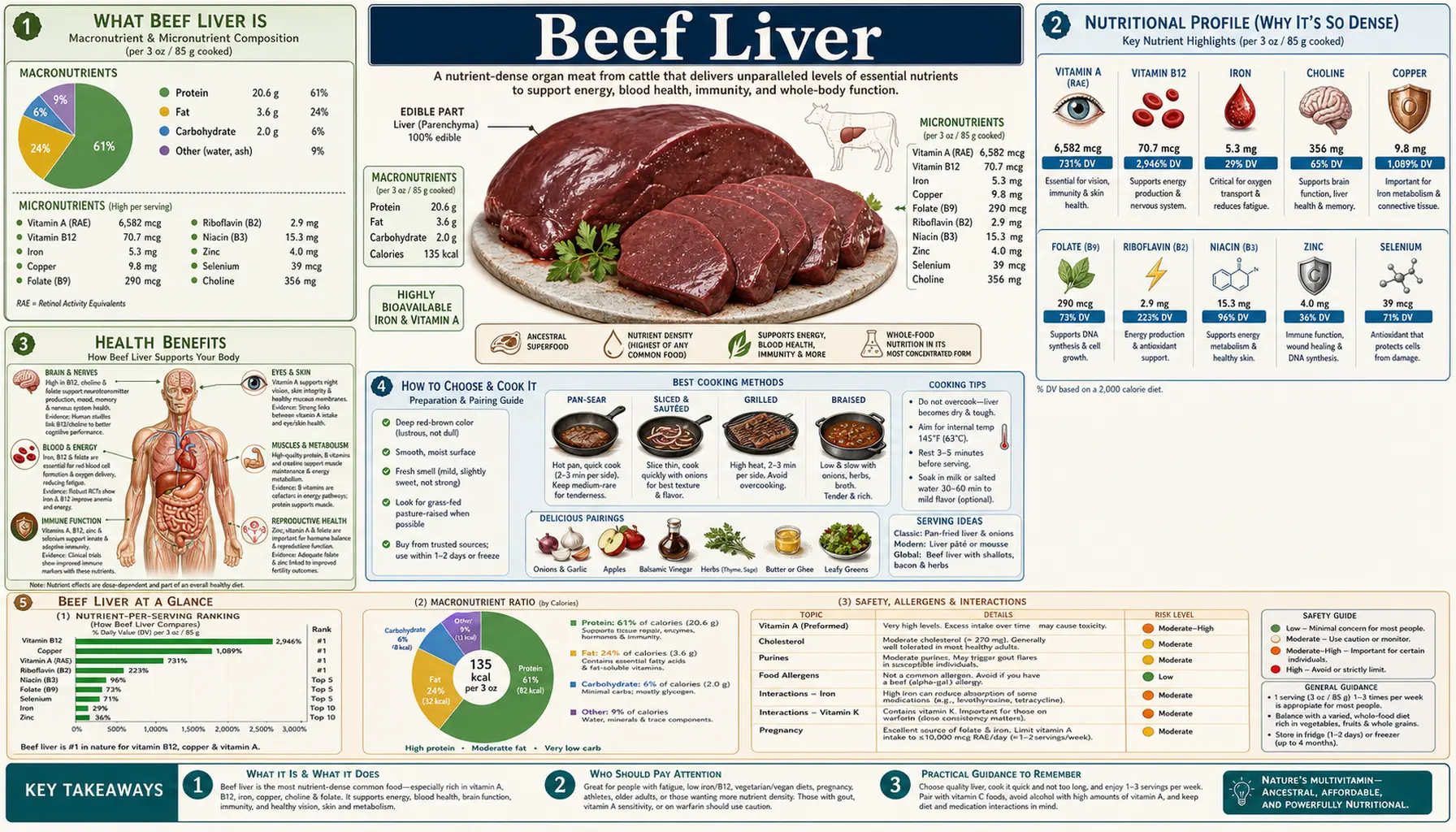
Beef liver is the single most nutrient-dense whole food most people will ever put on a plate. Often called "nature's multivitamin," a small portion delivers more preformed vitamin A, vitamin B12, copper, and riboflavin than almost any other food on earth — frequently many times a full day's requirement. That extraordinary density is exactly why beef liver is both a remarkable nutritional ally and a food to treat with respect: the same concentration that makes it so valuable also means a little goes a long way, and more is genuinely not better. This page explains what beef liver is, why it is so dense, the real health benefits, how to choose and cook it, sensible serving sizes, and the cautions that matter most — including one that pregnant women in particular need to read.
Table of Contents
- What Beef Liver Is
- Nutritional Profile (Why It's So Dense)
- Health Benefits
- How to Choose & Cook It
- How Much, How Often
- Cautions — Read This
- Research Papers
- Connections
- Featured Videos
What Beef Liver Is
Beef liver is exactly what it sounds like: the liver of cattle. Among organ meats — also called offal — it is the most iconic and the most widely eaten. The liver is one of the body's hardest-working organs, and that metabolic intensity is reflected in its nutrient content: it is packed with the vitamins and minerals the animal needed to keep its own metabolism running.
Liver has a distinctive, strongly mineral, slightly metallic flavor and a soft, dense texture that people tend to either love or actively avoid. You can buy it in several forms:
- Fresh — sold at butchers and many grocery stores, usually sliced.
- Frozen — convenient because liver freezes well, and freezing in small portions lets you use just a little at a time.
- Desiccated (freeze-dried) liver capsules or powder — concentrated dried liver in pill form, popular with people who want the nutrients but dislike the taste.
You will also see grass-fed versus grain-fed liver. Both are highly nutritious. Grass-fed beef liver tends to carry a somewhat more favorable fat profile and may be modestly higher in certain nutrients, but for the headline nutrients beef liver is famous for — vitamin A, B12, copper, riboflavin — even ordinary grain-fed liver is exceptionally rich. Choosing grass-fed is a reasonable preference, not a requirement for the nutritional payoff.
Nutritional Profile (Why It's So Dense)
The numbers below are approximate, per ~100 grams (about 3.5 ounces) of cooked, pan-fried beef liver, based on USDA FoodData Central data. Percentages refer to the U.S. Daily Value (DV) for a typical adult. They are striking:
- Preformed vitamin A (retinol) — roughly 7,700 micrograms RAE (about 26,000 IU), on the order of ~860% of the Daily Value. This is among the highest of any food on earth, and unlike the beta-carotene in plants, it is preformed retinol your body uses directly. This single fact drives most of the cautions later on.
- Vitamin B12 — about 83 micrograms, which is on the order of thirty times a full day's need (DV is 2.4 µg). Few foods come close.
- Copper — roughly 14–15 milligrams, often well over 1,000% of the Daily Value. Beef liver is one of the richest dietary copper sources known.
- Riboflavin (vitamin B2) — about 3.4 milligrams, around 260% of the DV.
- Folate — about 260 micrograms, roughly 65% of the DV.
- Choline — about 420 milligrams, a large share of the daily adequate intake (around 76%) — important for brain and liver health.
- Iron — about 6 milligrams (~34% of the DV), and crucially it is heme iron, the form from animal foods that the body absorbs far more efficiently than the non-heme iron in plants.
- Selenium — about 33 micrograms (~60% of the DV), plus generous niacin (B3), vitamin B6, pantothenic acid (B5), and zinc.
It manages all of this in a lean package: roughly 175 calories, 26 grams of high-quality protein, and only about 5 grams of fat per 100 g. No multivitamin pill matches this profile in whole-food form — which is precisely why the "nature's multivitamin" nickname stuck.
Health Benefits
The honest framing for beef liver is simple: its benefits flow almost entirely from being one of the most nutrient-dense whole foods that exists. It is not a cure for anything, but as a concentrated source of nutrients that many people fall short on, it is hard to beat.
Building healthy red blood cells (anemia)
Beef liver is almost uniquely suited to supporting red-blood-cell formation because it supplies four of the key building blocks at once: vitamin B12 and folate (both required to make red blood cells), heme iron (the well-absorbed iron that fills those cells with oxygen-carrying hemoglobin), and copper (needed to mobilize and use iron properly). Deficiencies in B12, folate, iron, or copper can each cause anemia, and beef liver covers all of them in a single food.
Energy and everyday metabolism
The B vitamins concentrated in liver — riboflavin, niacin, B6, B12, pantothenic acid, and folate — are the cofactors your cells use to turn food into usable energy. They do not "give" you energy like caffeine; rather, they are the machinery that lets your body extract energy from everything you eat. A diet chronically low in these vitamins can leave metabolism running poorly.
Eyes, skin, and immune defense (vitamin A)
Preformed vitamin A (retinol) is essential for night vision, for healthy skin and the linings of the respiratory and digestive tracts, and for a properly functioning immune system. Beef liver is one of the most concentrated natural sources of retinol in existence — which is a genuine benefit for people who are deficient, and also the reason portion control matters (see Cautions).
Brain and nervous-system support (choline)
Liver is one of the best whole-food sources of choline, a nutrient most people under-consume. Choline is used to build cell membranes and to make acetylcholine, a neurotransmitter central to memory and muscle control, and it also helps the liver handle fat. Adequate choline matters across life, and it is especially important during pregnancy for fetal brain development — though, as the Cautions section explains, pregnancy is also exactly when liver's vitamin A content calls for restraint.
How to Choose & Cook It
The biggest hurdle with beef liver is flavor and texture, and both are very manageable with technique.
- Choosing: Look for liver that is glossy and deep reddish-brown, not gray or dried at the edges. Calf (younger) liver is milder than liver from older cattle. Buy it as fresh as you can, or buy frozen and thaw what you need.
- Soak to mellow the flavor: The classic trick is to soak sliced liver in milk (or buttermilk) for 30 minutes to a few hours in the fridge before cooking. This noticeably tames the strong, mineral taste that puts many people off. Pat dry before cooking.
- Liver and onions: The traditional preparation for good reason — sweet caramelized onions balance liver's richness. Dredge thin slices lightly in seasoned flour and sear quickly in a hot pan.
- Do not overcook: This is the number-one mistake. Overcooked liver turns dry, grainy, and tough. Cook it hot and fast, leaving the inside just barely pink — a couple of minutes per side for thin slices. It should be tender, not rubbery.
- Pâté: Blending cooked liver with butter, sautéed onion, and seasonings makes a smooth, spreadable pâté — an easy "gateway" for people who dislike liver served as a slab, because the strong flavor is softened and stretched.
- Freeze in small portions: Liver is potent, so portioning it into ~100 g pieces before freezing makes it easy to add a modest weekly serving without committing to a large meal.
- Desiccated liver capsules: For the truly flavor-averse, freeze-dried liver in capsule or powder form delivers the nutrients without the taste. Follow the product's serving guidance — and remember the same vitamin A and copper cautions apply, because it is still concentrated liver.
How Much, How Often
Here is the practical rule that makes beef liver work for you instead of against you: treat it as a once-a-week food, not a daily one. A sensible target for most healthy adults is a modest serving of around 100 grams (3.5 ounces) about once a week — roughly one ordinary portion of liver and onions.
The reasoning is the same as everything above: beef liver is so concentrated in preformed vitamin A and copper that a single weekly serving already provides far more than a day's worth of each. Eating it daily would stack those amounts up week after week and push you toward the levels where vitamin A in particular can cause problems. Once a week gives you liver's remarkable nutrient payoff with a wide margin of safety. If you also take a multivitamin containing vitamin A or copper, or desiccated-liver capsules, count those toward your total — it is easy to double up without realizing it.
Cautions — Read This
Beef liver's density cuts both ways. These cautions are not reasons to avoid it for most people — they are reasons to keep portions modest and to know who should limit it.
Vitamin A toxicity — and the pregnancy warning that matters most
This is the single most important caution on this page. Beef liver is extraordinarily high in preformed vitamin A (retinol), and unlike the beta-carotene in vegetables, preformed vitamin A is stored in the body and can build up to harmful levels. Consistently eating large amounts can cause vitamin A toxicity (hypervitaminosis A), with effects ranging from headaches, nausea, dry skin, and hair loss to, in severe chronic cases, liver damage and bone problems. For most adults a single weekly serving is safe; the danger comes from frequent large servings, or from stacking liver on top of vitamin A supplements.
Pregnancy is the critical exception. High intakes of preformed vitamin A are teratogenic — meaning they can cause serious birth defects, particularly when intake is high in early pregnancy. Because a single serving of beef liver can contain many times the recommended daily vitamin A, pregnant women, and women who may become pregnant, are generally advised to limit or avoid liver entirely, and to avoid vitamin A supplements unless a doctor directs otherwise. Health authorities in several countries explicitly advise against eating liver during pregnancy for this reason. If you are pregnant or trying to conceive, treat this as a firm caution and discuss your diet with your doctor or midwife. (Choline, which liver also supplies, is valuable in pregnancy — but it should come from sources that do not carry liver's vitamin A load.)
Very high copper — caution with Wilson's disease
Beef liver is one of the richest copper sources in the diet. For most people copper is an essential nutrient and this is a benefit. But people with Wilson's disease — a genetic disorder in which the body cannot clear copper and dangerously accumulates it — must strictly avoid liver and other high-copper foods. Anyone advised to restrict copper for any reason should treat beef liver as off-limits.
High purines — relevant for gout
Organ meats including liver are high in purines, which the body breaks down into uric acid. For people with gout or a tendency to high uric acid, liver can trigger or worsen attacks, and it is one of the foods most often recommended for limitation in gout management.
Dietary cholesterol — context
Beef liver contains a fair amount of dietary cholesterol (roughly 380 mg per 100 g). For most people, current evidence indicates that dietary cholesterol from whole foods has a smaller effect on blood cholesterol than was once believed, and a weekly serving is not a concern for the average healthy person. Still, it is worth noting, and people with specific lipid conditions or who are cholesterol-sensitive should factor it in.
The "liver stores toxins" myth — set the record straight
A persistent claim is that you should not eat liver because it is the body's "filter" and is therefore "full of toxins." This is not accurate. The liver is a processing organ: it chemically transforms drugs, alcohol, and other compounds so the body can excrete them — it does not act like a sponge that traps and hoards them. While liver can concentrate some fat-soluble nutrients (vitamin A, copper) and, in heavily contaminated environments, can carry some contaminant load like any tissue, the idea that liver is a reservoir of accumulated heavy metals and poisons is a myth. From a healthy, well-raised animal, beef liver is a clean and exceptionally nutritious food. The real reason to keep portions modest is its nutrient density — especially vitamin A — not "toxins."
Research Papers
- Rothman KJ, Moore LL, Singer MR, et al. Teratogenicity of high vitamin A intake. New England Journal of Medicine. 1995;333(21):1369–1373. doi:10.1056/NEJM199511233332101 — Landmark study linking high intake of preformed vitamin A in early pregnancy to a marked increase in birth defects; the basis for advising pregnant women to limit liver and vitamin A supplements.
- Maia SB, Souza ASR, Caminha MFC, et al. Vitamin A and pregnancy: a narrative review. Nutrients. 2019;11(3):681. doi:10.3390/nu11030681 — Reviews vitamin A needs in pregnancy and why women in well-nourished countries are advised to avoid liver and high-dose vitamin A.
- Olson JM, Daley SF, Goyal A. Vitamin A toxicity. In: StatPearls. Treasure Island (FL): StatPearls Publishing; 2023. NCBI Bookshelf NBK532916 — Clinical review of acute, chronic, and teratogenic vitamin A toxicity (hypervitaminosis A): causes, symptoms, and management.
- Latoch A, Stasiak DM, Siczek P. Edible offal as a valuable source of nutrients in the diet—a review. Nutrients. 2024;16(11):1609. doi:10.3390/nu16111609 — Documents why organ meats, with liver foremost, are among the most micronutrient-dense foods (bioavailable retinol, B12, iron, zinc, copper).
- Kalman DS, Hewlings S, et al. Dietary heme iron: a review of efficacy, safety and tolerability. Nutrients. 2025;17(13):2132. doi:10.3390/nu17132132 — Explains why the heme iron in foods like liver is absorbed far more efficiently (~25–30%) than the non-heme iron in plant foods (~3–5%).
- U.S. Department of Agriculture, FoodData Central. Beef, variety meats and by-products, liver, cooked, pan-fried (FDC ID 168627). fdc.nal.usda.gov — The authoritative U.S. reference for beef liver's per-100 g nutrient values cited throughout this article.
Connections
- All Food
- Beef Liver Benefits: Overview · Vitamin A · B12 & Folate · Copper & Iron · Choline
- Chicken Liver
- Pork Liver
- Cod Liver
- Organ Meats
- Liver Extract — the therapeutic extract and the 1934 Nobel-Prize anemia therapy
- Organ Meats for Liver and Vitamins — retinol, B12, folate and copper per serving.
- Morley Robbins on Whole Food Copper Sources — why the Root Cause Protocol makes beef liver its daily copper cornerstone.
- Whole-Food Copper Sources (RCP food list) — serving sizes, sourcing brands and recipes, with beef liver ranked first for copper density.