Beef Liver, Vitamin A, and Vision, Immunity & Skin
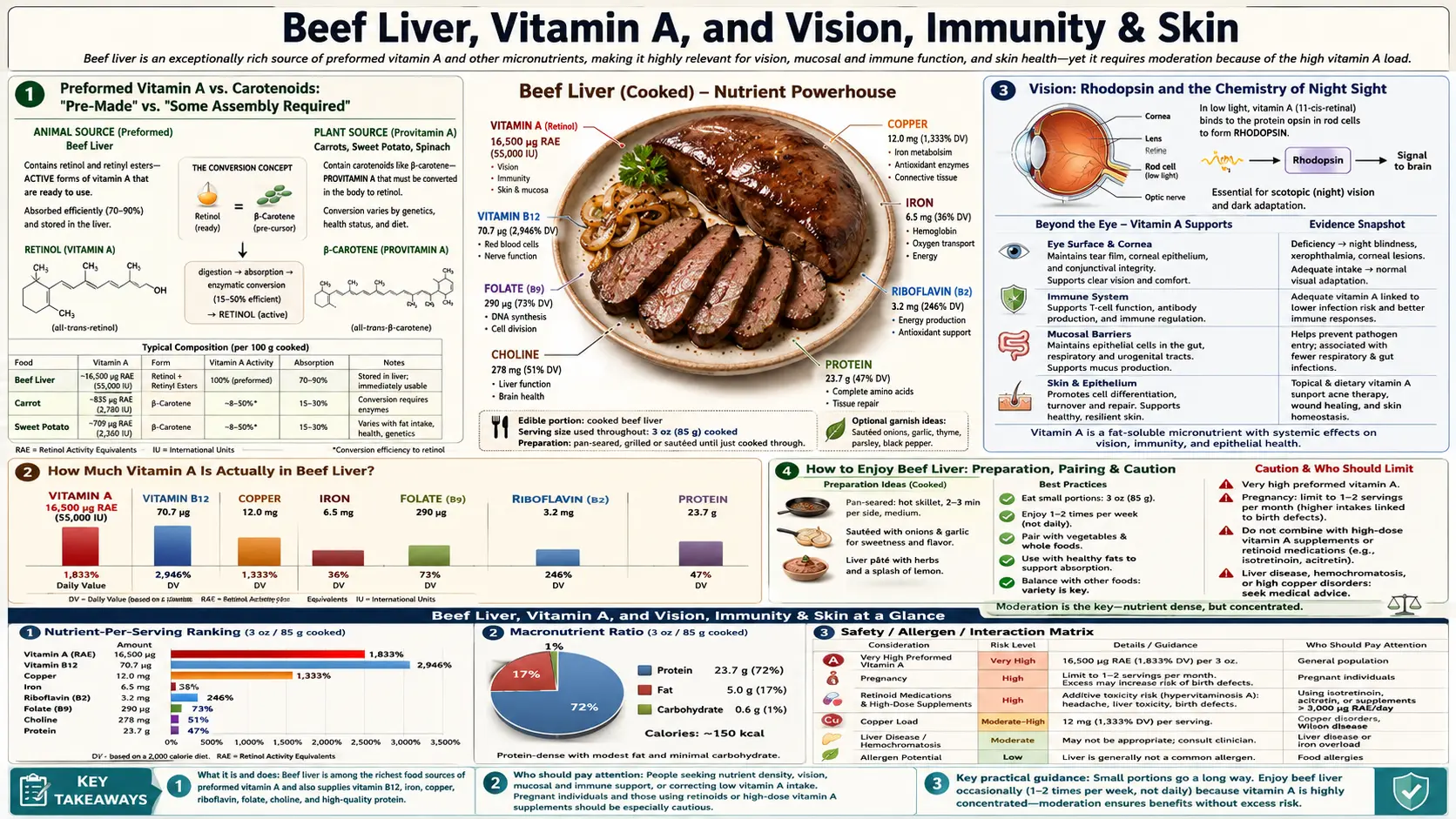
Beef liver is, ounce for ounce, the single richest food source of preformed vitamin A — the "pre-made," ready-to-use form your body needs for night vision, a strong immune barrier, and healthy skin. A 100-gram cooked portion supplies roughly 9,440 micrograms RAE (about 31,700 IU) of vitamin A, which is more than ten times an adult's daily target. That makes liver a genuine nutritional powerhouse, but also one of the very few foods where you can get too much of a good thing. This article explains what preformed vitamin A actually does inside your eyes, immune system, and skin, why it differs from the beta-carotene in carrots, and the one situation — pregnancy — where liver's extraordinary potency turns from an asset into a real risk. The practical takeaway is simple: for most people, liver once or twice a week is a gift; in pregnancy, it should be limited or skipped.
Table of Contents
- Preformed Vitamin A vs. Carotenoids: "Pre-Made" vs. "Some Assembly Required"
- How Much Vitamin A Is Actually in Beef Liver?
- Vision: Rhodopsin and the Chemistry of Night Sight
- Immune Function: Barriers and Mucosal Defense
- Skin and Cellular Differentiation
- How It Works: Gene Expression Through Retinoic Acid Receptors
- The Critical Caution: Too Much Preformed Vitamin A
- Pregnancy and Teratogenicity: Why Liver Comes With a Warning
- Who Benefits and Who Should Be Cautious
- Practical Guidance: How Often, How Much
- Key Research Papers
- Connections
- Featured Videos
Preformed Vitamin A vs. Carotenoids: "Pre-Made" vs. "Some Assembly Required"
"Vitamin A" is really an umbrella term for two different things that arrive in your diet by two different routes. Understanding the difference is the key to understanding why beef liver is so potent — and why it deserves respect.
Preformed vitamin A (retinol and its esters) comes from animal foods: liver, egg yolks, dairy fat, and cod liver oil. It is the finished, ready-to-use molecule. Think of it as a meal delivered hot and ready to eat — your body absorbs it efficiently and can put it straight to work. Beef liver is the densest natural source of this form on the planet.
Provitamin-A carotenoids (mainly beta-carotene) come from plant foods: carrots, sweet potatoes, dark leafy greens, and orange squash. These are precursors, not the finished product. Your body has to convert them into retinol using an enzyme in the gut and liver. Think of carotenoids as a meal-kit: the ingredients are all there, but assembly is required, and the kitchen only makes as much as it needs.
This conversion step is the crucial safety valve. The enzyme that splits beta-carotene into retinol (beta-carotene 15,15'-oxygenase) is down-regulated when your vitamin A stores are already full. In plain terms, your body refuses to over-make retinol from plants — if you eat a mountain of carrots, you may turn faintly orange (a harmless condition called carotenemia), but you will not poison yourself with vitamin A. Conversion is also inefficient and variable from person to person; on average it takes roughly 12 micrograms of dietary beta-carotene to yield 1 microgram of retinol. The general overview of how retinol is absorbed, stored, and trafficked through the body was laid out clearly by Blomhoff and Blomhoff (2006).
Preformed vitamin A from liver has no such safety valve. It is absorbed almost completely (70–90%) and goes straight into your tissues and liver stores whether you need it or not. That is exactly why liver is both a superb way to correct a deficiency and the one food where over-consumption can cause genuine harm. For a deeper comparison of the two forms, see the Vitamin A page on skin and cellular differentiation and the broader Vitamin A overview.
How Much Vitamin A Is Actually in Beef Liver?
The numbers are striking. According to the USDA FoodData Central reference entry for cooked (braised) beef liver, a 100-gram portion (about 3.5 ounces) contains:
- ~9,440 micrograms RAE of vitamin A (RAE = Retinol Activity Equivalents, the modern standard unit)
- ~9,430 micrograms of retinol specifically — meaning essentially all of it is the preformed, pre-made form
- This is equivalent to roughly 31,700 IU in the older International Unit system
Per ounce (28 grams), that works out to about 2,640 micrograms RAE (~8,900 IU). Even a small 1-ounce taste of liver delivers several times a full day's worth of vitamin A.
To put that in context, the Recommended Dietary Allowance (RDA) for adults is 900 micrograms RAE/day for men and 700 micrograms RAE/day for women. A single 100-gram serving of beef liver therefore provides on the order of 10 to 13 times the daily requirement in one sitting. This is why traditional cultures treated liver as a periodic delicacy and a food for the vulnerable — pregnant women in some traditions notably avoided it — rather than an everyday staple.
One historical aside that illustrates just how concentrated animal liver can be: polar bear and husky-dog liver are famously toxic to humans, and Arctic explorers have suffered acute hypervitaminosis A (headache, vomiting, peeling skin) after eating them. Beef liver is far milder than that, but it sits on the same spectrum — potent enough to be a real source of vitamin A in a way that no vegetable can match, and potent enough to warrant the cautions later in this article.
Vision: Rhodopsin and the Chemistry of Night Sight
The oldest and most famous job of vitamin A is in the eye, and it is one of the most elegant pieces of chemistry in human biology. The phrase "eat your carrots to see in the dark" is, unusually for folk wisdom, basically true — though it works far faster with liver's preformed retinol than with a carrot's precursors.
Here is the mechanism, which the Nobel laureate George Wald worked out and summarized in his landmark 1968 paper on the molecular basis of visual excitation. The light-sensitive cells in the back of your eye — the rods, which handle dim-light and peripheral vision — contain a pigment called rhodopsin. Rhodopsin is built from a protein (opsin) bound to a small molecule called 11-cis-retinal, which your body makes directly from vitamin A (retinol).
When a single photon of light strikes rhodopsin, it physically bends the retinal molecule, snapping it from its curved "11-cis" shape into a straightened "all-trans" shape. That tiny shape change is the trigger: it sets off a cascade that sends an electrical signal up the optic nerve to your brain, which you perceive as light. Think of 11-cis-retinal as a mousetrap set in the cocked position; a photon is the feather-light touch that springs it.
After firing, the all-trans-retinal must be recycled back into the 11-cis shape (a process called the visual cycle) before the rod can detect light again. This recycling steadily consumes a little vitamin A. If your vitamin A stores run low, the eye cannot regenerate rhodopsin fast enough, and the first symptom is night blindness (nyctalopia) — difficulty seeing in dim light, trouble adjusting when headlights pass, slow dark-adaptation entering a dark room. Night blindness is, historically and globally, the earliest clinical sign of vitamin A deficiency, and it is fully reversible with vitamin A — which is precisely what a few servings of liver can supply almost overnight.
If deficiency continues, the damage moves from the rods to the surface of the eye itself, causing dryness (xerophthalmia), Bitot's spots, corneal softening (keratomalacia), and eventually irreversible blindness. Vitamin A deficiency remains the leading cause of preventable childhood blindness worldwide. For more on the eye specifically, see the Vitamin A Benefits hub and the dedicated vision article linked there.
Immune Function: Barriers and Mucosal Defense
Long before scientists understood why, they noticed that animals and children short on vitamin A died of infections at strikingly higher rates. In the 1920s the British researchers Harry Green and Edward Mellanby dubbed vitamin A the "anti-infective vitamin" in a now-classic 1928 paper, simply on the basis of how reliably deficient animals succumbed to pneumonia, gut infections, and abscesses. A century of work since then — reviewed comprehensively by Stephensen (2001) — has filled in the mechanism, and it operates on two fronts.
First front: the barriers. Your body's real first line of defense is not white blood cells — it is the moist, mucus-coated lining (the epithelium) of your airways, gut, eyes, and urinary tract. These linings physically trap pathogens, sweep them out with tiny hair-like cilia, and bathe them in antimicrobial chemicals. Building and maintaining this lining depends on vitamin A. When vitamin A is scarce, the lining undergoes squamous metaplasia — the soft, wet, mucus-making surface dries out and hardens into a flat, scaly, keratin-coated surface (the same visible process that causes the dry-eye spots of deficiency). A dried-out airway lining cannot sweep out inhaled bacteria; a compromised gut lining lets microbes slip through. The walls of the fortress crumble.
Second front: the immune cells themselves. Inside the body, retinol is converted into its most active form, retinoic acid, which acts as a chemical instructor for the immune system. Retinoic acid helps direct the maturation of T cells, tilts the balance of inflammatory versus regulatory responses in the gut, and — in an especially neat trick worked out by Iwata and colleagues (2004) — imprints immune cells with "gut-homing" address tags (the receptors CCR9 and integrin alpha-4-beta-7) so they travel to the intestine where they are needed. Retinoic acid also steers the choice between inflammatory "Th17" cells and calming "regulatory T" cells, a balance Mucida and colleagues (2007) showed is tipped by how much retinoic acid is present. It additionally promotes B cells to produce secretory IgA, the antibody that patrols mucosal surfaces.
The clinical payoff of all this is enormous on a global scale. In populations where deficiency is common, supplementing children with vitamin A reduces deaths from measles, diarrhea, and pneumonia — the landmark community trial by Sommer and colleagues in Indonesia (1986) found roughly a 23% drop in overall child mortality. None of this means a well-nourished adult should megadose vitamin A to "boost immunity" (more is not better, and can be harmful — see the cautions below). It does mean that a food like liver, which reliably keeps your stores topped up, supports the immune barriers and signaling that keep everyday infections at bay. For the full immune story, see Vitamin A for Immune Function.
Skin and Cellular Differentiation
If you have ever used a "retinol" night cream or a prescription tretinoin (Retin-A) for acne or wrinkles, you have already met vitamin A's effect on skin — those products are literally vitamin A derivatives applied to the surface. The same molecule that powers your night vision is a master regulator of how skin cells grow, mature, and renew.
The technical term is cellular differentiation: the process by which a generic, immature cell matures into a specialized cell that does a particular job. Skin is a factory of constant renewal — the bottom layer of the epidermis is always producing new cells that migrate upward, flatten, fill with protective keratin, and are eventually shed from the surface. Vitamin A, through retinoic acid, keeps this assembly line orderly: it tells skin cells when to keep dividing and when to mature and stop.
When vitamin A is deficient, this orderly turnover goes wrong. The skin becomes dry, rough, and bumpy — a condition called follicular hyperkeratosis (sometimes nicknamed "toad skin"), where dead keratin plugs build up around hair follicles, giving the skin a permanent goosebump-like texture. The same dysregulated keratinization affects the linings discussed in the immune section above, which is why the skin and the eye and the airways all suffer together in true deficiency.
This is also the basis for vitamin A's role in dermatology. Topical and oral retinoids normalize the differentiation of skin cells, which is why they work for acne (they keep pore-lining cells from clumping and clogging) and for photoaging (they restore more youthful skin-cell behavior and stimulate collagen). The molecular machinery behind these skin effects — how retinoic acid binds nuclear receptors to switch skin genes on and off — is the subject of the gene-expression section next. Importantly, getting enough dietary vitamin A (as liver does generously) supports normal skin from the inside, but it does not mean you should take high-dose oral vitamin A as an acne treatment — that crosses into toxic, and in some cases teratogenic, territory. For the cellular-biology deep dive, see Vitamin A for Skin and Cellular Differentiation.
How It Works: Gene Expression Through Retinoic Acid Receptors
Vision uses retinal as a light-catching antenna, but almost everything else vitamin A does — immunity, skin, growth, the maintenance of every epithelial lining in the body — works through a completely different mechanism: controlling which genes are switched on. This is worth understanding because it explains why vitamin A is so powerful, and why too much of it is so disruptive.
Here is the idea in plain terms. Inside your cells, retinol is converted to all-trans-retinoic acid, the active signaling form. Retinoic acid is small enough to slip into the cell's nucleus, where your DNA is stored. There it docks onto protein "switches" called retinoic acid receptors (RARs), which pair up with partner proteins called retinoid X receptors (RXRs). This RAR–RXR pair sits on specific stretches of DNA (called retinoic acid response elements) like a hand on a light switch.
When retinoic acid binds, the switch flips: the receptor changes shape, releases proteins that were keeping nearby genes silent, and recruits proteins that turn those genes on. The result is that the cell starts manufacturing the proteins those genes encode — the keratins of a maturing skin cell, the homing receptors of an immune cell, the structural proteins of a healthy gut lining. The function of these receptors during growth and development was mapped in detail by Mark, Ghyselinck and Chambon (2009), and the broader logic of how retinoic acid orchestrates gene programs across tissues is reviewed by Rhinn and Dollé (2012).
Think of retinoic acid as a conductor and the RAR–RXR receptors as the conductor's baton resting on the orchestra: a single signaling molecule, by binding these switches, coordinates hundreds of genes at once into a unified performance. This explains two things. First, why vitamin A touches so many seemingly unrelated systems — the same hormone-like signal reaches genes in the eye, the gut, the skin, and the developing embryo. Second, why excess vitamin A is so damaging: cranking up a master gene-controller above its normal range scrambles the orchestra, throwing off the carefully timed programs of cell maturation — which is exactly the catastrophe that unfolds in a developing fetus exposed to too much, the subject of the next two sections.
The Critical Caution: Too Much Preformed Vitamin A
This is the section that matters most, because beef liver is one of the very few everyday foods capable of delivering a genuinely excessive dose. Vitamin A is fat-soluble, which means — unlike water-soluble vitamins such as C, where the excess simply leaves in your urine — your body stores the surplus in your liver, and it can accumulate to harmful levels over time.
The authoritative review of vitamin A toxicity by Penniston and Tanumihardjo (2006) distinguishes two kinds of overdose:
- Acute toxicity — from a single very large dose (think hundreds of thousands of IU at once, as in the polar-bear-liver stories). Symptoms include severe headache, blurred or double vision, nausea and vomiting, dizziness, and within days, peeling skin. It resolves once the source is removed.
- Chronic toxicity — the more relevant risk for ordinary diets and supplements. Sustained intake well above the daily requirement, built up over weeks to months, can cause headaches, dry and itchy peeling skin, hair loss, cracked lips, joint and bone pain, liver damage, and elevated calcium. There is also good evidence that habitual high preformed-vitamin-A intake is associated with reduced bone density and increased fracture risk in older adults — the excess appears to interfere with vitamin D's bone-building signaling and to stimulate bone breakdown.
To guard against this, the U.S. Institute of Medicine set a Tolerable Upper Intake Level (UL) of 3,000 micrograms RAE per day of preformed vitamin A for adults. Notice the word preformed: the UL applies to retinol from animal foods, supplements, and medications — not to beta-carotene from plants, which has no UL because of the safety valve described earlier. Your body never overdoses on carrots.
Now do the arithmetic for liver. A single 100-gram serving delivers about 9,440 micrograms RAE — roughly three times the daily upper limit in one meal. This does not mean one serving will hurt you; the UL is a chronic daily-average ceiling with a built-in safety margin, and an occasional spike is buffered by your body's large storage capacity. What it does mean, clearly, is that beef liver is not an every-day food. Eating it daily would push your weekly average far past the safe ceiling. Eating it once or twice a week keeps your average daily intake comfortably reasonable while still giving you liver's remarkable nutrient density. The same caution applies doubly if you also take a multivitamin or cod liver oil containing preformed retinol, or a standalone vitamin A supplement — those stack on top of the liver.
Pregnancy and Teratogenicity: Why Liver Comes With a Warning
There is one circumstance where vitamin A excess is not merely a long-term bone-and-liver concern but an acute danger to a developing baby: pregnancy. This deserves its own section because the stakes are so high and the food in question — liver — is the very food most able to deliver a dangerous dose.
The reason ties back to the gene-expression mechanism. In the embryo, retinoic acid is one of the most important developmental signals there is — it literally helps lay out the body plan, telling cells in the early embryo which structures to become and where. Because it is such a powerful patterning signal, getting the dose wrong is catastrophic. Too much retinoic acid in early pregnancy disrupts the formation of the brain and spinal cord, face, ears, heart, and great vessels — these are called retinoid (or vitamin A) birth defects. A substance that causes birth defects is called a teratogen, and high-dose preformed vitamin A is a proven human teratogen.
The defining human evidence came from Rothman and colleagues, published in the New England Journal of Medicine in 1995. In a prospective study of more than 22,000 pregnant women, those consuming high amounts of preformed vitamin A — above roughly 10,000 IU (3,000 micrograms RAE) per day — had a substantially elevated rate of birth defects, specifically the cranial-neural-crest malformations that retinoic acid disrupts. The risk rose with intake, and the excess was attributable to preformed vitamin A from supplements and food, not to beta-carotene, which showed no such association. This is the single most important reason the safety valve on plant carotenoids matters: a pregnant woman can eat all the sweet potatoes and spinach she likes, but preformed retinol from supplements or liver is a different matter entirely.
The practical guidance that follows is clear and is echoed by health authorities worldwide:
- Pregnant women, and women who might become pregnant, should limit or avoid liver and liver products (including pâté and liver sausage). In the United Kingdom, official advice is simply to avoid liver in pregnancy; elsewhere the advice is to keep it to occasional small portions at most. Given that a single serving exceeds the daily upper limit several-fold, the cautious and widely recommended approach during pregnancy is to skip it.
- Avoid high-dose vitamin A supplements in pregnancy. Prenatal vitamins are formulated with this in mind — they typically supply vitamin A as beta-carotene or keep preformed retinol low. Do not add a separate high-dose vitamin A product, and check cod liver oil labels (some are very high in retinol).
- Never use oral retinoid medications in pregnancy. Drugs like isotretinoin (Accutane) for acne and acitretin for psoriasis are concentrated vitamin A derivatives and are among the most powerful known teratogens — pregnancy must be strictly avoided while taking them and for a period afterward. This is a medication issue separate from diet, but it flows from exactly the same biology.
To be clear and reassuring: this warning is specifically about preformed vitamin A in excess during pregnancy. Vitamin A itself is essential in pregnancy — the developing baby needs it — and the amount in a normal prenatal vitamin and a balanced diet is both safe and necessary. The problem is never "vitamin A"; the problem is a large preformed dose, and liver is the food most likely to deliver one.
Who Benefits and Who Should Be Cautious
Who benefits most from beef liver's vitamin A:
- People with low intake or low stores — those eating few animal foods, dairy, or orange/green vegetables. A serving or two of liver per week reliably corrects this.
- People with fat-malabsorption conditions — because vitamin A is fat-soluble, conditions like Crohn's disease, celiac disease, cystic fibrosis, chronic pancreatitis, and the after-effects of bariatric (gastric-bypass) surgery all impair absorption and can cause quiet vitamin A deficiency despite a normal diet. (These individuals should be guided by their clinician and have blood levels monitored, since needs and safe doses vary.)
- People with night-vision complaints or dry eyes in the context of a poor diet — early deficiency is fully reversible, and liver is a fast dietary fix.
- Anyone wanting a nutrient-dense whole food — beyond vitamin A, liver is exceptionally rich in B12 and folate, bioavailable copper and heme iron, and choline.
Who should be cautious or avoid liver:
- Pregnant women and those trying to conceive — the central caution of this article. Limit or avoid liver; favor beta-carotene sources instead.
- Anyone taking oral retinoid medications (isotretinoin, acitretin, etretinate, high-dose vitamin A therapy) — liver stacks more preformed vitamin A on top of an already-high pharmaceutical dose and increases toxicity risk.
- People taking standalone high-dose vitamin A supplements or large amounts of cod liver oil — the combined total can exceed the 3,000 micrograms RAE/day upper limit. Count your sources.
- Older adults concerned about bone density / osteoporosis — chronic high preformed vitamin A is linked to lower bone mass; keep liver occasional rather than frequent.
- People with liver disease — the organ that stores and processes vitamin A is itself impaired; discuss intake with a clinician.
Practical Guidance: How Often, How Much
The whole article distills to a few simple, memorable rules:
- Frequency: once or twice a week, not daily. A 3-to-4-ounce (about 85–115 gram) serving once or twice weekly gives you liver's full nutritional benefit while keeping your average daily preformed-vitamin-A intake sensible. Daily liver would push you chronically past the safe ceiling.
- Portion: a modest serving goes a very long way. Because even 1 ounce supplies several days' worth of vitamin A, you do not need a large portion. A small serving alongside other foods is plenty.
- Count all your sources of preformed vitamin A. If you also take a multivitamin, a vitamin A supplement, or cod liver oil that lists retinol/retinyl palmitate, those add to the liver. Read labels and keep the running total in mind against the 3,000 microgram RAE/day adult upper limit.
- Get vitamin A from plants when you want it daily. If you like a daily dose of vitamin A activity, lean on beta-carotene foods — sweet potato, carrots, spinach, kale, butternut squash. Your body converts only what it needs, so there is no upper limit and no toxicity risk.
- In pregnancy: when in doubt, skip the liver. Use carotene-rich vegetables and a properly formulated prenatal vitamin instead. This is the one rule worth being conservative about.
- If you have a malabsorption condition or take retinoid drugs, individualize with your clinician. Blood retinol testing can clarify whether you are deficient or replete before you decide how much liver is right for you.
Used this way — respectfully, occasionally, and with pregnancy as the clear exception — beef liver is one of the most nutrient-dense foods available, and the richest natural way to keep your vision, immune barriers, and skin well supplied with the vitamin A they depend on.
Key Research Papers
- Wald G. Molecular basis of visual excitation. Science. — 1968; 162(3850): 230–239
- Blomhoff R, Blomhoff HK. Overview of retinoid metabolism and function. Journal of Neurobiology. — 2006; 66(7): 606–630
- Rhinn M, Dollé P. Retinoic acid signalling during development. Development. — 2012; 139(5): 843–858
- Mark M, Ghyselinck NB, Chambon P. Function of retinoic acid receptors during embryonic development. Nuclear Receptor Signaling. — 2009; 7: e002
- Stephensen CB. Vitamin A, infection, and immune function. Annual Review of Nutrition. — 2001; 21: 167–192
- Mucida D, Park Y, Kim G, et al. Reciprocal Th17 and regulatory T cell differentiation mediated by retinoic acid. Science. — 2007; 317(5835): 256–260
- Iwata M, Hirakiyama A, Eshima Y, et al. Retinoic acid imprints gut-homing specificity on T cells. Immunity. — 2004; 21(4): 527–538
- Green HN, Mellanby E. Vitamin A as an anti-infective agent. British Medical Journal. — 1928; 2(3537): 691–696
- Penniston KL, Tanumihardjo SA. The acute and chronic toxic effects of vitamin A. American Journal of Clinical Nutrition. — 2006; 83(2): 191–201
- Rothman KJ, Moore LL, Singer MR, et al. Teratogenicity of high vitamin A intake. New England Journal of Medicine. — 1995; 333(21): 1369–1373
- Sommer A, Tarwotjo I, Djunaedi E, et al. Impact of vitamin A supplementation on childhood mortality: a randomised controlled community trial. The Lancet. — PubMed
Live PubMed Searches
- PubMed: Preformed vitamin A / retinol from liver
- PubMed: Vitamin A, rhodopsin, and night vision
- PubMed: Hypervitaminosis A and the upper limit
- PubMed: Vitamin A teratogenicity in pregnancy
- PubMed: Retinoic acid and epithelial / skin differentiation
Connections
- All Food
- Beef Liver Overview
- Beef Liver Benefits Hub
- Vitamin A Overview
- Vitamin A for Immune Function
- Vitamin A for Skin & Cellular Differentiation
- Cod Liver (Cod Liver Oil)