Beef Liver for Bioavailable Copper & Heme Iron
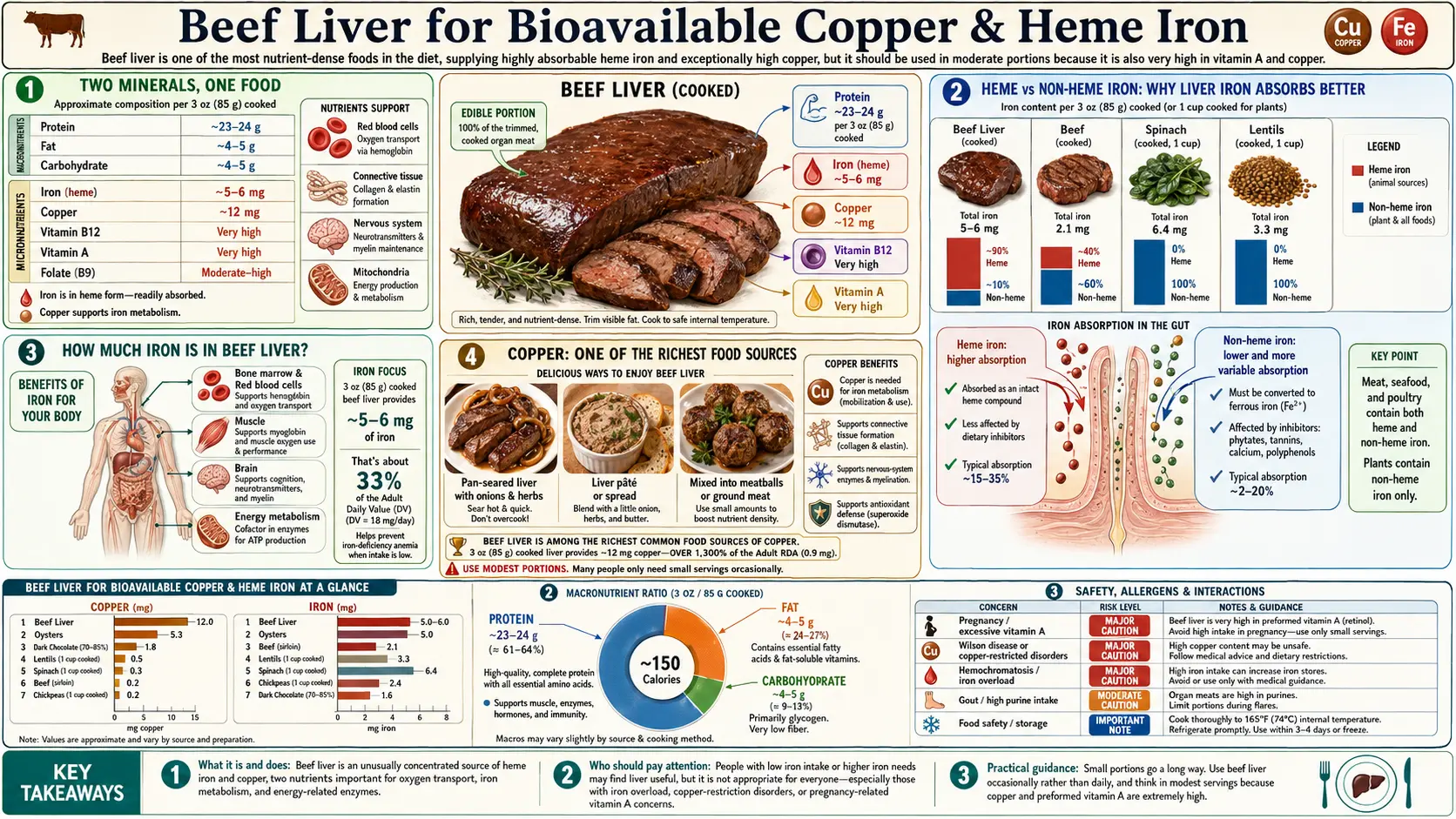
Beef liver is one of nature's most concentrated sources of two minerals that the body uses as a team: heme iron — the form of iron your gut absorbs most efficiently — and copper, which is the mineral your body actually needs in order to use iron at all. You can eat plenty of iron and still run low on usable iron if you are short on copper, because copper-dependent enzymes are what load iron onto the protein that carries it through your blood. A single small serving of liver delivers both at once, in highly absorbable form, which is exactly why it was a folk remedy for "tired blood" long before anyone understood the biochemistry. This page explains, in plain language, why liver iron is absorbed so much better than plant iron, what copper does (for iron, energy, antioxidant defense, and connective tissue), why the copper–iron and copper–zinc partnerships matter, and — honestly — who should be cautious about iron and copper rather than seeking more.
Table of Contents
- Two Minerals, One Food
- Heme vs Non-Heme Iron: Why Liver Iron Absorbs Better
- How Much Iron Is in Beef Liver?
- Copper: One of the Richest Food Sources
- The Copper–Iron Partnership (Why Copper Lets You Use Iron)
- Copper's Other Jobs: Energy, Antioxidants, Connective Tissue
- The Copper–Zinc Balance
- Who Benefits Most
- Honest Cautions: Iron Overload, Copper Toxicity, Vitamin A
- Putting It on the Plate
- Key Research Papers
- Connections
- Featured Videos
Two Minerals, One Food
Most foods are good sources of one nutrient or another. Liver is unusual because it is a top-tier source of several nutrients at the same time — it is, after all, the organ the animal used to store iron, copper, vitamin A, B12, and folate. For the purposes of this page we focus on the two minerals that work together in the bloodstream: iron and copper.
Iron is famous; copper is overlooked. People talk about iron-deficiency anemia constantly, and almost never mention copper. But the two are biochemically inseparable. Copper-containing enzymes are the machinery that moves iron out of storage and loads it into transport. A body low in copper behaves, in some ways, like a body low in iron — even when iron stores are full — because the iron is stuck and cannot get where it needs to go. This was actually one of the first clues that copper was an essential nutrient at all: animals fed iron but deprived of copper still became anemic, and the anemia only resolved when copper was restored.
Beef liver solves both problems in one bite. It supplies iron in its most absorbable chemical form, and it supplies the copper needed to put that iron to work. That combined, "ready-to-use" quality is what makes it nutritionally different from, say, a copper supplement and an iron supplement taken side by side.
Heme vs Non-Heme Iron: Why Liver Iron Absorbs Better
Dietary iron comes in two chemical forms, and your gut treats them completely differently.
- Heme iron is iron tucked inside a ring-shaped molecule called a porphyrin — the same structure that sits at the center of hemoglobin and myoglobin. It comes only from animal tissue: red meat, poultry, fish, and organ meats like liver. The whole heme unit is absorbed largely intact across the gut wall, which protects the iron from the things in food that would otherwise grab it and block absorption.
- Non-heme iron is plain ionic iron, the kind found in plants, grains, beans, and iron-fortified foods (and in iron supplements). It is far more sensitive to its surroundings. Phytates in whole grains and legumes, polyphenols in tea and coffee, and calcium all bind it and dramatically lower how much gets absorbed.
The practical difference is large. Heme iron is typically absorbed at roughly 15–35%, and that rate stays fairly steady regardless of what else is on the plate. Non-heme iron absorption swings wildly — often only a few percent up to maybe 15% — depending on whether the meal is full of absorption blockers or enhancers. A 2025 review of dietary heme iron summarizes why heme is the more efficient and more consistently tolerated dietary form, and why animal-source iron contributes disproportionately to usable iron intake even when it is a minority of total iron eaten.
There is a bonus effect, too. Eating heme iron alongside non-heme iron actually helps you absorb the plant iron in the same meal — the so-called "meat factor." So a meal of liver and onions with a side of lentils extracts more iron from the lentils than the lentils would give up on their own. Vitamin C does the same thing for non-heme iron, which is why a squeeze of lemon or a side of peppers boosts a plant-iron meal.
This is the core reason liver was the original anti-anemia food: it delivers iron in the form the body grabs most readily, and it improves the yield of the iron eaten with it.
How Much Iron Is in Beef Liver?
Cooked beef liver supplies roughly 5–6.5 mg of iron per 100 grams (about a 3.5-ounce portion), with the bulk of it in the readily absorbed heme form. The exact number varies by cut, animal, and cooking method, but liver consistently lands among the most iron-dense common foods.
For perspective, the daily iron target for a menstruating adult woman is about 18 mg, and for an adult man or a postmenopausal woman about 8 mg. A single modest serving of liver therefore covers a meaningful slice of the day's iron — and because it is heme iron, a much larger share of it actually crosses into the body than the milligram count alone would suggest. Compare that with spinach: spinach is often cited as "high in iron," but its iron is non-heme and heavily bound by oxalate, so the fraction that gets absorbed is small.
The takeaway is not that liver has the highest raw iron number on the shelf — certain fortified cereals print bigger numbers — but that liver's iron is among the most bioavailable. Bioavailability is what your bone marrow actually sees. A modest amount of well-absorbed heme iron can do more for your iron status than a large amount of poorly-absorbed non-heme iron.
Copper: One of the Richest Food Sources
If iron is liver's headline mineral, copper is its quiet superpower. Beef liver is one of the single richest dietary sources of copper there is, frequently supplying more than 10 mg of copper per 100 grams — many times an adult's daily requirement (the recommended intake for adults is about 0.9 mg per day). Only a few other foods, notably oysters, shellfish, and cocoa, come close.
That density is no accident. The liver is the body's central copper warehouse: it takes up dietary copper, packages it into copper-dependent proteins, and exports it where the body needs it. When you eat liver, you are eating that warehouse, copper and all.
Because most everyday diets are only modestly supplied with copper — and because high zinc intake, certain medications, and gut conditions can quietly erode copper status — an occasional serving of liver is a reliable way to keep copper stores topped up. A comprehensive review of copper nutrition and biochemistry lays out copper's many roles in human physiology and why even mild, long-running shortfalls matter. The rest of this page walks through what copper actually does.
For the full picture of copper, including food sources, requirements, and deficiency signs, see the dedicated Copper page.
The Copper–Iron Partnership (Why Copper Lets You Use Iron)
Here is the single most important and least appreciated idea on this page: copper is required to use iron. You can have plenty of iron in your body and still act iron-deficient if copper is low, because the steps that move iron around depend on copper enzymes.
The key players are a family of copper-containing enzymes called ferroxidases — literally "iron oxidizers." Iron has to be in a specific chemical state (the ferric, Fe³⁺, form) to bind to transferrin, the protein that ferries iron through the blood to the bone marrow and tissues. Ferroxidases do that conversion:
- Ceruloplasmin is a copper protein circulating in your blood that oxidizes iron as it leaves storage cells (liver and spleen), allowing it to load onto transferrin and travel to where new red blood cells are made. Without enough copper, ceruloplasmin activity drops, and iron gets trapped in storage even though stores are full.
- Hephaestin is a related copper ferroxidase sitting in the wall of the small intestine. It helps newly absorbed iron exit the gut cell and enter the bloodstream. Animal studies show that hephaestin meaningfully boosts intestinal iron absorption, and that copper deficiency impairs this exit step.
The classic demonstration is decades old: growing animals fed adequate iron but deprived of copper develop anemia, accumulate iron in their tissues that they cannot mobilize, and show low ceruloplasmin — and giving them copper fixes it. In people, severe copper deficiency (from gut surgery, malabsorption, or excessive zinc) can produce an anemia that looks exactly like iron-deficiency anemia but does not respond to iron — only to copper. Reviews of the "metabolic crossroads" of iron and copper, and of how the two minerals intersect in the intestine and liver, describe this interdependence in detail.
So when liver delivers iron and copper together, it is delivering the cargo and the forklift in the same package. That is the practical meaning of the partnership.
Copper's Other Jobs: Energy, Antioxidants, Connective Tissue
Copper does far more than help with iron. It sits at the catalytic heart of several enzymes that the body cannot run without:
- Energy production — cytochrome c oxidase. This is the final enzyme in the mitochondrial electron-transport chain, the assembly line that makes the bulk of your cellular energy (ATP). Cytochrome c oxidase contains copper at its core, and without copper this last step stalls. Tissues with high energy demand — heart, brain, and muscle — are especially dependent on it.
- Antioxidant defense — copper/zinc superoxide dismutase (Cu/Zn SOD). This enzyme neutralizes the superoxide free radical, one of the first and most reactive byproducts of using oxygen for energy. It needs both copper and zinc in its active site. Adequate copper supports your built-in antioxidant system rather than relying solely on dietary antioxidants.
- Connective tissue — lysyl oxidase. This copper enzyme forms the chemical cross-links that turn loose collagen and elastin fibers into strong, elastic tissue. Those cross-links give skin its resilience, blood vessels their strength, and bone its toughness. Classic biochemistry established that lysyl oxidase is the copper-dependent enzyme responsible for collagen and elastin cross-linking, and copper-deficient animals develop fragile connective tissue and weakened arteries as a result.
The connective-tissue role is covered in more depth on the dedicated Copper for Connective Tissue page. The short version: copper is not just about blood — it is structural, it is metabolic, and it is part of your antioxidant machinery. Liver supplies it in abundance.
The Copper–Zinc Balance
Copper and zinc compete with each other in the gut. They are absorbed by overlapping pathways, and a large intake of one can suppress absorption of the other. In practice the problem usually runs one direction: too much zinc lowers copper.
The mechanism is well understood. High zinc intake induces a protein in the intestinal lining called metallothionein, which binds copper tightly and holds it inside the gut cell. That cell is then shed and lost in the stool, carrying the trapped copper with it. Controlled studies confirm the mutual antagonism between copper and zinc absorption. This is why chronic high-dose zinc supplementation — for example, large daily zinc lozenges or high-zinc multivitamins taken for months — is a recognized cause of copper deficiency, sometimes severe enough to cause anemia and nerve damage before anyone suspects it.
The flip side is reassuring for people who eat liver: a copper-rich food is a natural counterweight to a zinc-heavy diet or supplement routine. You do not need to micromanage the ratio with a calculator. The goal is simply balance — if you take zinc regularly, make sure copper is somewhere in the picture, and an occasional serving of liver handles that easily. For more on zinc itself and the zinc–copper relationship from the other side, the broader mineral pages are linked in the Connections section below.
Who Benefits Most
Liver's copper-plus-heme-iron combination is most valuable for people whose needs are higher or whose intake is lower:
- Menstruating women. Monthly blood loss makes iron deficiency far more common in women of reproductive age than in men. Because liver iron is heme iron, a small serving delivers usable iron efficiently, and the copper that comes with it ensures that iron can actually be loaded and circulated.
- Pregnant and recently postpartum women have markedly increased iron requirements — though pregnancy carries a specific vitamin A caution for liver, discussed in the next section, so this group should be especially careful with portion size and frequency.
- Endurance and high-volume athletes. Athletes, especially distance runners and women in sport, have higher rates of low iron status from a combination of increased losses (including through the gut and feet), inflammation that limits iron absorption, and high turnover. Heme iron from food is a practical part of keeping iron stores up.
- People with genuinely low intake — those eating little red meat or organ meat, restrictive dieters, and some older adults — may be quietly short on both copper and well-absorbed iron. Liver corrects both at once.
- People on long-term high-dose zinc (see the previous section) need a reliable copper source to offset zinc's suppressive effect.
For these groups, the message is simple: a modest serving of liver, perhaps once a week, is one of the most efficient whole-food ways to support iron and copper status together.
Honest Cautions: Iron Overload, Copper Toxicity, Vitamin A
Liver is potent, and potency cuts both ways. More is not better here. There are three honest cautions, and they are the reason the entire framing of this page is moderation, not maximization.
- Iron overload — not everyone should seek more iron. The body has no efficient way to excrete excess iron, so once iron stores are high, extra dietary iron can accumulate. Most healthy men and postmenopausal women rarely need extra iron — they are not losing it monthly — and routinely loading up on the most absorbable iron is not automatically a good idea for them. More importantly, people with hereditary hemochromatosis, the most common inherited condition in people of Northern European ancestry, absorb iron excessively and can develop dangerous iron buildup in the liver, heart, and pancreas. Anyone with hemochromatosis, a family history of it, or unexplained high ferritin should treat heme-iron-rich foods like liver with real caution and follow their clinician's guidance. A blood test for ferritin and transferrin saturation settles the question.
- Copper toxicity — possible at extreme intakes and in Wilson's disease. Copper is essential, but it is a transition metal, and far too much is harmful. For the general population this is a non-issue from food — the body regulates copper well and the tolerable upper limit (about 10 mg/day for adults) is high. But it is reachable if someone eats large amounts of liver daily on top of copper supplements. The serious exception is Wilson's disease, a genetic disorder in which the body cannot excrete copper and it builds up toxically in the liver and brain. People with Wilson's disease must strictly limit copper-rich foods — liver, shellfish, and chocolate are specifically restricted — under medical supervision.
- The vitamin A caution still applies. Liver is so rich in preformed vitamin A that frequent large servings can push intake into the range associated with toxicity, and high preformed vitamin A is specifically a concern in pregnancy because of birth-defect risk. This is unrelated to iron and copper, but it shares the same conclusion: keep liver an occasional food — a small serving once a week is a sensible ceiling for most people — rather than a daily one. The vitamin A issue is covered fully on the companion Vitamin A page for beef liver.
Put simply: liver is a powerful nutritional tool used in small, infrequent doses. The people who benefit most (menstruating women, athletes, those with low intake) are different from the people who should be cautious (those with hemochromatosis or Wilson's disease, and pregnant women regarding vitamin A). Knowing which group you are in is the whole game.
Putting It on the Plate
If you decide liver belongs in your diet, a few practical points make it both safer and more effective:
- Portion and frequency. A serving of about 50–100 grams (roughly 2–3.5 ounces), once a week, gives you the iron and copper benefit while staying comfortably under the vitamin A concern for most adults. There is no need to eat it daily, and good reason not to.
- Pair it for iron synergy. Serving liver in the same meal as iron-containing plants (beans, lentils, leafy greens) raises the iron you absorb from those plants thanks to the "meat factor." A squeeze of citrus or some vitamin-C-rich vegetables adds further to non-heme iron absorption.
- Watch the absorption blockers at iron-focused meals. Tea, coffee, and calcium-rich dairy reduce non-heme iron absorption; if you are eating specifically to build iron, keep strong tea and coffee an hour or two away from the meal. (Heme iron from the liver itself is largely shielded from these.)
- Cook it gently. Liver toughens when overcooked. Quick searing or a short braise preserves texture; soaking in milk or lemon water beforehand mellows the strong flavor that puts many people off.
- If in doubt, test. Cheap blood tests — ferritin and transferrin saturation for iron, and serum copper or ceruloplasmin for copper — tell you whether you are someone who needs more of these minerals or someone who already has plenty. Eating to a number beats eating to a guess.
For the food itself and its full nutrient breakdown, see the main Beef Liver page and the Beef Liver Benefits hub.
Key Research Papers
- Kalman DS, et al. Dietary Heme Iron: A Review of Efficacy, Safety and Tolerability. Nutrients, 2025;17:2132. — 10.3390/nu17132132
- Hurrell R, Egli I. Iron bioavailability and dietary reference values. The American Journal of Clinical Nutrition, 2010;91:1461S–1467S. — 10.3945/ajcn.2010.28674f
- Collins JF, Prohaska JR, Knutson MD. Metabolic crossroads of iron and copper. Nutrition Reviews, 2010;68:133–147. — 10.1111/j.1753-4887.2010.00271.x
- Doguer C, Ha JH, Collins JF. Intersection of Iron and Copper Metabolism in the Mammalian Intestine and Liver. Comprehensive Physiology, 2018:1433–1461. — 10.1002/cphy.c170045
- Kosman DJ. FET3P, ceruloplasmin, and the role of copper in iron metabolism. Advances in Protein Chemistry, 2002;60:221–269. — 10.1016/s0065-3233(02)60055-5
- Fuqua BK, et al. The Multicopper Ferroxidase Hephaestin Enhances Intestinal Iron Absorption in Mice. PLoS ONE, 2014;9:e98792. — 10.1371/journal.pone.0098792
- Evans GW, Abraham PA. Anemia, Iron Storage and Ceruloplasmin in Copper Nutrition in the Growing Rat. The Journal of Nutrition, 1973;103:196–201. — 10.1093/jn/103.2.196
- Siegel RC, Pinnell SR, Martin GR. Cross-linking of collagen and elastin. Properties of lysyl oxidase. Biochemistry, 1970;9:4486–4492. — 10.1021/bi00825a004
- Oestreicher P, Cousins RJ. Copper and Zinc Absorption in the Rat: Mechanism of Mutual Antagonism. The Journal of Nutrition, 1985;115:159–166. — 10.1093/jn/115.2.159
- Copper nutrition and biochemistry and human (patho)physiology. Advances in Food and Nutrition Research, 2021;96:311–364. — 10.1016/bs.afnr.2021.01.005
- McLaren GD, et al. Hereditary hemochromatosis: insights from the Hemochromatosis and Iron Overload Screening (HEIRS) Study. Hematology (ASH Education Program), 2009;2009:195–206. — 10.1182/asheducation-2009.1.195
Live PubMed Searches
- PubMed: Heme iron bioavailability and absorption
- PubMed: Copper, iron metabolism, ceruloplasmin / ferroxidase
- PubMed: Copper deficiency anemia and zinc excess
- PubMed: Cytochrome c oxidase, Cu/Zn superoxide dismutase
- PubMed: Hereditary hemochromatosis and iron overload
Connections
- All Food
- Copper Overview
- Copper for Connective Tissue
- Iron Overview
- Beef Liver Overview
- Beef Liver Benefits Hub
- Beef Liver Vitamin A (Caution)