Prunes for Blood Sugar, Weight, and Antioxidants
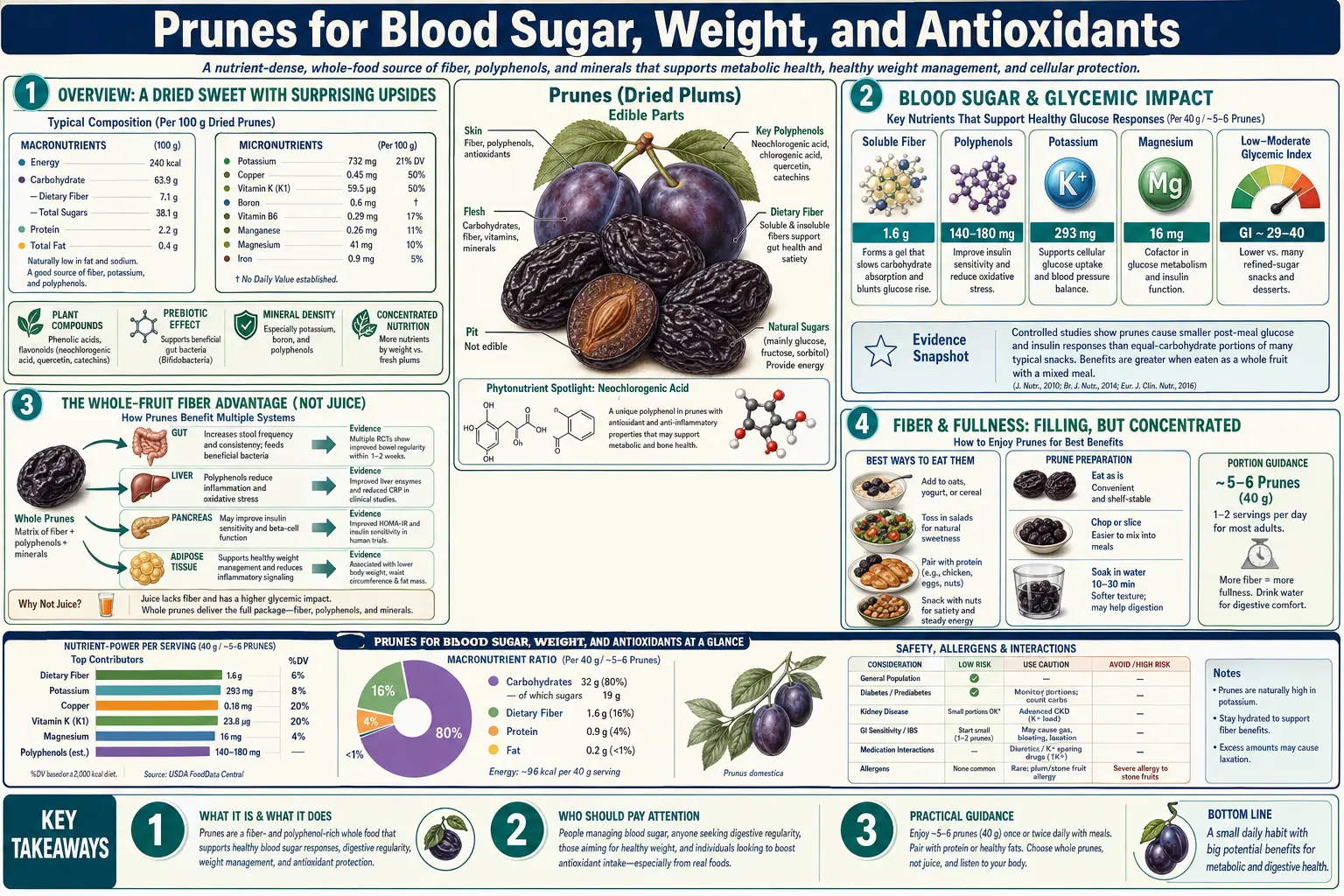
Prunes are sweet, sticky, and dried — which means they are calorie- and sugar-dense, and it would be dishonest to call them a free pass for blood sugar or weight. And yet, eaten in small, deliberate portions, dried plums have some genuinely surprising metabolic positives. Their sweetness is buffered by a generous load of fiber and the sugar alcohol sorbitol, so a few prunes raise blood sugar more gently than their sweetness suggests, and their chew and fiber can be quite filling. On top of that, prunes are among the higher-antioxidant foods you can eat, packed with polyphenols and supplying useful amounts of vitamin K, copper, potassium, and boron. This page explains, in plain language, what prunes really do for blood sugar and weight, what the research shows, and how to enjoy them as a portion-controlled sweet snack — never as candy you can eat by the handful.
Table of Contents
- Overview: A Dried Sweet With Surprising Upsides
- Blood Sugar & Glycemic Impact
- The Whole-Fruit Fiber Advantage (Not Juice)
- Fiber & Fullness: Filling, but Concentrated
- Weight Management: A Sweet Snack vs Candy
- Antioxidants, Vitamins & Minerals
- Practical How-To: Portion, Pairing, and Choice
- Honest Caveats: Calories, Sugar & Sensitivity
- Key Research Papers
- Connections
- Featured Videos
Overview: A Dried Sweet With Surprising Upsides
Let us start with the honest part, because it is the most important. A prune is a plum with most of its water removed. Drying concentrates everything — the sugar, the calories, and the flavor — into a small, dense, chewy package. Where a fresh plum is mostly water and modest in calories, a handful of prunes carries a real load of sugar and energy in very little volume. So prunes are not a low calorie food, and anyone who tells you that you can eat them freely while watching blood sugar or weight is not being straight with you.
With that said, prunes are far more interesting than "just dried candy." Drying removed the water but left the fruit's fiber and its plant compounds intact — and concentrated them too. The result is a sweet food whose sugar is wrapped in a lot of fiber and a sugar alcohol called sorbitol, both of which slow how fast that sugar hits your bloodstream. The same fiber and chew make a few prunes genuinely filling. And prunes happen to be one of the more antioxidant-rich foods in the grocery store, rich in polyphenols and supplying vitamin K, copper, potassium, and the trace element boron.
The honest headline for this whole page, then, is about portion. In a small, controlled serving — think four to six prunes, not a bowl — prunes can be a smart, gentle-on-blood-sugar, nutrient-dense sweet that beats most candy and processed snacks. Eaten by the handful, repeatedly, they are a concentrated sugar source like any other dried fruit. Everything below is written with that line firmly in mind.
One more honest note runs throughout. Most of the human evidence on fruit, fiber, blood sugar, and weight is observational — it watches what people eat and what happens to them rather than randomly assigning a food. That kind of evidence can show strong, consistent associations, but it cannot by itself prove that a single food causes the benefit. Where we lean on it, we will say so plainly, and we will not dress up association as proof.
Blood Sugar & Glycemic Impact
The glycemic index (GI) is a scale that ranks carbohydrate foods by how quickly and how much they raise blood glucose after eating, compared with pure glucose. Foods are loosely grouped as low (55 or under), medium (56–69), or high (70 and above). Here is the genuinely surprising part: despite being a sweet dried fruit, prunes have a relatively low glycemic index — commonly reported in the low-to-mid 40s — which is low glycemic for any food and notably low for something this sweet and concentrated.
Why would a sticky dried sweet land in the low-GI range? Several features of the prune work together:
- Fiber slows everything down. Prunes are rich in fiber, including soluble fiber and pectin that form a soft gel in the gut. That gel slows how fast sugar is released and absorbed, so blood sugar rises more gently than the fruit's sweetness would predict.
- Sorbitol is absorbed slowly. A good share of a prune's sweetness comes from sorbitol, a sugar alcohol that the body absorbs slowly and incompletely. Slow absorption means a smaller, gentler effect on blood glucose (it is also why prunes have their famous laxative effect — see the caveats).
- Fructose has a smaller immediate glucose effect. Much of the remaining sugar is fructose, which is handled differently from glucose and has a smaller direct effect on blood-glucose readings than the same amount of glucose would.
This matters in practice, but the honest qualifier is essential: a low GI is not the same as a small dose. Glycemic index describes the quality of the carbohydrate — how gently it is absorbed — not how much sugar is on your plate. Because prunes are concentrated, the amount of carbohydrate per piece is meaningful, and a large serving still delivers a large sugar load even at a low GI. The gentle, low-glycemic behavior is real and useful for a small portion; it is not a license to eat a lot. For someone managing blood sugar — including many people with or at risk of type 2 diabetes — a few prunes can satisfy a sweet craving more gently than refined snacks, and the broader research on carbohydrate quality is clear that choosing higher-fiber, lower-glycemic foods is associated with better blood-sugar control (Reynolds 2019). But the serving has to stay small, and it has to be counted as part of the day's carbohydrates. For more on the condition itself, see Diabetes.
The Whole-Fruit Fiber Advantage (Not Juice)
One of the most useful ideas about prunes is that they are whole fruit — the fiber is still there, just dried. That is what separates a few prunes from prune juice, and it matters a great deal. Whole prunes keep their fiber intact, so the sugar is buffered and absorbed slowly. Prune juice, by contrast, strains out most of the fiber and concentrates the sugar into an easy-to-drink liquid — the same fruit in a form that behaves much more like a sugary drink. If your goal is gentle blood sugar and fullness, the whole dried fruit is the better choice; the juice is not the same thing.
The most-cited evidence on form comes from a large study by Muraki and colleagues (2013), which pooled three long-running prospective cohorts following many thousands of adults over time. The findings went in opposite directions depending on form. Eating more whole fruit was associated with a lower risk of developing type 2 diabetes, while drinking more fruit juice was associated with a higher risk — and the researchers estimated that swapping juice for whole fruit was linked to lower diabetes risk. The take-home about form is clear and consistent: the fiber in whole fruit is doing protective work that juicing throws away.
Two honest cautions keep this accurate. First, this is an observational study: it shows a strong, consistent association across three big cohorts, but it cannot by itself prove that whole fruit causes lower diabetes risk — people who drink a lot of juice may differ in other dietary and lifestyle ways. Second, the study examined whole fruit as a group; prunes specifically were not the highlighted standout, so the cleanest takeaway is about the value of whole fruit over juice, which prunes are. There is a further prune-specific honesty point: although a prune is technically whole fruit, it is dried and therefore far more concentrated than the fresh fruit in those cohorts. The whole-fruit fiber advantage is real, but it does not erase the calorie and sugar density of drying. The practical lesson is twofold and solid: prefer whole prunes to prune juice, and still keep the portion small.
Fiber & Fullness: Filling, but Concentrated
The same fiber that steadies blood sugar is also what makes a few prunes surprisingly filling. Prunes are a notably fiber-rich food, and they also have to be chewed — both of which contribute to satiety, the feeling of being full and satisfied. For a sweet snack, that is a real advantage: the fullness can help a small serving of prunes hold you over in a way that a fast-melting candy never does.
The fiber contributes to fullness in a few concrete ways:
- It slows stomach emptying. The soluble fiber's gel keeps food in the stomach a little longer, so fullness lasts and the urge to snack again soon is blunted.
- Chewing and texture matter. Prunes are dense and chewy; eating them takes time and effort, which gives the body a chance to register "enough." Sipping prune juice does none of this.
- It steadies blood sugar. Because a small serving of prunes affects blood sugar gently, you avoid the spike-and-crash that can trigger hunger an hour or two after a sugary snack. Steadier blood sugar tends to mean steadier appetite.
But here is the honest counterweight that makes prunes different from a fresh, watery fruit: prunes are calorie-dense. A fresh pear or plum is filling and low in calories because it is mostly water. A prune is filling per piece, but each piece carries far more calories and sugar than its small size suggests, precisely because the water is gone. So fullness is real, but it arrives with a meaningful calorie cost. The practical implication is that the satiety benefit only pays off if you eat a few prunes — a small, deliberate serving — rather than reaching back into the bag again and again. A handful eaten repeatedly will fill you up and overshoot your calories at the same time. The broader science is supportive of fiber's role here: reviews of dietary fiber and body weight (Slavin 2005) consistently find that higher fiber intake is associated with lower body weight and better appetite control. Prunes deliver that fiber — the discipline you have to add is portion size. Their fiber and sorbitol also support digestion and regularity, covered in the companion page on Digestion & Constipation Relief.
Weight Management: A Sweet Snack vs Candy
Can a concentrated, sugary dried fruit really help with weight management? The honest answer is: yes, but only in a specific, portion-controlled way — and not because prunes do anything magical. The realistic role of prunes in weight management is as a swap: a small serving of prunes can replace candy, cookies, or processed snacks, delivering sweetness plus fiber, fullness, and real nutrients instead of empty sugar. Eaten that way — as a portion-controlled sweet snack rather than as candy — prunes can fit comfortably into a sensible eating pattern.
The relevant human research is reassuring but, again, deserves honest framing. A large cohort analysis by Bertoia and colleagues (2015) followed many thousands of US men and women for up to 24 years and found that increasing intake of fruit — especially fiber-rich, lower-glycemic fruits — was associated with less weight gain over time. The honest caveats are important: this is an observational study and cannot prove that any fruit causes weight loss, since people who increase fruit intake often improve other habits at the same time; and the standouts in that analysis were largely fresh, watery fruits, not dried fruit. So the study supports the general principle that fiber-rich fruit fits well with weight management — it does not show that eating lots of prunes makes you lose weight, and it would be wrong to claim it does.
There is also a small but interesting line of work suggesting that, when used as a deliberate snack swap within a controlled diet, dried plums do not cause weight gain and may even support modest weight outcomes — likely because their fiber and chew make a small serving satisfying enough to displace higher-calorie snacking. That fits the broader fiber-and-satiety evidence (Slavin 2005). But the mechanism is appetite and substitution, not fat-burning, and the whole effect hinges on keeping the serving small. The fair summary: prunes can be a genuinely useful tool for weight management as a portion-controlled replacement for candy and processed sweets — not as a food you can eat freely, and not as something that melts fat. The discipline is the same one this page keeps returning to: a few prunes, counted, instead of a handful, repeated.
Antioxidants, Vitamins & Minerals
Blood sugar and weight are not the only reasons a few prunes earn their place. This is where prunes genuinely shine: they are among the higher-antioxidant foods you can eat, and they deliver a quietly impressive package of vitamins and minerals for such a small serving. Drying concentrates these compounds along with the sugar, which is part of why prunes punch above their weight nutritionally.
- Polyphenols and a high ORAC. Prunes are rich in polyphenols — plant antioxidants including chlorogenic acid and neochlorogenic acid — and they consistently test very high for antioxidant capacity. On the older ORAC scale (Oxygen Radical Absorbance Capacity), which estimates how well a food neutralizes free radicals in the lab, prunes ranked among the highest of common foods. These polyphenols have anti-inflammatory potential, and they are thought to be a major reason prunes are linked with bone and heart benefits elsewhere on this site. (An honest note: ORAC is a test-tube measure and the agency that once published an ORAC database has since withdrawn it because lab antioxidant capacity does not translate directly into health effects in the body. Prunes are genuinely polyphenol-rich; just treat sky-high ORAC numbers as a rough signal, not a promise.)
- Vitamin K. Prunes are a useful source of vitamin K, which the body needs for normal blood clotting and for directing calcium into bone — one reason prunes feature in the bone-health story. (People taking the blood-thinning medication warfarin should keep their vitamin-K intake steady rather than swinging it up and down; a consistent small serving of prunes is fine for most, but worth mentioning to a clinician.)
- Copper. Prunes supply copper, a trace mineral involved in iron handling, energy production, the formation of connective tissue, and the body's own antioxidant defenses.
- Potassium. Prunes are a good source of potassium, the mineral that helps balance sodium, supports normal blood pressure, and is important for nerve and muscle function. (This is a benefit for most people but, as the caveats note, something to watch in advanced kidney disease.)
- Boron. Prunes are one of the better dietary sources of boron, a trace element that appears to play a supporting role in bone metabolism and in how the body handles calcium and magnesium.
A good review of the fruit's composition and possible health effects (Stacewicz-Sapuntzakis 2001) summarizes dried plums as a uniquely polyphenol-rich, high-antioxidant food that also contributes fiber, sorbitol, potassium, boron, and other nutrients — a combination the authors describe as making prunes a candidate "functional food." The practical message is that the antioxidant and mineral payoff is real and concentrated, which is yet another argument for treating prunes as a small, nutrient-dense sweet rather than a snack to graze on.
Practical How-To: Portion, Pairing, and Choice
Getting the benefit of prunes without the downside comes down to one word repeated three ways: portion, portion, portion. Here is how to make a few prunes work for blood sugar, weight, and nutrition.
- Keep the serving small — about four to six prunes. This is the single most important habit on the page. A serving of roughly four to six prunes gives you the fiber, antioxidants, and minerals without an outsized sugar or calorie load. Count them out rather than eating from an open bag, where it is far too easy to drift from a few into a handful, and then another.
- Pair them with protein or fat. A few prunes with a small handful of nuts, a little cheese, or a spoonful of plain yogurt or nut butter slows sugar absorption further and makes the snack more satisfying and steadier on blood sugar. The protein and fat blunt the glucose response and add staying power.
- Choose unsweetened, plain prunes. Some packaged dried fruit is coated in added sugar or syrup, which defeats the purpose entirely. Read the label and pick prunes (dried plums) with no added sugar — they are sweet enough on their own.
- Use prunes as a candy swap. The best way to deploy a prune is in place of something worse: reach for a few prunes instead of candy, cookies, or a sugary snack bar. You get sweetness plus fiber, antioxidants, and minerals, instead of empty sugar.
- Prefer whole prunes to prune juice. Whole prunes keep their fiber; juice does not. For blood sugar and weight, eat the fruit rather than drink it. (Prune juice has its place for constipation, but that is a different goal.)
For the fruit's broader nutrition and other benefits, see the main Prunes page and the Benefits hub.
Honest Caveats: Calories, Sugar & Sensitivity
Prunes are a healthy choice for most people in a small serving, but an honest account has to be clear about the limits — and with a dried fruit, the limits matter more than usual.
- Prunes are calorie- and sugar-dense — not a free pass. This bears repeating because it is the heart of the matter. Drying removes the water and concentrates the sugar and calories, so prunes are not a low calorie food, and a low glycemic index does not change that. A modest serving of prunes still delivers a real amount of sugar and energy in a small, easy-to-overeat package. For anyone managing diabetes or weight, prunes are a portion-controlled treat to be counted into the day — not something to eat freely.
- They are not a treatment for diabetes. A few prunes can be a gentler, more nutritious sweet than candy, but no fruit manages blood sugar on its own. Blood sugar is governed by the whole diet, activity, weight, and (for many people) medication. Fit prunes into that bigger picture as a small, counted carbohydrate — do not lean on them as a fix.
- Sorbitol and FODMAPs can upset digestion. Prunes are high in the sugar alcohol sorbitol and in fructose, both of which are FODMAPs — fermentable carbohydrates that can cause gas, bloating, cramping, or loose stools, especially in larger amounts or in people with irritable bowel syndrome (IBS) or fructose/sorbitol sensitivity. For many people this is exactly the point (the gentle laxative effect helps with constipation), but those who are sensitive should start with a very small amount. Working out your own tolerance with a clinician or dietitian beats blanket avoidance.
- Potassium and advanced kidney disease. Prunes are a good source of potassium, which is a benefit for most people. But anyone with advanced chronic kidney disease who has been told to limit potassium should treat prunes (and prune juice) as a high-potassium food and check with their care team before making them a habit.
- Dental stickiness. Prunes are sticky and sugary, so they cling to teeth and can feed cavity-causing bacteria if they sit there. Eat them with a meal rather than as a slow nibble, and rinse with water or brush afterward.
None of these caveats erases the upside. In a small, deliberate serving — about four to six prunes, ideally paired with protein or fat — prunes are a gentle-on-blood-sugar, fiber-rich, exceptionally antioxidant-dense sweet that beats candy on every count. The whole skill is portion control: a few prunes, counted, as a treat — never a handful, repeated, as if they were free.
Key Research Papers
- Stacewicz-Sapuntzakis M, et al. Chemical composition and potential health effects of prunes: a functional food? Critical Reviews in Food Science and Nutrition. 2001. doi:10.1080/20014091091814 — review of prunes as a polyphenol- and fiber-rich, high-antioxidant candidate functional food.
- Muraki I, et al. Fruit consumption and risk of type 2 diabetes: results from three prospective longitudinal cohort studies. BMJ. 2013. doi:10.1136/bmj.f5001 — whole fruit linked to lower diabetes risk, fruit juice to higher risk.
- Bertoia ML, et al. Changes in intake of fruits and vegetables and weight change in United States men and women followed for up to 24 years. PLOS Medicine. 2015. doi:10.1371/journal.pmed.1001878 — increasing fiber-rich fruit intake associated with less weight gain.
- Slavin JL. Dietary fiber and body weight. Nutrition. 2005. doi:10.1016/j.nut.2004.08.018 — review linking higher fiber intake to lower body weight and better appetite control.
- Reynolds A, et al. Carbohydrate quality and human health: a series of systematic reviews and meta-analyses. The Lancet. 2019. doi:10.1016/S0140-6736(18)31809-9 — higher-fiber, lower-glycemic carbohydrates tied to better health outcomes.
- Anderson JW, et al. Health benefits of dietary fiber. Nutrition Reviews. 2009. doi:10.1111/j.1753-4887.2009.00189.x — broad review of fiber's benefits for blood sugar, weight, and metabolic health.
PubMed Topic Searches
- PubMed: Dried plum / prune & glycemic index
- PubMed: Whole fruit & type 2 diabetes
- PubMed: Prune polyphenols, antioxidant & ORAC
- PubMed: Dietary fiber, satiety & body weight
Connections
- All Food
- Prunes (Main Page)
- Prunes Benefits Hub
- Prunes for Digestion & Constipation Relief
- Prunes for Bone Health & Osteoporosis
- Prunes for Heart Health & Cholesterol
- Diabetes
- Pears