Prunes for Heart Health and Cholesterol
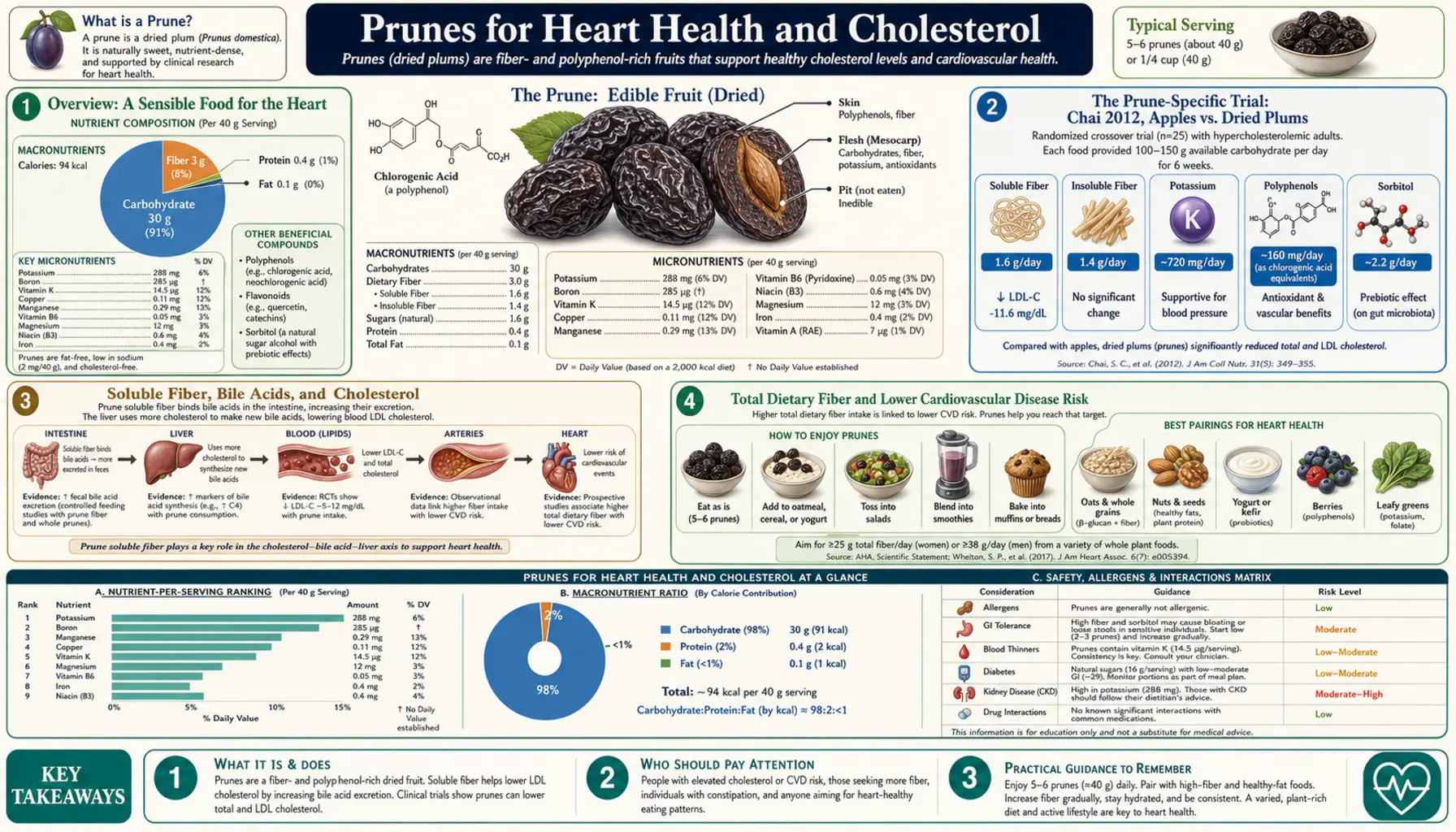
A prune — a dried plum — is not a heart medication, and an honest page will not pretend it is. But it is one of those ordinary, inexpensive foods whose ingredients line up with what is good for the heart: a generous amount of dietary fiber, including soluble fiber that can nudge LDL cholesterol down a little; a useful dose of potassium with almost no sodium to help keep blood pressure in a healthy range; and an unusually high load of polyphenols and antioxidants — chiefly chlorogenic and neochlorogenic acids — with anti-inflammatory properties. This page explains, in plain language, how a prune's parts plausibly help your heart, and it is careful throughout to separate what is genuinely proven from what is merely associated — and to flag the calorie-and-sugar caveat that comes with any dried fruit.
Table of Contents
- Overview: A Sensible Food for the Heart
- The Prune-Specific Trial: Chai 2012, Apples vs. Dried Plums
- Soluble Fiber, Bile Acids, and Cholesterol
- Total Dietary Fiber and Lower Cardiovascular Disease Risk
- Potassium, Low Sodium, and Blood Pressure
- Polyphenols and Antioxidants: An Anti-Inflammatory Edge
- The Dried-Fruit Caveat: Calories, Sugar, and Portion Sense
- How to Eat Prunes for Heart Benefit
- The Honest Bottom Line
- Key Research Papers
- Connections
- Featured Videos
Overview: A Sensible Food for the Heart
When people ask whether a particular food is "good for the heart," the useful answer is rarely about that one food in isolation. It is about whether the food fits a pattern — plenty of vegetables, fruit, whole grains, beans, and nuts; not much processed food, added sugar, or excess salt — that decades of research consistently link to fewer heart attacks and strokes. Prunes fit that pattern well. A prune is a whole, fiber-rich dried fruit, naturally low in sodium, with no saturated fat and a generous supply of potassium and plant compounds.
What makes prunes worth a closer look is that several of their components each have a plausible, mechanism-based reason to help the cardiovascular system. Their soluble fiber can modestly lower cholesterol. Their potassium-to-sodium balance favors healthy blood pressure. And prunes are one of the more polyphenol-dense fruits you can buy, with strong antioxidant and anti-inflammatory activity. None of these effects is dramatic on its own, and a prune is not a substitute for a statin or a blood-pressure drug when one is needed. But added up, and eaten in sensible amounts as part of a good diet, they are real — with one important catch that sets prunes apart from fresh fruit: because the water has been removed, prunes are calorie- and sugar-dense, so portion size genuinely matters.
One honest caveat applies to this whole page and is worth stating up front: prunes are rarely studied by themselves for hard heart outcomes such as heart attacks or deaths. There is one well-known prune-specific feeding trial (covered next), but most of the strong cardiovascular evidence comes from studying classes of nutrients — soluble fiber, total dietary fiber, flavonoids — or from studying fruit as a group. Where the evidence is about prunes specifically, we will say so. Where it is about fiber or fruit in general, we will say that too, and we will distinguish what is proven by experiment from what is merely associated in observational data.
The Prune-Specific Trial: Chai 2012, Apples vs. Dried Plums
The closest thing to a head-to-head test of prunes for the heart is a randomized feeding study by Chai and colleagues, published in 2012 in the Journal of the Academy of Nutrition and Dietetics. Over the course of a year, postmenopausal women were assigned to eat either a daily portion of dried plums (prunes) or a daily portion of dried apples, and the researchers measured a panel of cardiovascular disease risk factors — blood lipids, including cholesterol, and markers of inflammation among them.
This is a genuinely useful study because it is one of the few that fed people actual prunes and tracked heart-relevant outcomes. But it needs to be read honestly, and three points keep it in proportion:
- It was small and specific. The trial enrolled a limited number of postmenopausal women — not a large, mixed population — so its findings cannot be stretched to everyone, and the small size makes it harder to detect modest effects with confidence.
- The comparison was fruit-versus-fruit. The control group was not eating junk; they were eating dried apples, themselves a healthy, fiber-rich food. A study like this asks "are prunes better than another good fruit?" — a much tougher bar than "are prunes better than a salty snack?" Differences between two healthy foods are naturally small.
- The effects on lipids were modest and mixed. Both dried-fruit groups did reasonably well on several measures, and the prune group did not produce a dramatic, across-the-board cholesterol drop relative to the apple group. The fair summary is that prunes performed like a sensible, fiber-and-polyphenol-rich fruit — not like a cholesterol drug.
So the honest takeaway from the one prune-specific trial is encouraging but measured: a daily serving of prunes behaved as a reasonable part of a heart-healthy diet in postmenopausal women, with modest and mixed effects on lipids and risk markers. It would overstate the evidence to claim the trial "proved prunes lower cholesterol." It is better read as one small, supportive piece that fits the broader fiber-and-polyphenol story below.
Soluble Fiber, Bile Acids, and Cholesterol
A small serving of prunes — about four or five — supplies a few grams of dietary fiber, a meaningful contribution toward a daily target most people never reach. Some of that fiber is insoluble (the "roughage" behind a prune's well-known effect on digestion and regularity), but a portion is soluble fiber, including pectin. The soluble fraction is the part of a prune most relevant to cholesterol.
The mechanism is simple enough to picture, and it is a general property of soluble fiber rather than anything unique to prunes. Your liver makes bile acids — substances released into the gut to help you digest fat — and it makes them out of cholesterol. Normally most of those bile acids are reabsorbed lower in the intestine and recycled. But soluble fiber dissolves into a thick gel that binds some of the bile acids and carries them out of the body in the stool instead of letting them be reabsorbed. To replace what it has lost, the liver must make new bile acids — and to do that, it pulls more cholesterol out of the bloodstream. The net result is a modest drop in circulating LDL cholesterol, the so-called "bad" cholesterol that drives the artery-clogging process.
How big is the effect? Honestly, modest. Across controlled studies of soluble fibers (such as pectin, oat beta-glucan, and psyllium), adding a meaningful daily amount typically lowers LDL cholesterol by a small but real percentage — the kind of nudge that matters most when it is one of several heart-healthy habits, not a stand-alone fix. A handful of prunes does not deliver a therapeutic fiber dose by itself; the benefit comes from prunes as a regular part of a fiber-rich diet that also includes oats, beans, vegetables, and other fruit. Reviews of dietary fiber place this bile-acid-binding, cholesterol-lowering action squarely in the soluble-fiber family of foods to which prunes belong.
Total Dietary Fiber and Lower Cardiovascular Disease Risk
Beyond the specific cholesterol mechanism, there is a broader and very robust body of evidence connecting dietary fiber as a whole to heart health. A large systematic review and meta-analysis by Threapleton and colleagues pooled many prospective studies and found that higher total dietary fiber intake was associated with a significantly lower risk of both cardiovascular disease and coronary heart disease. People who ate more fiber, year after year, had fewer cardiac events than people who ate less.
Prunes contribute to that total fiber intake in a concentrated, palatable form, bringing both the soluble fraction tied to cholesterol and the insoluble fraction that aids digestion. This is also reflected in broader work on carbohydrate quality: Reynolds and colleagues, in a major series of systematic reviews and meta-analyses, found that diets higher in fiber and whole, minimally processed plant carbohydrates were associated with lower rates of cardiovascular disease, type 2 diabetes, and premature death — one more reason to favor whole fruit such as prunes over refined, low-fiber snacks.
It is worth being precise about what this kind of evidence can and cannot show. These are observational findings — they track what large groups of people eat and what happens to their health over time. They show a consistent association: high-fiber eaters have less heart disease. They cannot, on their own, prove that fiber is the sole cause, because people who eat lots of fiber also tend to eat less processed food, smoke less, and move more. But the association is strong, consistent across many studies, and backed by a believable mechanism (the cholesterol effect above), which together make it about as trustworthy as nutritional evidence gets. Whole, fiber-rich foods like prunes belong in a heart-protective diet.
Potassium, Low Sodium, and Blood Pressure
High blood pressure is one of the biggest drivers of heart attacks, strokes, and kidney damage, and diet has a direct effect on it. Two minerals sit at the center of that effect: sodium (which tends to raise blood pressure) and potassium (which tends to lower it). Most modern diets supply far too much sodium — largely from processed and restaurant food — and far too little potassium. Prunes lean the right way on both counts, and because drying concentrates minerals, they are an especially potassium-dense fruit for their size.
A small serving of prunes provides a useful amount of potassium and contains essentially no sodium. Potassium helps lower blood pressure in two complementary ways: it helps the kidneys excrete excess sodium in the urine, and it helps relax the walls of blood vessels. The body works best when potassium clearly outweighs sodium in the diet, and whole plant foods — fruit, vegetables, beans, and the like — are how you achieve that balance. This is the same logic behind the well-studied DASH eating pattern, which lowers blood pressure largely by raising potassium-rich produce and cutting sodium.
As always, a handful of prunes is not a blood-pressure treatment. But choosing potassium-rich whole fruit such as prunes in place of salty, processed snacks shifts your overall sodium-to-potassium balance in the heart-protective direction, day after day. For more on the mineral itself and on managing blood pressure, see Potassium and Hypertension. (One note of caution: people with advanced kidney disease are sometimes told to limit potassium — and dried fruit is concentrated — so if that is you, follow your clinician's guidance rather than this general advice.)
Polyphenols and Antioxidants: An Anti-Inflammatory Edge
One of the most distinctive things about prunes is how rich they are in polyphenols — plant compounds that act as antioxidants. Gram for gram, prunes rank among the more polyphenol-dense fruits, and their dominant polyphenols are chlorogenic acid and neochlorogenic acid (a related pair sometimes grouped as hydroxycinnamic acids). A foundational review by Stacewicz-Sapuntzakis and colleagues documented this chemistry and laid out why prunes have been described as a candidate "functional food." These polyphenols are thought to contribute to heart health in a few overlapping ways.
- Anti-inflammatory and antioxidant effects. Chronic, low-grade inflammation and oxidative stress are part of how arteries become damaged and clogged over time. The chlorogenic and neochlorogenic acids in prunes have anti-inflammatory and antioxidant actions that may help counter this process — reducing oxidative damage and dampening some of the inflammatory signaling involved in artery disease.
- Support for blood-vessel function. Polyphenols are thought to support the endothelium — the thin lining of your blood vessels — which helps vessels relax and dilate properly. Healthy endothelial function matters for normal blood pressure and blood flow.
- An association with lower cardiovascular mortality. A meta-analysis of prospective cohort studies by Kim and Je found that higher dietary flavonoid intake was associated with lower mortality from cardiovascular disease and from all causes. (A note on precision: the chlorogenic-type acids most prominent in prunes are polyphenols but are not, strictly, flavonoids; prunes do contain some flavonoids too. The Kim and Je finding speaks to the broader value of polyphenol-rich whole foods rather than to prunes specifically.)
It is fair to say the polyphenol story is promising rather than settled, and most of the human cardiovascular evidence is at the level of nutrient classes or fruit groups rather than the prune itself. The practical takeaway is uncomplicated and low-risk: prunes are a concentrated source of antioxidant polyphenols, and they fit well alongside berries, apples, tea, and other plant foods in a varied, anti-inflammatory diet.
The Dried-Fruit Caveat: Calories, Sugar, and Portion Sense
Here is the one place prunes differ from fresh fruit in a way that matters for the heart, and it deserves a plain warning rather than a footnote. Because drying removes the water, everything else — calories and natural sugars included — becomes concentrated. A small handful of prunes packs the calories and sugar of a much larger volume of fresh plums, and it is far easier to overeat dried fruit than fresh, since a few prunes barely register as a serving and go down quickly.
That concentration is exactly why prunes deliver so much fiber, potassium, and polyphenol per bite — but it cuts both ways. Eaten by the small handful, prunes are a nutrient-dense, heart-friendly food. Eaten by the absent-minded fistful in front of a screen, they become a significant source of sugar and calories, which over time works against weight control and the very cardiovascular goals you are eating them for. Excess calories and added sugar are not heart-healthy, whatever wholesome food they arrive in.
The fix is simply portion sense: treat a serving as roughly four or five prunes (about 30–40 grams), keep them in a bowl rather than eating from the bag, and count them as part of your day's fruit and sugar rather than a freebie. Used that way, the dried-fruit caveat is easy to manage and does not undo the benefits.
How to Eat Prunes for Heart Benefit
Getting the heart benefit out of prunes is straightforward, but a few choices make a real difference — and the first one is simply not overdoing it.
- Keep the portion small. Four or five prunes is a sensible serving. Because they are concentrated, more is not better — it just adds sugar and calories. Portion them into a bowl rather than grazing from the bag.
- Choose whole prunes over juice. Prune juice keeps the natural sugars and the potassium but strips out most of the soluble fiber and a share of the polyphenols — so you lose the cholesterol and digestion benefits while concentrating the sugar. Whole prunes are filling and slow to digest; a glass of juice is neither.
- Use prunes as a swap. The clearest cardiovascular win is replacing something less healthy — a salty packaged snack, a sugary dessert — with a small serving of prunes. That single swap lowers sodium, adds potassium, fiber, and polyphenols, and usually cuts added sugar.
- Make it a habit, not an event. Like fiber and potassium generally, prunes' benefits accrue from regular, ordinary inclusion in your diet — a few most days — rather than from any single large serving.
- Keep variety. Prunes are one good fruit among many. Rotating them with apples, berries, citrus, and vegetables gives you a broader range of fibers and polyphenols than relying on any one food — and helps keep total dried-fruit sugar in check.
For the broader food-source overview, see the main Prunes page; for the fiber-and-gut side of the same fruit, see the companion pages on Digestion and Constipation Relief and Blood Sugar, Weight, and Antioxidants.
The Honest Bottom Line
Prunes are a sensible part of a heart-healthy way of eating — with effects that are real but modest, and that work best in combination rather than alone. Their soluble fiber can nudge LDL cholesterol down a little by helping the liver pull cholesterol from the blood. Their total dietary fiber adds to the well-documented link between high-fiber eating and lower cardiovascular disease risk. Their potassium-and-low-sodium profile supports healthy blood pressure. And their unusually rich polyphenols — chlorogenic and neochlorogenic acid — are antioxidant and anti-inflammatory. The one prune-specific feeding trial (Chai 2012) found prunes behaving like a reasonable heart-healthy fruit in postmenopausal women, with modest, mixed effects on lipids and markers — supportive, not spectacular.
What prunes are not is a drug. They will not, on their own, treat established high cholesterol or high blood pressure, and much of the supporting evidence is at the level of fiber, polyphenols, or fruit groups rather than the prune specifically — and is observational, showing association rather than proof. They also carry a real catch fresh fruit does not: as a dried fruit they are calorie- and sugar-dense, so portion size matters. If your numbers warrant medication, eat your prunes — in sensible amounts — and take your prescribed treatment. Used the right way — a small handful, whole rather than juiced, in place of less healthy snacks, and as one fruit among many — prunes are a small, genuine contribution to a heart that you are looking after in many ways at once.
Key Research Papers
- Chai SC, et al. Daily apple versus dried plum: impact on cardiovascular disease risk factors in postmenopausal women. Journal of the Academy of Nutrition and Dietetics. 2012. doi:10.1016/j.jand.2012.05.005 — small randomized trial feeding postmenopausal women a daily portion of dried plums (prunes) or dried apples and tracking cardiovascular risk factors, with modest and mixed effects on lipids and markers.
- Threapleton DE, et al. Dietary fibre intake and risk of cardiovascular disease: systematic review and meta-analysis. BMJ. 2013. doi:10.1136/bmj.f6879 — pooled prospective studies showing higher total fiber intake linked to lower cardiovascular and coronary heart disease risk.
- Kim Y, Je Y. Flavonoid intake and mortality from cardiovascular disease and all causes: a meta-analysis of prospective cohort studies. Clinical Nutrition ESPEN. 2017. doi:10.1016/j.clnesp.2017.03.004 — higher dietary flavonoid intake associated with lower cardiovascular and all-cause mortality.
- Stacewicz-Sapuntzakis M, et al. Chemical composition and potential health effects of prunes: a functional food? Critical Reviews in Food Science and Nutrition. 2001. doi:10.1080/20014091091814 — foundational review of prunes' nutrient and polyphenol composition (including chlorogenic and neochlorogenic acid) and their potential health effects.
- Anderson JW, et al. Health benefits of dietary fiber. Nutrition Reviews. 2009. doi:10.1111/j.1753-4887.2009.00189.x — review of how soluble and total fiber affect cholesterol, blood pressure, and cardiovascular risk.
- Reynolds A, et al. Carbohydrate quality and human health: a series of systematic reviews and meta-analyses. The Lancet. 2019. doi:10.1016/S0140-6736(18)31809-9 — higher fiber and whole-carbohydrate diets associated with less cardiovascular disease, diabetes, and premature death.
PubMed Topic Searches
- PubMed: Dried plum / prune, cholesterol & lipids
- PubMed: Soluble fiber & LDL cholesterol
- PubMed: Dietary fiber & cardiovascular disease
- PubMed: Potassium & blood pressure
Connections
- All Food
- Prunes (Main Page)
- Prunes Benefits Hub
- Prunes for Digestion & Constipation Relief
- Prunes for Bone Health & Osteoporosis
- Prunes for Blood Sugar, Weight & Antioxidants
- Potassium
- Cholesterol Management
- Hypertension (High Blood Pressure)
- Pears