Prunes for Digestion, Bowel Movements, and Constipation Relief
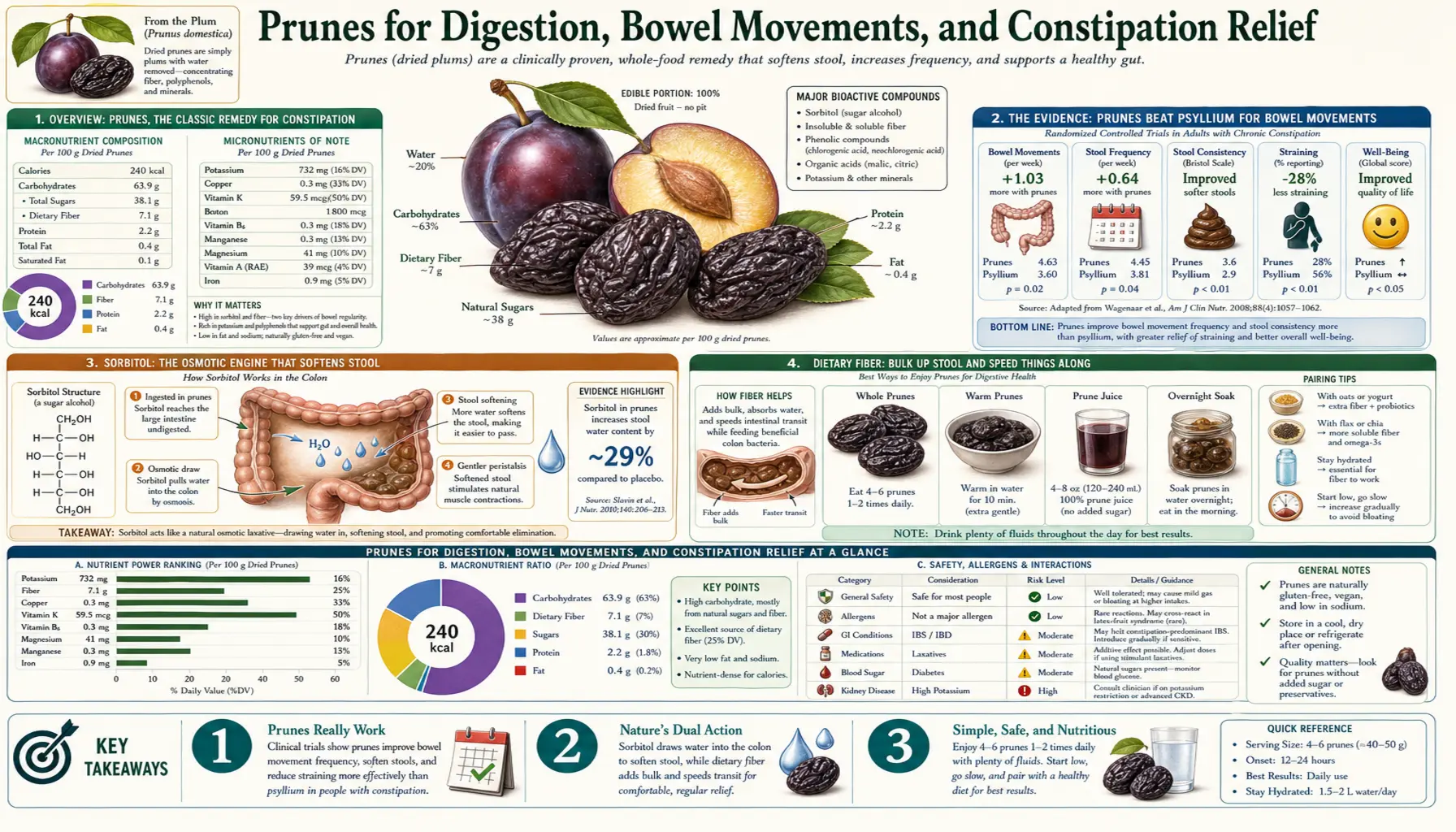
If you want one ordinary food with real science behind it for getting things moving, prunes are it. Prunes (dried plums) are the most reliable, best-studied natural food for relieving constipation and producing a comfortable bowel movement — and they are not just folklore. In a head-to-head randomized trial, prunes worked better than psyllium, a standard fiber laxative, at improving stool frequency and consistency. They pull this off by combining sorbitol (a sugar your body absorbs poorly that draws water into the bowel), a hefty dose of dietary fiber, and gut-active polyphenols — all working together as a gentle natural laxative. This page explains, in plain language, why prunes are so effective for digestion, regularity, and constipation relief, how to use them, and who should go a little easy.
Table of Contents
- Overview: Prunes, the Classic Remedy for Constipation
- The Evidence: Prunes Beat Psyllium for Bowel Movements
- Sorbitol: The Osmotic Engine That Softens Stool
- Dietary Fiber: Bulk Up Stool and Speed Things Along
- Polyphenols: A Possible Extra Push for Gut Motility
- How They Work Together: The Natural Laxative Combo
- How to Use Prunes for Constipation Relief
- The Flip Side: Gas, Bloating, and Loose Stools
- Who Should Be Cautious: IBS, FODMAPs, and Fructose
- When to See a Doctor About Constipation
- Key Research Papers
- Connections
- Featured Videos
Overview: Prunes, the Classic Remedy for Constipation
Prunes — the dried fruit of the European plum, Prunus domestica — have been the go-to home remedy for constipation for generations, and for once the old reputation is fully backed by science. When it comes to ordinary, everyday constipation, prunes are arguably the best-evidenced natural laxative you can eat. They reliably soften the stool, increase how often you have a bowel movement, and help people stay regular — all from a food, not a pill.
Here is the short version of why they work. Prunes carry a large amount of sorbitol, a sugar alcohol your small intestine cannot fully absorb. What is not absorbed travels on into the colon, where it draws water in by osmosis — softening the stool and gently stimulating a bowel movement. On top of that, prunes are high in dietary fiber (about 7 grams per 100 grams), which adds bulk and helps move waste through the gut. And they contain plant compounds called polyphenols that may give bowel activity a further nudge. Drying plums into prunes concentrates the sorbitol, the fiber, and the polyphenols, which is exactly why dried prunes work better than the same weight of fresh plums.
One honest framing up front, and it is a happy one: unlike most "natural remedy" foods, prunes actually have real clinical trial evidence behind them for constipation, including a randomized controlled trial. So this is not a case of leaning on mechanism and hope — the effect has been measured directly in people. That said, prunes are a food remedy for ordinary constipation; they are not a treatment for serious bowel disease, and persistent or alarming symptoms still need a doctor. With that in mind, let us look at what the studies actually found.
The Evidence: Prunes Beat Psyllium for Bowel Movements
The standout study is a randomized clinical trial published in 2011 by Attaluri and colleagues. Researchers took adults with chronic constipation and directly compared prunes against psyllium — psyllium being a well-known, widely used fiber supplement (the active ingredient in products like Metamucil) that is itself a recommended constipation treatment. Participants ate either prunes (about 50 grams twice a day, roughly 6 grams of fiber) or psyllium (delivering a similar amount of fiber), then switched after a washout period, so each person served as their own comparison.
The result was striking: prunes came out ahead. People had more complete spontaneous bowel movements per week — that is, satisfying bowel movements without needing a laxative — while eating prunes than while taking psyllium, and their stool consistency improved more, too. In other words, a common dried fruit outperformed a standard fiber laxative for these two key measures of constipation relief. That is a remarkable finding for a food, and it is the single best reason prunes deserve their reputation.
That trial does not stand alone. A systematic review by Lever and colleagues in 2014 gathered the available studies on how prunes affect gastrointestinal function. It concluded that prunes increase stool frequency and improve stool consistency and weight, and reasonably suggested that prunes could be considered a first-line option for mild-to-moderate constipation. The review also flagged the honest caveat that the overall body of trials is still relatively small — more and larger studies would strengthen the picture — but the direction of the evidence is clear and consistent: prunes help you go.
So when we say prunes are the best-evidenced natural food for constipation, this is what we mean: an actual randomized trial in which prunes beat a standard fiber laxative, supported by a systematic review pointing the same way. That is a stronger evidence base than almost any other "regularity food" can claim.
Sorbitol: The Osmotic Engine That Softens Stool
To understand why prunes work, start with sorbitol. Sorbitol is a sugar alcohol — a naturally occurring sweet compound found in prunes, plums, pears, apples, and several other fruits. Prunes are an especially rich source: a typical serving can supply well over a gram of sorbitol, and because drying concentrates it, prunes carry far more than fresh plums by weight. The crucial thing about sorbitol is that your small intestine absorbs it slowly and incompletely. Whatever it does not absorb keeps moving down into the large intestine.
Once it reaches the colon, sorbitol acts as an osmotic laxative. "Osmotic" simply means it pulls water toward itself: the unabsorbed sorbitol raises the concentration of dissolved material in the gut, so water is drawn from the body into the intestine to balance it out. That extra water does two helpful things at once — it softens the stool, and the added volume gently stretches the colon wall, which is one of the natural triggers for a bowel movement. This is the same principle behind many pharmacy laxatives.
In fact, sorbitol is not merely a food ingredient that happens to have this effect — it is used clinically as a laxative in its own right. A classic randomized trial by Lederle and colleagues found that sorbitol relieved constipation in older adults about as well as the prescription laxative lactulose, at a fraction of the cost. So the active osmotic ingredient doing much of the work in a prune is a recognized medical laxative. This also explains why prunes, pears, and apples all share a reputation for the same job: they share the sorbitol mechanism. Sorbitol is the engine of the prune's power as a gentle laxative — and a major reason prunes edged out a fiber-only product like psyllium, which has no sorbitol.
Dietary Fiber: Bulk Up Stool and Speed Things Along
The second pillar of a prune's digestive power is dietary fiber. Prunes are genuinely high in fiber — roughly 7 grams per 100 grams, which works out to about 3 to 4 grams in a typical serving of around five prunes. That is a meaningful contribution toward the daily fiber target (about 25–38 g for most adults) from a small handful of dried fruit, and it is a big part of why prunes support regularity.
Prunes carry both major kinds of fiber, and they work in complementary ways:
- Insoluble fiber does not dissolve in water. It adds bulk to the stool and speeds up "transit time" — how quickly waste moves through the colon. By bulking up the stool and keeping it moving, insoluble fiber is the classic "roughage" that fights constipation and helps you stay regular.
- Soluble fiber dissolves into a soft gel in the gut. That gel holds onto water and helps soften the stool, making it easier and more comfortable to pass. Soluble fiber is also fermented by your gut bacteria, which supports overall digestive health.
So fiber attacks constipation from two sides at once — insoluble fiber bulks up and pushes things along, while soluble fiber draws in water to keep the stool soft. This is why fiber-rich foods are a first-line, doctor-recommended approach to constipation relief: pooled analyses (meta-analyses by Yang and by Christodoulides and colleagues) confirm that increasing dietary fiber raises stool frequency and improves consistency in people with constipation. The important nuance with prunes is that fiber is only part of the story. In the Attaluri trial, prunes were matched roughly gram-for-gram against psyllium's fiber and still won — which tells you the prune's advantage comes from fiber plus sorbitol (and possibly polyphenols), not fiber alone. One gentle reminder: fiber works best when you also drink enough fluid, so have water alongside your prunes.
Polyphenols: A Possible Extra Push for Gut Motility
Beyond sorbitol and fiber, prunes are loaded with plant compounds called polyphenols — in particular chlorogenic acid and neochlorogenic acid, two of the most abundant antioxidants in prunes. (Prunes consistently rank among the highest-antioxidant common fruits, largely thanks to these compounds.) There is reason to think these polyphenols add a third dimension to the prune's effect on digestion.
In laboratory and animal studies, these phenolic compounds appear to influence gut activity — potentially stimulating motility (the muscular contractions that move contents through the bowel) and acting on the gut in ways that could contribute to a bowel movement. They are also fermented by colon bacteria, which can have its own mild effects on bowel function. The thinking is that prunes' well-rounded reputation as a natural laxative may come not only from osmosis (sorbitol) and bulk (fiber) but from these motility-active polyphenols as well.
Here we need to be honest about the strength of the evidence. The polyphenol-and-motility idea is plausible and supported mainly by mechanistic, lab-based work rather than by large human trials. We do not have strong clinical proof that the polyphenols in prunes are what drive the constipation relief seen in people — the firmest human evidence still points to sorbitol and fiber. So treat the polyphenols as a likely contributor and a bonus for general health (they are genuine antioxidants), not as a proven third mechanism. It is a real possibility, framed honestly: prunes probably help through more than one pathway, and polyphenols are a reasonable candidate for one of them.
How They Work Together: The Natural Laxative Combo
No single feature of a prune is dramatic on its own. What makes the prune such an effective natural laxative — effective enough to beat psyllium in a trial — is that several mild effects stack on top of one another, all pushing toward a softer stool and an easier bowel movement:
- Sorbitol — the unabsorbed sugar alcohol draws water into the colon (the osmotic effect), softening stool and triggering the urge to go. This is the engine, and it is what plain fiber supplements lack.
- Dietary fiber — insoluble fiber bulks up the stool and speeds transit; soluble fiber holds water to keep it soft. This is the bulk and the movement.
- Polyphenols — chlorogenic and neochlorogenic acids that may stimulate gut motility and are fermented in the colon (a likely contributor, on mechanistic evidence).
- The water you drink with them — prunes are a concentrated, dried food, so fluid alongside them keeps the system hydrated and lets the fiber and sorbitol do their job, keeping stool soft.
Think of it as a gentle, multi-pronged nudge rather than a forceful shove. That is precisely why prunes are described as a gentle laxative: the effect is real and well-measured, but it is mild and food-based, working with your digestion instead of overriding it the way a strong stimulant laxative can. For everyday constipation relief and to help you stay regular, that combination — sorbitol plus fiber plus polyphenols plus fluid — is hard to beat in a single ordinary food, and the science shows it.
How to Use Prunes for Constipation Relief
Here is how to actually use prunes to get things moving, in plain practical terms.
- A typical effective amount is about 4 to 12 prunes a day (roughly 50 to 100 grams). The amount used in the Attaluri trial was about 50 grams (around 6 prunes) twice daily. That is the well-tested upper range; many people get plenty of help from less. Pair them with a glass of water — the fluid helps the fiber and sorbitol work.
- Start low and build up. If you do not normally eat much dried fruit or fiber, begin with about 3 to 4 prunes a day and increase gradually over a week or two. Ramping up slowly lets your gut adapt and helps you avoid the gas and bloating that a sudden big serving can cause.
- Give it a few days, not a few minutes. Prunes are a gentle food remedy, not an instant purge. Some people notice an effect within a day, but the best results — steady regularity rather than a one-off — come from making prunes a daily habit. Eating them at a consistent time, such as breakfast or evening, works well.
- Prune juice works too. Prune juice is more concentrated in sorbitol but lower in fiber than whole prunes (much of the fiber is left behind in juicing). Because the sorbitol is concentrated and there is no fiber to slow things down, juice can act a bit faster and is a long-standing gentle remedy for constipation — it is even a common home approach for mild constipation in children, though you should always check with a pediatrician first for infants and young kids. For day-to-day gut health, favor whole prunes; reach for the juice when you want a quicker nudge.
- Easy ways to eat them. Whole as a snack, chopped into oatmeal or yogurt, stewed (which softens them and many people find especially effective), or blended into smoothies. Soaking dried prunes in water for a few hours plumps them up and makes them gentler on the stomach.
For the broader nutrition picture, see the main Prunes page. Pears and Apples work through the very same sorbitol mechanism and are easy partner fruits if you would rather not rely on prunes alone — though prunes are the more potent, better-studied option of the three.
The Flip Side: Gas, Bloating, and Loose Stools
The honest counterpart to all of this: the exact same features that make prunes such a good natural laxative can become unwelcome in larger amounts. The unabsorbed sorbitol (and the fruit's fructose) that draw water into the colon are also fermented by your gut bacteria, and that fermentation produces gas. The dietary fiber adds to fermentation too. And because prunes are dried, they are calorie- and sugar-dense and very easy to over-eat — a small handful is a real serving, and it is surprisingly easy to keep reaching into the bag. So in bigger portions, prunes can cause:
- Gas and bloating — from bacterial fermentation of the sorbitol, fructose, and fiber in the colon.
- Abdominal cramping — the same osmotic water-drawing and increased gut activity that ease constipation can, when overdone, cause crampy discomfort.
- Loose stools or diarrhea — too much sorbitol pulls in too much water, which can tip a helpful softening effect into watery, urgent stools.
This is dose-dependent and very individual. For most people, a modest serving is comfortable and helpful; problems tend to appear with large quantities, a lot of concentrated prune juice, or in those who are simply more sensitive to these sugars. The practical fix is moderation and ramping up slowly: build your intake gradually over a week or two so your gut can adapt, and drink water as you go. Because dried fruit is so easy to over-eat, it helps to portion prunes out rather than snacking straight from the bag. If prunes reliably cause gas, bloating, or loose stools even in small amounts, that is a sign to read the next section.
Who Should Be Cautious: IBS, FODMAPs, and Fructose
Prunes are healthy and helpful for the great majority of people, but there is one group that should approach them carefully: people with sensitive guts, particularly irritable bowel syndrome (IBS) and fructose malabsorption.
The reason comes down to a category called FODMAPs — short for Fermentable Oligosaccharides, Disaccharides, Monosaccharides And Polyols. These are exactly the kinds of poorly-absorbed, rapidly-fermented carbohydrates we have been describing, and prunes are a high-FODMAP food on two counts at once: they are rich in sorbitol (a polyol) and contain fructose (a monosaccharide), both concentrated by drying. For someone with IBS, those fermentable sugars can trigger the very symptoms they struggle with — gas, bloating, cramping, and either diarrhea or worsened discomfort — even from a small portion. People following a structured low-FODMAP approach for IBS are typically advised to limit or avoid prunes during the strict phase and to test their tolerance carefully when reintroducing foods. See the Irritable Bowel Syndrome (IBS) page for the bigger picture.
People with fructose malabsorption (sometimes called dietary fructose intolerance) have a reduced ability to absorb fructose, so high-fructose, high-sorbitol foods like prunes can cause pronounced gas, bloating, pain, and diarrhea. For them, prunes are one of the foods most likely to cause trouble.
The sensible advice for anyone with a sensitive gut is the same: introduce prunes gradually and in small amounts, and watch how you respond. Tolerance varies a lot from person to person — some people with mild sensitivity handle a prune or two fine, while others react to very little. If prunes (or dried fruit in general) consistently cause distress, it is worth working with a doctor or dietitian rather than guessing, especially before starting any elimination diet.
When to See a Doctor About Constipation
Eating prunes (with fiber, fluids, and movement) is a perfectly reasonable — and unusually well-supported — first step for ordinary, occasional constipation. But constipation is sometimes a signal of something that needs medical attention, and food is not the right tool for those situations. See a doctor — do not just reach for more prunes — if you have any of the following:
- Blood in the stool, or black, tarry stools.
- Unexplained weight loss alongside constipation.
- A sudden or persistent change in your bowel habits — for example, new constipation unlike your normal pattern, especially after age 50.
- Severe abdominal pain, vomiting, or a swollen, tender belly — which can signal a blockage and may be an emergency.
- Constipation that does not improve after a couple of weeks of more fiber, fluids, and movement, or that keeps coming back.
- Constipation alternating with diarrhea, or constipation accompanied by fever.
To keep this in perspective: prunes are an excellent, gentle, food-based aid for everyday regularity and mild-to-moderate constipation relief, and they enjoy unusually good evidence for a food — including a randomized trial in which they beat a standard fiber laxative. That is worth celebrating. But they are still a remedy for ordinary constipation, not a treatment for serious bowel disease, and the warning signs above should guide you to a doctor when constipation is more than a passing nuisance. For more on the symptom itself, see the Constipation page.
Key Research Papers
- Attaluri A, et al. Randomised clinical trial: dried plums (prunes) vs. psyllium for constipation. Alimentary Pharmacology & Therapeutics. 2011. doi:10.1111/j.1365-2036.2011.04594.x — the head-to-head trial in which prunes produced more complete spontaneous bowel movements and better stool consistency than psyllium.
- Lever E, et al. Systematic review: the effect of prunes on gastrointestinal function. Alimentary Pharmacology & Therapeutics. 2014. doi:10.1111/apt.12913 — review concluding prunes increase stool frequency and improve consistency, supporting them for mild-to-moderate constipation.
- Stacewicz-Sapuntzakis M, et al. Chemical composition and potential health effects of prunes: a functional food? Critical Reviews in Food Science and Nutrition. 2001. doi:10.1080/20014091091814 — foundational overview of prunes' sorbitol, fiber, and polyphenol content and their laxative effect.
- Lederle FA, et al. Cost-effective treatment of constipation in the elderly: a randomized double-blind comparison of sorbitol and lactulose. The American Journal of Medicine. 1990. doi:10.1016/0002-9343(90)90177-f — trial showing the sugar alcohol sorbitol relieves constipation about as well as the laxative lactulose.
- Yang J, et al. Effect of dietary fiber on constipation: a meta analysis. World Journal of Gastroenterology. 2012. doi:10.3748/wjg.v18.i48.7378 — pooled evidence that dietary fiber increases stool frequency in people with constipation.
- Christodoulides S, et al. Systematic review with meta-analysis: effect of fibre supplementation on chronic idiopathic constipation in adults. Alimentary Pharmacology & Therapeutics. 2016. doi:10.1111/apt.13662 — review confirming fiber improves stool frequency and consistency in chronic constipation.
- Müller-Lissner SA, et al. Myths and misconceptions about chronic constipation. The American Journal of Gastroenterology. 2005. doi:10.1111/j.1572-0241.2005.40885.x — sorts what actually helps constipation (fiber, fluid) from common myths.
- Fedewa A, Rao SSC. Dietary fructose intolerance, fructan intolerance and FODMAPs. Current Gastroenterology Reports. 2014. doi:10.1007/s11894-013-0370-0 — why high-fructose, high-FODMAP foods like prunes can cause gas and diarrhea in sensitive people.
PubMed Topic Searches
- PubMed: Dried plum, prune, constipation & bowel
- PubMed: Sorbitol, constipation & osmotic laxative
- PubMed: Prune vs. psyllium randomized trial
- PubMed: FODMAPs, sorbitol, fructose & IBS
Connections
- All Food
- Prunes (Main Page)
- Prunes Benefits Hub
- Prunes for Bone Health & Osteoporosis
- Prunes for Heart Health & Cholesterol
- Prunes for Blood Sugar, Weight & Antioxidants
- Constipation
- Irritable Bowel Syndrome (IBS)
- Pears
- Pears for Digestion & Constipation Relief
- Apples