Cystatin C: A Muscle-Independent Kidney Function Marker
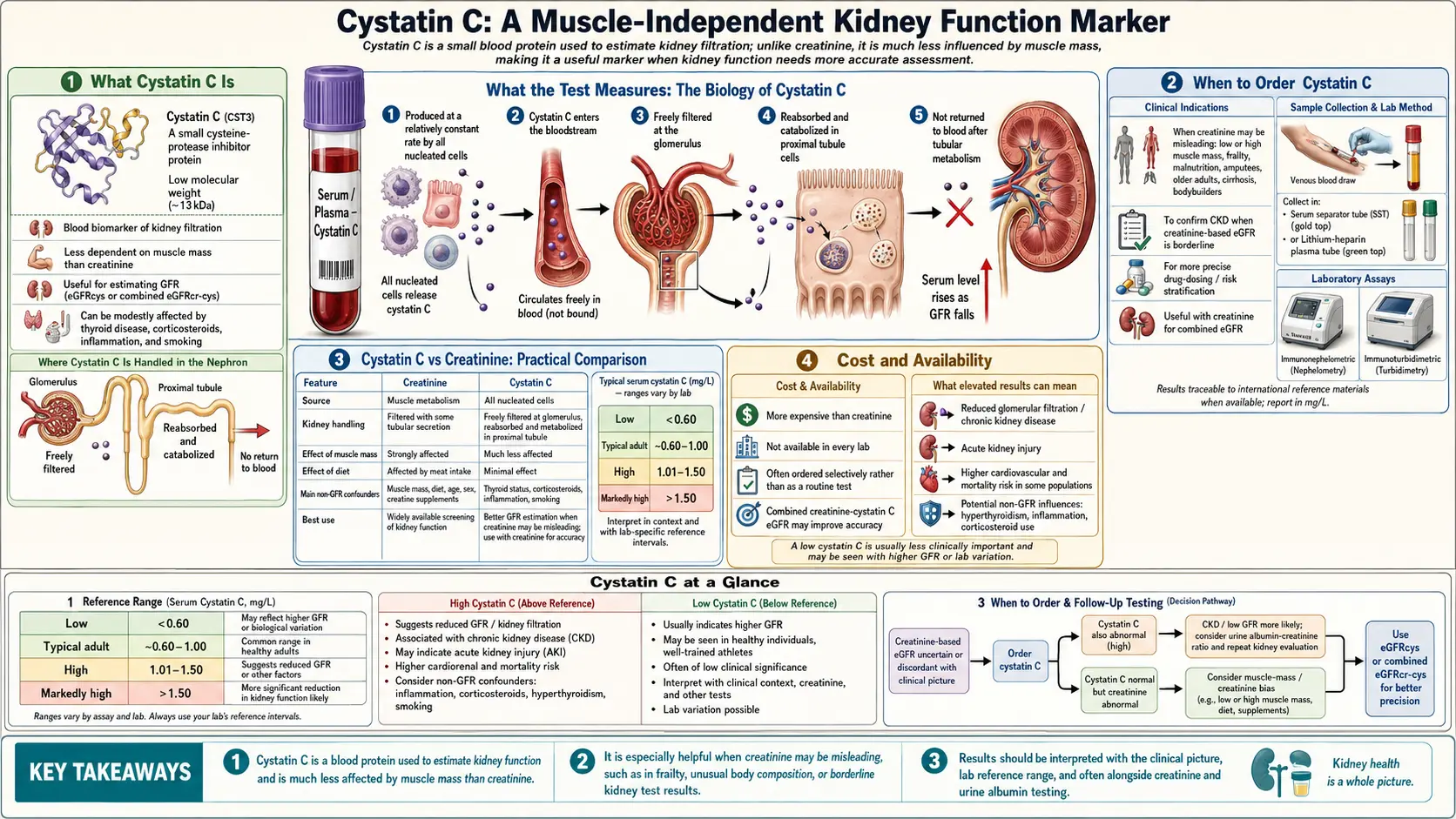
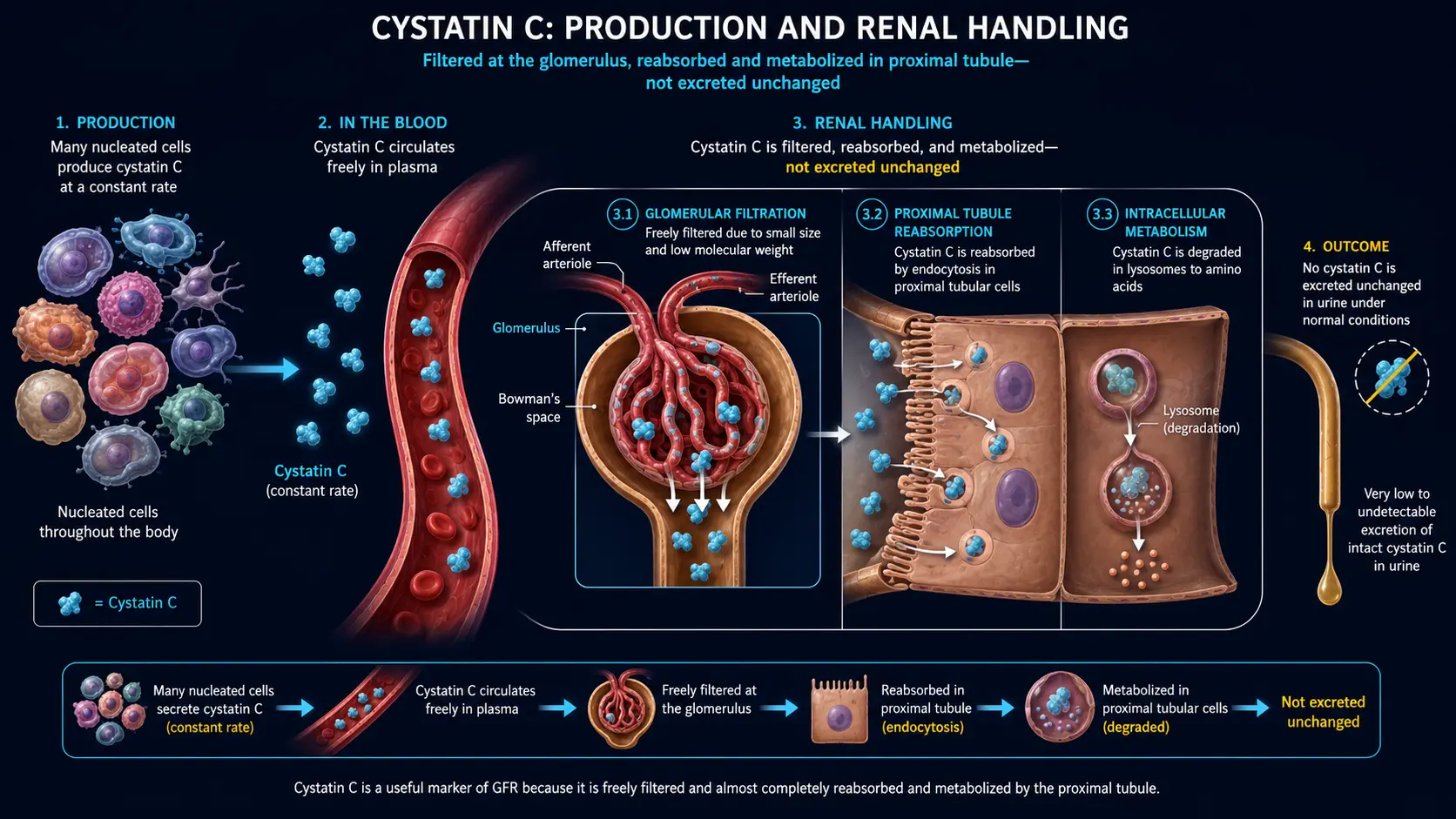
Cystatin C is a small (13 kDa) cysteine protease inhibitor produced at a near-constant rate by every nucleated cell in the body. Like creatinine, it is freely filtered at the glomerulus — but unlike creatinine, it is almost completely metabolized by the proximal tubule cells, with negligible secretion. The combination makes serum cystatin C a remarkably clean filtration marker, largely independent of muscle mass, age, sex, ethnicity, and dietary protein. It is the test that catches early CKD that creatinine misses, and the test that disambiguates kidney function in patients with non-standard body composition.
Interactive Visualization Kidney Nephron — watch blood become urine Follow blood into the glomerulus and see filtration and reabsorption turn 180 litres of filtrate into urine — then toggle dehydration or diabetes. Launch →Table of Contents
- What Cystatin C Is
- Why It Outperforms Creatinine
- Reference Range
- eGFR from Cystatin C
- When to Order Cystatin C
- Non-Kidney Influences on Cystatin C
- Cystatin C vs Creatinine: Practical Comparison
- The Combined Creatinine + Cystatin C Equation
- Cardiovascular and Mortality Predictions
- Cost and Availability
- Research Papers and References
- Connections
- Featured Videos
What Cystatin C Is
Cystatin C is a member of the cystatin superfamily of cysteine protease inhibitors. It is encoded on chromosome 20, expressed by virtually all nucleated cells, and secreted into the bloodstream at a steady rate that does not depend on muscle, diet, or activity level. Its biological role is to regulate extracellular cysteine proteases such as cathepsins, which is why production is so consistent across cell types.
Once in plasma, cystatin C is freely filtered by the glomerulus (its small size and positive charge make it an ideal substrate). The proximal tubule then re-internalizes nearly 100% of the filtered cystatin C and degrades it intracellularly. Almost no intact cystatin C reappears in urine. As a result, serum cystatin C concentration is set almost entirely by the balance between steady production and glomerular filtration. When filtration falls, cystatin C rises — cleanly.
Why It Outperforms Creatinine
Creatinine has been the dominant kidney marker since the 1920s, but five practical limitations make it noisy:
- Creatinine is generated from muscle, so muscle mass, age, sex, and amputation move it
- Tubular secretion contributes 10–20% of clearance; that fraction varies with drugs (cimetidine, trimethoprim) and CKD stage
- Dietary creatine and a recent meal of red meat raise creatinine
- Creatinine has a "blind range" up to about 50% nephron loss
- The Jaffe and enzymatic assays disagree by 5–10%
Cystatin C is largely insensitive to all five problems. Production is constant across body composition. There is no relevant tubular secretion. Diet does not affect it. The slope between cystatin C and true GFR is steeper than creatinine's, so cystatin C detects nephron loss earlier. And cystatin C immunoassays are more standardized than creatinine assays, with traceability to an international reference material.
Reference Range
Serum Cystatin C (mg/L)
Reference ranges are slightly tighter than for creatinine because production is more uniform across populations. Adult ranges are typically 0.5–1.0 mg/L. Levels rise modestly with age (about 0.005–0.01 mg/L per year after 50), reflecting the gradual age-related loss of nephrons. Pregnancy lowers cystatin C in the first and second trimesters and may rise back near baseline in the third.
eGFR from Cystatin C
Just as serum creatinine can be plugged into a regression equation to give an eGFR, serum cystatin C feeds into the 2021 CKD-EPI cystatin C equation:
For all adults: eGFRcysC = 133 × min(cysC/0.8, 1)-0.499 × max(cysC/0.8, 1)-1.328 × 0.996age × (0.932 if female)
The output is in the familiar mL/min/1.73 m² units, directly comparable to creatinine-based eGFR. Most laboratories that offer cystatin C will report the eGFRcysC automatically, so manual calculation is rarely needed.
The 2021 CKD-EPI creatinine + cystatin C combined equation uses both markers and outperforms either alone in head-to-head validation studies. KDIGO 2024 guidelines now recommend the combined equation when an early or precise eGFR matters.
When to Order Cystatin C
Cystatin C is not (yet) part of every routine metabolic panel because it costs more than creatinine. Targeted indications:
- Non-standard body composition: elderly frail, bodybuilders, amputees, paraplegics, vegan/vegetarian, anorexia, post-bariatric — anywhere creatinine is unreliable due to muscle mass
- Borderline eGFR: creatinine-based eGFR is 50–65 with no other CKD markers — cystatin C confirms or refutes the diagnosis
- Drug dosing precision: chemotherapy, anticoagulation, methotrexate, vancomycin — getting the dose right matters and creatinine-based eGFR is too noisy
- Pre-operative assessment in older patients
- Suspected hyperfiltration: early diabetes, obesity — cystatin C is more sensitive to early changes
- Confirming AKI in patients with low baseline creatinine (e.g., post-bariatric)
- Pediatric kidney function (cystatin C performs well across pediatric age ranges)
Non-Kidney Influences on Cystatin C
Cystatin C is cleaner than creatinine, but it is not perfect. Known modifiers:
- Hyperthyroidism — raises cystatin C (increased cell turnover and protein synthesis)
- Hypothyroidism — lowers cystatin C
- Glucocorticoids — high-dose prednisone or dexamethasone can raise cystatin C 10–15%
- Smoking — modestly raises cystatin C
- Obesity — modestly raises cystatin C; not enough to cause stage misclassification
- Heterophile antibodies — rare immunoassay interference
- Critical illness, sepsis, malignancy — can transiently raise cystatin C through inflammatory effects
None of these are common enough or large enough to disqualify cystatin C as a routine marker; they are reasons to interpret the test in clinical context, just as you would creatinine.
Cystatin C vs Creatinine: Practical Comparison
Where the two disagree, the right answer depends on the patient. The dominant rule of thumb: cystatin C is more accurate when muscle mass is unusual.
- Frail elderly woman, creatinine 0.6, eGFRcr 88, cystatin C 1.6, eGFRcysC 38: the cystatin C tells the truth. She has CKD G3b that creatinine missed because of low muscle mass.
- Heavily muscled male athlete, creatinine 1.4, eGFRcr 65, cystatin C 0.7, eGFRcysC 110: the cystatin C tells the truth. Healthy kidneys, just a lot of muscle.
- Newly diagnosed diabetic, BMI 26, creatinine 0.9, eGFRcr 95, cystatin C 1.0, eGFRcysC 72: the cystatin C is showing early hyperfiltration risk that creatinine misses.
- Post-bariatric patient on metformin, creatinine 0.5, eGFRcr 110, cystatin C 1.1, eGFRcysC 62: the cystatin C reveals occult CKD G2 that low muscle mass was hiding.
The Combined Creatinine + Cystatin C Equation
The 2021 CKD-EPI combined equation uses both serum creatinine and serum cystatin C to compute a single eGFR. It is the most accurate non-isotopic estimate of GFR available in routine practice. KDIGO 2024 guidance:
- Confirm CKD when creatinine-only eGFR is borderline (50–65)
- Stage CKD precisely when creatinine alone is suspect (atypical body composition)
- Decide whether SGLT2 inhibitors, contrast studies, or specific drug doses are appropriate
- Pre-transplant evaluation
If your physician offers cystatin C only as the second test (creatinine first), the combined equation result is what they will use to make decisions.
Cardiovascular and Mortality Predictions
An interesting and clinically important property of cystatin C: it predicts cardiovascular events and all-cause mortality independently of eGFR. Multiple large cohort studies (Cardiovascular Health Study, ARIC, Framingham) have shown that an elevated cystatin C is associated with higher cardiovascular and all-cause mortality even in patients with normal creatinine and normal eGFR. This may reflect that cystatin C captures vascular and inflammatory processes beyond filtration alone, or that it is simply a more sensitive index of subclinical kidney decline. In practice, an unexpectedly high cystatin C in a "healthy" patient is a flag to look harder at cardiovascular risk: blood pressure, lipids, glucose, exercise capacity, and inflammation markers (hs-CRP).
Cost and Availability
Cystatin C costs roughly 5–15× more than creatinine in US labs (typical patient charge $25–50, vs $5–10 for creatinine). It is available at all major reference labs (Quest, Labcorp, Mayo, Cleveland Clinic) and most hospital cores, but is rarely included automatically. It must be ordered explicitly, which means the patient or referring clinician needs to know to ask. Insurance coverage for the test is generally good when ordered with appropriate clinical indication; out-of-pocket pricing through online direct-access labs is typically $40–70.
Research Papers and References
- Cystatin C as a kidney marker — PubMed search
- CKD-EPI cystatin C combined equation — PubMed search
- Cystatin C and cardiovascular mortality — PubMed search
- Cystatin C vs creatinine sensitivity — PubMed search
- Cystatin C confounders — PubMed search
- KDIGO 2024 cystatin C guidance — PubMed search
- Pediatric cystatin C eGFR — PubMed search
External Authoritative Resources
- MedlinePlus — Cystatin C Test
- KDIGO CKD Guideline (cystatin C recommendations)
- National Kidney Foundation — Blood Tests
Connections
- All Lab Tests
- Kidney Nephron — interactive animation
- Creatinine
- eGFR
- BUN
- Kidney Function Tests
- Comprehensive Metabolic Panel
- Inflammatory Markers
- Urinalysis
- Kidney Disease
- Acute Kidney Injury
- Nephrotic Syndrome
- Cysteine
- Obesity
- Diabetes
- Uric Acid
- Creatine
- Cystatin C — the standalone test page: how to order it, what it costs, and how to read the result on its own.