Tryptase
Tryptase is an enzyme that your body keeps packed inside mast cells — the immune cells that sit in your skin, gut, airways, and around blood vessels and act as the front line of allergic reactions. When mast cells are triggered, they burst open and pour out their contents, tryptase among them, so the amount of tryptase in your blood is one of the few practical windows we have into how many mast cells you have and how active they are right now. A tryptase blood test is used mainly in two very different situations: to help confirm, after the fact, that a frightening collapse or reaction was truly anaphylaxis, and to screen for conditions in which the body carries too many or overly excitable mast cells, such as mastocytosis. This page explains what the test measures, the crucial difference between a brief spike and a steadily high level, why the timing of the blood draw matters so much, and an important modern caveat — hereditary alpha-tryptasemia — that keeps a high result from being over-read. It is written to help you understand your own results, not to replace the allergist or hematologist who should interpret them with you.
Table of Contents
- What Tryptase Is
- Two Kinds of Measurement: A Spike vs a Baseline
- Confirming Anaphylaxis
- Screening for Mastocytosis and Mast-Cell Disorders
- Hereditary Alpha-Tryptasemia
- How to Read Your Result
- How and When the Blood Is Drawn
- Related Tests
- When to Talk With a Doctor
- Research Papers
- Connections
- Featured Videos
What Tryptase Is
Tryptase is a protein-cutting enzyme (a protease) and it is by far the most abundant protein stored inside the granules of mast cells. A tiny amount also comes from basophils, a related white blood cell, but for practical purposes a tryptase result is a read-out of mast cells. Because mast cells are scattered throughout the tissues that meet the outside world — skin, lungs, nose, and the lining of the digestive tract — they are perfectly placed to sound the alarm when the immune system meets something it treats as a threat, whether that is a bee sting, a peanut protein, a drug, or a contrast dye.
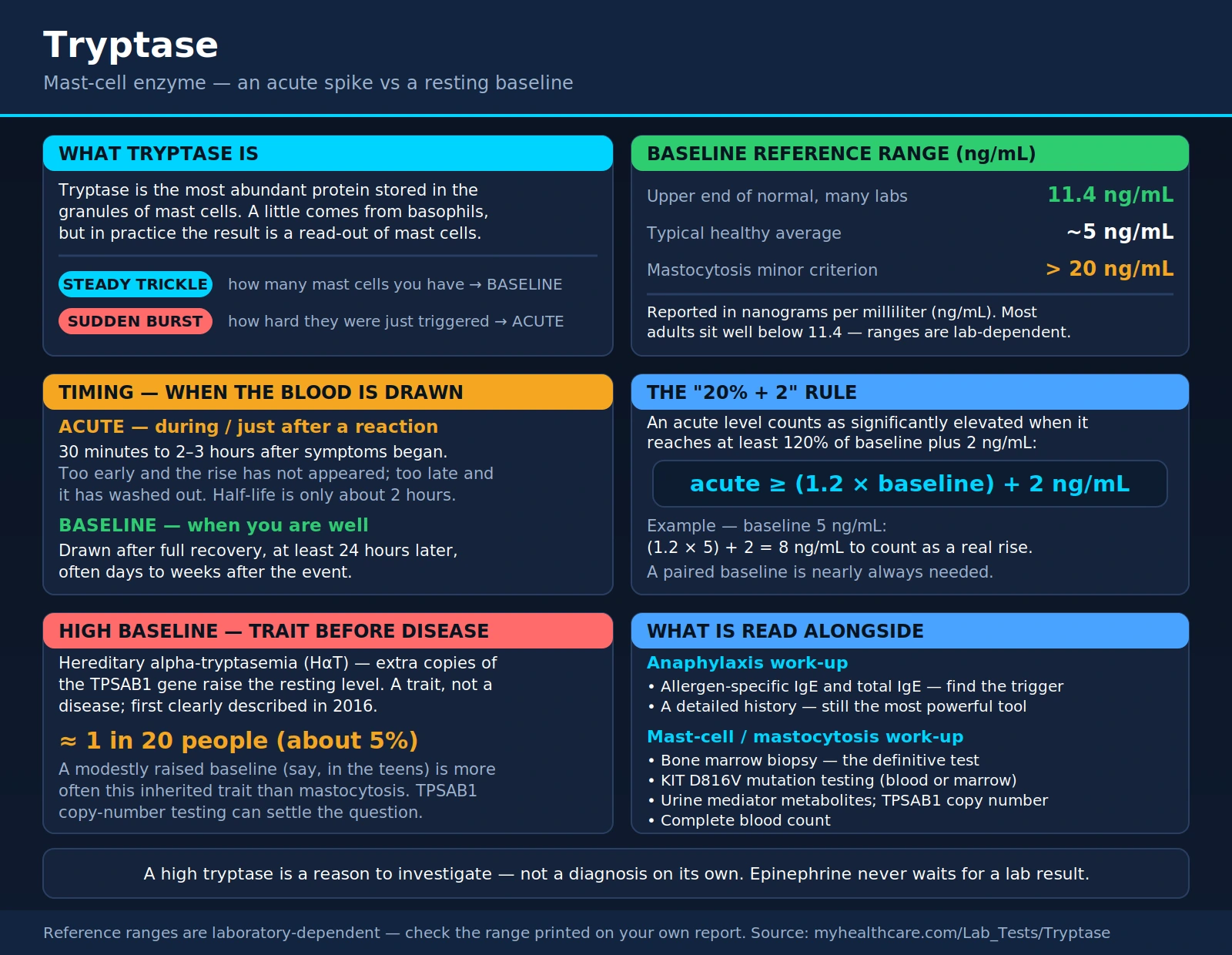
Mast cells release tryptase in two ways, and this is the key to understanding the test. A small, steady trickle of tryptase leaks out all the time simply because mast cells exist; the more mast cells you have, the higher this background level. Then, when a mast cell is strongly activated — classically when an allergen bridges two IgE antibodies sitting on its surface — it degranulates, dumping a large burst of mature tryptase along with histamine and other mediators into the surrounding tissue and bloodstream. So a tryptase level reflects two things at once: how many mast cells you have (the baseline) and, in a sample taken at the right moment, how hard they were just triggered (the spike).
Two Kinds of Measurement: A Spike vs a Baseline
Almost all confusion around this test dissolves once you separate the two things it can measure:
- An acute (transient) rise. During and shortly after a severe allergic reaction, tryptase climbs, peaks within a couple of hours, and then falls back toward normal — it has a half-life of only about two hours, so the window to catch it is short. A blood sample taken during that window can capture the spike.
- A persistently elevated baseline. This is your resting level, measured when you are well and not in the middle of a reaction. A baseline that is high day after day suggests you simply carry more mast cells than usual, or that they release more tryptase at rest — a different question entirely from whether you just had a reaction.
The single most useful measurement is often both: an acute level taken during the event, compared against a baseline level taken later. It is the size of the rise relative to your own baseline, not the raw number, that tells the real story. A person with a naturally high baseline can have a dangerous reaction that only nudges the number up a little, while a person with a low baseline can double their level and still land inside the “normal” range. Comparing the two protects against both mistakes.
Confirming Anaphylaxis
Anaphylaxis — a severe, whole-body allergic reaction with breathing trouble, a drop in blood pressure, hives, swelling, or collapse — is diagnosed at the bedside from what is happening to the patient, and treatment (epinephrine) should never wait for a lab result. But afterward there is often real doubt about what actually happened: was that faint truly anaphylaxis, or a vasovagal episode, a panic attack, or something cardiac? This is where a tryptase level earns its keep. A spike in tryptase drawn at the right time is strong supporting evidence that mast cells degranulated massively, which points to genuine anaphylaxis.
Timing is everything. Because tryptase rises and then clears within hours, the sample should ideally be drawn roughly 30 minutes to 2–3 hours after symptoms began. Draw it too early and the rise has not yet appeared; wait too long and it has already washed out. In practice the reaction is often documented and the time of onset noted, so the lab result can be read against the clock.
Just as important, a second sample — the baseline — should be drawn later, usually at least 24 hours after everything has settled and the person has fully recovered (often days or a few weeks out). The comparison of the acute level against this baseline is what confirms a meaningful rise. A single acute number in isolation is far weaker evidence, which is why the modern approach always pairs the two.
Screening for Mastocytosis and Mast-Cell Disorders
If your baseline tryptase is persistently high — measured when you are well, on more than one occasion — it raises the possibility that you have too many mast cells, or mast cells that behave abnormally. The best-known condition here is mastocytosis, in which mast cells accumulate in the skin, bone marrow, and other organs. In the systemic form, a persistently elevated baseline serum tryptase above 20 ng/mL is one of the recognized minor diagnostic criteria used by pathologists and hematologists. “Minor criterion” matters: a high tryptase alone does not diagnose mastocytosis. The diagnosis rests on a fuller picture — usually a bone marrow biopsy, a search for the characteristic KIT D816V mutation, and specific findings about how the mast cells look and what markers they carry.
Tryptase also has a role in following known mast-cell disease over time, because the level tends to track roughly with the overall mast-cell burden: a rising baseline can flag that the disease is expanding. A related, less clearly defined category is mast-cell activation syndrome (MCAS), where mast cells are thought to be over-reactive even though their numbers may be normal; here the useful signal is again an acute rise in tryptase captured during an episode, not the resting level, because the baseline is frequently normal in these patients.
Hereditary Alpha-Tryptasemia
Here is the honest modern nuance that changed how a high tryptase should be read. The gene that encodes one form of tryptase, TPSAB1, normally comes in a set number of copies — but some people are simply born with extra copies. Each extra copy raises the resting tryptase level, so these individuals carry a genetically high baseline tryptase for a completely benign reason: it is a trait, not a disease. This condition is called hereditary alpha-tryptasemia (HαT), and it was only clearly described in 2016.
What makes this so important is that HαT is common — found in roughly 1 in 20 people (about 5%) of the general population — and it accounts for a large share of the mildly-to-moderately elevated baseline tryptase levels that clinics see. In other words, a raised tryptase is far more likely to reflect this inherited trait than mastocytosis. Some people with HαT do report symptoms — flushing, itching, gut complaints, or more severe reactions to stings — and research into those associations is ongoing, but the central takeaway is interpretive: a high tryptase number should not be assumed to mean mast-cell disease. Genetic testing for extra TPSAB1 copies can settle the question and spare people an unnecessary bone marrow biopsy or years of worry.
How to Read Your Result
Tryptase is reported in nanograms per milliliter (ng/mL). In most healthy adults the baseline sits well below about 11.4 ng/mL, which many laboratories use as the upper end of the normal range, with a typical average nearer 5 ng/mL. But the raw number is only the beginning; interpretation depends on which question is being asked.
For a suspected reaction: the acute-versus-baseline rule
To decide whether an acute sample truly shows mast-cell activation, clinicians compare it to your own baseline using a widely adopted formula from expert consensus: the acute tryptase is considered significantly elevated if it rises to at least 120% of baseline plus 2 ng/mL — often shortened to the “20% + 2” rule. For example, if your baseline is 5 ng/mL, an acute level would need to reach at least (1.2 × 5) + 2 = 8 ng/mL to count as a meaningful rise. This threshold is why a baseline sample is nearly always needed to interpret an acute one.
For a persistently high number: think trait before disease
A baseline that stays high across repeated measurements deserves a fuller work-up — but not panic. Because hereditary alpha-tryptasemia is so common, a modestly elevated baseline (say, in the teens) is more often that inherited trait than mastocytosis. A level persistently above 20 ng/mL is the threshold that counts toward a mastocytosis evaluation, yet even then it is only one minor criterion and must be weighed alongside genetic and bone marrow findings. The practical rule of thumb: a high tryptase is a reason to investigate, not a diagnosis on its own.
How and When the Blood Is Drawn
The test itself is an ordinary blood draw from a vein, and it needs no fasting or special preparation. What matters is when the blood is taken:
- Acute sample (during a reaction): ideally about 30 minutes to 2–3 hours after symptoms started, to catch the spike before it clears. In an emergency department this is often drawn while the patient is being treated and stabilized.
- Baseline sample (when well): drawn after full recovery, typically at least 24 hours later and often days to weeks after the event, to measure the resting level for comparison.
If only one sample was ever taken — say, during a hospital stay — it is worth asking whether a follow-up baseline should be drawn once you are well, because a lone number is much harder to interpret than a pair.
Related Tests
Tryptase rarely travels alone. Depending on why it was ordered, it is usually read alongside other tests:
In an anaphylaxis work-up
- Allergen-specific IgE and total IgE — to identify the trigger (foods, venom, drugs) that set the mast cells off.
- A detailed history — still the most powerful tool for diagnosing anaphylaxis; the tryptase level supports it rather than replacing it.
In a mastocytosis or mast-cell work-up
- Bone marrow biopsy — the definitive test for systemic mastocytosis, examining mast cell numbers, shape, and surface markers.
- KIT D816V mutation testing — on blood or marrow; this mutation drives most cases of systemic mastocytosis and is itself a diagnostic criterion.
- Urine mast-cell mediator metabolites — such as N-methylhistamine and prostaglandin D2 and leukotriene E4 breakdown products, which reflect mast-cell activity over a collection period.
- Genetic testing for TPSAB1 copy number — to identify hereditary alpha-tryptasemia when the baseline is high.
- Complete blood count — to check for related blood abnormalities and eosinophils.
When to Talk With a Doctor
A tryptase result is a piece of a larger clinical picture, and the picture is what matters. Reach out to a doctor — ideally an allergist / immunologist — if:
- You have had a severe allergic reaction (trouble breathing, throat tightness, fainting, widespread hives, or swelling). Anyone with a history of anaphylaxis needs a proper evaluation, a written action plan, and, in most cases, a prescribed epinephrine auto-injector to carry.
- Your baseline tryptase is elevated on more than one test — this warrants a calm work-up that considers hereditary alpha-tryptasemia first, and mastocytosis where the number and symptoms justify it.
- You have recurring, unexplained episodes of flushing, itching, hives, abdominal cramps, low blood pressure, or reactions to stings, which may point to a mast-cell disorder worth investigating.
Anaphylaxis is a medical emergency: if a reaction is happening, use epinephrine if it has been prescribed and call emergency services. The tryptase test is for understanding the event afterward — it is never a reason to delay treatment.
Research Papers
- Schwartz LB, Metcalfe DD, Miller JS, Earl H, Sullivan T. Tryptase levels as an indicator of mast-cell activation in systemic anaphylaxis and mastocytosis. New England Journal of Medicine. 1987;316(26):1622–1626. doi:10.1056/NEJM198706253162603 — the foundational study establishing serum tryptase as a marker of mast-cell activation.
- Schwartz LB, Bradford TR, Rouse C, et al. Development of a new, more sensitive immunoassay for human tryptase: use in systemic anaphylaxis. Journal of Clinical Immunology. 1994;14(3):190–204. doi:10.1007/BF01533368 — introduced the sensitive assay behind modern tryptase testing.
- Valent P, Horny HP, Escribano L, et al. Diagnostic criteria and classification of mastocytosis: a consensus proposal. Leukemia Research. 2001;25(7):603–625. doi:10.1016/S0145-2126(01)00038-8 — the consensus criteria in which baseline tryptase above 20 ng/mL became a minor diagnostic criterion.
- Payne V, Kam PCA. Mast cell tryptase: a review of its physiology and clinical significance. Anaesthesia. 2004;59(7):695–703. doi:10.1111/j.1365-2044.2004.03757.x — a clear review of tryptase biology and its use in confirming anaphylaxis.
- Schwartz LB. Diagnostic value of tryptase in anaphylaxis and mastocytosis. Immunology and Allergy Clinics of North America. 2006;26(3):451–463. doi:10.1016/j.iac.2006.05.010 — explains how acute and baseline tryptase are used together in practice.
- Valent P, Akin C, Arock M, et al. Definitions, criteria and global classification of mast cell disorders with special reference to mast cell activation syndromes: a consensus proposal. International Archives of Allergy and Immunology. 2012;157(3):215–225. doi:10.1159/000328760 — the source of the “20% + 2 ng/mL” rule for a significant acute rise.
- Sala-Cunill A, Cardona V, Labrador-Horrillo M, et al. Usefulness and limitations of sequential serum tryptase for the diagnosis of anaphylaxis in 102 patients. International Archives of Allergy and Immunology. 2013;160(2):192–199. doi:10.1159/000339749 — demonstrates the value of paired acute-and-baseline sampling and its real-world limits.
- Lyons JJ, Yu X, Hughes JD, et al. Elevated basal serum tryptase identifies a multisystem disorder associated with increased TPSAB1 copy number. Nature Genetics. 2016;48(12):1564–1569. doi:10.1038/ng.3696 — the landmark paper defining hereditary alpha-tryptasemia.
- Valent P, Akin C, Metcalfe DD. Mastocytosis: 2016 updated WHO classification and novel emerging treatment concepts. Blood. 2017;129(11):1420–1427. doi:10.1182/blood-2016-09-731893 — the current framework for classifying and diagnosing mastocytosis.
- Akin C. Mast cell activation syndromes. Journal of Allergy and Clinical Immunology. 2017;140(2):349–355. doi:10.1016/j.jaci.2017.06.007 — reviews MCAS and the acute-rise criterion for diagnosing mast-cell activation.
- Weiler CR, Austen KF, Akin C, et al. AAAAI Mast Cell Disorders Committee Work Group Report: mast cell activation syndrome (MCAS) diagnosis and management. Journal of Allergy and Clinical Immunology. 2019;144(4):883–896. doi:10.1016/j.jaci.2019.08.023 — practical guidance on when and how to use tryptase in evaluating mast-cell activation.
- Robey RC, Wilcock A, Bonin H, et al. Hereditary alpha-tryptasemia: UK prevalence and variability in disease expression. The Journal of Allergy and Clinical Immunology: In Practice. 2020;8(10):3549–3556. doi:10.1016/j.jaip.2020.05.057 — confirms how common the alpha-tryptasemia trait is and how variably it presents.
Connections
- All Lab Tests
- Immunoglobulins (IgE & Allergy Antibodies)
- Complete Blood Count
- Complement
- Allergy & Anaphylaxis
- Immunology
- Hematology
- Hereditary Alpha-Tryptasemia (HαT) — the TPSAB1 gene duplication that raises baseline serum tryptase without mast cell disease.
- Mastocytosis — the clonal mast cell disorder that persistently elevated tryptase is used to screen for.
- MCAS Testing Guide — how to time a tryptase draw around a flare and pair it with the other mast cell mediator tests.
- MCAS Mediators and Symptom Map — where tryptase sits among the other mast cell mediators and which symptoms it drives.