Glauber's Salt (Sodium Sulfate)
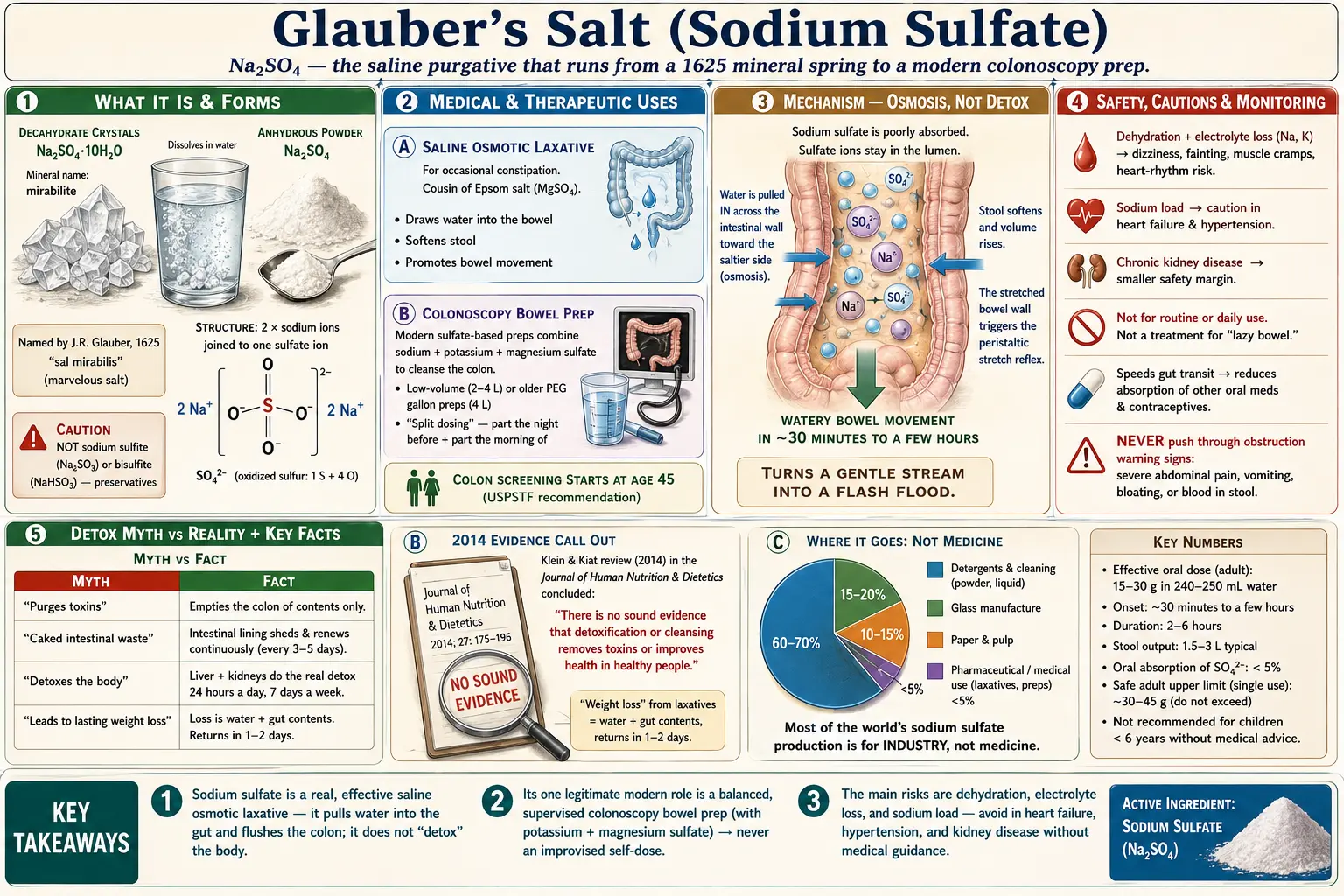
Glauber's salt is the old apothecary name for sodium sulfate — a plain, water-soluble mineral salt that, taken by mouth in a large enough dose, reliably empties the bowel. In the 1926 U.S. Dispensatory it was a standard "purgative," given to clear out the gut and, in the language of the time, to "purge toxins." That phrase is worth pausing on, because it's where history and modern science part ways. Sodium sulfate is a genuine, effective saline osmotic laxative, and a close chemical relative of it is still used today inside some of the liquids people drink to clean out before a colonoscopy. But it does not "detox" your body in the way wellness marketing implies — it pulls water into your intestine and flushes the colon. Your liver and kidneys do the real detoxifying, every day, on their own. This page tells the honest story: what Glauber's salt actually is, what doctors used it for a century ago, how a saline laxative really works, where sodium sulfate still earns its keep in modern medicine, why the "purge toxins" idea is mostly folklore, and the real safety cautions — fluid and electrolyte shifts, dehydration, and sodium load — that the old marketing never mentioned.
Table of Contents
- What It Actually Is
- Historical Medical Use (the 1926 U.S. Dispensatory)
- How a Saline Osmotic Laxative Works
- Modern Use: Sodium Sulfate in Colonoscopy Bowel Prep
- The "Purge Toxins / Detox" Myth, Debunked
- How It's Used Today
- Safety, Cautions & Myths
- Key Research Papers
- Connections
- Featured Videos
What It Actually Is
Glauber's salt is sodium sulfate. In its most familiar crystalline form it is the decahydrate — chemical formula Na2SO4·10H2O, meaning each unit of sodium sulfate is bound together with ten molecules of water locked into the crystal. Those big, clear, glassy crystals dissolve easily in water and taste cool, bitter, and salty. When the water is driven off you're left with anhydrous sodium sulfate (Na2SO4), a white powder. Chemically it is simply two parts of the mineral sodium joined to one sulfate group — sulfate being the fully oxidized form of sulfur (one sulfur atom surrounded by four oxygens, SO42−). It is a close cousin of magnesium sulfate (Epsom salt); the difference is the metal partner — sodium instead of magnesium — and both behave as saline laxatives for the same underlying reason.
The name honors the German-Dutch chemist and apothecary Johann Rudolf Glauber, who first described the salt in 1625 after isolating it from a mineral spring. He was so impressed by what he saw as its broad medicinal usefulness that he called it "sal mirabilis" — Latin for "miraculous salt." That marketing flourish stuck for centuries. Glauber's salt occurs naturally in mineral springs, alkaline lakes, and evaporite mineral deposits (where it forms a mineral called mirabilite), which is why so many historic European "purging spring" spa waters owed their famously laxative effect to dissolved sodium and magnesium sulfates. Today most sodium sulfate is produced industrially and used far more in detergents, glass, and paper manufacturing than in medicine — but its laxative property is real and is the thread that runs from Glauber's spring water to a modern colonoscopy prep bottle.
One quick clarification, because the names get tangled: sodium sulfate (Na2SO4, Glauber's salt, a laxative) is not the same as sodium sulfite or sodium bisulfite (food preservatives), nor sodium thiosulfate (a different medical agent). The "sulf-" family of words is easy to mix up; this page is strictly about sodium sulfate.
Historical Medical Use (the 1926 U.S. Dispensatory)
By 1926, when Wood and LaWall published the 21st edition of the United States Dispensatory — the authoritative American drug reference of its day — Glauber's salt had already been a mainstay of the medicine cabinet for three centuries. It was listed as a saline purgative (a strong laxative), given by mouth dissolved in water to produce a prompt, watery bowel movement. In the medical thinking of the era, regularly "moving the bowels" and "clearing the system" was considered broadly healthful, and physicians reached for purgatives like Glauber's salt, Epsom salt, and senna to treat constipation, to empty the gut before or after other treatments, and — in the older framing — to "purge toxins" or "bad humors" from the body.
That last goal reflects a much older idea. For most of medical history, illness was explained by humoral theory: the belief that disease came from an imbalance or buildup of bodily "humors" or impurities, which the doctor's job was to drain, sweat, bleed, or purge out. Purging the bowel with a salt like Glauber's was one of the gentler tools in that kit. So when a 1926-era source talks about a laxative "purging toxins," it is describing a sincere medical belief of the time — and it is honest history to report it as such. What it is not is a description of how the body actually works, which later science would make clear. The 1926 use as a purgative was real and effective at what it physically did (emptying the colon); the explanation attached to it — sweeping disease-causing toxins out of the body — was the part that didn't survive scrutiny.
It's worth noting that the era also overused purgatives. Habitual "spring cleaning" of the bowel with strong salines was common, and the downsides — dehydration, cramping, salt imbalances, and laxative dependence — were poorly appreciated. Modern medicine kept the genuinely useful applications of sodium sulfate (and gentler, better-tolerated laxatives for everyday constipation) and discarded both the routine purging habit and the toxin theory behind it.
How a Saline Osmotic Laxative Works
The mechanism is pure physics, and it's the same one that makes Epsom salt and milk of magnesia work. The key word is osmosis.
Sulfate is a large, electrically charged ion that the intestinal wall absorbs very poorly. When you swallow a strong dose of sodium sulfate dissolved in water, most of that sulfate stays inside the tube of your intestine rather than being taken up into the blood. A high concentration of dissolved particles inside the gut creates an osmotic pull: water moves across the intestinal lining from your body into the gut to dilute those particles, because water always migrates toward the saltier side of a membrane. The result is a large volume of fluid sitting in the bowel.
Two things then happen. First, the extra water softens the stool and dramatically increases its volume. Second, that swollen, fluid-filled bowel stretches its walls, which triggers the natural stretch reflex that drives peristalsis — the rhythmic muscular waves that move contents along. Within roughly half an hour to a few hours, depending on dose, you get a watery, flushing bowel movement. Think of it less like a chemical "scrub" and more like turning a gentle stream into a flash flood: the sheer volume of water does the work of clearing the channel.
This is the defining feature of a saline osmotic laxative, and it's exactly why a high enough dose is so effective for completely emptying the colon — and also exactly why the major risk is fluid and salt loss, since that flushing water and the electrolytes carried with it come out of your body. (Stimulant laxatives like senna or castor oil work differently, by directly irritating the gut nerves; sodium sulfate's action is the gentler-in-concept but high-volume osmotic route.) This osmotic principle, and the trade-off between effective cleansing and fluid loss, is described in the American Gastroenterological Association's technical review on constipation and in the standard clinical reviews cited below.
Modern Use: Sodium Sulfate in Colonoscopy Bowel Prep
Here is the genuinely modern, evidence-based home for sodium sulfate — and it surprises most people. To perform a colonoscopy (the screening test that finds and removes colon polyps before they can become cancer), the colon has to be completely clean; any retained stool can hide a polyp. So before the procedure, patients drink a "bowel prep" — a measured laxative solution that flushes the colon out over several hours.
Several modern prescription bowel preps are sulfate-based: they combine sodium sulfate with potassium sulfate and magnesium sulfate, sometimes alongside other agents, in a carefully balanced formula. These are the descendants of Glauber's purging salt, re-engineered for a precise medical job. Compared with the older, very large-volume polyethylene-glycol (PEG) preps that required drinking up to a gallon of liquid, sulfate-based and other low-volume preps let patients drink less while still achieving an adequately clean colon, which improves how many people actually finish the prep — a real clinical problem, since an incomplete prep means a missed polyp or a repeat procedure. Major gastroenterology guidelines — from the U.S. Multi-Society Task Force on Colorectal Cancer, the American Society for Gastrointestinal Endoscopy (ASGE), and the European Society of Gastrointestinal Endoscopy (ESGE) — review sulfate-based preparations among the validated options and emphasize "split dosing" (taking part of the prep the night before and part the morning of the test) for the best cleansing.
The important takeaway: sodium sulfate's legitimate modern role is this controlled, one-time, medically-supervised colon cleanout as part of a balanced electrolyte formula — taken with specific large volumes of additional clear fluid, under a doctor's instructions, with attention to the patient's heart and kidney status. It is a world away from casually swallowing Glauber's salt to "cleanse." Colonoscopy itself is one of the most valuable preventive procedures in medicine — the U.S. Preventive Services Task Force recommends colorectal-cancer screening for average-risk adults starting at age 45 — and an effective, well-tolerated bowel prep is what makes a good colonoscopy possible.
The "Purge Toxins / Detox" Myth, Debunked
This is the central correction this page exists to make. The 1926 idea that a laxative "purges toxins" lives on today, rebranded as the "detox cleanse." It deserves a clear, evidence-based debunking.
What sodium sulfate actually does: it empties your colon. That's it. It pulls water into the bowel and flushes out whatever stool is there. Stool is mostly water, fiber, dead gut bacteria, and digestive leftovers — it is not a reservoir of mysterious "toxins" poisoning you, and there is no sludge of accumulated waste "caked" onto your intestinal walls that a flush is rescuing you from. That image, common in cleanse marketing, is not how the gut works; the intestinal lining continuously sheds and renews itself.
What actually detoxifies your body: your liver and kidneys. Real detoxification — neutralizing drugs, alcohol, metabolic byproducts, and environmental chemicals — is done continuously by your liver (which chemically transforms substances into safer, excretable forms) and your kidneys (which filter your blood and excrete waste in urine), with help from your lungs and skin. These organs work every minute of every day. A bowel flush does not assist them, speed them up, or "give them a rest." If anything, the dehydration a strong purge can cause makes the kidneys' job harder, not easier.
A 2014 critical review in the Journal of Human Nutrition and Dietetics examined the evidence for commercial "detox diets" and cleanses for toxin elimination and weight management and found no sound clinical evidence that they remove toxins or produce sustained benefit; the few studies were small and methodologically weak. The "weight loss" people see after a purge is mostly water and the temporary loss of gut contents — it returns within a day or two of normal eating and drinking. Meanwhile, repeated or aggressive cleansing carries the real harms covered in the next section. In short: keep the honest history ("in 1926, doctors purged the bowel to clear toxins"), but don't carry the belief forward. Sodium sulfate empties the bowel; it does not detox the body in the marketing sense.
How It's Used Today
Putting the legitimate uses together, here is where sodium sulfate honestly fits in modern practice:
- As part of prescription colonoscopy bowel-prep solutions. This is its main, evidence-based medical use — sulfate-based preps (sodium + potassium + magnesium sulfate) used once, on a doctor's schedule, with large volumes of clear fluid. Follow the exact product and clinic instructions; these are designed and dosed for that single purpose.
- Occasionally as a saline laxative for constipation, the same class as Epsom salt (magnesium sulfate) and other osmotic agents. For everyday constipation, however, modern guidance generally favors gentler, better-tolerated first steps — more fiber and fluids, then osmotic agents such as polyethylene glycol (PEG 3350), which are effective and have a strong safety record — rather than strong saline purges. Strong salines are better reserved for short-term, specific situations.
- In industry, not medicine, for most of the world's supply. The vast majority of sodium sulfate produced goes into detergents, glassmaking, and pulp/paper — a reminder that "it's used in industry" says nothing about whether you should swallow it for health.
On dosing: the honest answer is that you should not improvise a dose of Glauber's salt for self-treatment. The amounts in medical bowel preps are precisely formulated and balanced with other electrolytes and mandatory fluid intake. Casual high doses of a saline purge are exactly what causes the dehydration and electrolyte problems below. If you need a laxative, talk to a pharmacist or clinician about an appropriate, well-studied product; if you're prepping for a colonoscopy, use the specific prep your doctor prescribes, exactly as directed.
Safety, Cautions & Myths
The 1926 marketing — and a lot of modern cleanse marketing — leaves out the safety story entirely. Because a saline osmotic laxative works by pulling water (and the salts dissolved in it) out of your body and into your gut, the central risks all come from fluid and electrolyte shifts. These are not trivial, especially in vulnerable people.
- Dehydration and electrolyte disturbance. A strong purge can cause significant loss of body water along with sodium, potassium, and other electrolytes. This can lead to lightheadedness, weakness, fainting, fast heart rate, kidney strain, and — in serious cases — dangerous heart-rhythm problems. Anyone using a saline purge or a bowel prep must drink the recommended clear fluids to replace losses, which is why prep instructions are so insistent about it.
- Sodium load — caution with heart failure, high blood pressure, and fluid-sensitive conditions. Sodium sulfate is a sodium salt. Some sodium is absorbed, and a sodium load can worsen heart failure, hypertension, fluid retention, and swelling. People with these conditions, or on a sodium-restricted diet, should avoid sodium-based purges unless a clinician has specifically approved an appropriate prep and is monitoring them.
- Kidney disease. The kidneys handle the fluid and electrolyte fallout of a purge. In chronic kidney disease, the margin for error is much smaller — dehydration and salt shifts can cause real harm, and clearance of magnesium (from sulfate preps that contain it) can be impaired. Bowel prep in kidney patients should be chosen and supervised by a clinician.
- Not for routine or casual use. Glauber's salt is a strong, one-off tool, not a daily "wellness" habit. Habitual purging can lead to chronic dehydration, persistent electrolyte problems, and a "lazy bowel" pattern where the gut becomes reliant on stimulation. For ongoing constipation, treat the cause and use gentler, sustainable measures.
- Drug-absorption timing. A flushing laxative speeds everything through the gut, which can reduce the absorption of medications taken around the same time — including some oral drugs and oral contraceptives. If you must use a purge or are doing a bowel prep, ask your pharmacist how to time your regular medications so they still work.
- Don't use it to mask warning signs. Constipation that is new, severe, or accompanied by abdominal pain, vomiting, blood in the stool, or unexplained weight loss can signal a problem (including a bowel obstruction, where any laxative can be dangerous). Never use a purge to push through these symptoms — get them evaluated.
Myth check, plainly stated: (1) Sodium sulfate does not "detox" your body — it empties your colon; your liver and kidneys do the detoxifying. (2) There is no caked-on intestinal waste a cleanse is removing. (3) The quick "weight loss" from a purge is water and gut contents, and it comes right back. (4) "Used in medicine/industry" does not mean "safe to self-dose." Sodium sulfate has a real, narrow, legitimate role — as a balanced, supervised bowel-prep ingredient and an occasional saline laxative — and outside that role the honest advice is to leave the purging to history.
Key Research Papers
- Johnson DA, Barkun AN, Cohen LB, et al. (2014). Optimizing Adequacy of Bowel Cleansing for Colonoscopy: Recommendations From the US Multi-Society Task Force on Colorectal Cancer. American Journal of Gastroenterology, 109(10):1528–1545. — The major U.S. consensus guidance on bowel preparation; reviews the validated prep regimens (including sulfate-based and low-volume options) and the importance of split dosing. (VERIFIED)
- Saltzman JR, Cash BD, Pasha SF, et al. (2015). Bowel preparation before colonoscopy. Gastrointestinal Endoscopy, 81(4):781–794. — The American Society for Gastrointestinal Endoscopy (ASGE) guideline on bowel prep, covering efficacy, safety, and patient tolerance across prep types. (VERIFIED)
- Hassan C, East J, Radaelli F, et al. (2019). Bowel preparation for colonoscopy: European Society of Gastrointestinal Endoscopy (ESGE) Guideline — Update 2019. Endoscopy, 51(8):775–794. — The European guideline; evaluates high- and low-volume preps (including sulfate-based regimens) and reinforces split-dose, day-of-procedure timing for the cleanest colon. (VERIFIED)
- Bharucha AE, Pemberton JH, Locke GR. (2013). American Gastroenterological Association Technical Review on Constipation. Gastroenterology, 144(1):218–238. — A detailed evidence review of constipation and its treatments, including how osmotic and saline laxatives work and their relative safety. (VERIFIED)
- Lembo A, Camilleri M. (2003). Chronic Constipation. New England Journal of Medicine, 349(14):1360–1368. — A classic clinical review explaining the categories of laxatives, including the osmotic/saline mechanism that underlies agents like sodium and magnesium sulfate. (VERIFIED)
- Klein AV, Kiat H. (2015). Detox diets for toxin elimination and weight management: a critical review of the evidence. Journal of Human Nutrition and Dietetics, 28(6):675–686. — A systematic critical review finding no sound clinical evidence that "detox" diets and cleanses eliminate toxins or produce lasting benefit — directly relevant to the "purge toxins" claim. (VERIFIED)
- US Preventive Services Task Force; Davidson KW, Barry MJ, Mangione CM, et al. (2021). Screening for Colorectal Cancer: US Preventive Services Task Force Recommendation Statement. JAMA, 325(19):1965–1977. — The current U.S. recommendation to begin colorectal-cancer screening at age 45 — context for why effective, well-tolerated bowel preps (sodium sulfate's legitimate modern use) matter. (VERIFIED)
Live PubMed Searches
- Sodium sulfate bowel preparation colonoscopy (randomized trials)
- Sulfate-based colonoscopy preparation: efficacy and safety
- Osmotic / saline laxative mechanism
- Bowel preparation: electrolyte disturbance and dehydration
- Detox / cleanse and toxin elimination: evidence
- Magnesium sulfate vs sodium sulfate as a laxative
Connections
- All Minerals
- Sodium
- Sulfur
- Magnesium Sulfate (Epsom Salt)
- Natural Constipation Relief
- Detox Protocols
- Fasting
- Nephrology & Hepatology