Carbon Monoxide
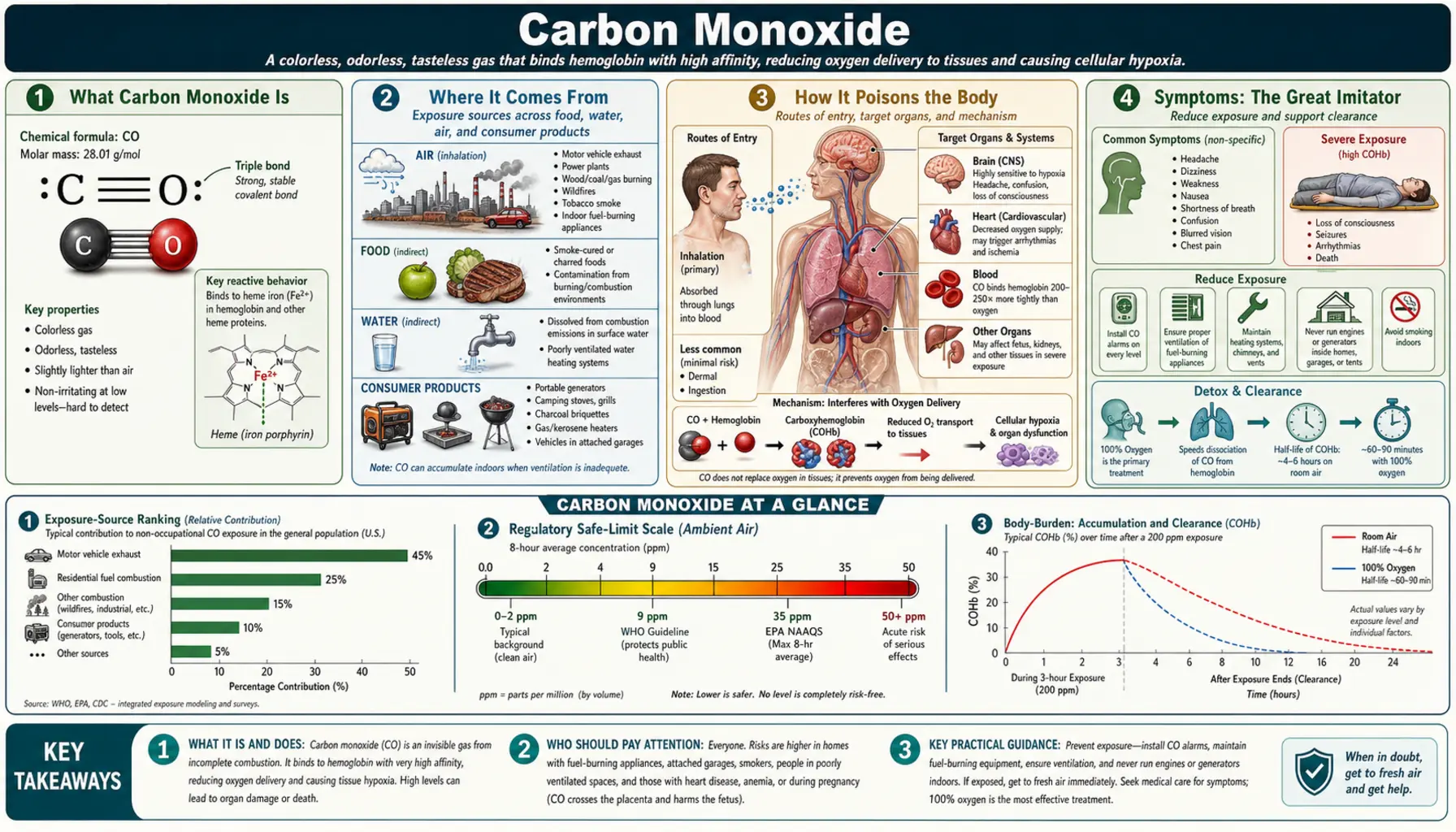
Carbon monoxide is often called "the silent killer," and the nickname is earned. It is a colorless, odorless, tasteless gas that you cannot see, smell, or taste. It gives no warning. It is produced whenever a fuel — natural gas, propane, gasoline, oil, wood, coal, or charcoal — burns without enough oxygen to burn completely. Every year in the United States, more than four hundred people die from accidental, non-fire carbon monoxide poisoning, and tens of thousands more end up in emergency rooms. The tragedy is that nearly all of these deaths are preventable. A working carbon monoxide alarm and a few simple habits — never running an engine or grill in an enclosed space, having fuel-burning appliances serviced once a year — stop almost every case before it starts. This page explains what carbon monoxide is, where it comes from, how it harms the body, the warning signs to watch for, and the concrete steps that save lives.
Interactive Visualization Hemoglobin & the O₂ Curve — bend the oxygen curve Load oxygen onto hemoglobin one cooperative step at a time to draw the S-curve — then shift it with exercise, watch carbon monoxide lock it shut, or switch to fetal hemoglobin. Launch →
Table of Contents
- What Carbon Monoxide Is
- Where It Comes From
- How It Poisons the Body
- Symptoms: The Great Imitator
- Who Is at Highest Risk
- Prevention: The Life-Saving Message
- Treatment
- Delayed Neurological Effects
- Research Papers
- Connections
- Featured Videos
What Carbon Monoxide Is
Carbon monoxide — written by chemists as CO — is a single carbon atom joined to a single oxygen atom. It is a normal, everyday byproduct of burning things, and in small amounts it is all around us: in car exhaust, in cigarette smoke, in the haze over a busy road. The danger begins when it builds up in an enclosed space where people are breathing.
What makes it so hazardous is the combination of two facts. First, it is genuinely undetectable by human senses — colorless, odorless, and tasteless. Unlike natural gas, which utilities deliberately scent with a rotten-egg additive so you can smell a leak, carbon monoxide slips in completely unnoticed. Second, it is produced by incomplete combustion. When a fuel burns with plenty of oxygen and a clean flame, it turns mostly into carbon dioxide (CO₂), the harmless gas we breathe out. But when the flame is starved of oxygen — a clogged burner, a blocked chimney, an engine running in a closed garage — combustion is incomplete, and it produces carbon monoxide instead. A yellow or flickering flame where a crisp blue one should be, or soot and staining around an appliance, can be a visible hint that a fuel is not burning cleanly.
Because the gas gives no sensory warning, people are typically poisoned without ever realizing what is happening. Many are asleep. Others feel vaguely unwell, assume they are coming down with something, and stay in the very room that is making them sick. This is why carbon monoxide safety relies on machines — alarms that detect what our noses cannot.
Where It Comes From
Almost anything that burns fuel can produce carbon monoxide if it is malfunctioning, poorly ventilated, or used in the wrong place. The most common household and recreational sources include:
- Faulty or poorly vented furnaces and boilers — a cracked heat exchanger or a blocked flue can send exhaust back into the living space instead of up the chimney. Home heating systems are among the leading causes, which is why poisonings spike in cold weather.
- Gas or oil water heaters — the same venting problems that affect furnaces apply here.
- Gas ranges and ovens — especially when used improperly as space heaters, a dangerous practice that has caused many deaths.
- Blocked or damaged chimneys and flues — a bird's nest, leaves, snow, or creosote buildup can trap exhaust indoors.
- Portable generators — one of the deadliest sources, particularly during power outages after storms. A generator run indoors, in a garage, in a basement, or even just outside a window can flood a home with lethal levels of CO within minutes. Generators must run far from the house — at least 20 feet away, with the exhaust pointed away from doors, windows, and vents.
- Vehicles in attached garages — starting a car and letting it "warm up" in a garage, even with the garage door open, can push carbon monoxide into the connected house. Never leave an engine running in an attached garage.
- Charcoal and gas grills, camp stoves, and hibachis — these are built for the outdoors. Burning charcoal indoors, in a garage, in a tent, or in a camper is a classic and frequently fatal mistake.
- Boats — gasoline engines and onboard generators produce carbon monoxide that can collect around the swim platform and rear deck, or seep into the cabin. "Station wagon effect" back-drafting has poisoned swimmers and passengers.
- Space heaters and fireplaces — any unvented or improperly vented kerosene, propane, or wood-burning heat source.
A pattern runs through this list: carbon monoxide becomes deadly when a fuel is burned in an enclosed or semi-enclosed space without adequate fresh air, or when an appliance meant to vent exhaust outdoors fails to do so. The single most protective rule is to keep combustion — engines, generators, grills, and open flames — outside and well away from where people breathe.
How It Poisons the Body
To understand why carbon monoxide is so dangerous even at low concentrations, it helps to know how your blood carries oxygen. Inside your red blood cells is a protein called hemoglobin. Its job is to grab oxygen in the lungs, carry it through the bloodstream, and release it to your tissues — your brain, heart, and muscles — where it fuels every cell.
Carbon monoxide sabotages this system by cheating. Hemoglobin binds carbon monoxide roughly 200 to 250 times more tightly than it binds oxygen. So even a small amount of CO in the air outcompetes oxygen for space on the hemoglobin molecule. When CO latches on, it forms carboxyhemoglobin, and that hemoglobin can no longer carry oxygen. The blood, in effect, becomes clogged with a gas that does nothing useful, while the oxygen your tissues need is left behind in the lungs.
It gets worse. The carbon monoxide that does bind also changes the shape of the hemoglobin molecule so that the little oxygen still on board is held more stubbornly and released to tissues less readily. So carbon monoxide delivers a double blow: it blocks oxygen from getting on, and it makes the remaining oxygen harder to hand off. Your organs are starved of oxygen even though you are still breathing.
Beyond the blood, carbon monoxide also causes damage inside cells directly. It interferes with the cell's tiny energy factories, the mitochondria, by binding to a key enzyme (cytochrome c oxidase) in the machinery that produces energy. It also binds myoglobin, the oxygen-storing protein in heart and skeletal muscle, which can weaken the heart. And as the poisoning resolves, a burst of inflammation and oxidative stress can injure tissue further — a process thought to underlie the delayed brain effects discussed below. In short, carbon monoxide poisoning is not just suffocation of the blood; it is a cellular assault, and the brain and heart — the organs that need the most oxygen — are hit hardest.
For context, a healthy non-smoker normally has a carboxyhemoglobin level below about 2 to 3 percent; a heavy smoker may sit near 5 to 10 percent. Serious poisoning pushes that figure far higher, and levels above roughly 40 to 50 percent are life-threatening.
Symptoms: The Great Imitator
The early symptoms of carbon monoxide poisoning are vague and easily blamed on something else. This is precisely what makes it so dangerous: people feel unwell but rarely suspect the true cause. Common early signs include:
- Headache — often the first and most common symptom, typically dull and pressing.
- Dizziness or lightheadedness
- Nausea and vomiting
- Fatigue and weakness
- Confusion, trouble thinking, or poor coordination
- Shortness of breath, especially with exertion
- Blurred vision
Notice how closely this resembles a viral illness. In fact, the single most useful clue for recognizing carbon monoxide poisoning is that it feels like "the flu without a fever." Carbon monoxide does not cause a fever, sore throat, or swollen glands. If a whole household feels achy, headachy, and nauseated during heating season but nobody is running a temperature, carbon monoxide should be on the list of suspects.
Two red flags deserve special attention:
- Everyone in the home feels sick at once. Viruses usually pass from one person to the next over days. Carbon monoxide poisons everyone breathing the same air simultaneously. If multiple family members develop headaches and nausea together — and especially if they feel better after leaving the house and worse when they return — that is a warning sign to take seriously.
- Pets are sick too. Because they are smaller and often closer to the floor, cats, dogs, and birds frequently show signs before people do. A pet that suddenly becomes lethargic, wobbly, or unwell alongside the humans is another clue.
As exposure continues or levels climb, the poisoning becomes severe: worsening confusion, chest pain, a racing heartbeat, seizures, loss of consciousness, and ultimately death. A frightening feature is that as the brain is starved of oxygen, judgment fails — a person may feel too weak, muddled, or drowsy to recognize the danger and simply walk out the door. Many victims are overcome in their sleep and never wake. The old notion that carbon monoxide turns the skin and lips "cherry red" is real but unreliable; it usually appears only in very severe or fatal cases and should never be waited for.
If you suspect carbon monoxide poisoning, the response is immediate and simple: get everyone and any pets out into fresh air right away, leave the doors open behind you, do not stop to investigate the source, and call emergency services (911 in the U.S.) or the fire department from outside. If someone has collapsed or is not breathing, this is a medical emergency.
Who Is at Highest Risk
Carbon monoxide can harm anyone, but some people are more vulnerable and are affected at lower exposures:
- Infants and young children — they breathe faster relative to their body size, so they take in more of the gas, and they cannot tell anyone how they feel.
- Older adults — aging bodies tolerate low oxygen poorly, and the confusion caused by carbon monoxide is easily mistaken for other conditions.
- People with heart disease — a heart already coping with narrowed arteries is especially sensitive to oxygen starvation, and carbon monoxide can trigger chest pain, heart-rhythm problems, or a heart attack at exposures a healthy person might survive.
- People with chronic lung conditions or anemia — those whose oxygen delivery is already limited have less reserve to lose.
- Pregnant women and their unborn babies — this is a particularly serious situation. Carbon monoxide crosses the placenta, and fetal hemoglobin binds it even more tightly than adult hemoglobin. The gas also lingers longer in the fetal bloodstream than in the mother's. A level of carbon monoxide that leaves the mother only mildly ill can seriously endanger the developing baby, so pregnancy is treated as a high-risk exposure requiring prompt medical care.
Because these groups can be harmed before others even notice a problem, the safety measures below are not just for households that "feel at risk" — they protect exactly the people least able to protect themselves.
Prevention: The Life-Saving Message
Nearly every carbon monoxide death is preventable. Three habits do the heavy lifting.
1. Install carbon monoxide alarms — and maintain them
A carbon monoxide alarm is the one thing that can warn you of a gas your senses cannot detect. It is inexpensive, widely available, and the closest thing to a guarantee against a silent nighttime poisoning. Practical guidance:
- Put an alarm on every level of the home, including the basement.
- Place one near every sleeping area, close enough to wake people who are asleep — because that is when many poisonings happen.
- Test the alarms monthly and replace the batteries as directed (or choose sealed 10-year-battery models).
- Replace the whole unit according to the manufacturer's instructions — the sensors wear out, typically after five to ten years depending on the model.
- Do not mount an alarm right next to a fuel-burning appliance or in very humid spots, where it may false-alarm; follow the placement directions on the package.
- If an alarm sounds, treat it as real: get everyone outside into fresh air and call for help. Do not assume it is a false alarm.
2. Never burn fuel in an enclosed space
This single rule prevents the most catastrophic poisonings:
- Never run a portable generator indoors, in a garage, in a basement, or near an open window. Place it well away from the house — at least 20 feet — with the exhaust directed away from doors, windows, and vents. Generator poisonings surge after storms and outages; more people should treat this as the deadly hazard it is.
- Never use a charcoal or gas grill, camp stove, or hibachi indoors — not in the house, garage, tent, or camper.
- Never leave a car, truck, or any gasoline engine running in an attached garage, even with the door open. Back the vehicle out first.
- Never use a gas oven or range to heat your home.
- On boats, be aware of exhaust around the rear deck and swim platform, and keep cabins ventilated.
3. Service fuel-burning appliances every year
Have a qualified technician inspect your furnace, water heater, chimney, and any other gas, oil, or coal appliances once a year, ideally before the heating season. A professional can catch a cracked heat exchanger, a blocked flue, or a failing vent before it becomes dangerous. Keep chimneys and vents clear of nests, debris, and snow, and make sure appliances are installed and vented to the outdoors. If you ever notice soot, staining, a persistently yellow burner flame, or excess moisture on windows near a gas appliance, have it checked.
Treatment
The first and most important treatment is simply fresh air: getting the person away from the source stops further poisoning immediately. After that, medical care centers on giving oxygen, which does two things at once — it supplies the tissues that carbon monoxide has been starving, and it speeds the removal of carbon monoxide from the blood.
The reason oxygen helps so much is a matter of timing. Breathing ordinary room air, it takes the body roughly four to five hours to clear half of the carbon monoxide from the blood. Breathing 100 percent oxygen through a tight-fitting mask cuts that to about 60 to 90 minutes. So in the emergency room, anyone with significant exposure is placed on high-flow oxygen right away and kept on it until levels fall and symptoms improve.
For severe poisoning, doctors may use hyperbaric oxygen therapy (HBOT) — pure oxygen delivered inside a pressurized chamber. The high pressure drives carbon monoxide off the hemoglobin even faster (clearing half in roughly 20 to 30 minutes) and floods the tissues with oxygen. Hyperbaric treatment is generally considered for the most serious cases: people who lost consciousness, who have neurological signs or heart involvement, who have very high carboxyhemoglobin levels, or who are pregnant. Some clinical trials have found that hyperbaric oxygen reduces the risk of lasting cognitive problems, while others have not, so its use varies between hospitals and is decided case by case. What is not in dispute is the value of getting to fresh air and onto oxygen quickly — that is the foundation of every good outcome. Recovery from a serious poisoning should also include medical follow-up, because problems can emerge later.
Delayed Neurological Effects
One of the most important and least-known facts about carbon monoxide is that the danger does not always end when the person feels better. A portion of people who survive a significant poisoning — and who seem to recover fully — go on to develop delayed neurological symptoms days to weeks later. This is sometimes called delayed neuropsychiatric sequelae, and it typically appears anywhere from a few days to about a month after the exposure, often after a deceptive period of apparent normality.
The delayed problems can include:
- Memory loss and difficulty concentrating
- Confusion or slowed thinking
- Personality and mood changes, including depression and irritability
- Movement problems, sometimes resembling Parkinson's disease (stiffness, slowness, a shuffling walk)
- Difficulty with everyday tasks, and in some cases loss of bladder or bowel control
These effects are thought to stem from the delayed wave of inflammation and oxidative injury to the brain that follows the initial oxygen starvation, with the deep brain structures that coordinate movement and memory being especially vulnerable. Many people improve over months, though some deficits can persist. The possibility of delayed effects is a major reason that carbon monoxide poisoning should be evaluated by medical professionals even when someone appears to bounce back, and why treatment decisions — including whether to use hyperbaric oxygen — weigh the goal of preventing these later problems, not just relieving the immediate symptoms.
Research Papers
- Weaver LK. Carbon monoxide poisoning. New England Journal of Medicine. 2009;360(12):1217–1225. doi:10.1056/NEJMcp0808891 — A widely cited clinical review covering diagnosis, oxygen therapy, and the case for hyperbaric treatment in serious poisoning.
- Rose JJ, Wang L, Xu Q, McTiernan CF, et al. Carbon Monoxide Poisoning: Pathogenesis, Management, and Future Directions of Therapy. American Journal of Respiratory and Critical Care Medicine. 2017;195(5):596–606. doi:10.1164/rccm.201606-1275CI — A modern overview explaining that CO harms not only through carboxyhemoglobin but through direct effects on cells, mitochondria, and inflammation.
- Weaver LK, Hopkins RO, Chan KJ, Churchill S, et al. Hyperbaric Oxygen for Acute Carbon Monoxide Poisoning. New England Journal of Medicine. 2002;347(14):1057–1067. doi:10.1056/NEJMoa013121 — A landmark randomized trial reporting that hyperbaric oxygen reduced the risk of delayed cognitive problems after CO poisoning.
- Hampson NB, Piantadosi CA, Thom SR, Weaver LK. Practice Recommendations in the Diagnosis, Management, and Prevention of Carbon Monoxide Poisoning. American Journal of Respiratory and Critical Care Medicine. 2012;186(11):1095–1101. doi:10.1164/rccm.201207-1284CI — Expert consensus guidance on recognizing, treating, and preventing carbon monoxide poisoning.
- Buckley NA, Juurlink DN, Isbister G, Bennett MH, et al. Hyperbaric oxygen for carbon monoxide poisoning. Cochrane Database of Systematic Reviews. 2011;2011(4):CD002041. doi:10.1002/14651858.CD002041.pub3 — A systematic review that found the trials on hyperbaric oxygen conflicting, illustrating why its use remains debated.
- Thom SR, Taber RL, Mendiguren II, Clark JM, et al. Delayed Neuropsychologic Sequelae After Carbon Monoxide Poisoning: Prevention by Treatment with Hyperbaric Oxygen. Annals of Emergency Medicine. 1995;25(4):474–480. doi:10.1016/S0196-0644(95)70261-X — An early trial documenting the delayed brain effects of CO poisoning and testing hyperbaric oxygen to prevent them.
- Prockop LD, Chichkova RI. Carbon monoxide intoxication: an updated review. Journal of the Neurological Sciences. 2007;262(1–2):122–130. doi:10.1016/j.jns.2007.06.037 — A neurology-focused review of how carbon monoxide injures the brain and produces delayed neurological damage.
- Hampson NB. U.S. Mortality Due to Carbon Monoxide Poisoning, 1999–2014: Accidental and Intentional Deaths. Annals of the American Thoracic Society. 2016;13(10):1768–1774. doi:10.1513/AnnalsATS.201604-318OC — A national analysis quantifying how many Americans die from carbon monoxide and how the toll has changed over time.
- Ernst A, Zibrak JD. Carbon monoxide poisoning. New England Journal of Medicine. 1998;339(22):1603–1608. doi:10.1056/NEJM199811263392206 — A classic review of the biology of CO poisoning, including its effect on hemoglobin and the tissues most at risk.
- Chiew AL, Buckley NA. Carbon monoxide poisoning in the 21st century. Critical Care. 2014;18(2):221. doi:10.1186/cc13846 — A practical clinical summary of how carbon monoxide poisoning is diagnosed and managed in modern emergency care.
Connections
- All Toxins
- Hemoglobin & the Oxygen Dissociation Curve — interactive animation
- Household Chemicals
- Air Pollution (PM2.5)
- Mold & Mycotoxins
- Carbon Monoxide Poisoning — clinical presentation, oximetry pitfall, hyperbaric oxygen.