Niacin Deficiency (Pellagra): Diarrhea and Digestive
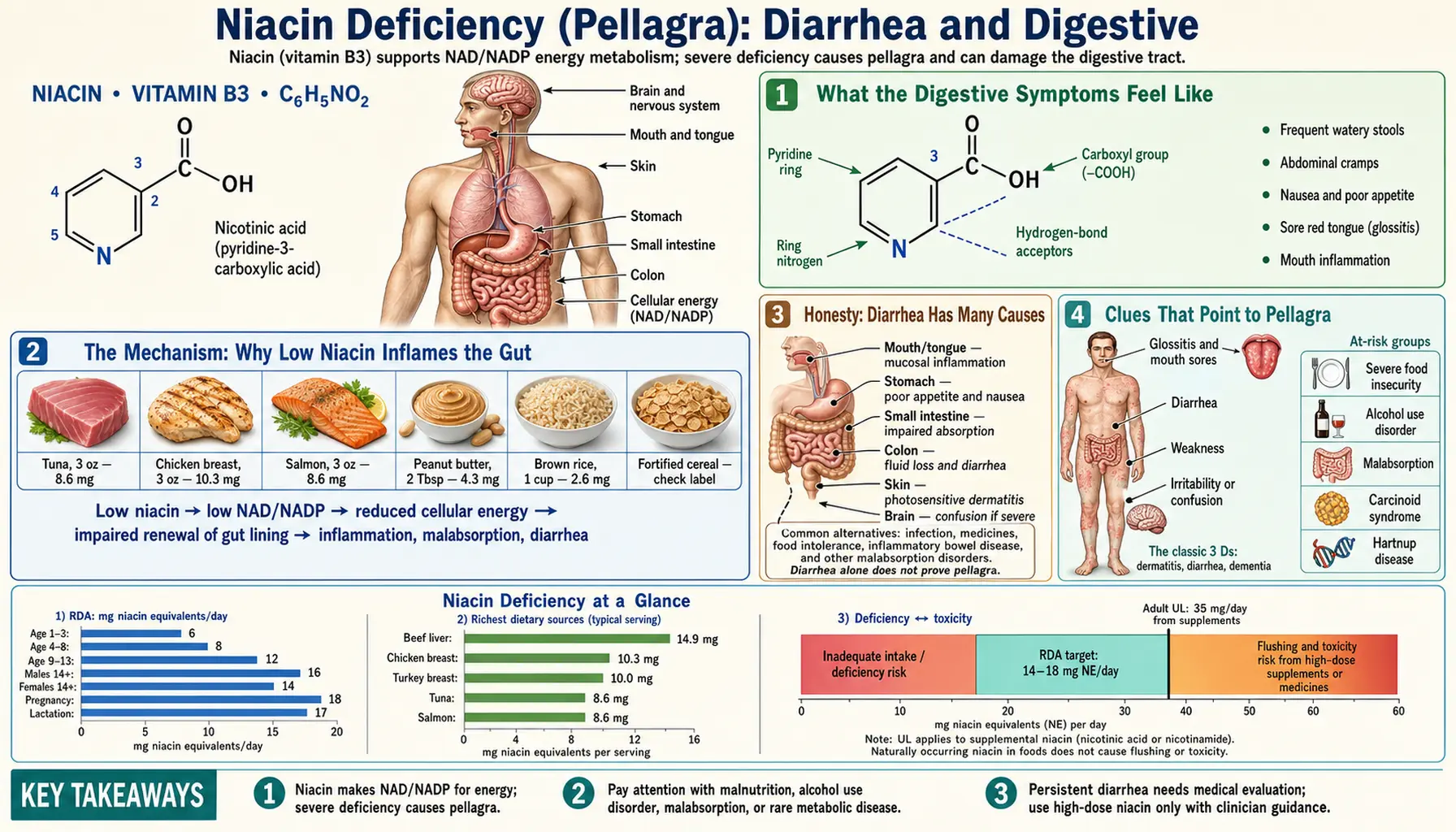
Pellagra — severe niacin (vitamin B3) deficiency — is classically remembered as the disease of the “four D’s”: dermatitis, diarrhea, dementia, and, untreated, death. This page is about the second D — the digestive arm. When niacin runs out, the cells lining the mouth and gut are among the first to suffer, producing a sore, beefy-red tongue (glossitis), inflamed cracked lips and mouth (stomatitis and cheilitis), a burning mouth and throat, poor appetite, nausea, and a watery, sometimes bloody diarrhea that can itself worsen the deficiency in a vicious circle. Be honest from the start: diarrhea has dozens of causes and is almost never by itself a sign of niacin deficiency. In pellagra it travels in company — alongside the sun-exposed rash (dermatitis) and the mental changes (dementia and mood change). This page explains why low niacin inflames the gut lining, what the digestive symptoms feel like, the many other causes of the same symptoms, the clues that point to pellagra, and how it is diagnosed and corrected.
Table of Contents
- What the Digestive Symptoms Feel Like
- The Mechanism: Why Low Niacin Inflames the Gut
- Honesty: Diarrhea Has Many Causes
- Clues That Point to Pellagra
- The Vicious Circle: Diarrhea Worsens Deficiency
- What Causes Niacin to Run Low
- Getting Diagnosed
- Correcting Niacin Deficiency
- When to Seek Care / Red Flags
- Key Research Papers
- Connections
- Featured Videos
What the Digestive Symptoms Feel Like
The digestive trouble of pellagra runs from the lips all the way through the bowel, because the entire lining of the gastrointestinal tract is built from fast-renewing cells that depend heavily on niacin. People describe a recognizable cluster:
- A sore, swollen, “beefy-red” tongue (glossitis) — the tongue looks smooth, shiny, and unusually red because the tiny surface bumps (papillae) flatten out. It can burn, sting against hot or spicy food, and make eating and even talking uncomfortable. In some cases the tongue and mouth turn almost scarlet and feel raw.
- Cracked, inflamed lips and mouth corners (cheilitis and stomatitis) — the lips crack and peel, the corners of the mouth split and become sore (angular cheilitis), and painful shallow ulcers can appear inside the cheeks. The whole mouth may feel scalded.
- A burning mouth and throat — a hot, raw sensation extending down the throat, sometimes with increased saliva, that makes swallowing painful and discourages eating.
- Loss of appetite, nausea, and vomiting — food becomes unappealing, the stomach feels queasy, and weight falls. This poor intake is part of why the deficiency tends to deepen once it starts.
- Diarrhea — the most talked-about gut symptom. Stools become loose, frequent, and watery; in more severe or prolonged disease they can contain mucus or blood, because the inflamed bowel lining sheds and bleeds. The diarrhea drives weight loss, dehydration, and exhaustion.
- Cramping and abdominal discomfort — vague belly pain and bloating often accompany the looser stools.
What makes this distinctive is the combination. A single beefy-red tongue, or a single bout of diarrhea, is common and rarely points anywhere unusual. But a sore red tongue plus a painful inflamed mouth plus chronic diarrhea plus a symmetric rash on sun-exposed skin plus a change in mood or thinking — that whole picture, especially in someone who eats poorly, drinks heavily, or has a malabsorption problem, is the recognizable shape of pellagra.
The Mechanism: Why Low Niacin Inflames the Gut
Niacin matters to every cell because the body converts it into two coenzymes — NAD (nicotinamide adenine dinucleotide) and NADP. These two molecules are the workhorses of energy metabolism: they shuttle electrons through the reactions that turn food into usable energy and that build and repair the cell. Without enough NAD/NADP, a cell cannot make energy efficiently or keep up with its own maintenance and division.
Here is the part that explains why the gut is hit early and hard. The lining of the mouth, stomach, and intestine is one of the fastest-renewing tissues in the body — the cells lining the small intestine are completely replaced roughly every few days. Tissues that divide that quickly have an enormous, constant demand for NAD to power that turnover. When niacin runs short, the tissues with the highest demand — skin (especially where sunlight adds extra stress), the nervous system, and the GI lining — are the ones that fail first. That is precisely why pellagra targets those three systems and gives the “four D’s.”
In the gut, low NAD means the lining cells cannot renew fast enough to replace themselves. The surface erodes, inflames, and in severe cases ulcerates and atrophies, with flattening of the finger-like absorptive projections (villi). A damaged, inflamed lining does two things that produce diarrhea: it cannot absorb water and nutrients properly (so they stay in the bowel and draw water with them), and it becomes leaky and irritated (so it secretes fluid and sheds cells). The result is watery, sometimes bloody, diarrhea — not because of a germ, but because the lining itself has broken down for lack of a vitamin.
An analogy. Picture the gut lining as a busy road crew that must constantly repave a stretch of highway that wears out every few days. NAD is the fuel that runs their machinery. Cut off the fuel and the crew can’t keep up; potholes open, the surface crumbles, and traffic (water and nutrients) that should pass smoothly instead pools and spills over the edges. Restore the fuel and the crew repaves the road — which is why, once niacin is replaced, the mouth and gut often heal strikingly fast.
Honesty: Diarrhea Has Many Causes
It is important to be straight about this: diarrhea is one of the most common and least specific symptoms in medicine, and niacin deficiency is a rare cause of it. A sore tongue and an inflamed mouth are likewise far more often due to something other than pellagra. If you have diarrhea, the overwhelmingly more likely explanations include:
- Infections — viral gastroenteritis (“stomach flu”), bacterial food poisoning, parasites, and C. difficile after antibiotics. These are by far the most common causes of acute diarrhea.
- Medications — antibiotics, metformin, magnesium-containing antacids and supplements, and many others.
- Irritable bowel syndrome (IBS) and food intolerances such as lactose intolerance — see Irritable Bowel Syndrome.
- Inflammatory bowel disease — Crohn’s disease and ulcerative colitis (collectively IBD).
- Celiac disease and other malabsorption — see Celiac Disease.
- Other causes — thyroid overactivity, diverticular disease, bile-acid issues, and many more.
A sore, red, smooth tongue (glossitis) likewise has its own list of more common culprits — especially vitamin B12, riboflavin (B2), folate, and iron deficiency; B12-deficiency glossitis in particular is a well-documented, far more frequent cause of a beefy-red painful tongue than niacin is. The honest bottom line: diarrhea or a sore tongue on its own is not evidence of pellagra. Niacin deficiency belongs on the list only when the broader picture — the company the symptom keeps and the person’s diet and risk factors — fits.
Clues That Point to Pellagra
So when should diarrhea and a sore mouth make a clinician (or an informed patient) think specifically of niacin deficiency? A few features shift the odds:
- The symptoms travel together. The single strongest clue is the combination with the other D’s: a symmetric, sharply bordered rash on sun-exposed skin — backs of the hands, forearms, the “V” of the neck (“Casal’s necklace”) — and changes in mood, memory, or thinking. Digestive symptoms plus that rash plus mental change is the pellagra pattern.
- The diet or absorption is clearly poor. Heavy alcohol use, a diet narrowly based on untreated corn (maize) with little protein, severe poverty or food insecurity, anorexia nervosa, restrictive fad diets, or a malabsorption disease all set the stage.
- There is a known niacin-draining condition. Carcinoid tumors (which divert tryptophan), the inherited transport disorder Hartnup disease, prolonged isoniazid (anti-tuberculosis) therapy, and after weight-loss (bariatric) surgery are recognized triggers (see causes below).
- A trial of niacin produces a dramatic, rapid response. Pellagra is famous for how fast it improves with treatment — the mouth and gut symptoms often begin settling within a couple of days of starting niacin. A striking response to replacement is itself supportive evidence.
If you have unexplained chronic diarrhea or a stubbornly sore tongue, the right move is not to self-diagnose pellagra — it is to be evaluated for the common causes first, while making sure niacin (and the other B vitamins) are on the radar if your diet, alcohol use, or a gut condition makes deficiency plausible.
The Vicious Circle: Diarrhea Worsens Deficiency
The digestive arm of pellagra is dangerous partly because it feeds on itself. Once the deficiency damages the gut, the gut makes the deficiency worse, in several reinforcing ways:
- A damaged lining absorbs less. The same inflamed, atrophied intestinal surface that causes the diarrhea is also worse at absorbing niacin, tryptophan (the amino acid the body converts into niacin), and the other nutrients needed to recover — so even a reasonable diet delivers less.
- Diarrhea flushes nutrients out. Frequent watery stools carry water, electrolytes, and nutrients out of the body before they can be taken up, deepening both the dehydration and the deficiency.
- The sore mouth shuts down intake. A burning tongue and painful, ulcerated mouth make eating miserable, so people eat less — cutting off the very protein and vitamins that would reverse the problem.
This self-reinforcing loop — less intake → worse lining → worse absorption → more diarrhea → still less intake — is why untreated pellagra can spiral downward and why the historical fourth “D,” death, followed when nothing was done. It is also why treatment works so well once started: replacing niacin breaks the loop at its source, the gut heals, absorption recovers, appetite returns, and the spiral reverses.
What Causes Niacin to Run Low
The body gets its niacin two ways: directly from food, and by manufacturing it from the amino acid tryptophan (roughly 60 mg of dietary tryptophan can be converted into about 1 mg of niacin). Pellagra develops when both routes fall short. The main situations:
- A poor diet, especially corn-based. The classic cause: a diet dominated by untreated corn (maize), which is low in available niacin and low in tryptophan, with little meat, dairy, eggs, or legumes. Historically, the traditional practice of treating corn with lime (nixtamalization) released its bound niacin and prevented the disease; populations that skipped that step suffered epidemic pellagra.
- Heavy alcohol use. Alcohol is one of the most common modern causes in wealthier countries. It does damage on several fronts at once: it displaces nutritious food, it directly impairs the gut’s absorption of niacin and tryptophan, and it interferes with the body’s conversion of tryptophan into niacin. Pellagra in someone who drinks heavily is well documented.
- Malabsorption and gut disease. Crohn’s disease, ulcerative colitis, celiac disease, chronic diarrhea of any cause, and small intestinal bacterial overgrowth all reduce niacin uptake. Pellagra has even been reported as the first sign of previously undiagnosed Crohn’s disease.
- After weight-loss (bariatric) surgery. Procedures that bypass part of the small intestine reduce absorption of niacin and other nutrients; pellagra is a recognized late complication when supplements are not kept up.
- Carcinoid syndrome. Carcinoid tumors consume large amounts of tryptophan to make serotonin, leaving little tryptophan available for niacin production — a classic, if uncommon, cause of acquired pellagra.
- Medications. The anti-tuberculosis drug isoniazid blocks a step in converting tryptophan to niacin and can precipitate pellagra; certain chemotherapy agents and some anti-seizure and Parkinson’s drugs can do the same.
- Hartnup disease. A rare inherited disorder in which a defective transporter (B0AT1 / SLC6A19) fails to absorb tryptophan and other neutral amino acids from the gut and reabsorb them in the kidney, producing a pellagra-like picture.
In every case the theme is the same: too little niacin coming in, too little tryptophan to make more, or a gut that can’t take up either. Anorexia nervosa and other severe restrictive eating, severe food insecurity, and dialysis are additional settings where it appears.
Getting Diagnosed
Pellagra is, in practice, largely a clinical diagnosis — recognized by the pattern of skin, gut, and mental symptoms in someone with the right risk factors, and confirmed by a rapid response to niacin. Direct blood tests for niacin status exist but are not routine, can be slow, and are often unreliable, so doctors lean on the overall picture. A few practical points:
- Niacin status testing. The most accepted laboratory measure is urinary excretion of niacin breakdown products (chiefly N1-methylnicotinamide and a related metabolite); blood levels of niacin or NAD can also be measured in specialized labs. These are not part of a standard panel and are usually reserved for confirming a strong clinical suspicion.
- A Comprehensive Metabolic Panel and blood count. Routine bloodwork doesn’t diagnose pellagra, but it checks for the dehydration and electrolyte disturbances that diarrhea causes, assesses kidney and liver function, and screens for anemia — all of which guide safe treatment.
- Look for company. Because pellagra rarely comes alone, clinicians check for co-existing deficiencies that travel with poor diet and alcohol use — thiamine (B1), riboflavin (B2), pyridoxine (B6), B12, and folate — and treat the whole cluster rather than niacin alone.
- Rule out the common causes of the symptoms. Especially for chronic diarrhea, the work-up sensibly includes stool studies for infection, and — depending on the picture — tests for celiac disease or evaluation for inflammatory bowel disease, so a treatable common cause isn’t missed while pellagra is being considered.
- The therapeutic trial. When suspicion is high, giving niacin and watching for the characteristic rapid improvement is both treatment and confirmation.
Correcting Niacin Deficiency
The good news is that pellagra is one of the most treatable serious deficiencies in medicine, and the digestive symptoms are among the quickest to respond. Treatment has two layers: replace the vitamin, and fix what caused the shortage.
- Niacin replacement (the core of treatment). Doctors treat established pellagra with supplemental niacin — usually the nicotinamide (niacinamide) form, which is preferred because it does not cause the uncomfortable skin flushing that plain nicotinic acid does. Typical treatment doses are far above the ordinary dietary requirement and are given for a period of weeks under medical supervision; severe cases or those who can’t take anything by mouth may be treated by injection at first. This is a medically supervised treatment, not a self-care regimen — the dose and form matter.
- Food first for prevention and mild cases. Once recovering, and for anyone at risk, the durable fix is a diet that supplies niacin and tryptophan: meat and beef, poultry, fish such as tuna, salmon, and sardines, eggs, dairy, lentils and other legumes, peanuts, and whole or enriched grains. Because the body also makes niacin from tryptophan, adequate overall protein is protective. See the niacin food sources page for details.
- Treat the whole B-vitamin cluster. Because pellagra usually arrives with other deficiencies, treatment commonly includes a broader B-complex and correction of any co-existing low thiamine, B12, or folate — this is especially important in heavy drinkers.
- Support the gut while it heals. Rehydration and electrolyte replacement matter when diarrhea has been heavy; the diarrhea and sore mouth typically settle within days of starting niacin, after which normal eating becomes possible again.
- Fix the cause. Replacing niacin without addressing why it dropped — treating alcohol use, managing the underlying gut disease, adjusting a drug like isoniazid (often by adding the right vitamins), keeping up supplements after bariatric surgery — is what prevents relapse.
The recommended dietary intake for healthy adults, for reference, is about 16 mg of niacin equivalents per day for men and 14 mg for women — easily met by an ordinary mixed diet. Treatment doses for active pellagra are much higher and are set by a clinician.
When to Seek Care / Red Flags
Mild, short-lived diarrhea usually settles on its own with fluids and rest. But certain features mean you should be seen promptly, and some mean get emergency help:
- Diarrhea lasting more than a few days, or that is severe, bloody, or accompanied by high fever — this needs medical evaluation for infection, inflammation, and other causes.
- Signs of dehydration — dizziness or fainting on standing, very dark or scant urine, a dry mouth, rapid heartbeat, or confusion. Heavy diarrhea can dehydrate quickly, especially in older adults.
- Diarrhea or a sore mouth together with a new rash on sun-exposed skin and changes in mood, memory, or thinking — this is the pellagra pattern and warrants evaluation for niacin (and broader B-vitamin) deficiency, particularly with heavy alcohol use, very poor diet, an eating disorder, or a malabsorption condition.
- Unintended weight loss, a tongue that stays sore and red for weeks, or a mouth too painful to eat.
- New or worsening confusion, agitation, disorientation, or unsteadiness — especially in someone who drinks heavily, because this can reflect the neurological arm of pellagra or a related thiamine-deficiency emergency, both of which need urgent treatment.
Above all, do not try to treat suspected pellagra yourself with high-dose niacin. The diagnosis needs to be confirmed, the right form and dose chosen, co-existing deficiencies found, and the underlying cause addressed — all of which call for a clinician.
Key Research Papers
- Hegyi J, Schwartz RA, Hegyi V (2014). The importance of recognizing pellagra (niacin deficiency) as it still occurs. Nutrition;30(11-12):1457-1458. — DOI: 10.1016/j.nut.2014.03.004
- Wan P, Moat S, Anstey A (2011). Pellagra: a review with emphasis on photosensitivity. British Journal of Dermatology;164(6):1188-1200. — DOI: 10.1111/j.1365-2133.2010.10163.x
- Goldsmith GA, Sarett HP, Register UD, Gibbens J (1958). Niacin-Tryptophan Relationships in Man and Niacin Requirement. The American Journal of Clinical Nutrition;6(5):479-486. — DOI: 10.1093/ajcn/6.5.479
- Badawy AA (2014). Pellagra and Alcoholism: A Biochemical Perspective. Alcohol and Alcoholism;49(3):238-250. — DOI: 10.1093/alcalc/agu010
- Ravikumar N, Ravikumar S (2025). Chronic Diarrhea and Alcoholism: Unravelling the Connection to Pellagra. Cureus;17(4):e82088. — DOI: 10.7759/cureus.82088
- Rosmaninho A, Sanches M, Fernandes IC, et al. (2012). Pellagra as the initial presentation of Crohn disease. Dermatology Online Journal;18(4):12. — DOI: 10.5070/d30rd7m740
- Swain CP, Tavill AS, Neale G (1976). Studies of Tryptophan and Albumin Metabolism in a Patient with Carcinoid Syndrome, Pellagra, and Hypoproteinemia. Gastroenterology;71(3):484-489. — DOI: 10.1016/s0016-5085(76)80460-x
- Iftikhar Talib M, Marks A, Saleem A, et al. (2026). Pellagra From Tryptophan Depletion in Carcinoid Syndrome due to a Pulmonary Atypical Carcinoid Neuroendocrine Tumor. Clinical Case Reports;14(4):e71719. — DOI: 10.1002/ccr3.71719
- Darvay A, Basarab T, McGregor JM, Russell-Jones R (1999). Isoniazid induced pellagra despite pyridoxine supplementation. Clinical and Experimental Dermatology;24(3):167-169. — DOI: 10.1046/j.1365-2230.1999.00444.x
- Bröer S (2009). The role of the neutral amino acid transporter B0AT1 (SLC6A19) in Hartnup disorder and protein nutrition. IUBMB Life;61(6):591-599. — DOI: 10.1002/iub.210
- Stoopler ET, Kuperstein AS (2013). Glossitis secondary to vitamin B12 deficiency anemia. Canadian Medical Association Journal;185(12):E582. — DOI: 10.1503/cmaj.120970
- National Institutes of Health, Office of Dietary Supplements (2023). Niacin — Health Professional Fact Sheet. — ods.od.nih.gov
PubMed Topic Searches
- PubMed — Pellagra, niacin deficiency, and diarrhea
- PubMed — Pellagra, glossitis, and stomatitis
- PubMed — Niacin deficiency and gastrointestinal malabsorption
- PubMed — Pellagra, alcoholism, and tryptophan
- PubMed — Glossitis and vitamin-deficiency differential diagnosis
Connections
- All Vitamins
- Niacin Deficiency (Pellagra) Hub
- Pellagra: Dermatitis (Skin)
- Pellagra: Dementia & Mental Changes
- Pellagra: Fatigue & Weakness
- Vitamin B3 (Niacin) Overview
- Pellagra: The Disease of the Four D’s
- Niacin Food Sources
- Tryptophan
- Vitamin B12
- Riboflavin (Vitamin B2)
- Vitamin B6
- Crohn’s Disease
- Celiac Disease
- Irritable Bowel Syndrome
- Comprehensive Metabolic Panel
- Tuna