Vitamin B6 Deficiency: Anemia and Seizures
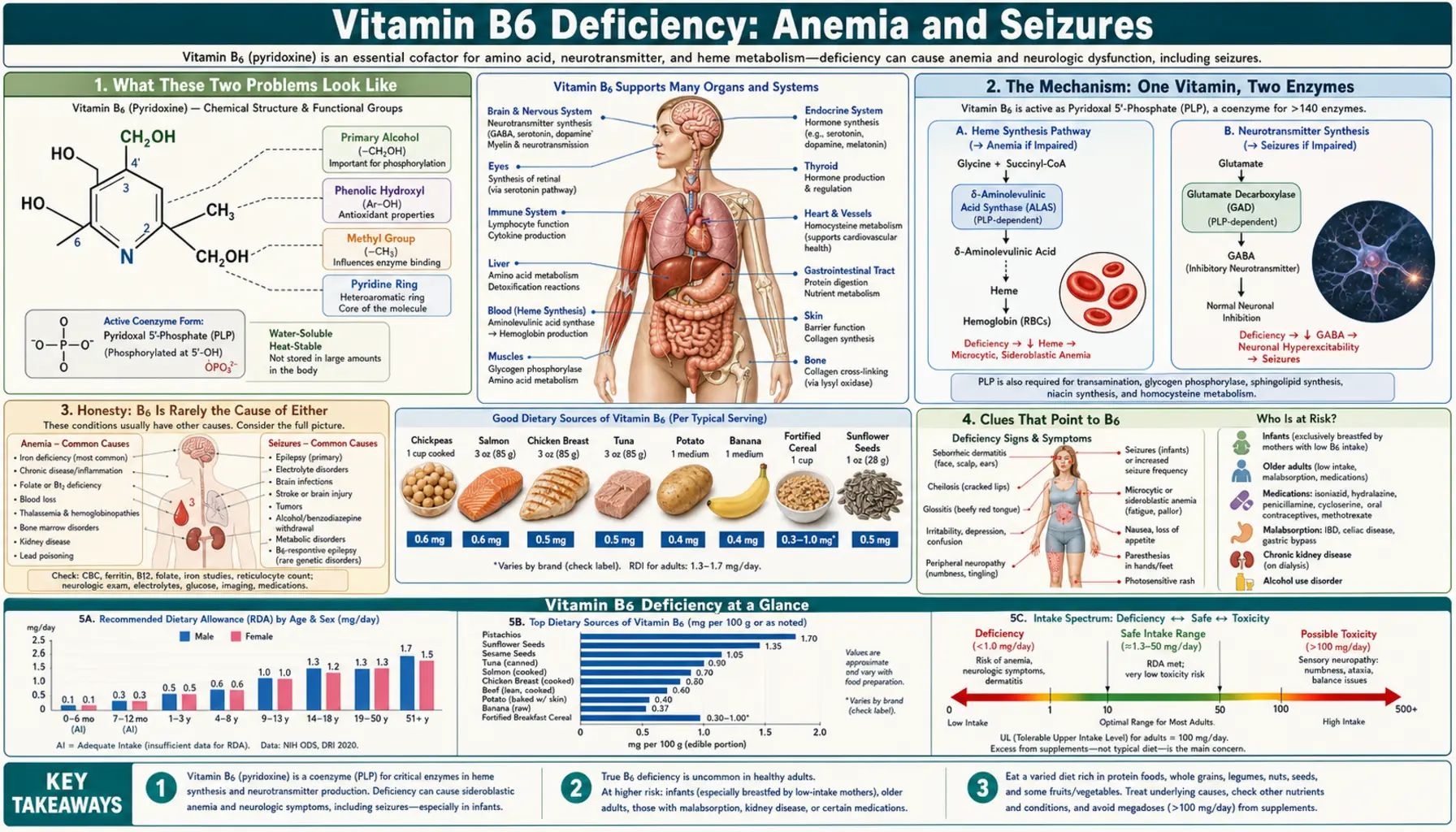
Two of the most striking consequences of a serious vitamin B6 shortfall sit at opposite ends of life. In some adults, low B6 produces an anemia in which the red cells come out small, pale, and oddly iron-loaded — a sideroblastic anemia, because the body has plenty of iron but can't finish building the red pigment (heme) that carries oxygen. In some newborns and young infants, a B6 shortage instead sets off seizures — convulsions that ordinary anti-seizure drugs barely touch but that can stop, sometimes within minutes, once B6 is given. Both trace back to the same single fact: the active form of B6, pyridoxal 5′-phosphate (PLP), is the helper molecule that two very different enzymes need to do their jobs. This page explains why a vitamin most people have never worried about can show up as anemia in a grandparent and as a frightening seizure in a baby, when each picture points to B6, and how each is corrected.
Table of Contents
- What These Two Problems Look Like
- The Mechanism: One Vitamin, Two Enzymes
- Honesty: B6 Is Rarely the Cause of Either
- Clues That Point to B6
- The Special Case: Pyridoxine-Dependent Epilepsy
- What Causes Low B6 in the First Place
- Getting Tested
- Correcting Low B6 Safely
- When to Seek Care / Red Flags
- Key Research Papers
- Connections
- Featured Videos
What These Two Problems Look Like
Although they share one root cause, the anemia and the seizures of B6 deficiency feel nothing alike and tend to appear in different people.
The anemia. An anemia from low B6 usually comes on slowly and quietly, the way most anemias do. People describe the familiar package of anemia symptoms: tiredness that sleep doesn't fix, breathlessness on stairs, pale skin and lips, a fast or pounding heartbeat, cold hands and feet, sometimes a headache or trouble concentrating. What makes a B6-related anemia distinctive is hidden inside the blood test rather than felt by the patient. The red cells are typically microcytic (smaller than normal) and hypochromic (pale, under-filled with hemoglobin) — the same pattern you see in classic iron deficiency. But here is the twist: the iron level is usually normal or even high. Under the microscope, a bone-marrow specialist may see ring sideroblasts — developing red cells with a ring of iron-stuffed mitochondria circling the nucleus. The cell has iron to spare; it simply cannot finish assembling heme around it. That combination — small pale cells plus high iron plus ring sideroblasts — is the signature of a sideroblastic anemia, and a B6-responsive form is one of its causes.
The seizures. At the other extreme, in newborns and infants, a severe B6 shortage can drive seizures. These may look like rhythmic jerking of the limbs, stiffening, repetitive eye or mouth movements, or episodes of going limp and unresponsive. In a newborn the signs can be subtle and easy to miss — lip-smacking, bicycling leg movements, pauses in breathing, an unusual cry. The hallmark that makes clinicians think of B6 is how stubborn the seizures are: they often fail to respond to the standard anti-seizure medicines used in babies, yet may stop dramatically — sometimes within minutes — after intravenous pyridoxine (vitamin B6) is given. That “drug-resistant seizure that answers to a vitamin” pattern is so important that giving a trial of B6 is a recognized step in evaluating hard-to-control neonatal seizures.
So the same deficiency speaks in two languages: a slow, silent anemia in some adults, and an acute, dramatic seizure in some infants. The rest of this page explains why one vitamin can do both.
The Mechanism: One Vitamin, Two Enzymes
Vitamin B6 is not, by itself, the working molecule. The body converts it into pyridoxal 5′-phosphate (PLP), which then acts as a coenzyme — a chemical helper that locks into the active site of an enzyme and makes a reaction possible. PLP is one of biology's busiest helpers: it assists more than 140 different enzyme reactions, most of them involving the handling of amino acids and the building of small but vital molecules. Two of those reactions explain this whole page.
Why the anemia: PLP and the first step of heme. Hemoglobin, the oxygen-carrying pigment of red blood cells, is built around a ring called heme. The very first step in making heme is performed by an enzyme called δ-aminolevulinic acid synthase (ALAS) — and ALAS absolutely requires PLP to function. In developing red cells, the relevant form is ALAS2, which sits inside the mitochondria and combines the amino acid glycine with a molecule called succinyl-CoA to start the heme assembly line. When PLP is in short supply, ALAS2 stalls. Iron keeps arriving at the mitochondria as usual, but with the production line jammed at step one, the iron has nowhere to go — so it piles up inside the mitochondria, forming the iron rings that give ring sideroblasts their name. The red cells that do get made are short on hemoglobin, so they come out small and pale. That is the entire logic of a B6-responsive sideroblastic anemia: plenty of iron, but no way to finish the heme. (This is also why a rare inherited form, X-linked sideroblastic anemia caused by an ALAS2 mutation, often improves with high-dose pyridoxine — extra B6 can partly rescue a sluggish enzyme.)
Why the seizures: PLP and the brain's brake. The brain runs on a balance between signals that excite neurons and signals that calm them. The main calming, inhibitory neurotransmitter is GABA (gamma-aminobutyric acid). GABA is made from the excitatory amino acid glutamate by an enzyme called glutamic acid decarboxylase (GAD) — and GAD, like ALAS, requires PLP to work. When PLP runs low, GAD slows down: less GABA is produced, the brain's “brake” weakens, and the balance tips toward over-excitation. In a newborn brain, which is especially dependent on tight neurotransmitter balance, that shift can be enough to trigger seizures. Restore PLP and GAD can make GABA again, the brake is reapplied, and the seizures can stop. B6's role in building GABA and other neurotransmitters is covered in more depth on the B6 and Neurotransmitter Synthesis page.
An analogy. Picture PLP as a single specialized tool — say, a particular drill bit — that two completely different workshops need. One workshop builds red blood cells; without the bit, it can't drive the first screw that starts each hemoglobin frame, so half-built frames and loose screws (iron) pile up. The other workshop makes the brain's brake pads (GABA); without the bit, it can't finish them, and a car with worn brakes is prone to running away. The same missing tool causes a parts backlog in one shop and a runaway in the other. That is why one vitamin shortfall shows up as anemia in one person and seizures in another — depending on which workshop is most stressed.
Honesty: B6 Is Rarely the Cause of Either
It would be misleading to leave you thinking that anemia means low B6, or that a seizure means low B6. Neither is true. Both symptoms have many causes, and a B6 deficiency is an uncommon one. Being honest about this matters, because chasing the wrong cause wastes time and, in the case of seizures, can be dangerous.
Anemia — the common causes come first. By far the most frequent reason for a small, pale-celled (microcytic) anemia is ordinary iron deficiency — from blood loss (heavy periods, gastrointestinal bleeding), poor intake, or poor absorption. Another common cause of microcytic cells is thalassemia, an inherited difference in hemoglobin production. Anemia of chronic disease (from ongoing inflammation, infection, or kidney disease) can also produce smaller cells. And a great many anemias are not microcytic at all: vitamin B12 and folate deficiency make red cells large (macrocytic), while sudden blood loss or red-cell destruction (hemolysis) gives normal-sized cells. The point is that when an anemia appears, B6 is well down the list; clinicians sort through iron status, B12 and folate, and signs of bleeding or chronic illness long before B6 enters the conversation. A B6-responsive sideroblastic anemia is found mainly when an anemia looks like iron deficiency but the iron is normal or high and standard treatment fails.
Seizures — the list is enormous. A first seizure, especially in an adult, almost never points to B6. Far more common causes include epilepsy of many types, fever (febrile seizures in young children), low blood sugar, low sodium, low calcium, low magnesium, head injury, stroke, brain infection, alcohol or drug withdrawal, and a long list of medications and poisons. In newborns, lack of oxygen at birth, infection, bleeding in the brain, and metabolic problems are all more common than B6 deficiency. B6 becomes a real consideration mainly in a specific scenario: a newborn or infant with seizures that don't respond to standard anti-seizure drugs, in whom a deliberate trial of pyridoxine is warranted. Outside that setting, treating every seizure as a vitamin problem would be a serious mistake.
In short: these two syndromes are real and important, but they are the exception, not the rule. The value of knowing about them is recognizing the narrow situations — outlined next — where B6 deserves to be on the list.
Clues That Point to B6
Because anemia and seizures usually have other causes, clinicians rely on specific clues before suspecting B6. The following patterns are the ones that raise the question.
For the anemia:
- “Looks like iron deficiency, but the iron is fine.” Small, pale red cells together with a normal or high iron level, high ferritin, and high transferrin saturation is the most useful red flag. True iron deficiency shows low iron stores; sideroblastic anemia shows the opposite.
- Iron supplements didn't help — or made things worse. An anemia that doesn't respond to iron, or in which iron seems to be accumulating, argues against iron deficiency and toward a problem in using iron, such as sideroblastic anemia.
- A relevant medication. Certain drugs interfere with B6 and can trigger a sideroblastic anemia — most classically isoniazid (a tuberculosis drug) and other agents that bind or deplete B6. A new anemia after starting such a drug is a meaningful clue.
- Ring sideroblasts on a bone-marrow exam. This is the defining finding, though it is only sought when the simpler clues above already point away from iron deficiency.
For the seizures:
- Age. The B6-responsive seizures that matter most occur in newborns and young infants, sometimes even before birth (mothers may report unusual rhythmic fetal movements). Onset in the first hours, days, or weeks of life is a classic setting.
- Resistance to standard drugs. Seizures that keep going despite the usual anti-seizure medicines are the single biggest clue. A vitamin that works where strong drugs failed is the surprising, telling feature.
- A dramatic response to pyridoxine. When intravenous B6 is given and the seizures stop — often quickly — that response is itself both a clue and part of the diagnosis. (This is done in a monitored setting, because the first dose can occasionally cause a baby to become very sleepy or stop breathing temporarily.)
These two symptom pages are siblings of the rest of B6 deficiency: low B6 also shows up as skin rashes and cracked lips and as nerve symptoms such as numbness and tingling. When two or more of these appear together in someone with a reason to be deficient, the case for B6 grows stronger.
The Special Case: Pyridoxine-Dependent Epilepsy
The most important pediatric scenario deserves its own section, because it is not, strictly, a dietary deficiency at all. Pyridoxine-dependent epilepsy (PDE) is a rare inherited disorder, most commonly caused by mutations in a gene called ALDH7A1, which makes an enzyme nicknamed antiquitin. Understanding it clears up a common confusion: how can a baby on a normal diet, getting plenty of B6 in formula or breast milk, still have B6-responsive seizures?
What goes wrong. Antiquitin normally helps break down lysine, an amino acid, in the brain. When it is faulty, an intermediate compound builds up and reacts with PLP, chemically inactivating it. In effect, these children have plenty of B6 coming in, but it is being destroyed inside the body faster than the brain can use it — so the brain is left functionally B6-starved, GAD can't keep up with GABA production, and seizures result. Because the problem is a constant drain on PLP rather than a one-time shortage, these children are not merely B6-deficient; they are B6-dependent — they need ongoing daily pyridoxine for life, not a single course of treatment. Stopping the vitamin lets the seizures return.
Why it matters to recognize. PDE typically begins in the newborn period or early infancy with seizures that resist standard anti-seizure drugs but respond to pyridoxine — exactly the pattern described above. The landmark discovery that ALDH7A1/antiquitin mutations cause these “pyridoxine-dependent seizures” (Mills and colleagues, 2006) transformed how the condition is diagnosed, because it can now be confirmed by measuring the build-up compounds in blood or urine and by genetic testing, rather than relying only on the response to the vitamin. Diagnosis matters enormously: children with PDE who are kept on lifelong pyridoxine can become seizure-free, although many still face developmental challenges, which is why specialists also explore additional treatments such as a lysine-restricted diet. A related, even rarer disorder responds specifically to the PLP form of the vitamin rather than to ordinary pyridoxine.
The take-home for families: a baby whose seizures stop with B6 should be evaluated for pyridoxine-dependent epilepsy, and should not have the vitamin stopped without specialist guidance. PDE is the clearest example of how B6 chemistry and the brain's seizure threshold are linked — and of why “B6-responsive” does not always mean “caused by a poor diet.”
What Causes Low B6 in the First Place
For the dietary and acquired forms (as opposed to inherited PDE), a true B6 deficiency severe enough to cause anemia or seizures rarely arises from food alone in healthy adults, because B6 is widespread in the diet — in poultry, fish, organ meats, potatoes and starchy vegetables, bananas, and fortified cereals. When deficiency does occur, it is usually because something is depleting B6 or blocking its use:
- Medications that antagonize B6. This is the leading cause worth knowing. Isoniazid (for tuberculosis) is the classic example — it binds B6 and can cause both nerve symptoms and a sideroblastic anemia, which is precisely why pyridoxine is co-prescribed with it. Other B6-depleting drugs include hydralazine (for blood pressure), penicillamine, cycloserine, and certain anti-seizure medicines. Some chemotherapy and immunosuppressive agents also lower B6.
- Alcohol use. Heavy alcohol intake lowers B6 in two ways: people who drink heavily often eat poorly, and a breakdown product of alcohol (acetaldehyde) actively displaces PLP from its carrier protein and speeds its destruction. Alcohol-related deficiency is one of the more common real-world causes.
- Kidney disease and dialysis. B6 is lost during dialysis, so people with advanced kidney disease can run low and may need supplementation.
- Malabsorption. Conditions such as celiac disease, inflammatory bowel disease, and other causes of poor nutrient absorption can lower B6 along with other vitamins.
- Increased need or poor intake at the extremes of life. Some older adults have low B6 from limited diets, and very rarely an infant fed a formula deficient in B6 can develop seizures — a scenario described historically, after a manufacturing error destroyed the B6 in a batch of infant formula in the 1950s, which produced an outbreak of infant convulsions and first taught medicine how essential B6 is to the developing brain.
Notice how many of these overlap with the clues above: a medication like isoniazid, or heavy alcohol use, can produce both the anemia and nerve symptoms at once, which is one reason B6 is considered when several of its deficiency signs cluster together.
Getting Tested
Working up these problems is really two separate evaluations — one for the anemia, one for the seizures — and in both, B6 testing comes after the common causes are addressed.
For the anemia. The starting point is a Complete Blood Count (CBC), which reveals the anemia and, crucially, the red-cell size (the MCV). A low MCV (microcytic) anemia prompts an Iron Panel — serum iron, ferritin, and transferrin saturation. This is the fork in the road: low iron stores point to ordinary iron deficiency, while normal or high iron with a microcytic anemia raises the possibility of sideroblastic anemia and other iron-use disorders. From there a clinician may check B12 and folate to rule out the macrocytic anemias, consider thalassemia testing, and — when sideroblastic anemia is genuinely suspected — arrange a bone-marrow examination, where iron staining can reveal the ring sideroblasts that confirm it. A B6 level can be measured (as plasma PLP), and a trial of pyridoxine that improves the anemia helps confirm a B6-responsive form. Genetic testing may follow if an inherited (e.g., ALAS2) cause is likely.
For the seizures. Newborn and infant seizures are a medical emergency evaluated urgently. The first job is to find and fix the common, treatable causes fast — checking blood sugar, sodium, calcium, and magnesium; looking for infection; and imaging the brain. When seizures persist despite standard anti-seizure medication, B6 enters the picture: a supervised trial of intravenous pyridoxine is given, with the response carefully watched. If seizures stop, the child is investigated for pyridoxine-dependent epilepsy — today this is done by measuring specific marker compounds (such as α-aminoadipic semialdehyde) in blood or urine and by ALDH7A1 genetic testing, which can confirm the diagnosis without relying on the vitamin trial alone.
The unifying theme is that B6 is confirmed by a combination of the right clinical picture, a measured low or functionally low B6, and a response to giving it — not by guessing.
Correcting Low B6 Safely
How B6 is replaced depends entirely on the cause and the setting. These problems are not self-treated; they are managed by clinicians, and the doses involved can be far higher than ordinary nutritional amounts.
- Sideroblastic anemia (B6-responsive). When a sideroblastic anemia is shown or suspected to be B6-responsive, treatment is pyridoxine, often at high doses (well above the everyday requirement), continued and monitored by a hematologist. Inherited X-linked forms (ALAS2) frequently improve — sometimes substantially — on high-dose pyridoxine, though not everyone responds fully. If the cause is a drug like isoniazid, the offending drug is reviewed and B6 is supplemented. A critical caution: because the iron is already normal or high, iron supplements are generally not the answer and can be harmful, and people with sideroblastic anemia are at risk of iron overload over time.
- Infant seizures. Acute B6-responsive seizures are stopped with intravenous pyridoxine given under monitoring, because the first dose can cause temporary deep sleepiness or pauses in breathing. If the diagnosis is pyridoxine-dependent epilepsy, the child then needs ongoing daily pyridoxine, usually for life, at a dose set by a specialist — and specialists may add a lysine-restricted diet or other measures to support brain development.
- Drug- or alcohol-related deficiency. Here the fix is to address the cause — co-prescribe B6 with isoniazid, reduce alcohol, support nutrition — alongside repletion. With isoniazid, modest daily pyridoxine alongside the antibiotic is standard preventive practice.
- Everyday prevention. For ordinary nutritional adequacy (a different matter from treating these syndromes), the adult RDA for B6 is about 1.3–1.7 mg per day, easily met by a normal diet rich in poultry, fish, potatoes, bananas, and whole grains. There is no need for most people to take B6 supplements.
A note of caution that cuts the other way. More B6 is not automatically better. Long-term, high-dose pyridoxine supplements (taken for months to years, typically at gram-level or near-gram-level doses) can themselves cause a sensory nerve problem — numbness, tingling, and unsteadiness — which is the subject of the B6 overview and its toxicity discussion. The high doses used to treat sideroblastic anemia or PDE are deliberately chosen and medically monitored precisely because of this risk; they are not a model for casual self-supplementation.
When to Seek Care / Red Flags
Most of what is on this page is handled by clinicians once the right tests are done. But certain situations call for urgent medical attention, not a routine appointment:
- Any seizure in a newborn or infant. Treat it as an emergency — call emergency services. Newborn seizures can be subtle (lip-smacking, bicycling legs, pauses in breathing, sudden limpness or stiffening); when in doubt, seek help immediately.
- A seizure that won't stop, or seizures that come one after another without the person recovering in between — this is a life-threatening emergency at any age.
- Severe anemia symptoms: chest pain, marked shortness of breath at rest, fainting or near-fainting, or a very fast or irregular heartbeat. These mean the anemia is straining the heart and need prompt evaluation.
- A new or worsening anemia after starting a medication such as isoniazid, or while drinking heavily — worth a timely (not emergency) medical review, because it may be reversible once the cause is addressed.
- New numbness, tingling, or unsteadiness in someone taking high-dose B6 supplements — stop the supplement and seek advice; this can be a sign of B6 excess, not deficiency.
The overarching message: a seizure — especially in a baby — is always an emergency, and a stubborn anemia deserves a proper diagnostic work-up rather than guesswork or unsupervised iron or vitamin pills.
Key Research Papers
- Parra M, Stahl S, Hellmann H (2018). Vitamin B6 and Its Role in Cell Metabolism and Physiology. Cells;7(7):84. — DOI: 10.3390/cells7070084
- Stach K, Stach W, Augoff K (2021). Vitamin B6 in Health and Disease. Nutrients;13(9):3229. — DOI: 10.3390/nu13093229
- Clayton PT (2006). B6-responsive disorders: a model of vitamin dependency. Journal of Inherited Metabolic Disease;29(2-3):317-326. — DOI: 10.1007/s10545-005-0243-2
- Ducamp S, Fleming MD (2019). The molecular genetics of sideroblastic anemia. Blood;133(1):59-69. — DOI: 10.1182/blood-2018-08-815951
- Harris JW (1994). X-Linked, Pyridoxine-Responsive Sideroblastic Anemia. New England Journal of Medicine;330(10):709-711. — DOI: 10.1056/NEJM199403103301011
- Ducamp S, Fleming MD (2018). Congenital sideroblastic anemias: from molecular causes to treatment. HemaSphere;2(S2):80-82. — DOI: 10.1097/HS9.0000000000000090
- Haden HT (1967). Pyridoxine-Responsive Sideroblastic Anemia Due to Antituberculous Drugs. Archives of Internal Medicine;120(5):602-606. — DOI: 10.1001/archinte.1967.00300040086015
- Coursin DB (1954). Convulsive seizures in infants with pyridoxine-deficient diet. Journal of the American Medical Association;154(5):406-408. — DOI: 10.1001/jama.1954.02940390030009
- Mills PB, Struys E, Jakobs C, et al. (2006). Mutations in antiquitin in individuals with pyridoxine-dependent seizures. Nature Medicine;12(3):307-309. — DOI: 10.1038/nm1366
- Kaminiów K, Pająk M, Pająk R, et al. (2022). Pyridoxine-Dependent Epilepsy and Antiquitin Deficiency Resulting in Neonatal-Onset Refractory Seizures. Brain Sciences;12(1):65. — DOI: 10.3390/brainsci12010065
- Tseng L, Teela L, Janssen M, et al. (2022). Pyridoxine-dependent epilepsy (PDE-ALDH7A1) in adulthood: a Dutch pilot study exploring clinical and patient-reported outcomes. Molecular Genetics and Metabolism Reports;31:100853. — DOI: 10.1016/j.ymgmr.2022.100853
- Minns AB, Ghafouri N, Clark RF (2010). Isoniazid-Induced Status Epilepticus in a Pediatric Patient After Inadequate Pyridoxine Therapy. Pediatric Emergency Care;26(5):380-381. — DOI: 10.1097/PEC.0b013e3181db24b6
PubMed Topic Searches
- PubMed — Pyridoxine-responsive sideroblastic anemia
- PubMed — Pyridoxine-dependent epilepsy (ALDH7A1 / antiquitin)
- PubMed — Vitamin B6 deficiency and infant seizures
- PubMed — Isoniazid, pyridoxine, and sideroblastic anemia
- PubMed — ALAS2, pyridoxal phosphate, and heme synthesis
Connections
- All Vitamins
- Vitamin B6 Deficiency Hub
- B6 Deficiency: Skin Rashes & Cracked Lips
- B6 Deficiency: Nerve Symptoms
- B6 Deficiency: Depression & Confusion
- Vitamin B6 Overview
- B6 and Neurotransmitter Synthesis
- B6 Benefits
- Anemia
- Epilepsy
- Iron Deficiency
- Iron Overview
- Vitamin B12
- Complete Blood Count
- Iron Panel
- Vitamin B12 Test
- Homocysteine Test