Vitamin B6 Deficiency: Nerve Symptoms
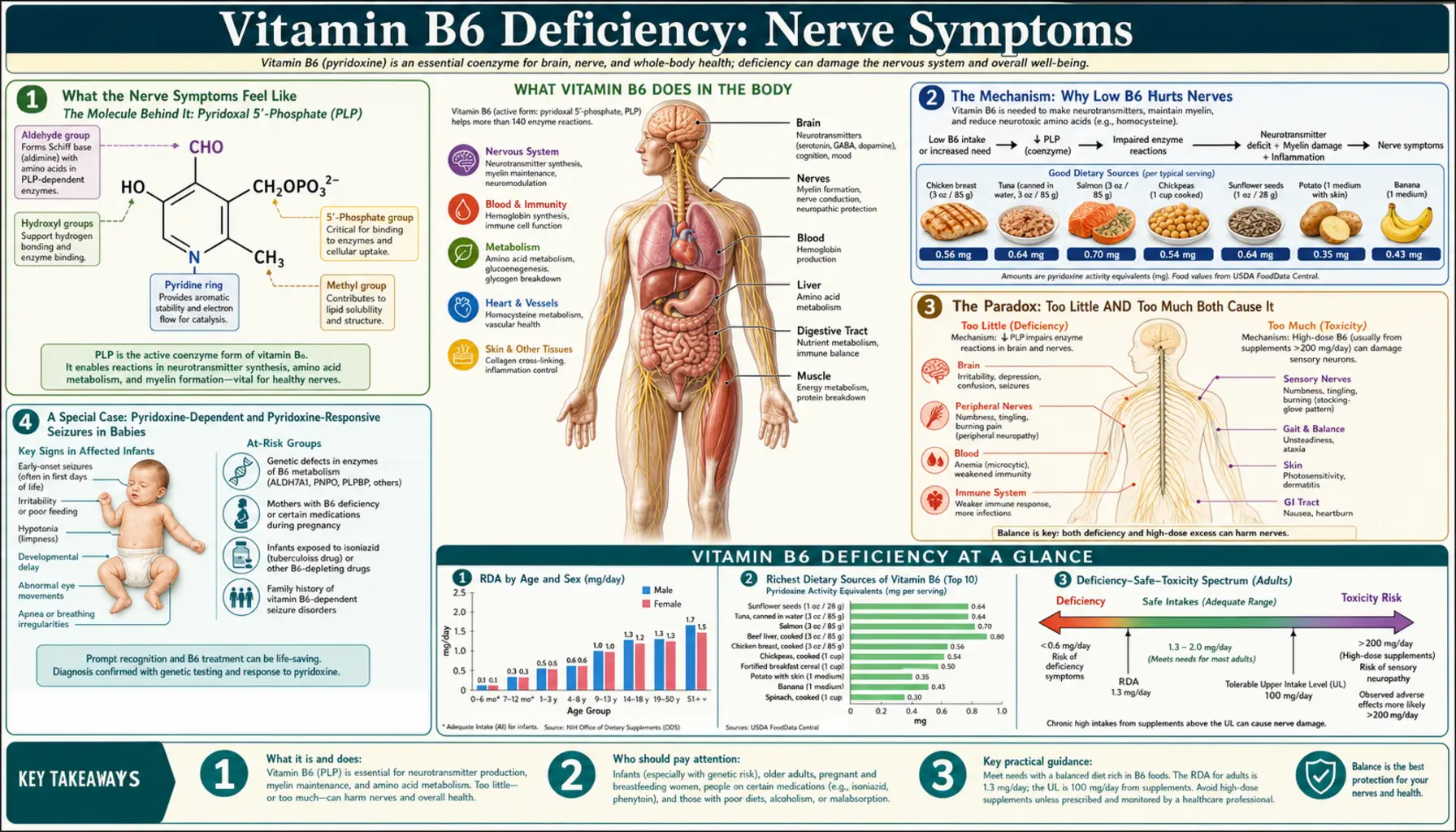
One of the strangest facts in all of nutrition is that vitamin B6 can damage your nerves two opposite ways: getting too little of it and taking far too much of it both cause the same kind of trouble — peripheral neuropathy, the burning, tingling, pins-and-needles, numb-feet sensation of damaged sensory nerves. This page is about the deficiency side: why a long-running shortage of B6 starves the nerves of a cofactor they cannot work without, what that feels like, who is at risk, and how it is corrected. If you instead arrived here because you take a high-dose B6 supplement and your hands or feet have gone tingly, that is the other story — megadose toxicity — and you should read the Vitamin B6 Toxicity leg, because the fix there is the opposite (stop the supplement, do not take more). Do not confuse the two.
Table of Contents
- What the Nerve Symptoms Feel Like
- The Mechanism: Why Low B6 Hurts Nerves
- The Paradox: Too Little AND Too Much Both Cause It
- A Special Case: Pyridoxine-Dependent and Pyridoxine-Responsive Seizures in Babies
- Be Honest: Many Things Cause Numb, Tingling Feet
- Clues That Point Toward B6
- What Drives B6 Low Enough to Affect Nerves
- Getting Tested
- Correcting Low B6 Safely
- When to Seek Care / Red Flags
- Key Research Papers
- Connections
- Featured Videos
What the Nerve Symptoms Feel Like
The nerve symptoms of vitamin B6 deficiency are those of a peripheral sensory neuropathy — damage to the long sensory nerves that carry sensation from the skin back to the spinal cord. Because those nerves are longest where they reach the feet, the trouble almost always starts there and works inward. People describe it in a handful of consistent ways:
- Tingling and “pins and needles” (the medical word is paresthesia) — a prickling, fizzing, or buzzing feeling in the toes and soles, often worse at night or when resting.
- Numbness — a deadened, padded, or “walking on cotton wool” sensation. Small objects underfoot are hard to feel; the floor can seem far away.
- Burning or a deep ache — some people feel a hot, raw, or burning discomfort rather than numbness, again most often in the feet.
- A “stocking-and-glove” pattern — the symptoms typically affect both feet roughly equally and creep up the legs over weeks to months; in more advanced cases the fingertips and hands follow the same symmetric pattern.
- Unsteadiness — when the nerves that report joint position are affected, balance suffers, especially in the dark or with the eyes closed, and some people feel wobbly on their feet.
The hallmark is that it is symmetric (both sides), distal (worst at the far ends — feet before legs, fingers before arms), and length-dependent (longest nerves first). It is usually a problem of sensation — what you feel — more than of strength, at least early on. That symmetric, feet-first signature is an important clue that separates a nutritional neuropathy from, say, a pinched nerve in one leg or a single trapped nerve at the wrist.
The Mechanism: Why Low B6 Hurts Nerves
Vitamin B6 is a family of related compounds (pyridoxine, pyridoxal, pyridoxamine and their phosphate forms). The body converts them into one master active form: pyridoxal 5′-phosphate, abbreviated PLP. PLP is a coenzyme — a small helper molecule that more than 140 different enzymes physically clamp onto in order to do their jobs. Without enough PLP, those enzymes stall.
Several of the reactions that depend most heavily on PLP happen to be the ones nerves cannot function without:
- Building neurotransmitters. PLP is the cofactor for the decarboxylase enzymes that make the brain and nervous system’s chemical messengers — including GABA (the main calming signal), serotonin, dopamine, and norepinephrine. When PLP runs short, the assembly line for these messengers slows. (The same shortfall is why severe deficiency can also tip into seizures and mood changes.)
- Sphingolipid and myelin metabolism. PLP-dependent enzymes help build sphingolipids, the fatty molecules that make up myelin — the insulating sheath around nerve fibers. Damaged insulation means signals that travel poorly or not at all.
- Amino-acid handling. PLP powers the transaminases and other enzymes that shuffle amino acids and keep one-carbon metabolism running (the same machinery that, with B6, folate and B12, clears homocysteine). Disruption here adds metabolic stress to already-struggling nerve cells.
An analogy. Picture PLP as a single shared key that opens dozens of locked tool cabinets along a factory floor. The workers (the enzymes) are present and willing, but if there are too few keys, cabinet after cabinet stays shut and the work simply does not get done. The longest production lines — the ones running all the way out to the feet — are the first to fall behind, because they have the most cabinets to open and the least slack. Restore the keys (PLP) and the lines can start moving again; this is why mild, recently-developed deficiency neuropathy can improve once B6 is replaced, though nerves heal slowly and very long-standing damage may only partly recover.
The Paradox: Too Little AND Too Much Both Cause It
This is the single most important thing to understand about B6 and nerves, and it confuses patients and clinicians alike: both ends of the B6 range can produce a peripheral neuropathy. The picture can look nearly identical from the outside — tingling, numb, burning feet in a stocking-and-glove pattern — but the cause and the cure are opposite.
- Deficiency neuropathy (this page) comes from a long-running shortage of B6, which starves nerves of the PLP coenzyme described above. The fix is to restore B6 — food first, then a measured supplement if needed.
- Toxicity neuropathy comes from taking too much supplemental B6, usually high-dose pyridoxine over months or years (classically gram-level doses, but cases are reported at lower long-term intakes too). Excess pyridoxine appears to overwhelm and damage the sensory nerve cell bodies. The fix is to stop the supplement — taking more B6 makes it worse.
The practical danger is obvious: a person with tingling feet who assumes “I must be low on a vitamin” and starts a high-dose B6 supplement could, if their problem was actually too much B6 (or if they push the dose far too high), make a toxic neuropathy worse. This is exactly why B6 should not be megadosed on a hunch, and why a blood test matters before treating. The toxicity side — how much is too much, the safe upper limit, and how to recognize it — is covered in full on the Vitamin B6 Toxicity leg. If you take a B6 supplement and have new tingling, read that page, not this one, and talk to a clinician before changing your dose.
A Special Case: Pyridoxine-Dependent and Pyridoxine-Responsive Seizures in Babies
There is a rare but vivid pediatric story where B6 and the nervous system collide, and it deserves its own section because it behaves unlike ordinary adult deficiency. It is not a dietary shortage at all — it is a genetic problem in handling B6 — but it is the clearest example of how completely the nervous system depends on this vitamin.
Pyridoxine-dependent epilepsy (PDE) is a rare inherited disorder, most often caused by mutations in a gene called ALDH7A1 (also called antiquitin). The faulty enzyme lets a toxic byproduct build up that inactivates PLP — chemically clamping onto and using up the very B6 coenzyme the brain needs. Affected newborns develop seizures, often in the first hours or days of life, that do not respond to standard anti-seizure medicines but stop dramatically when pyridoxine (B6) is given, sometimes within minutes. The discovery that ALDH7A1/antiquitin mutations cause this condition was a landmark in metabolic medicine. Children with PDE typically need lifelong daily pyridoxine (alongside other measures such as a lysine-restricted diet in some protocols) to stay seizure-free, and early diagnosis matters for brain development.
A closely related and broader idea is pyridoxine-responsive (or B6-responsive) seizures: any neonatal or infantile seizures that settle once B6 is supplied. Because the stakes are so high and the test so simple, it is standard practice in many centers to give a trial of pyridoxine to a newborn with otherwise-unexplained, treatment-resistant seizures. (There is also a related disorder of the PNPO enzyme, which makes the active PLP form, that responds specifically to pyridoxal phosphate rather than to plain pyridoxine.)
The takeaway for families: these are rare, specialist-managed genetic conditions, not the everyday low-B6 deficiency this page is mostly about — but they are the most striking proof of how essential B6 is to the nervous system. Ordinary seizures in older children and adults are not usually caused by B6 deficiency and should never be self-treated with high-dose B6. General B6-and-seizure information for the deficiency context lives on the sibling page, Vitamin B6 Deficiency: Anemia & Seizures.
Be Honest: Many Things Cause Numb, Tingling Feet
It would be misleading to suggest that tingling or numb feet means you are low on B6. In reality, peripheral neuropathy is common and has many causes, and B6 deficiency is far from the most frequent one. An honest list of the usual suspects helps put it in perspective:
- Diabetes (and prediabetes) — chronically high blood sugar is the single most common cause of peripheral neuropathy in the developed world. See Diabetes and the overview at Peripheral Neuropathy.
- Vitamin B12 deficiency — another nutritional cause, classic in vegans, older adults, and people on long-term acid-reducing drugs or metformin; see Vitamin B12.
- Alcohol — heavy use damages nerves directly and through poor nutrition (often including low B6 itself).
- Medications — certain chemotherapy drugs, some antibiotics, and others can be neurotoxic.
- Thyroid disease, kidney disease, autoimmune and inflammatory conditions, and inherited neuropathies — all can present with the same tingling, numb feet.
- Mechanical nerve compression — a trapped nerve such as carpal tunnel syndrome at the wrist, or a pinched nerve in the back, but these are usually one-sided and follow a single nerve’s territory rather than the symmetric stocking-and-glove pattern.
- Too much B6 — as covered above, megadose B6 toxicity is itself a cause and must be ruled in or out before assuming deficiency.
The right move when feet go numb or tingly is not to guess, but to get evaluated. A clinician will sort through this list with a history, an exam, and a few blood tests — and B6 status is reasonably checked as part of that workup, not assumed.
Clues That Point Toward B6
While numb, tingling feet are non-specific, a few features make low B6 more plausible and worth checking:
- A reason to be deficient. B6 deficiency rarely strikes a well-nourished person out of the blue. It is more believable when there is a clear setup — heavy alcohol use, long-term use of certain medications (see below), kidney disease on dialysis, a malabsorption condition, or a very poor diet.
- Company it keeps. True B6 deficiency tends to travel with other signs of the same shortage: a red, scaly, greasy rash or cracked lips and sore tongue, low mood or confusion, and a particular kind of anemia. Neuropathy appearing alongside these is more suggestive than neuropathy alone.
- The isoniazid connection. The tuberculosis drug isoniazid (INH) directly inactivates B6 and is a well-known, almost textbook cause of a B6-related peripheral neuropathy — which is exactly why pyridoxine is co-prescribed with it to prevent nerve damage.
- It improves with replacement. If a confirmed low B6 is corrected and the early neuropathy eases, that supports the diagnosis after the fact.
Even with these clues, the diagnosis is confirmed with a blood test rather than assumed — and the toxicity possibility is always considered in anyone already taking B6.
What Drives B6 Low Enough to Affect Nerves
B6 is widespread in the food supply — it is found in fish, poultry, organ and other meats, starchy vegetables, and many other foods — so an outright dietary deficiency severe enough to damage nerves is uncommon in healthy people eating a varied diet. When it does happen, there is usually one or more of these drivers:
- Medications that antagonize B6. The classic example is isoniazid for tuberculosis; others include certain other drugs that bind or deplete B6. This is the most reliably nerve-relevant cause, and prophylactic pyridoxine is standard with isoniazid for exactly this reason.
- Heavy alcohol use. Alcohol both displaces good nutrition and interferes with how the body activates and retains B6, making low B6 common in people who drink heavily.
- Kidney disease, especially dialysis. Dialysis removes water-soluble vitamins, including B6, which is why people on dialysis are often supplemented.
- Malabsorption. Celiac disease, inflammatory bowel disease, and other gut disorders can impair absorption of B6 along with other nutrients.
- Increased need or poor intake. Pregnancy, very restricted or processed diets, and some chronic illnesses raise the risk of falling short.
It is worth noting that population surveys find a meaningful fraction of people, including certain older adults and women using oral contraceptives, have low-normal or marginally low B6 levels by blood testing — usually without symptoms. Marginal status is common; symptomatic deficiency neuropathy is much rarer and tends to require one of the stronger drivers above.
Getting Tested
B6 status is measured with a blood test for plasma pyridoxal 5′-phosphate (PLP) — the active form — which is the standard direct marker of B6 status. It is a simple blood draw; a low PLP level supports a diagnosis of deficiency, while a normal or high level argues against it (and a high level in someone who supplements raises the question of toxicity instead). Because B6 problems can cut both ways, knowing the actual number is genuinely useful before treating.
B6 is not on a routine Comprehensive Metabolic Panel, so it has to be ordered specifically. In practice, a clinician evaluating numb or tingling feet will usually test for the more common causes at the same time — blood sugar and HbA1c for diabetes, vitamin B12, thyroid and kidney function — and may add a PLP level when the history fits. An elevated homocysteine can also be a downstream clue of poor B-vitamin status, though it is not specific to B6.
If the diagnosis is uncertain, a neurologist may use nerve conduction studies and electromyography (EMG) to confirm and characterize a peripheral neuropathy — useful both to document the nerve damage and to help separate a length-dependent sensory neuropathy (the B6 pattern) from other types.
Correcting Low B6 Safely
If a true deficiency is confirmed, restoring B6 is straightforward — and the watchword is enough, not excess, precisely because too much B6 has its own nerve toxicity.
- Food first. For mild or marginal deficiency, B6-rich whole foods are the foundation: fish such as salmon and tuna, poultry and other meats including pork and beef, chickpeas and other legumes, potatoes and starchy vegetables, and bananas. The adult RDA for B6 is modest — on the order of 1.3–1.7 mg/day — and a varied diet easily supplies it.
- Measured supplementation, when needed. When diet alone is not enough — or when an ongoing cause (like a medication or dialysis) keeps draining B6 — a clinician may prescribe a B6 supplement at a sensible dose to correct the deficiency and maintain levels. The key is to use the amount actually needed, not a megadose.
- Treat the cause. Addressing why B6 dropped — co-prescribing pyridoxine with isoniazid, reducing alcohol, managing malabsorption, supplementing on dialysis — is what makes the correction stick.
- Mind the ceiling. Because high-dose B6 can itself cause neuropathy, supplementation is kept at appropriate levels and not stacked up “just in case.” If you are already taking B6 and have nerve symptoms, the move may be to reduce or stop it, not add more — see Vitamin B6 Toxicity.
Recovery of nerves is slow. Sensory symptoms from a recently-developed, mild deficiency may improve over weeks to months once B6 is restored, but long-standing nerve damage can be incomplete in its recovery — which is why catching and correcting it early matters.
When to Seek Care / Red Flags
Numb or tingling feet always deserve a proper evaluation rather than self-treatment — both because the cause needs identifying and because guessing wrong (especially adding high-dose B6) can do harm. See a clinician promptly for any of the following:
- New, spreading, or worsening numbness, tingling, or burning in the feet or hands — especially if it is climbing up the legs.
- Weakness, foot drop, frequent tripping, or worsening balance — signs the problem may be progressing beyond pure sensation.
- Nerve symptoms while taking a B6 supplement — do not increase the dose; stop or reduce it and seek advice, because this may be B6 toxicity.
- Numbness with diabetes — loss of foot sensation raises the risk of unnoticed injuries and ulcers and needs active foot care and follow-up.
- A baby or young child with seizures — this is an emergency in its own right and must be assessed by doctors immediately; pyridoxine-responsive seizures are a specialist diagnosis, never a home remedy.
- Sudden, severe, or one-sided numbness or weakness, or symptoms with bowel/bladder changes — treat as urgent, as these point away from a slow nutritional cause toward something needing immediate attention.
The reassuring reality is that confirming or excluding B6 as the culprit takes one inexpensive blood test, and most early deficiency neuropathy responds to correcting the shortage — provided the dose is right and any toxicity is ruled out first.
Key Research Papers
- Stach K, Stach W, Augoff K (2021). Vitamin B6 in Health and Disease. Nutrients;13(9):3229. — DOI: 10.3390/nu13093229
- Parra M, Stahl S, Hellmann H (2018). Vitamin B6 and Its Role in Cell Metabolism and Physiology. Cells;7(7):84. — DOI: 10.3390/cells7070084
- Ueland PM, Ulvik A, Rios-Avila L, et al. (2015). Direct and Functional Biomarkers of Vitamin B6 Status. Annual Review of Nutrition;35(1):33-70. — DOI: 10.1146/annurev-nutr-071714-034330
- Morris MS, Picciano MF, Jacques PF, Selhub J (2008). Plasma pyridoxal 5′-phosphate in the US population: the National Health and Nutrition Examination Survey, 2003–2004. The American Journal of Clinical Nutrition;87(5):1446-1454. — DOI: 10.1093/ajcn/87.5.1446
- Muhamad R, Akrivaki A, Papagiannopoulou G, et al. (2023). The Role of Vitamin B6 in Peripheral Neuropathy: A Systematic Review. Nutrients;15(13):2823. — DOI: 10.3390/nu15132823
- Reddy P (2021). Preventing Vitamin B6–Related Neurotoxicity. American Journal of Therapeutics;29(6):e637-e643. — DOI: 10.1097/mjt.0000000000001460
- Nisar M, Watkin SW, Bucknall RC, Agnew RAL (1990). Exacerbation of isoniazid induced peripheral neuropathy by pyridoxine. Thorax;45(5):419-420. — DOI: 10.1136/thx.45.5.419
- Mills PB, Struys E, Jakobs C, et al. (2006). Mutations in antiquitin in individuals with pyridoxine-dependent seizures. Nature Medicine;12(3):307-309. — DOI: 10.1038/nm1366
- NIH Office of Dietary Supplements. Vitamin B6 — Health Professional Fact Sheet (deficiency, requirements, and safety/upper limit). — PubMed: vitamin B6 deficiency and peripheral neuropathy reviews
- Consensus literature on pyridoxine-dependent (ALDH7A1) and pyridoxine-responsive epilepsy — diagnosis and lifelong management. — PubMed: pyridoxine-dependent epilepsy ALDH7A1 management
PubMed Topic Searches
- PubMed — Vitamin B6 deficiency and peripheral neuropathy
- PubMed — Pyridoxine toxicity and sensory neuropathy (the other side)
- PubMed — Isoniazid, pyridoxine prophylaxis, and neuropathy
- PubMed — Pyridoxine-dependent epilepsy (ALDH7A1 / antiquitin)
- PubMed — Plasma PLP and B6 status in populations
Connections
- All Vitamins
- Vitamin B6 Deficiency Hub
- B6 Deficiency: Skin Rashes & Cracked Lips
- B6 Deficiency: Depression & Confusion
- B6 Deficiency: Anemia & Seizures
- Vitamin B6 Toxicity (megadose neuropathy)
- Vitamin B6 Overview
- Vitamin B6 Food Sources
- Peripheral Neuropathy
- Diabetes
- Carpal Tunnel Syndrome
- Vitamin B12
- Magnesium
- Comprehensive Metabolic Panel
- Homocysteine Test
- Salmon
- Chickpeas