Vitamin C Toxicity (High-Dose Vitamin C): Symptoms, Causes, and Risks
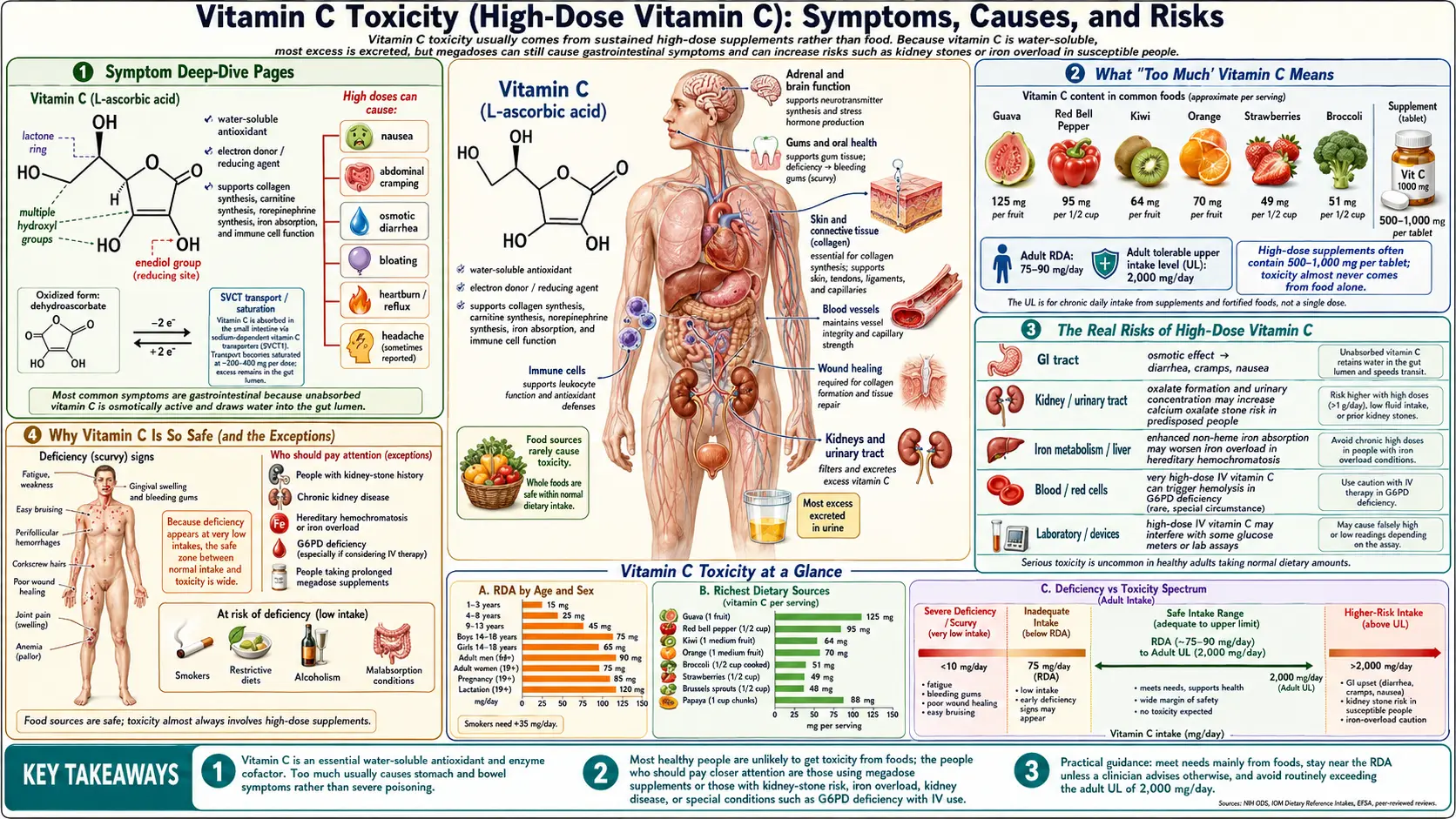
Vitamin C is one of the safest of all vitamins, and true "toxicity" in the way we think of toxic metals or a vitamin A overdose essentially does not exist — it is a water-soluble vitamin, so your body simply absorbs less of it and flushes the surplus out in your urine. Here is the honest, balanced picture: you cannot get too much vitamin C from food, and even large supplement doses are not dangerous for most healthy people. What can happen, and what this page is really about, are a handful of real but mild, dose-dependent nuisances and risks that show up mostly above roughly 2,000 mg a day — the official Tolerable Upper Intake Level (UL) for adults. The most common is simple digestive upset: cramps, nausea, and osmotic diarrhea once you swallow more than your gut can absorb. In people prone to calcium-oxalate kidney stones, very high doses can modestly raise stone risk because some excess vitamin C is converted to oxalate. And because vitamin C boosts iron absorption, large doses are a genuine concern for the small group with iron-overload conditions such as hereditary hemochromatosis. None of this means vitamin C is hazardous — it means a few specific situations call for a sensible ceiling. This hub explains what counts as "too much," who actually needs to be careful, and what to do, with deep-dive pages on each effect. For nearly everyone, vitamin C is benign; the fixes here are simple.
Symptom Deep-Dive Pages
Digestive Upset & Diarrhea
The most common and most harmless effect of megadosing vitamin C — how unabsorbed ascorbic acid pulls water into the gut and triggers osmotic diarrhea, cramps, and nausea, and why it stops as soon as you lower the dose.
Kidney Stones
The modest, real link between very high-dose vitamin C and calcium-oxalate stones — how some excess vitamin C is converted to oxalate, who is actually at risk, and why food sources and ordinary doses are not the problem.
Iron Overload Risk
Why vitamin C’s helpful ability to boost iron absorption becomes a genuine caution for the small group with hereditary hemochromatosis or other iron-overload conditions — and why this rarely matters for everyone else.
Interactive Visualization Vitamin C, Collagen & Why Sailors Fell Apart Zip three protein chains into the strongest rope in biology — then take the vitamin C away and watch the helix unravel, and old healed scars split back open. Launch →
Table of Contents
- Symptom Deep-Dive Pages
- What "Too Much" Vitamin C Means
- The Real Risks of High-Dose Vitamin C
- Why Vitamin C Is So Safe (and the Exceptions)
- What Causes a Vitamin C Excess
- How a Vitamin C Problem Is Recognized
- What to Do About Too Much Vitamin C
- When to Seek Care / Red Flags
- Key Research Papers
- Connections
- Featured Videos
What "Too Much" Vitamin C Means
Vitamin C (ascorbic acid) is an essential, water-soluble nutrient. That single word — water-soluble — is the key to understanding why it is so hard to overdose on. Unlike the fat-soluble vitamins (A, D, E, and K), which the body can store in fat and the liver and which therefore can build up to toxic levels, water-soluble vitamins dissolve in the watery part of your blood, and any surplus your body does not need is filtered out by the kidneys and lost in the urine. Your body keeps very little vitamin C in reserve, and it has a built-in ceiling on how much it will take in.
That ceiling matters. Careful pharmacokinetic studies showed that vitamin C absorption is tightly regulated: when you take it by mouth, the fraction your gut absorbs falls steadily as the dose rises. At a normal dietary intake you absorb the large majority of it; at single doses around 200–500 mg the body is already close to "full," and at very large doses (above roughly 1,000 mg at once) absorption drops sharply and the kidneys dump the rest. In other words, swallowing a 2,000 mg tablet does not put 2,000 mg of usable vitamin C into your blood — much of it never gets absorbed at all, and what does get in is quickly excreted. This is why blood levels of vitamin C plateau and simply will not climb into a dangerous range from oral pills, no matter how many you take.
So what counts as "too much"? The Food and Nutrition Board sets two useful numbers for adults:
- The Recommended Dietary Allowance (RDA) — about 90 mg/day for men and 75 mg/day for women (smokers need an extra 35 mg/day). This is the small amount that prevents deficiency and keeps tissues replete; it is easily met by a normal diet with fruit and vegetables.
- The Tolerable Upper Intake Level (UL) — 2,000 mg/day for adults. This is not a poison threshold. It is the daily amount above which the mild, dose-dependent side effects (mainly gut upset and diarrhea) become likely enough that experts flag it as a sensible ceiling for routine supplementation.
Two honest points follow. First, you cannot reach a harmful intake from food. An orange has about 70 mg; a cup of strawberries about 85 mg; a red bell pepper around 150 mg. You would have to eat an implausible amount of produce to approach the UL, and no recognized illness comes from a vitamin-C-rich diet. The issues on this page come almost entirely from high-dose supplements — the 1,000 mg "immune support" tablets, effervescent megadose powders, or intravenous infusions used in some alternative-medicine settings. Second, the word "toxicity" overstates the case. There is no vitamin C poisoning syndrome the way there is for vitamin A or vitamin D. What exists is a short list of mild and reversible effects, plus a couple of situations — oxalate kidney stones and iron overload — where high doses genuinely warrant caution. The rest of this page treats each of those accurately, without alarm and without dismissing them.
The Real Risks of High-Dose Vitamin C
Because vitamin C does not accumulate to poisonous levels, the genuine concerns are not about the vitamin "building up." They are three specific, dose-dependent effects, each with its own mechanism. It helps to keep them in proportion: the first is common but trivial, and the second and third matter chiefly to particular groups of people.
- Digestive upset and diarrhea — common, harmless, and the dose-limiting effect. This is by far the most frequent consequence of taking too much vitamin C, and it is the main reason the UL exists. Once you swallow more vitamin C than your intestine can absorb, the unabsorbed ascorbic acid stays in the gut, where (like any poorly absorbed substance) it draws water in by osmosis and speeds things along. The result is nausea, abdominal cramps, bloating, and loose stools or diarrhea. It is uncomfortable but not dangerous, it does not damage the gut, and it stops within a day or two of cutting the dose. Some people deliberately push to this point ("bowel tolerance") — the body is essentially telling them they have exceeded what it can use. The deep dive is on the Digestive Upset & Diarrhea page.
- Calcium-oxalate kidney stones — a modest, real risk in predisposed people. When the body metabolizes vitamin C, a portion of the surplus is converted to oxalate, which is then excreted in the urine. Oxalate is one of the building blocks of the most common type of kidney stone (calcium oxalate). Controlled metabolic studies confirm that high-dose vitamin C measurably increases urinary oxalate, and large prospective cohorts — most notably studies of tens of thousands of men — have linked supplemental vitamin C (around 1,000 mg/day or more) to a higher incidence of kidney stones. The increase is modest and is seen mainly in men, in people who already form stones, and at high supplemental doses; ordinary dietary vitamin C is not implicated, and the data in women are weaker. Still, for a stone-former this is a real reason to avoid high-dose vitamin C. See the Kidney Stones deep dive and the general Kidney Stones page.
- Increased iron absorption — a benefit for most, a hazard in iron overload. One of vitamin C’s most useful jobs is helping the gut absorb plant (non-heme) iron: it keeps iron in the more absorbable ferrous form. For most people this is a good thing — it is why squeezing lemon on spinach or taking vitamin C with an iron supplement helps prevent iron-deficiency anemia. But for the small number of people with iron-overload conditions — especially hereditary hemochromatosis, where the body already absorbs and stores far too much iron — that same boost is unwelcome and can worsen iron loading over time. People with these conditions, or those receiving repeated blood transfusions, are generally advised to avoid high-dose vitamin C supplements. The deep dive is on the Iron Overload Risk page; see also Hemochromatosis.
A few less-common effects round out the honest picture. Very high-dose intravenous vitamin C (a different route used in some integrative settings, not the same as oral pills) has its own specific cautions — it can cause dangerous red-cell breakdown (hemolysis) in people with G6PD deficiency, and acute oxalate deposition in the kidneys (oxalate nephropathy) has been reported, especially in people with poor kidney function. Megadoses can also interfere with certain laboratory tests, for example causing false readings on some home glucose meters and stool occult-blood tests. These are edge cases, but they are real and worth knowing.
Why Vitamin C Is So Safe (and the Exceptions)
It is worth dwelling on why a vitamin so many people megadose causes so little trouble, because understanding the biology makes the exceptions easy to remember. The safety of vitamin C rests on three overlapping safeguards, all of which the deficiency-prone fat-soluble vitamins lack.
- Regulated absorption. The transporters that carry vitamin C across the intestinal wall become saturated as the dose climbs. The bigger the dose, the smaller the percentage you absorb — an automatic brake on how much can enter your body at all.
- Efficient kidney excretion. Once blood levels rise past the point where tissues are saturated, the kidneys stop reabsorbing vitamin C and pour the excess into the urine. Blood concentrations therefore plateau; they cannot be driven into a toxic range with oral doses.
- No meaningful storage. Because the body holds only a modest pool of vitamin C and keeps no large depot, there is nowhere for a dangerous surplus to accumulate. Stop the high dose and the extra is gone within a day or two.
This is the opposite of how fat-soluble vitamin toxicity works, and it is the reason every credible safety review concludes that vitamin C has very low toxicity. The body treats a megadose less like a poison and more like a tap that has been turned on too far: it lets through only what it can use and runs the rest down the drain.
But "very low toxicity" is not the same as "no consequences at all," and the exceptions are precisely where the body’s safeguards do not help:
- The gut’s response to unabsorbed vitamin C — osmotic diarrhea — happens because absorption is limited. The very safeguard that keeps blood levels safe produces the side effect in the gut.
- Oxalate production sidesteps the safeguards: the small amount of vitamin C the body does metabolize yields oxalate that the kidneys must excrete, and in a stone-former that extra oxalate matters even though blood vitamin C never gets high.
- Iron absorption is enhanced at the point of entry in the gut, long before any excretion can occur — so in someone who absorbs too much iron to begin with, vitamin C makes a pre-existing problem worse.
The practical lesson is reassuring and specific at the same time. For the general population, vitamin C is genuinely one of the safest supplements you can take, and worry about "toxicity" is misplaced. The people who should respect a ceiling are a defined, knowable group: recurrent kidney-stone formers, people with hereditary hemochromatosis or other iron-overload states, people with significant kidney disease, and those with G6PD deficiency facing high-dose IV vitamin C. If you are not in one of those groups, the worst a megadose is likely to do is send you to the bathroom.
What Causes a Vitamin C Excess
Because food cannot push you into excess, an over-intake of vitamin C is almost always a supplement story. Knowing the common sources makes it easy to spot — and to fix — a problem.
- High-dose oral supplements — the usual source. Vitamin C is sold in 500 mg and 1,000 mg tablets, chewables, gummies, and effervescent powders, often marketed for "immune support" or cold prevention. Taking one or two of these a day routinely pushes intake well past the RDA and, with the larger doses or several products combined, past the 2,000 mg UL. This is the typical setup for the digestive upset described above.
- "Stacking" multiple products. People frequently do not realize how the doses add up. A daily multivitamin, a separate vitamin C tablet, an effervescent "immune" drink, and an electrolyte or "wellness" powder can each contain vitamin C; together they can quietly exceed the UL even though no single product looks excessive.
- Cold-season megadosing. The popular practice of swallowing very large vitamin C doses at the first sign of a cold — sometimes several grams a day — is the classic trigger for osmotic diarrhea. The evidence that this shortens or prevents colds in the general population is weak at best, while the gut upset is reliable.
- Intravenous (IV) vitamin C. Some integrative and alternative-medicine practices give vitamin C by IV infusion in doses far larger than anything achievable by mouth, bypassing the gut’s absorption limit and producing very high blood levels. This is an entirely different exposure from oral pills, and it carries the specific risks noted earlier (hemolysis in G6PD deficiency, oxalate nephropathy in people with kidney impairment). It is not something to undertake casually.
- Buffered and combination forms. Some products pair vitamin C with minerals (for example as calcium ascorbate or sodium ascorbate, or in formulas that include iron). These do not make the vitamin C itself more potent, but combination iron-plus-vitamin-C products are worth noting for anyone with an iron-overload concern.
The thread running through all of these is simple: excess vitamin C is something you take, not something you eat. A diet rich in fruit and vegetables — which is exactly what nutrition guidance recommends — will never be the cause. (For where vitamin C actually comes from in food, see the Vitamin C Food Sources page.)
How a Vitamin C Problem Is Recognized
There is no routine "vitamin C level" test ordered to catch an overdose, for the simple reason that blood vitamin C does not climb dangerously and an overdose is not a recognized medical emergency. Instead, a high-dose-vitamin-C problem is almost always recognized the same practical way: by connecting the symptom to the supplement.
- A careful history. The single most useful step is a frank review of everything a person is taking — not just "vitamins," but every tablet, gummy, effervescent drink, and powder, with the milligrams added up. New digestive upset that started after beginning or increasing a vitamin C product, and that eases when the product is paused, is usually all the "diagnosis" needed. The same logic applies to iron-overload concerns: the relevant question is whether someone with hemochromatosis is also taking high-dose vitamin C.
- Tests for the specific consequence, not for vitamin C itself. When a real downstream problem is suspected, the testing targets that problem:
- Kidney stones are evaluated with imaging and, for recurrent stone-formers, a 24-hour urine collection that measures urinary oxalate and other stone-forming chemistries — which can reveal whether high-dose vitamin C is contributing.
- Iron overload is assessed with iron studies — serum ferritin and transferrin saturation — and, for hemochromatosis, genetic testing. (See the Iron Panel.)
- Kidney function is checked with a routine metabolic panel when high-dose or IV vitamin C is used in someone with kidney concerns. (See the Comprehensive Metabolic Panel.)
- Watch for lab interference. A clinically important quirk: high-dose vitamin C can distort other tests. It can cause falsely high or low readings on some point-of-care blood-glucose meters and falsely negative results on stool occult-blood tests. Anyone on megadoses who is having such tests should mention it, because the vitamin — not a disease — may be skewing the result.
In short, you do not measure the vitamin; you recognize the pattern and, if needed, test for the specific effect it can cause. The good news is that the link is usually obvious once the supplement list is laid out plainly.
What to Do About Too Much Vitamin C
The reassuring flip side of vitamin C’s safety is that "treatment" is almost always simple, and recovery is quick. Because the vitamin does not accumulate, the body corrects itself within a day or two once the excess stops. The approach is matched to the situation.
- For ordinary digestive upset — just lower the dose. If high-dose vitamin C is causing nausea, cramps, or diarrhea, the fix is to cut back to a sensible amount — for most people, staying at or below a few hundred milligrams a day from supplements (well under the 2,000 mg UL) is more than enough. The symptoms resolve on their own; no medication or medical visit is needed. Splitting a dose into smaller amounts through the day, taking it with food, or choosing a buffered (less acidic) form can also help if you want more than the basics. There is rarely any health reason to take grams of vitamin C in the first place.
- For stone-formers — avoid high-dose supplements and prioritize fluids. Anyone who has formed calcium-oxalate kidney stones should generally steer clear of high-dose vitamin C supplements and get their vitamin C from food instead. Staying well hydrated (which dilutes the urine and is the cornerstone of stone prevention) and following any oxalate or dietary guidance from a clinician matters more than the vitamin alone. The Kidney Stones deep dive covers this in detail.
- For iron overload — avoid supplemental vitamin C and treat the iron. People with hereditary hemochromatosis or other iron-overload conditions should avoid high-dose vitamin C (and iron-plus-vitamin-C combination products), and may be advised to keep even dietary timing in mind. The underlying iron overload itself is treated separately — classically by therapeutic phlebotomy (scheduled blood removal) or iron-chelation medication, managed by a clinician. See Hemochromatosis.
- For IV vitamin C — screen first. High-dose intravenous vitamin C should be given only with appropriate precautions, including screening for G6PD deficiency before infusion and caution (or avoidance) in people with significant kidney impairment, because of the risks of hemolysis and oxalate nephropathy. This is a clinical decision, not a do-it-yourself one.
- If you take megadoses, flag it before lab tests. To avoid being chased for a "disease" that is really just the vitamin, tell whoever is running your blood-glucose or stool tests that you are on high-dose vitamin C.
The bottom line for almost everyone is the gentlest of all: there is no detox, no antidote, and no hospital visit — just dial the dose back to something reasonable, and the issue resolves itself.
When to Seek Care / Red Flags
Vitamin C excess is, for the vast majority of people, a minor and self-correcting nuisance rather than a medical danger — so the most useful "red flags" are mostly about the downstream conditions it can aggravate, not about the vitamin causing acute harm. Still, certain situations warrant medical attention. Contact a clinician if you experience any of the following:
- Severe flank or back pain, or blood in the urine — the classic signs of a kidney stone, especially in someone taking high-dose vitamin C with a history of stones. Severe stone pain with fever or vomiting needs prompt care.
- Persistent or severe diarrhea that does not settle after lowering the dose, or that comes with signs of dehydration (dizziness, very dark urine, weakness) — while vitamin C diarrhea is usually mild, dehydration from any cause deserves attention.
- Known iron overload or hemochromatosis — if you have these conditions, take it as a standing red flag to avoid high-dose vitamin C supplements and discuss your supplement use with your clinician, even when you feel perfectly well.
- Significant kidney disease, or any plan for high-dose IV vitamin C — do not start large oral or intravenous doses without medical guidance, because of the small but real risk of oxalate deposition in the kidneys.
- Dark or unusually colored urine, jaundice, or sudden fatigue after IV vitamin C in someone with G6PD deficiency — possible signs of red-cell breakdown (hemolysis); seek care promptly.
For nearly everyone else, no special action is needed: vitamin C from food is entirely safe, and even high supplement doses are, at worst, a temporary stomach upset that resolves when you cut back. If you are unsure whether your situation falls into one of the cautionary groups, a brief conversation with a clinician — and a look at your full supplement list — settles it. For the opposite problem, see the Vitamin C Deficiency (Scurvy) hub.
Key Research Papers
- Levine M, Conry-Cantilena C, Wang Y, et al. (1996). Vitamin C pharmacokinetics in healthy volunteers: evidence for a recommended dietary allowance. Proceedings of the National Academy of Sciences;93(8):3704-3709. — DOI: 10.1073/pnas.93.8.3704
- Carr AC, Frei B (1999). Toward a new recommended dietary allowance for vitamin C based on antioxidant and health effects in humans. The American Journal of Clinical Nutrition;69(6):1086-1107. — DOI: 10.1093/ajcn/69.6.1086
- Padayatty SJ, Katz A, Wang Y, et al. (2003). Vitamin C as an Antioxidant: Evaluation of Its Role in Disease Prevention. Journal of the American College of Nutrition;22(1):18-35. — DOI: 10.1080/07315724.2003.10719272
- Schlueter AK, Johnston CS (2011). Vitamin C: Overview and Update. Journal of Evidence-Based Complementary & Alternative Medicine;16(1):49-57. — DOI: 10.1177/1533210110392951
- Lykkesfeldt J, Poulsen HE (2010). Is vitamin C supplementation beneficial? Lessons learned from randomised controlled trials. British Journal of Nutrition;103(9):1251-1259. — DOI: 10.1017/s0007114509993229
- Massey LK, Liebman M, Kynast-Gales SA (2005). Ascorbate Increases Human Oxaluria and Kidney Stone Risk. The Journal of Nutrition;135(7):1673-1677. — DOI: 10.1093/jn/135.7.1673
- Thomas LDK, Elinder CG, Tiselius HG, et al. (2013). Ascorbic Acid Supplements and Kidney Stone Incidence Among Men: A Prospective Study. JAMA Internal Medicine;173(5):386-388. — DOI: 10.1001/jamainternmed.2013.2296
- Ferraro PM, Curhan GC, Gambaro G, Taylor EN (2016). Total, Dietary, and Supplemental Vitamin C Intake and Risk of Incident Kidney Stones. American Journal of Kidney Diseases;67(3):400-407. — DOI: 10.1053/j.ajkd.2015.09.005
- Robitaille L, Mamer OA, Miller WH, et al. (2009). Oxalic acid excretion after intravenous ascorbic acid administration. Metabolism;58(2):263-269. — DOI: 10.1016/j.metabol.2008.09.023
- Cook JD, Reddy MB (2001). Effect of ascorbic acid intake on nonheme-iron absorption from a complete diet. The American Journal of Clinical Nutrition;73(1):93-98. — DOI: 10.1093/ajcn/73.1.93
- Padayatty SJ, Sun AY, Chen Q, et al. (2010). Vitamin C: Intravenous Use by Complementary and Alternative Medicine Practitioners and Adverse Effects. PLoS ONE;5(7):e11414. — DOI: 10.1371/journal.pone.0011414
- Vitamin C and iron overload in hereditary hemochromatosis — literature on ascorbate, iron loading, and tissue iron. — PubMed search
PubMed Topic Searches
- PubMed — Vitamin C upper intake level and adverse effects
- PubMed — High-dose vitamin C, oxalate, and kidney stones
- PubMed — Ascorbic acid and non-heme iron absorption
- PubMed — IV vitamin C: G6PD hemolysis and oxalate nephropathy
- PubMed — Vitamin C interference with laboratory tests
Connections
- All Vitamins
- Vitamin C, Collagen & Why Sailors Fell Apart — interactive animation
- Vitamin C Toxicity: Digestive Upset & Diarrhea
- Vitamin C Toxicity: Kidney Stones
- Vitamin C Toxicity: Iron Overload Risk
- Vitamin C Overview
- Vitamin C Deficiency (Scurvy) Hub
- Vitamin C Benefits Hub
- Vitamin C Food Sources
- Vitamin C and Iron Absorption
- Kidney Stones
- Hemochromatosis
- Iron
- Iron Toxicity (Overload) Hub
- Iron Panel
- Comprehensive Metabolic Panel