Vitamin K Deficiency: Bleeding and Easy Bruising
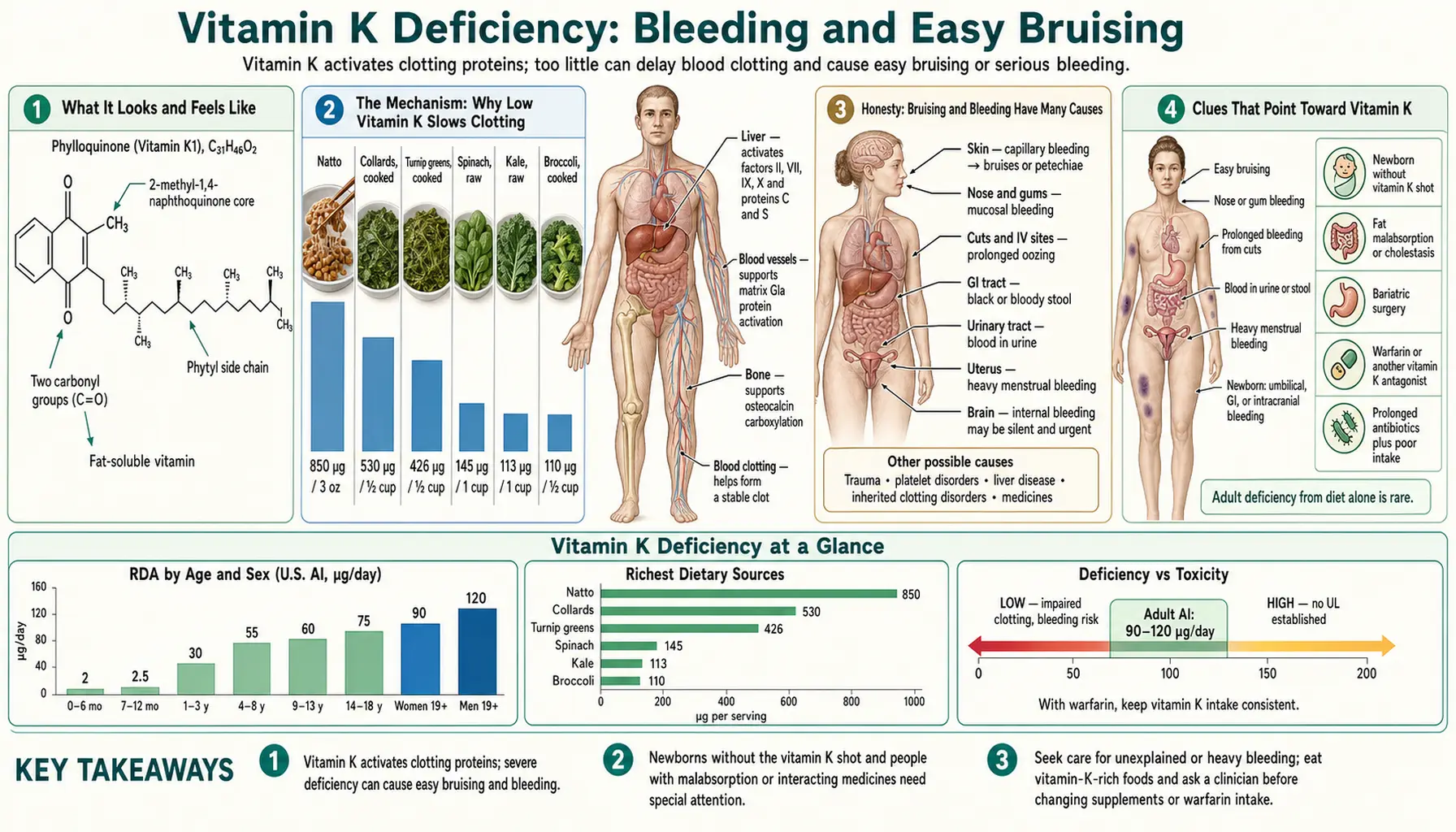
The most direct, recognizable sign of running low on vitamin K is bleeding that doesn't quite behave — bruises that bloom from a knock you barely noticed, gums that ooze when you brush, nosebleeds that take their time to stop, or a small cut that keeps weeping. Vitamin K is the nutrient your liver uses to finish building several of the proteins that make blood clot. When it is missing, those proteins come off the assembly line incomplete and inactive, so the clotting machinery slows down. This page explains exactly why low vitamin K shows up as bruising and bleeding, why those same signs have many other causes (so a bruise is never proof of deficiency on its own), the clues that point toward vitamin K specifically, and how it is tested and corrected.
Table of Contents
- What It Looks and Feels Like
- The Mechanism: Why Low Vitamin K Slows Clotting
- Honesty: Bruising and Bleeding Have Many Causes
- Clues That Point Toward Vitamin K
- What Drives Low Vitamin K in Adults
- Getting Tested: PT, INR, and Beyond
- Correcting Low Vitamin K Safely
- A Special Case: Warfarin and Vitamin K
- When to Seek Care / Red Flags
- Key Research Papers
- Connections
- Featured Videos
What It Looks and Feels Like
Vitamin K deficiency rarely announces itself with pain or tiredness. Instead, it shows up as a change in how readily you bleed and bruise. The signs are usually small at first and easy to wave away, which is part of why this deficiency can go unrecognized. The most common everyday complaints are:
- Easy or unexplained bruising — large or numerous bruises (the medical term is ecchymoses) appearing from minor bumps you wouldn't normally expect to mark you, or seeming to come from nowhere. Pinpoint red or purple spots in the skin (petechiae) can also appear.
- Bleeding gums — gums that ooze blood when you brush or floss, beyond what a little gum inflammation would explain.
- Nosebleeds — frequent or hard-to-stop nosebleeds (epistaxis).
- Cuts and wounds that keep oozing — small cuts, or the site of a blood draw or injection, that bleed longer than usual or restart after they seemed to stop.
- Heavy menstrual bleeding — periods that become noticeably heavier or more prolonged than your norm.
- Blood in urine or stool — pink or red urine, or black, tarry, or bloody stools, which point to bleeding deeper inside the body and are more serious.
The unifying theme is that bleeding, once it starts, is harder to stop than it should be. A healthy clotting system seals a small injury within minutes; when vitamin K is low, that sealing step is sluggish, so the same minor injury bleeds more and longer. Many people first notice it cosmetically — arms and shins that look perpetually mottled with bruises — long before anything dangerous happens.
Two things are worth knowing up front. First, mild deficiency may produce no visible bleeding at all; it can be a purely laboratory finding (a slightly slow clotting time) picked up by chance. Second, when bleeding does become severe, it is a genuine emergency — the red-flags section below spells out the warning signs that mean "get help now."
The Mechanism: Why Low Vitamin K Slows Clotting
To understand the bruising, it helps to know what vitamin K actually does. Forming a blood clot is a chain reaction — the coagulation cascade — in which a series of proteins (called clotting factors) activate one another in sequence, ending in a mesh of fibrin that plugs the leak. Several of those factors are made in the liver but leave the assembly line in a non-functional state. They only become able to do their job after a final chemical finishing touch, and that finishing touch requires vitamin K.
Specifically, vitamin K is the essential helper (a cofactor) for an enzyme called gamma-glutamyl carboxylase. This enzyme adds an extra carboxyl group onto certain glutamic-acid building blocks in the clotting factors, converting them into gamma-carboxyglutamate (abbreviated “Gla”). Those new Gla groups are what let the factor grab onto calcium and anchor to the surface of platelets and injured tissue — the step that lets the cascade snap together at the site of a wound. The vitamin-K–dependent clotting factors are II (prothrombin), VII, IX, and X, plus the natural anticoagulant proteins C and S. When vitamin K is in short supply, the carboxylase can't finish these factors, and they circulate as inactive decoys (called PIVKA, proteins induced by vitamin K absence). The factors are physically present, but they don't work — so clotting is slow, and bleeding goes unchecked.
An analogy. Think of each clotting factor as a key that has just come out of the key-cutting machine, but with the final groove not yet filed in. Without that last groove, the key fits in the lock but won't turn — the door (the clot) won't latch. Vitamin K is the file that cuts that final groove. With enough vitamin K, every key gets finished and the clot latches in seconds. Without it, you've got a drawer full of keys that look complete but can't turn the lock, and the smallest leak keeps leaking.
There is a reason the body is vulnerable here: it stores very little vitamin K compared with the other fat-soluble vitamins (A, D, and E). Its stores can be depleted within roughly one to two weeks if intake stops and the gut bacteria that make a usable form (menaquinones, vitamin K2) are wiped out — for example, by broad-spectrum antibiotics combined with poor eating during an illness. That small reserve is why a deficiency severe enough to cause bleeding can develop faster than people expect. For the broader picture of how vitamin K builds clots, see Vitamin K and Blood Clotting.
Honesty: Bruising and Bleeding Have Many Causes
It is important to be candid: easy bruising and bleeding are common, and the overwhelming majority of cases are not caused by vitamin K deficiency. A new crop of bruises or bleeding gums is a reason to think, not to panic, and certainly not to assume a vitamin is missing. Among the many other explanations:
- Age and thin skin. Older adults bruise far more easily because skin and the small blood vessels beneath it become fragile (sometimes called senile purpura) — this is mechanical, not a clotting problem.
- Medications. Aspirin, ibuprofen and other NSAIDs, blood thinners (warfarin, apixaban, rivaroxaban, clopidogrel), fish oil in large doses, and corticosteroids all promote bruising and bleeding through mechanisms that have nothing to do with vitamin K intake.
- Platelet problems. A low platelet count (thrombocytopenia) or platelets that don't work properly cause bruising and petechiae. Platelets are made in the bone marrow and are unrelated to vitamin K.
- Liver disease. The liver manufactures clotting factors, so cirrhosis and other liver disease can cause bleeding even when vitamin K is adequate — though, confusingly, liver disease can also reduce vitamin K activity.
- Von Willebrand disease and hemophilia. Inherited clotting-factor disorders are a classic cause of lifelong easy bruising and bleeding, and the most common bleeding disorder (von Willebrand disease) is frequently undiagnosed.
- Vitamin C deficiency (scurvy). A separate vitamin deficiency that weakens blood-vessel walls and causes bruising and bleeding gums — with different other features (gum swelling, poor wound healing).
- Serious blood and marrow disorders. Less commonly, leukemia and other bone-marrow conditions present with unexplained bruising; this is one reason new, unexplained bleeding always deserves a medical evaluation.
So a bruise is not proof of anything by itself. What raises the suspicion of vitamin K specifically is the context — the clues in the next section — combined with a simple blood test that can sort most of this out quickly.
Clues That Point Toward Vitamin K
Vitamin K deficiency becomes a plausible explanation for bruising and bleeding when the right setting is present. The strongest clues are:
- A reason to malabsorb fat. Because vitamin K is fat-soluble, anything that impairs fat absorption can starve you of it: celiac disease, Crohn's disease, chronic pancreatitis, bile-flow problems (cholestasis), or weight-loss surgery. Bruising in someone with a known fat-malabsorption condition is a strong pointer.
- Recent broad-spectrum antibiotics, especially during a period of eating little. Antibiotics suppress the gut bacteria that make usable vitamin K (menaquinones); combine that with poor intake and small body stores and a deficiency can appear within a couple of weeks.
- A clotting test that improves quickly with vitamin K. The most telling clue of all is a laboratory one: a prolonged prothrombin time (PT/INR) that corrects within hours of giving vitamin K. That response is close to a signature of vitamin K deficiency and helps distinguish it from liver disease, which often does not fully correct.
- The bleeding pattern. Vitamin K deficiency tends to cause bruising, mucosal bleeding (gums, nose), and oozing — rather than the deep joint and muscle bleeds typical of hemophilia. Pinpoint petechiae point more toward a platelet problem than toward a clotting-factor problem like vitamin K deficiency.
This is also a place to think about siblings of this symptom. The same vitamin K shortage that slows clotting also leaves the bone protein osteocalcin uncarboxylated, which over years is associated with weaker bones — see Vitamin K Deficiency: Bone Health & Fractures. And the most dramatic clotting consequence of low vitamin K is in newborns, whose stores are very low at birth; that is covered on Newborn Bleeding (VKDB).
What Drives Low Vitamin K in Adults
Outside of the newborn period, dietary vitamin K deficiency in an otherwise healthy adult is genuinely uncommon, because the vitamin is widespread in food (especially green leafy vegetables) and is also made by gut bacteria. When a clinically meaningful deficiency does occur in an adult, it is almost always because something is interfering with intake, absorption, or use:
- Fat malabsorption. The leading cause. Vitamin K needs bile and a working small intestine to be absorbed. Conditions that block this include celiac disease, Crohn's disease and other inflammatory bowel disease, chronic pancreatitis, cystic fibrosis, short-bowel syndrome, and bariatric (weight-loss) surgery.
- Bile-flow and liver problems. Bile is required to absorb fat-soluble vitamins, so cholestasis (obstructed bile flow), primary biliary cholangitis, and biliary obstruction reduce vitamin K absorption. Advanced liver disease compounds this by also impairing the liver's ability to use vitamin K and make clotting factors.
- Broad-spectrum antibiotics. Prolonged antibiotics knock out the gut bacteria that produce menaquinones (vitamin K2), removing a steady background source — most consequential in someone already eating poorly.
- Vitamin K antagonist drugs. Warfarin and related anticoagulants deliberately block vitamin K recycling to slow clotting; an excess effect produces a functional vitamin K deficiency state (covered in its own section below).
- Very poor diet plus illness. A person who is critically ill, barely eating, on intravenous nutrition without vitamin K, and on antibiotics can deplete their small stores in one to two weeks. Chronic heavy alcohol use adds poor intake to possible liver injury.
The practical upshot: when an adult has unexplained bruising or bleeding, clinicians look for one of these setups. If none is present, vitamin K deficiency drops well down the list of likely explanations, and the search turns toward medications, platelets, the liver, and inherited disorders instead.
Getting Tested: PT, INR, and Beyond
The cornerstone test is inexpensive and widely available. A coagulation panel measures the prothrombin time (PT), usually reported as the standardized INR (International Normalized Ratio). The PT specifically depends on factors II, VII, and X — three of the vitamin-K–dependent factors — and factor VII has the shortest half-life of the group, so a prolonged PT/INR is often the first abnormality to appear when vitamin K runs low. A normal INR is about 1.0; a higher number means clotting is slower.
Because bruising and bleeding have so many causes, the workup usually goes further to sort them out:
- aPTT (activated partial thromboplastin time) — reported alongside PT on the coagulation panel; in vitamin K deficiency both PT and aPTT can be prolonged, with PT affected first and more.
- A vitamin K challenge. The classic confirmatory step: giving vitamin K and rechecking the PT/INR. In true vitamin K deficiency the clotting time corrects substantially, often within 12–24 hours — whereas the prolonged PT of liver disease typically does not fully correct, which is what separates the two.
- A complete blood count (CBC) — to check the platelet count, since a low platelet count is a common, separate cause of bruising that needs to be excluded.
- Liver function tests — to assess whether liver disease is contributing, since the liver both makes clotting factors and processes vitamin K.
- Specialized assays — in unclear cases, a hematologist may measure individual clotting-factor levels or the inactive PIVKA-II protein, which rises specifically when vitamin K is lacking.
Direct measurement of vitamin K in the blood is possible but is not routine: levels fluctuate with recent meals and don't reflect tissue stores well, so the functional tests above (PT/INR and the response to vitamin K) are far more useful in practice.
Correcting Low Vitamin K Safely
How vitamin K is replaced depends on how low it is, why, and whether there is active bleeding. The approach is matched to the danger — food and modest supplementation for mild, asymptomatic cases; prompt medical treatment when bleeding is present.
- Food first, for prevention and mild cases. The richest dietary source is vitamin K1 (phylloquinone) from green leafy vegetables: kale, spinach, collards, Swiss chard, and broccoli. Because vitamin K is fat-soluble, eating these with a little fat (olive oil, avocado) improves absorption. Vitamin K2 (menaquinones) comes from fermented foods such as natto and from some animal foods and cheeses. The adult Adequate Intake set by U.S. authorities is about 120 micrograms/day for men and 90 micrograms/day for women — a single serving of leafy greens easily exceeds it. See the vitamin K food sources page for more.
- Oral vitamin K supplements — used when intake or absorption is inadequate. In malabsorption, higher or more frequent dosing (and sometimes a water-soluble form) may be needed because the gut can't take up the usual amount.
- Injectable (parenteral) vitamin K — given when absorption is unreliable or when the PT/INR needs to correct promptly. It bypasses the gut and is used in significant deficiency.
- For active, serious bleeding — vitamin K alone works too slowly (it takes hours to make new functional clotting factors). In an emergency, clinicians give the missing factors directly — with prothrombin complex concentrate (PCC) or fresh frozen plasma — alongside vitamin K, so clotting is restored within minutes while the vitamin K rebuilds the factors over the following hours.
- Fix the underlying cause. Treating the celiac disease, restoring bile flow, stopping an unnecessary antibiotic, or adjusting an anticoagulant is what prevents the deficiency from coming back.
One important caution. If you take warfarin, do not start a vitamin K supplement or dramatically change how many leafy greens you eat without telling your prescriber — vitamin K directly opposes warfarin, and an abrupt change can swing your INR and either raise your clot risk or your bleeding risk. Consistency matters more than avoidance (see the next section).
A Special Case: Warfarin and Vitamin K
The clearest real-world example of a vitamin-K–related bleeding state is the anticoagulant drug warfarin (Coumadin). Warfarin works by blocking the enzyme (VKOR) that recycles vitamin K back into its active form inside the liver. With less active vitamin K available, the liver makes less functional factor II, VII, IX, and X — deliberately slowing clotting to prevent dangerous clots in people with atrial fibrillation, mechanical heart valves, or a history of clots. In effect, warfarin creates a controlled, reversible functional vitamin K deficiency, and its effect is monitored with the same PT/INR test used to detect dietary deficiency.
Two practical points follow. First, when warfarin's effect is too strong (INR too high) and bleeding occurs or threatens, the antidote is exactly the missing nutrient — vitamin K (oral for milder over-anticoagulation, intravenous plus clotting-factor concentrates for serious bleeding). Second, the food you eat matters: a sudden surge of dietary vitamin K (a big change in leafy-green intake, or a new supplement) can blunt warfarin and let clots form, while a sudden drop can over-thin the blood and cause bleeding. The guidance for people on warfarin is therefore consistency, not avoidance — keep your vegetable intake roughly steady week to week, and tell your anticoagulation clinic before any deliberate change. (The newer direct oral anticoagulants — apixaban, rivaroxaban, dabigatran — do not act on vitamin K and do not require this dietary balancing act.)
When to Seek Care / Red Flags
Mild, isolated easy bruising in a well person is usually not an emergency — but it is worth a non-urgent medical evaluation, because the cause needs sorting out. Certain features mean seek medical care right away, by emergency services if severe:
- Bleeding that won't stop — a cut, nosebleed, or wound that keeps bleeding despite firm, sustained pressure.
- Blood in urine or stool — pink/red urine, or black, tarry, or bloody stools, which signal internal bleeding.
- Vomiting blood or coughing up blood.
- Sudden severe headache, confusion, weakness on one side, or vision changes — possible bleeding in or around the brain, a true emergency.
- Large, spreading, or rapidly multiplying bruises without a clear injury, or widespread pinpoint spots (petechiae).
- Bleeding on a blood thinner — any significant bleeding while taking warfarin or another anticoagulant should be assessed urgently.
- Heavy menstrual bleeding that soaks through protection hourly, or comes with dizziness and a racing heart.
- Signs of significant blood loss — lightheadedness, fainting, pallor, breathlessness, or a fast heartbeat.
The reassuring part is that, where vitamin K is the culprit, the problem is correctable — often dramatically — once it is identified, and a single inexpensive blood test points the way. When in doubt about new or unexplained bleeding, get it checked; sorting out the cause early is what keeps a minor nuisance from becoming a dangerous bleed.
Key Research Papers
- Shearer MJ, Newman P (2014). Recent trends in the metabolism and cell biology of vitamin K with special reference to vitamin K cycling and MK-4 biosynthesis. Journal of Lipid Research;55(3):345-362. — DOI: 10.1194/jlr.r045559
- Shearer MJ, Newman P (2008). Metabolism and cell biology of vitamin K. Thrombosis and Haemostasis;100(4):530-547. — DOI: 10.1160/th08-03-0147
- Shearer MJ, Fu X, Booth SL (2012). Vitamin K Nutrition, Metabolism, and Requirements: Current Concepts and Future Research. Advances in Nutrition;3(2):182-195. — DOI: 10.3945/an.111.001800
- Booth SL (2009). Roles for Vitamin K Beyond Coagulation. Annual Review of Nutrition;29:89-110. — DOI: 10.1146/annurev-nutr-080508-141217
- Cranenburg ECM, Schurgers LJ, Vermeer C (2007). Vitamin K: The coagulation vitamin that became omnipotent. Thrombosis and Haemostasis;98(1):120-125. — DOI: 10.1160/th07-04-0266
- Shearer MJ (2009). Vitamin K deficiency bleeding (VKDB) in early infancy. Blood Reviews;23(2):49-59. — DOI: 10.1016/j.blre.2008.06.001
- Crowther MA, Douketis JD, Schnurr T, et al. (2002). Oral Vitamin K Lowers the International Normalized Ratio More Rapidly Than Subcutaneous Vitamin K in the Treatment of Warfarin-Associated Coagulopathy. Annals of Internal Medicine;137(4):251-254. — DOI: 10.7326/0003-4819-138-7-200304010-00030
- Ageno W, Gallus AS, Wittkowsky A, et al. (2012). Oral Anticoagulant Therapy: Antithrombotic Therapy and Prevention of Thrombosis, 9th ed: American College of Chest Physicians Evidence-Based Clinical Practice Guidelines. Chest;141(2 Suppl):e44S-e88S. — DOI: 10.1378/chest.11-2292
- DiNicolantonio JJ, Bhutani J, O'Keefe JH (2015). The health benefits of vitamin K. Open Heart;2(1):e000300. — DOI: 10.1136/openhrt-2015-000300
- Degrassi I, Leonardi I, Di Profio E, et al. (2023). Fat-Soluble Vitamins Deficiency in Pediatric Cholestasis: A Scoping Review. Nutrients;15(11):2491. — DOI: 10.3390/nu15112491
PubMed Topic Searches
- PubMed — Vitamin K deficiency and the coagulation factors
- PubMed — Vitamin K deficiency and easy bruising in adults
- PubMed — Vitamin K malabsorption and prolonged prothrombin time
- PubMed — Warfarin, vitamin K, and INR reversal
- PubMed — Gamma-glutamyl carboxylase, PIVKA, and vitamin K
Connections
- All Vitamins
- Vitamin K Deficiency Hub
- Newborn Bleeding (VKDB)
- Vitamin K Deficiency: Bone Health & Fractures
- Vitamin K Overview
- Vitamin K and Blood Clotting
- Vitamin K Food Sources
- Vitamin K2 (Menaquinone)
- Coagulation Panel (PT, INR, aPTT)
- Complete Blood Count (CBC)
- Liver Function Tests
- Celiac Disease
- Crohn's Disease
- Cirrhosis
- Liver Disease
- Kale
- Spinach
- Natto