L-Theanine + Caffeine Synergy
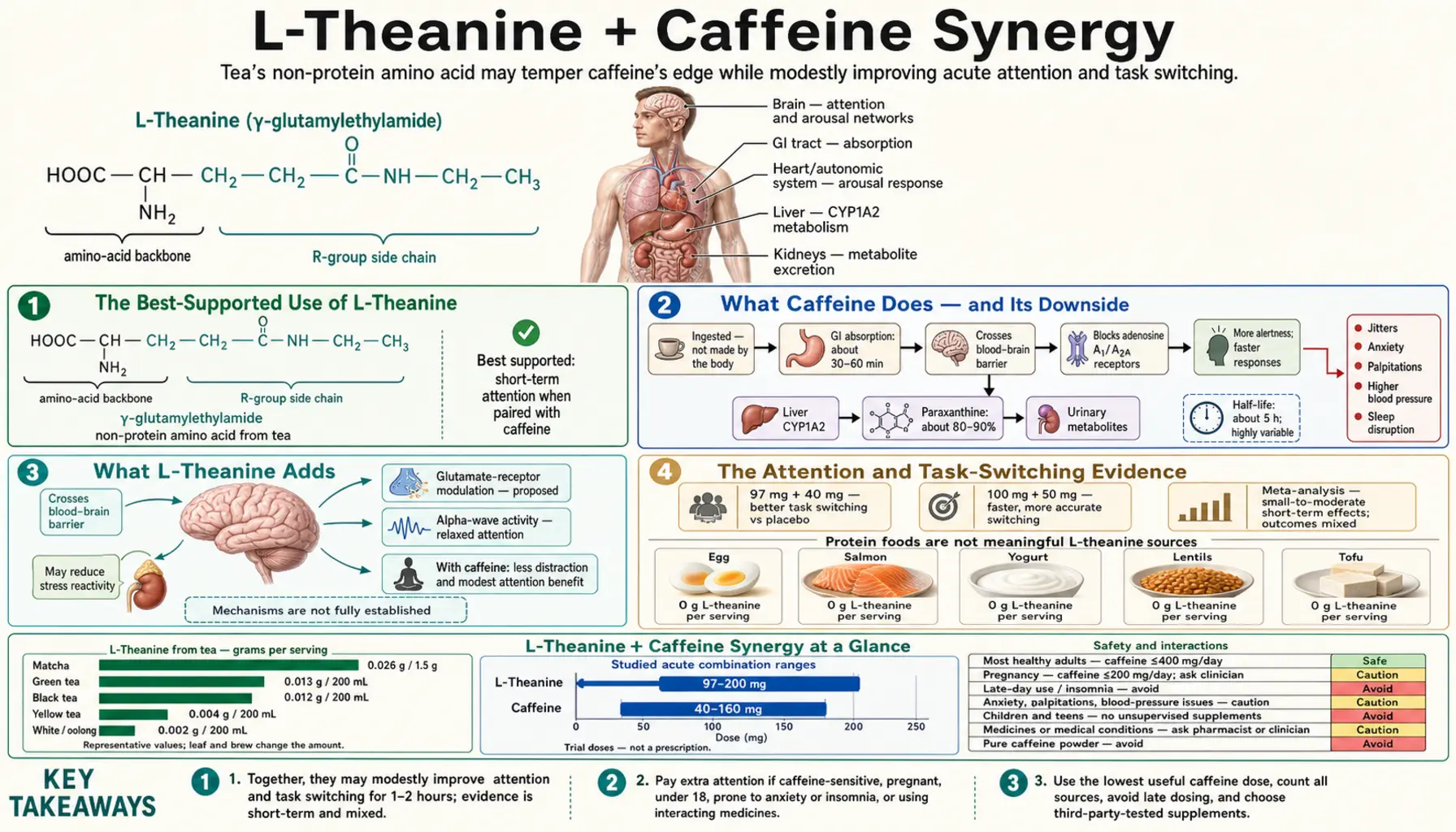
If there is one L-theanine claim the science genuinely supports, it is this one: pairing L-theanine with caffeine gives you caffeine's boost to attention and reaction time while blunting its downsides — the jitters, the anxious edge, and the small rise in blood pressure. This is not folklore. It is why a cup of tea, which naturally contains both, feels so different from a cup of coffee with the same caffeine. Multiple independent laboratories have replicated the combination's effect on attention, and it is the reason the theanine + caffeine "stack" became popular long before most people had heard of either compound alone.
Interactive Visualization Caffeine, Adenosine & Why Coffee Stops Working Caffeine doesn’t give you energy — it blocks the tiredness signal while adenosine keeps piling up behind the blockade. Move your coffee to 2 p.m. and watch your deep sleep vanish. Launch →
Table of Contents
- The Best-Supported Use of L-Theanine
- What Caffeine Does — and Its Downside
- What L-Theanine Adds
- The Attention and Task-Switching Evidence
- Blood Pressure and the Jitters
- The Classic 2:1 Ratio
- Why Tea Feels Different from Coffee
- The Honest Limits
- Practical How-To
- Cautions
- Key Research Papers
- Connections
- Featured Videos
The Best-Supported Use of L-Theanine
Across the whole L-theanine literature, the combination with caffeine has the most consistent, most replicated human evidence. A 2014 systematic review and meta-analysis by Camfield and colleagues, pooling the controlled trials, concluded that the L-theanine + caffeine combination improves attention and alertness more reliably than either component alone — the acute cognitive effects were driven by the pairing, especially for demanding attention tasks. When independent research groups keep finding the same effect, that is exactly the pattern that should raise your confidence.
What Caffeine Does — and Its Downside
Caffeine is the world's most widely used stimulant, and it works mainly by blocking adenosine receptors. Adenosine is a molecule that accumulates in the brain during waking hours and promotes sleepiness — Fredholm's work describes it as an endogenous "distress and slow-down" signal. By occupying adenosine's receptors, caffeine removes the brakes on arousal, which increases alertness, speeds reaction time, and improves vigilance. McLellan and colleagues' comprehensive review documents these robust benefits to cognitive and physical performance.
But blocking adenosine everywhere also produces caffeine's familiar downsides in many people:
- Jitteriness, restlessness, and a "wired" over-aroused feeling
- Increased anxiety in sensitive individuals
- A modest, transient rise in blood pressure
- Sometimes a racing heart or a jittery crash later
These are the costs that L-theanine appears to offset.
What L-Theanine Adds
Where caffeine raises arousal (and sometimes over-raises it), L-theanine gently lowers arousal and increases relaxed-alert alpha activity. Pair them and you get an unusual outcome: the two do not simply cancel out. Instead, caffeine keeps the alertness and speed, while L-theanine files off the jittery, anxious edge — leaving a state people describe as "clean" or "smooth" focus.
Mechanistically it makes sense that these two work on complementary systems: caffeine acts on adenosine signaling to boost arousal, while L-theanine nudges GABA, dopamine, and alpha-wave activity toward calm. The result is not a wash but a rebalancing — the cognitive upside of the stimulant with less of its autonomic and emotional overshoot.
The Attention and Task-Switching Evidence
The human trials are unusually consistent for a supplement:
- Haskell et al. (2008) tested L-theanine, caffeine, and the combination. The combination improved speed and accuracy on attention-demanding tasks and reduced susceptibility to distraction more than either alone.
- Owen et al. (2008) found the combination improved performance on demanding cognitive tasks and increased alertness, with the pairing outperforming caffeine alone on several measures.
- Kelly et al. (2008), using EEG, showed the combination improved attention on a target-detection task and was associated with changes in alpha-band activity linked to the ability to ignore distractors.
- Einöther et al. (2010) found L-theanine + caffeine improved task switching (mental flexibility) — though, honestly, in that study it did not improve every measure, such as intersensory attention or subjective alertness. A useful reminder that the benefit is specific, not universal.
- Kahathuduwa et al. (2017, 2018) reported that theanine + caffeine improved attention, including target-specific attention and reduced mind-wandering, in acute-dosing studies.
- Dodd et al. (2015) looked at cerebral blood flow, cognition, and mood, finding the combination altered brain blood flow and improved aspects of cognition and mood relative to placebo.
The through-line: the most reliable benefit is on attention — staying on task, switching between tasks, and filtering out distraction — rather than on every cognitive domain. It is a focus enhancer, not a general "smart pill."
Blood Pressure and the Jitters
One of the most practically useful findings is Rogers and colleagues' 2008 "Time for tea" study. It examined caffeine and theanine alone and together on mood, blood pressure, and cognition, and found that L-theanine counteracted the blood-pressure-raising effect of caffeine. Caffeine alone nudged blood pressure up; adding L-theanine attenuated that rise. Yoto and colleagues (2012) similarly reported that L-theanine reduced blood-pressure increases under stress conditions.
For someone who loves the focus of caffeine but dislikes the pounding-heart, blood-pressure-spiking, anxious side of it, this is the single most relevant piece of evidence on the page: L-theanine appears to take the physiological edge off caffeine without sacrificing the mental boost.
The Classic 2:1 Ratio
Most positive studies used roughly 100 mg of caffeine with about 200 mg of L-theanine — a 2:1 theanine-to-caffeine ratio — though ratios from 1:1 to 2:1 have been tested. Practical translations:
- With coffee: a standard cup of coffee has roughly 80–120 mg caffeine, so pairing it with a 200 mg L-theanine capsule lands near the studied ratio.
- With tea: tea naturally contains both, but at lower absolute amounts. A cup of tea might carry 20–50 mg caffeine and a smaller amount of L-theanine — the ratio is favorable but the total dose is gentle (see the Sources & Dosing page).
- Pre-formulated: many "clean energy" and nootropic products bundle the two at a fixed ratio.
There is nothing magic about the exact 2:1 figure — it is simply the ratio the successful trials happened to use. Individual tolerance to caffeine varies enormously, so the caffeine side of the equation should be sized to what you already handle well.
Why Tea Feels Different from Coffee
This synergy is the best explanation for a common everyday observation: tea drinkers often report that tea gives them a calmer, more sustained alertness than coffee, even accounting for tea's lower caffeine. Tea (from Camellia sinensis) is essentially the only common dietary source of L-theanine, so every cup delivers the caffeine + theanine combination pre-packaged by the plant. Coffee delivers caffeine with no L-theanine at all. The plant, in effect, discovered the stack first.
Green tea, and especially shade-grown teas like matcha and gyokuro, tend to be richer in L-theanine, which is part of why they are marketed as providing "calm energy." The effect is real in direction, even if the absolute amounts in a single cup are modest.
The Honest Limits
Even this best-supported use has boundaries worth stating plainly:
- Not every study is uniformly positive. As noted, Einöther (2010) improved task switching but not other attention measures or subjective alertness. Effects are task-specific.
- The benefit is on attention, not general intelligence. This is about focus and filtering distraction, not raising IQ or memory across the board.
- Effect sizes are moderate. These are real, replicated, but not enormous improvements — useful for a study session or a demanding task, not a transformation.
- It does not fix caffeine over-use. If you are relying on large caffeine doses to paper over sleep debt, L-theanine smooths the edge but does not repay the debt.
Practical How-To
- Starting point: pair your usual caffeine (coffee, tea, or ~100 mg caffeine) with ~200 mg L-theanine. Take them together.
- Best for: focused work, studying, or any task where you want caffeine's alertness without the anxious buzz.
- If caffeine makes you anxious: this combination is one of the more evidence-based ways to keep the alertness while reducing the jitters.
- Timing for sleep: remember the caffeine half — even smoothed by L-theanine, caffeine late in the day still disrupts sleep. Keep caffeine to the morning and early afternoon.
Cautions
- Caffeine still has all its usual cautions. The theanine does not remove caffeine's effects on heart rhythm, reflux, anxiety disorders, pregnancy limits, or sleep. See our Coffee and Coffee (Food) pages.
- Blood pressure and heart conditions. While L-theanine blunts caffeine's pressor effect, people with hypertension or arrhythmias should still be cautious with caffeine overall.
- Caffeine sensitivity. If you already avoid caffeine because it makes you unwell, adding L-theanine is not a reason to start.
- Pregnancy. Caffeine intake should be limited in pregnancy regardless of L-theanine; supplemental theanine lacks pregnancy safety data.
Key Research Papers
- Haskell CF, Kennedy DO, Milne AL, Wesnes KA, Scholey AB (2008). The effects of L-theanine, caffeine and their combination on cognition and mood. Biological Psychology. — PubMed
- Owen GN, Parnell H, De Bruin EA, Rycroft JA (2008). The combined effects of L-theanine and caffeine on cognitive performance and mood. Nutritional Neuroscience. — PubMed
- Kelly SP, Gomez-Ramirez M, Montesi JL, Foxe JJ (2008). L-theanine and caffeine in combination affect human cognition as evidenced by oscillatory alpha-band activity and attention task performance. Journal of Nutrition. — PubMed
- Einöther SJ, Martens VE, Rycroft JA, De Bruin EA (2010). L-theanine and caffeine improve task switching but not intersensory attention or subjective alertness. Appetite. — PubMed
- Kahathuduwa CN, Dassanayake TL, Amarakoon AMT, Weerasinghe VS (2017). Acute effects of theanine, caffeine and theanine-caffeine combination on attention. Nutritional Neuroscience. — PubMed
- Kahathuduwa CN, Wakefield S, West BD, et al. (2018). L-theanine and caffeine improve target-specific attention by decreasing mind wandering: a human fMRI study. Nutrition Research. — PubMed
- Dodd FL, Kennedy DO, Riby LM, Haskell-Ramsay CF (2015). A double-blind, placebo-controlled study evaluating the effects of caffeine and L-theanine both alone and in combination on cerebral blood flow, cognition and mood. Psychopharmacology. — PubMed
- Camfield DA, Stough C, Farrimond J, Scholey AB (2014). Acute effects of tea constituents L-theanine, caffeine, and epigallocatechin gallate on cognitive function and mood: a systematic review and meta-analysis. Nutrition Reviews. — PubMed
- Rogers PJ, Smith JE, Heatherley SV, Pleydell-Pearce CW (2008). Time for tea: mood, blood pressure and cognitive performance effects of caffeine and theanine administered alone and together. Psychopharmacology. — PubMed
- Yoto A, Motoki M, Murao S, Yokogoshi H (2012). Effects of L-theanine or caffeine intake on changes in blood pressure under physical and psychological stresses. Journal of Physiological Anthropology. — PubMed
- McLellan TM, Caldwell JA, Lieberman HR (2016). A review of caffeine's effects on cognitive, physical and occupational performance. Neuroscience & Biobehavioral Reviews. — PubMed
- Fredholm BB (2007). Adenosine, an endogenous distress signal, modulates tissue damage and repair. Cell Death and Differentiation. — PubMed
PubMed Topic Searches
- PubMed: Theanine + caffeine attention
- PubMed: Theanine + caffeine cognition/mood
- PubMed: Theanine + caffeine blood pressure
- PubMed: Caffeine adenosine mechanism
External Authoritative Resources
Connections
- All Amino Acids
- Caffeine, Adenosine & Why Coffee Stops Working — interactive animation
- L-Theanine Overview
- L-Theanine Benefits Hub
- L-Theanine for Calm Focus & Anxiety
- L-Theanine Sources & Dosing
- Green Tea
- Coffee (Remedy)
- Coffee (Food)
- Tyrosine
- GABA
- ADHD
- Anxiety
- Hypertension
- Taurine
- EGCG
- All Foods