Grape Seed Extract: OPC Proanthocyanidin Antioxidants
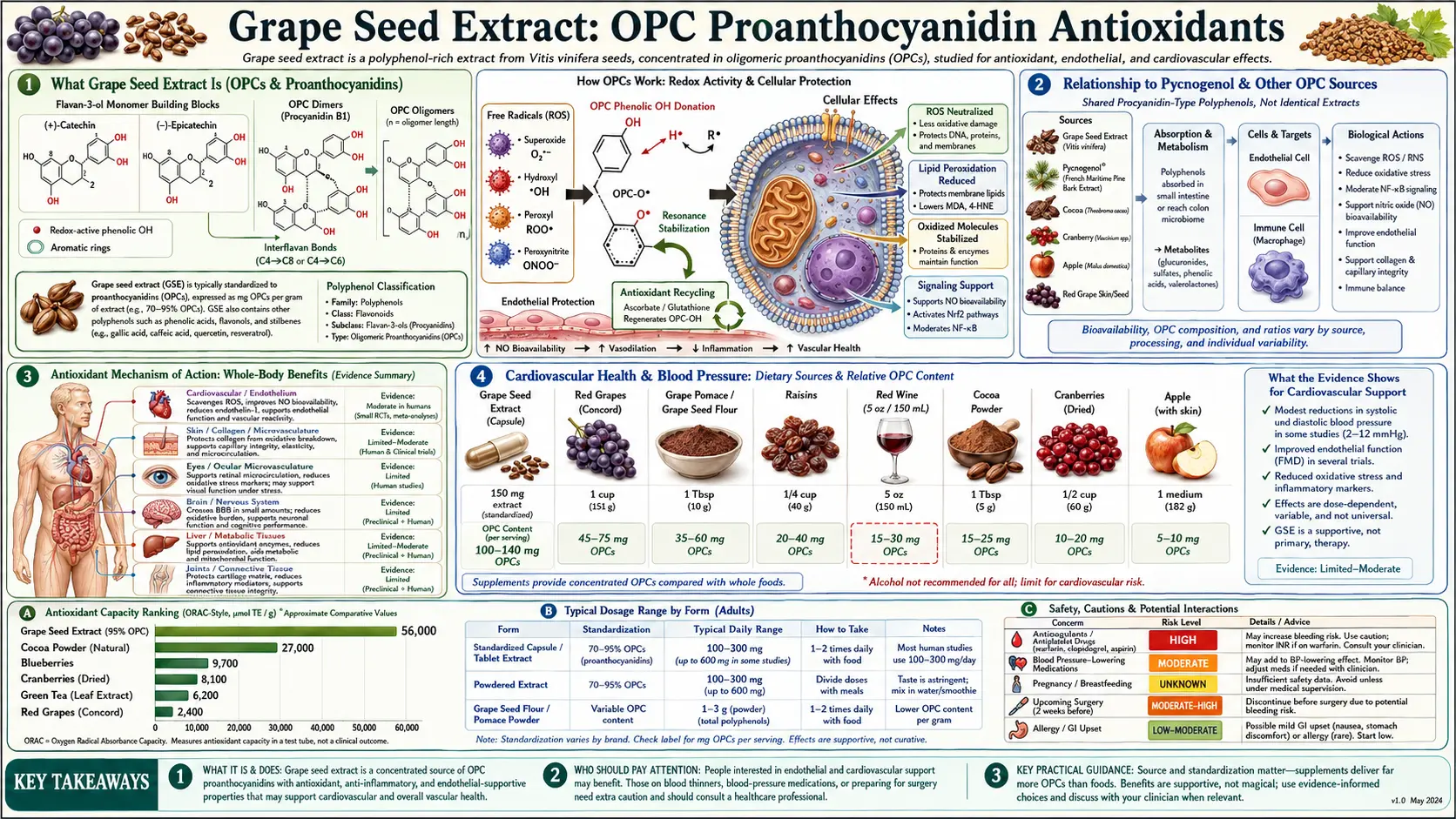
Grape seed extract (GSE) is concentrated from the seeds of Vitis vinifera — the common wine and table grape — and is one of the richest dietary sources of oligomeric proanthocyanidins (OPCs), a class of flavonoid antioxidant that also defines French maritime pine bark extract (Pycnogenol). OPCs are water-soluble polyphenols built from catechin and epicatechin units; they are among the most potent free-radical scavengers in the plant kingdom and have a particular affinity for collagen, elastin, and the vascular endothelium. The strongest clinical evidence is in blood-pressure reduction, chronic venous insufficiency and edema, and protection of LDL cholesterol from oxidation. Standardized products are defined by their OPC content, typically 95% proanthocyanidins.
Table of Contents
- What Grape Seed Extract Is (OPCs & Proanthocyanidins)
- Relationship to Pycnogenol & Other OPC Sources
- Antioxidant Mechanism of Action
- Cardiovascular Health & Blood Pressure
- Venous Insufficiency, Edema & Circulation
- Skin, Collagen & Wound Healing
- Cholesterol Oxidation & Lipid Protection
- Cognition & Neuroprotection
- Metabolic & Other Emerging Uses
- Forms & Standardization (% OPCs)
- Recommended Dosage
- Cautions and Contraindications
- Key Research Papers
- Connections
- Featured Videos
What Grape Seed Extract Is (OPCs & Proanthocyanidins)
Grape seed extract is a concentrated polyphenol preparation made by crushing, de-oiling, and solvent-extracting the seeds left over from wine and grape-juice production. The seeds of Vitis vinifera are an agricultural byproduct of enormous volume, which is part of why GSE became a commercially viable supplement: the raw material is abundant and cheap.
The active compounds are proanthocyanidins — also called condensed tannins or, in their shorter-chain form, oligomeric proanthocyanidins (OPCs). These are flavonoid polymers built from individual flavan-3-ol monomers, principally catechin and epicatechin (the same monomers found in green tea and cocoa). When two to roughly seven of these monomers link together, the result is an oligomer (OPC); longer chains are polymeric proanthocyanidins (PPCs), which are less well absorbed.
OPCs are sometimes referred to by older trade and research names that appear in the literature: procyanidins, leucoanthocyanins, and historically "pycnogenols" (lowercase, a generic chemical term coined by Jacques Masquelier — distinct from the trademarked pine-bark product Pycnogenol®). When you see any of these terms, the underlying chemistry is the same family of catechin/epicatechin-based flavonoids.
Compared with the proanthocyanidins in cocoa, apples, or cranberries, grape seed proanthocyanidins are notable for two features: a high proportion of galloylated units (epicatechin gallate and related esters, which increase antioxidant potency) and a relatively high fraction of low-molecular-weight oligomers that are absorbable from the gut. This combination is why grape seed is one of the preferred raw materials for standardized OPC supplements.
Relationship to Pycnogenol & Other OPC Sources
Grape seed extract and Pycnogenol (French maritime pine bark extract, from Pinus pinaster) are the two best-known commercial OPC products, and they are frequently discussed together because they share the same core chemistry and were developed by the same researcher.
The French scientist Jacques Masquelier first isolated proanthocyanidins from peanut skins in 1947, then patented extracts from both pine bark (1951) and grape seeds (1970). His work established OPCs as the active vascular-protective fraction in both materials. Pycnogenol is a specific patented, standardized pine-bark extract; grape seed extract is a category of products from grape seeds, sold by many manufacturers under their own standardization specs.
Key similarities and differences:
- Shared backbone — both are dominated by catechin/epicatechin-based proanthocyanidins and both concentrate in collagen-rich tissue and the vascular wall.
- Grape seed is richer in larger oligomers and galloylated units, giving it a slightly higher in-vitro antioxidant capacity per gram.
- Pycnogenol contains additional phenolic acids (ferulic, caffeic, taxifolin) not present in grape seed, and is sold only as a single standardized product, so its clinical-trial dataset is more uniform.
- Cost — grape seed extract is typically far less expensive per milligram of OPCs, which is why it is often used as a budget alternative to Pycnogenol for the same indications (venous insufficiency, blood pressure, skin).
Other meaningful dietary OPC sources include cocoa and dark chocolate, green tea, cranberries, bilberry and other dark berries, apples, and red wine. Grape seed simply delivers them in the most concentrated, standardized supplemental form. Conceptually, GSE sits alongside other polyphenol antioxidants such as quercetin and curcumin as part of the broader flavonoid-antioxidant toolkit.
Antioxidant Mechanism of Action
OPCs are direct free-radical scavengers. The multiple hydroxyl groups on the catechin/epicatechin rings donate hydrogen atoms and electrons to neutralize reactive oxygen and nitrogen species — superoxide, hydroxyl radical, peroxyl radicals, peroxynitrite, and singlet oxygen. In standard in-vitro assays (ORAC, FRAP, DPPH), grape seed proanthocyanidins consistently rank among the most powerful plant antioxidants measured, several-fold higher than vitamin C or vitamin E on a molar basis.
But raw radical-scavenging is only part of the picture. The clinically relevant mechanisms of GSE include several indirect, tissue-level effects:
- Collagen and elastin binding/protection — OPCs bind avidly to collagen and elastin fibers and inhibit the enzymes (collagenase, elastase, hyaluronidase) that degrade them. This stabilizes connective tissue and the basement membrane of blood vessels, the structural basis of their "vascular sealing" effect.
- Endothelial nitric oxide support — OPCs increase endothelial nitric oxide synthase (eNOS) activity and protect already-formed nitric oxide from oxidative destruction by superoxide, improving vasodilation and blood flow.
- Capillary stabilization — by protecting the capillary basement membrane and reducing capillary permeability and fragility, OPCs reduce fluid leakage into tissue (edema) and small-vessel bleeding.
- LDL protection — OPCs partition into lipoproteins and inhibit the oxidation of LDL particles, an early initiating step in atherosclerosis.
- Anti-inflammatory signaling — OPCs downregulate NF-κB-driven inflammatory gene expression, reducing production of inflammatory cytokines and adhesion molecules.
- Glutathione and endogenous antioxidant support — like many polyphenols, GSE activates the Nrf2 pathway, upregulating the body's own antioxidant enzymes (glutathione peroxidase, catalase, superoxide dismutase).
A frequently cited property is that OPCs help recycle vitamin C and vitamin E, extending their antioxidant lifespan in tissue — the same network-antioxidant behavior described for alpha lipoic acid and CoQ10. This is why OPC supplements are often framed as "force multipliers" for the rest of the antioxidant network rather than standalone agents.
Cardiovascular Health & Blood Pressure
Blood-pressure reduction is the indication with the most consistent clinical evidence for grape seed extract. A 2016 meta-analysis by Zhang and colleagues (Medicine) pooled 16 randomized controlled trials and found that GSE significantly lowered both systolic blood pressure (by roughly 6 mmHg) and heart rate, with the largest effects in younger and obese subjects and in those with metabolic disorders. A separate 2020 meta-analysis (Foshati et al.) reached similar conclusions, with diastolic pressure also falling modestly.
The proposed mechanisms align directly with the antioxidant mechanism above: improved endothelial nitric oxide bioavailability, reduced oxidative inactivation of NO by superoxide, and improved arterial flow-mediated dilation. Several trials have documented improved flow-mediated dilation (a direct measure of endothelial function) within hours to weeks of GSE dosing.
Beyond blood pressure, GSE has been studied for broader cardiovascular benefits — improved arterial stiffness, reduced platelet aggregation, and reduced markers of vascular inflammation. The effect sizes are modest and GSE is best understood as a supportive adjunct, not a replacement for guideline-directed therapy, in anyone with established hypertension or cardiovascular disease. It pairs logically with other vascular-supportive antioxidants and with attention to lipid and ApoB status.
Venous Insufficiency, Edema & Circulation
Grape seed OPCs have a long history of use in Europe for chronic venous insufficiency (CVI) — the condition behind varicose veins, leg heaviness, aching, nighttime cramps, and ankle swelling caused by poorly functioning vein valves and leaky capillaries. This is the indication for which Masquelier originally developed OPC extracts, and the mechanism (capillary sealing plus collagen/elastin stabilization of the vein wall) is well matched to the pathology.
A 2010 systematic review by Schaefer and colleagues found that proanthocyanidins improved CVI symptoms — reduced lower-limb edema, heaviness, and pain — in placebo-controlled trials. GSE has also been studied for reducing edema after surgery or trauma and for premenstrual and travel-related (e.g., long flights) fluid retention, with several small positive trials. The capillary-stabilizing effect is the common thread: by reducing capillary permeability and fragility, OPCs reduce the leakage of fluid and proteins into surrounding tissue.
OPCs are also studied for diabetic and hypertensive retinopathy and for general microcirculatory support, on the same rationale of strengthening fragile small vessels. Both grape seed extract and Pycnogenol appear in the European phytotherapy literature for these microvascular indications, often interchangeably.
Skin, Collagen & Wound Healing
The collagen and elastin affinity of OPCs is the basis of grape seed extract's reputation as a skin and connective-tissue antioxidant. By binding collagen fibers and inhibiting the enzymes that degrade them (collagenase, elastase, hyaluronidase), OPCs help preserve dermal structural integrity. They also protect against UV-induced oxidative damage in keratinocytes and fibroblasts.
Documented and studied skin effects include:
- Photoprotection — oral and topical grape seed proanthocyanidins reduce UV-induced oxidative damage, inflammation, and immunosuppression in human and animal skin models, complementing (not replacing) sunscreen.
- Wound healing — topical GSE has accelerated wound closure and improved the quality of new connective tissue in experimental and small clinical studies, partly through stimulating VEGF-driven angiogenesis and partly through antioxidant protection of the healing bed.
- Melasma and hyperpigmentation — a Japanese open trial found oral GSE lightened melasma over several months, consistent with its mild tyrosinase-inhibiting and antioxidant activity.
- Anti-aging cosmetics — GSE is a common ingredient in serums and creams, frequently combined with vitamin C and vitamin E for a network antioxidant effect.
The connective-tissue-stabilizing logic extends beyond skin to joints, gums, and the vascular wall — anywhere collagen integrity matters — though the dedicated clinical evidence outside dermatology and vascular health is thinner.
Cholesterol Oxidation & Lipid Protection
It is not LDL cholesterol itself but oxidized LDL that initiates atherosclerotic plaque: oxidized LDL is taken up by macrophages to form the foam cells of early lesions and drives endothelial inflammation. Antioxidants that protect LDL from oxidation therefore target an early, mechanistic step in vascular disease.
Grape seed OPCs partition into lipoprotein particles and inhibit their peroxidation. Human trials have shown that GSE supplementation reduces markers of LDL oxidation (oxidized-LDL antibodies, malondialdehyde, lipid hydroperoxides), particularly in smokers and high-oxidative-stress populations. A frequently cited Japanese study found that GSE reduced oxidized LDL in heavy smokers, and several trials combining GSE with chromium or with vitamin C reported additive reductions in oxidized LDL and total/LDL cholesterol.
The effect of GSE on the lipid panel numbers themselves (total cholesterol, LDL-C, triglycerides) is modest and inconsistent across trials; the more reliable and mechanistically interesting finding is reduced LDL oxidation. This positions GSE alongside CoQ10 as a supplement aimed at slowing the oxidative damage that converts circulating LDL into a plaque-forming particle, relevant to anyone tracking ApoB or Lipoprotein(a).
Cognition & Neuroprotection
Polyphenols that cross the blood-brain barrier can scavenge radicals in neural tissue and support cerebral blood flow, and grape seed OPCs have been studied for cognitive and neuroprotective effects. A randomized crossover trial in healthy middle-aged adults (Schon et al., 2019; the "Cognigrape" line of research used a related grape extract) reported improvements in attention and processing speed and reductions in blood pressure after grape polyphenol supplementation.
Preclinical work is more extensive: grape seed proanthocyanidin extract reduces amyloid-beta aggregation and tau pathology in Alzheimer's-model animals, protects against ischemic and oxidative neuronal injury, and improves memory performance in aged rodents. The mechanisms involve direct antioxidant protection of neurons, improved cerebral microcirculation (the same capillary-supportive effect seen peripherally), and anti-inflammatory signaling in the brain.
Human cognitive evidence remains early and the effect sizes modest, so GSE should be regarded as a plausible supportive agent rather than a proven cognitive therapy. As with cardiovascular use, its strongest rationale is vascular: protecting the brain's small vessels and endothelium. It fits naturally into a broader brain-and-vascular antioxidant strategy alongside bilberry and omega-3 fatty acids.
Metabolic & Other Emerging Uses
Beyond the core cardiovascular, venous, skin, and lipid indications, grape seed extract has a growing list of emerging research applications:
- Glycemic control — GSE has improved markers of oxidative stress and, in some trials, fasting glucose and insulin sensitivity in patients with type 2 diabetes or metabolic syndrome, plausibly via reduced oxidative damage to pancreatic beta cells and improved endothelial function.
- Edema and post-exercise recovery — the capillary-stabilizing effect has been applied to reducing exercise-induced muscle damage and delayed-onset soreness in small studies.
- Anti-microbial and oral health — grape seed proanthocyanidins have shown activity against cariogenic bacteria and have been studied as a dentin-collagen cross-linking agent in dentistry.
- Cancer chemoprevention (preclinical) — GSE induces apoptosis and inhibits proliferation in numerous cancer cell-line and animal models. This is laboratory-stage evidence only; GSE is not a cancer treatment, and antioxidant timing relative to chemotherapy should be coordinated with oncology.
- Kidney and organ protection — animal models show GSE reduces oxidative and ischemia-reperfusion injury to the kidneys, liver, and heart.
These emerging uses share the same underlying mechanism — broad antioxidant and anti-inflammatory protection plus microvascular support — but most rest on preclinical or small-trial evidence and should be framed cautiously.
Forms & Standardization (% OPCs)
Because grape seed extract is sold by many manufacturers, standardization is the single most important thing to check on a label. Products are defined by their proanthocyanidin content:
- Standardized to 95% proanthocyanidins (OPCs) — the most common and best-studied specification. A "95%" product means 95% of the extract by weight is proanthocyanidins.
- Standardized to ~90% or to a stated polyphenol percentage — some labels report total polyphenols rather than OPCs specifically; read carefully, as these are not equivalent.
- Leucoselect / Masquelier's Original OPCs — trademarked, well-characterized grape seed extracts used in much of the published research; useful reference standards.
- MegaNatural-BP — a specific water-extracted grape seed extract standardized for blood-pressure trials; used in several of the cited cardiovascular studies.
- Low-molecular-weight (LMW) OPC extracts — preferentially concentrate the smaller, more absorbable oligomers (dimers, trimers) over the poorly absorbed polymers.
Practical guidance on the label: look for a stated percentage of proanthocyanidins (ideally 95%) and a clear milligram amount of extract per capsule. Avoid products that list only "grape seed" with no standardization. Capsules and tablets are the standard delivery form; GSE is water-soluble and does not require taking with fat (in contrast to fat-soluble CoQ10).
A note on absorption: only the smaller oligomers and monomers are meaningfully absorbed intact; the larger polymers are not, though they are metabolized by gut bacteria into smaller phenolic acids that are absorbed and may carry biological activity. This is one reason low-molecular-weight standardized extracts are sometimes preferred.
Recommended Dosage
- General antioxidant support — 100-200 mg/day of a 95% OPC standardized extract
- Blood pressure / cardiovascular — 100-300 mg/day; most positive blood-pressure trials used 100-300 mg/day, often as MegaNatural-BP, for 4-16 weeks
- Chronic venous insufficiency & edema — 150-300 mg/day; European protocols commonly use 150-360 mg/day of standardized OPCs
- Skin / photoprotection / anti-aging — 100-150 mg/day orally, often combined with vitamin C and vitamin E; topical preparations applied separately
- LDL-oxidation protection — 100-300 mg/day, frequently studied in smokers and high-oxidative-stress groups
- Cognitive / neuroprotective support (investigational) — 150-400 mg/day of grape polyphenols in the cognitive trials
Practical notes. Grape seed extract is water-soluble, so it can be taken with or without food. Effects on blood pressure, edema, and oxidative markers typically take 4-12 weeks to become apparent, so trials should run at least that long before judging response. There is no established upper limit for general use, but most clinical evidence sits in the 100-300 mg/day range; higher doses (up to ~600 mg/day) have been used short-term in trials without notable toxicity. GSE combines logically with vitamin C and vitamin E (network antioxidant recycling) and is often paired with Pycnogenol indications interchangeably.
Cautions and Contraindications
Grape seed extract has an excellent safety record in clinical trials, with adverse effects generally no different from placebo. Important considerations:
- Anticoagulant / antiplatelet interaction — OPCs have mild antiplatelet activity and may add to the effect of warfarin, aspirin, clopidogrel, and the direct oral anticoagulants, theoretically increasing bleeding risk. Use cautiously and discuss with a clinician if you take blood thinners, and stop GSE 1-2 weeks before scheduled surgery.
- Blood pressure medications — GSE's mild antihypertensive effect can add to ACE inhibitors, ARBs, calcium channel blockers, beta-blockers, and diuretics; monitor blood pressure when combining.
- Possible CYP enzyme effects — grape-derived polyphenols may modestly affect drug-metabolizing enzymes (analogous to grapefruit, though weaker); be cautious with narrow-therapeutic-index drugs and ask a pharmacist about specific medications.
- GI upset — uncommon; nausea, headache, dry/itchy scalp, dizziness, or abdominal discomfort have been reported at higher doses and usually resolve with dose reduction or taking with food.
- Allergy — rare, but anyone with a known grape allergy should avoid GSE.
- Pregnancy and breastfeeding — insufficient safety data; best avoided as a supplement during pregnancy and lactation absent a specific medical reason.
- Cancer chemotherapy — as with other antioxidants, coordinate with the oncology team before adding GSE during active treatment, since some chemotherapy mechanisms depend on oxidative stress.
Key Research Papers
- Zhang H, Liu S, Li L, et al. The impact of grape seed extract treatment on blood pressure changes: a meta-analysis of 16 randomized controlled trials. Medicine (Baltimore). 2016;95(33):e4247. doi:10.1097/MD.0000000000004247
- Foshati S, Rouhani MH, Amani R. The effect of grape seed extract supplementation on flow-mediated dilatation, blood pressure, and heart rate: a systematic review and meta-analysis. Phytotherapy Research. 2021;35(2):669-682. doi:10.1002/ptr.6852
- Schaefer E, Peil H, Ambrosetti L, Petrini O. Oedema protective properties of the red vine leaf extract AS 195 in the treatment of chronic venous insufficiency. Arzneimittelforschung. 2003;53(4):243-246. doi:10.1055/s-0031-1297106
- Sano A, Tokutake S, Seo A. Proanthocyanidin-rich grape seed extract reduces leg swelling in healthy women during prolonged sitting. Journal of the Science of Food and Agriculture. 2013;93(3):457-462. doi:10.1002/jsfa.5773
- Sivaprakasapillai B, Edirisinghe I, Randolph J, et al. Effect of grape seed extract on blood pressure in subjects with the metabolic syndrome. Metabolism. 2009;58(12):1743-1746. doi:10.1016/j.metabol.2009.05.030
- Vinson JA, Proch J, Bose P. MegaNatural Gold grapeseed extract: in vitro antioxidant and in vivo human supplementation studies. Journal of Medicinal Food. 2001;4(1):17-26. doi:10.1089/10966200152053668
- Bagchi D, Bagchi M, Stohs SJ, et al. Free radicals and grape seed proanthocyanidin extract: importance in human health and disease prevention. Toxicology. 2000;148(2-3):187-197. doi:10.1016/S0300-483X(00)00210-9
- Sharma SD, Meeran SM, Katiyar SK. Dietary grape seed proanthocyanidins inhibit UVB-induced oxidative stress and activation of mitogen-activated protein kinases and NF-κB signaling in human epidermal keratinocytes. Molecular Cancer Therapeutics. 2007;6(3):995-1005. doi:10.1158/1535-7163.MCT-06-0661
- Yamakoshi J, Sano A, Tokutake S, et al. Oral intake of proanthocyanidin-rich extract from grape seeds improves chloasma. Phytotherapy Research. 2004;18(11):895-899. doi:10.1002/ptr.1537
- Wang YH, Yang XL, Wang L, et al. Effects of proanthocyanidins from grape seed on treatment of recurrent ulcerative colitis in rats. Canadian Journal of Physiology and Pharmacology. 2010;88(9):888-898. doi:10.1139/Y10-071
- Wang YJ, Thomas P, Zhong JH, et al. Consumption of grape seed extract prevents amyloid-β deposition and attenuates inflammation in brain of an Alzheimer's disease mouse. Neurotoxicity Research. 2009;15(1):3-14. doi:10.1007/s12640-009-9000-x
- Kar P, Laight D, Rooprai HK, et al. Effects of grape seed extract in type 2 diabetic subjects at high cardiovascular risk: a double blind randomized placebo controlled trial examining metabolic markers, vascular tone, inflammation, oxidative stress and insulin sensitivity. Diabetic Medicine. 2009;26(5):526-531. doi:10.1111/j.1464-5491.2009.02727.x
Live PubMed Searches
- PubMed: Grape seed extract proanthocyanidin antioxidant
- PubMed: Grape seed extract blood pressure
- PubMed: Grape seed proanthocyanidin venous insufficiency edema
- PubMed: Grape seed extract LDL oxidation cholesterol
- PubMed: Grape seed proanthocyanidin skin collagen UV
- PubMed: Oligomeric proanthocyanidins (OPC) vascular
- PubMed: Grape seed extract cognition neuroprotection
- PubMed: Grape seed extract diabetes metabolic syndrome
External Authoritative Resources
- NCCIH — Grape Seed Extract
- MedlinePlus — Grape Seed Extract
- PubMed — All research on grape seed extract
Connections
- Rutin
- Hesperidin
- All Antioxidants
- Pycnogenol (Pine Bark OPCs)
- Quercetin
- Bilberry
- CoQ10
- Alpha Lipoic Acid
- Curcumin
- NAC (Glutathione Precursor)
- Oxidative Stress
- Cardiovascular Disease
- Hypertension
- Vitamin C
- Vitamin E
- Omega-3 Fatty Acids
- Lipid Panel
- Apolipoprotein B
- Lipoprotein(a)