Lycopene: The Red Carotenoid Antioxidant
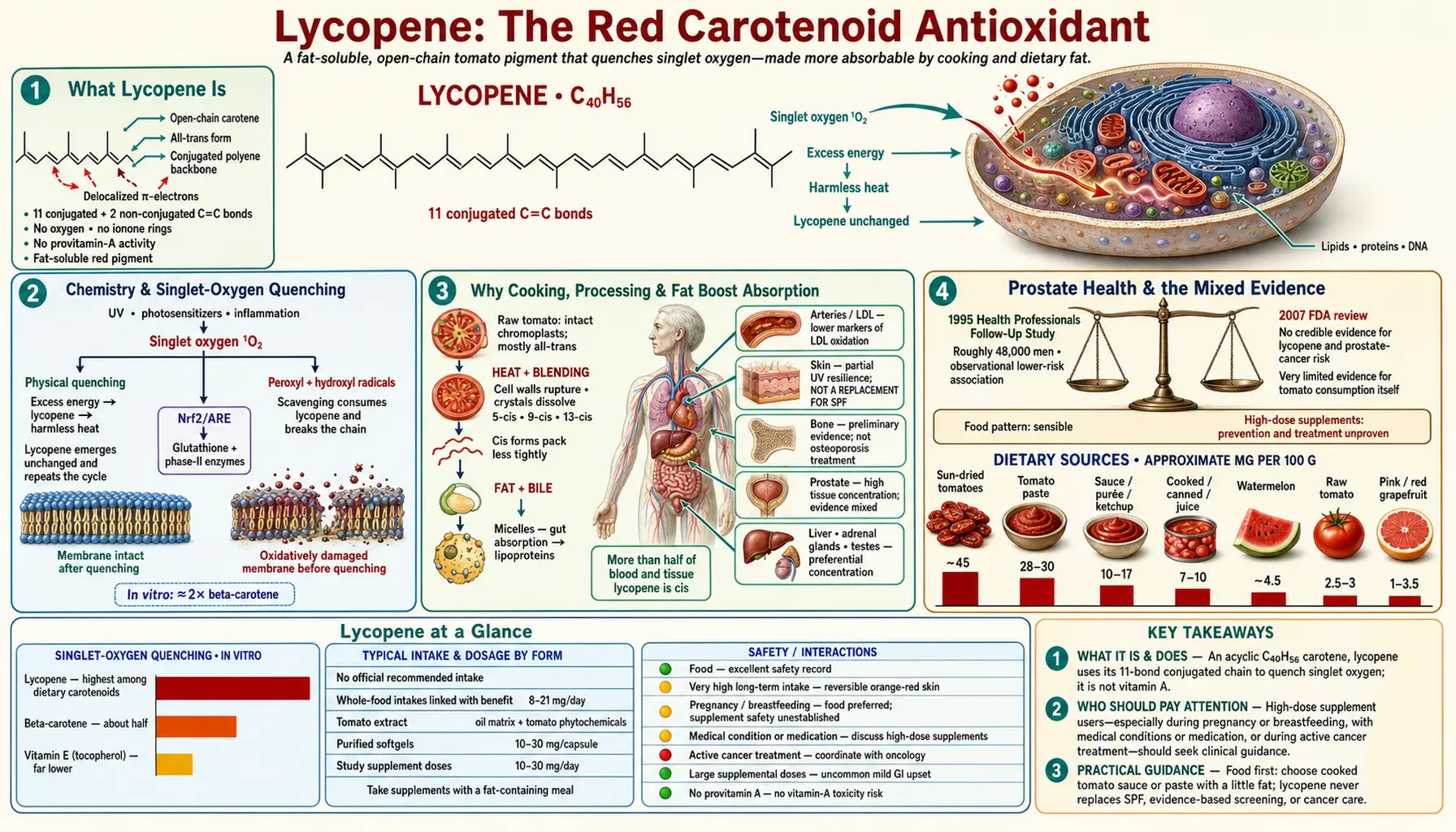
Lycopene is the bright-red carotenoid pigment that gives tomatoes, watermelon, and pink grapefruit their color. Chemically it is an acyclic carotene — a long, open-chain hydrocarbon with eleven conjugated double bonds and no oxygen and no closed ionone ring — which makes it the single most efficient quencher of singlet oxygen among the common dietary carotenoids, roughly twice as effective as beta-carotene. Unlike most foods, cooked and processed tomatoes deliver more usable lycopene than raw ones, because heat and a little dietary fat convert the molecule into more absorbable cis-isomers. The strongest human evidence links lycopene-rich diets to lower oxidation of LDL cholesterol and modestly lower cardiovascular risk; the prostate-cancer story is real but the trial evidence is genuinely mixed and should not be oversold.
Table of Contents
- What Lycopene Is
- Chemistry & Singlet-Oxygen Quenching
- Why Cooking, Processing & Fat Boost Absorption
- Prostate Health & the Mixed Evidence
- Cardiovascular Health & LDL Oxidation
- Skin Photoprotection
- Bone Health
- Other Investigated Effects
- Dietary Sources
- Forms & Dosage
- Cautions & Lycopenemia
- Key Research Papers
- Connections
- Featured Videos
What Lycopene Is
Lycopene is a carotenoid — one of the family of fat-soluble plant pigments that also includes beta-carotene, lutein, zeaxanthin, and astaxanthin. Its name comes from Solanum lycopersicum, the botanical name of the tomato, which is by far the dominant dietary source in the Western diet. In plants, lycopene is both a pigment that attracts seed-dispersing animals and a photoprotective antioxidant that shields the plant's own tissues from light-driven oxidative damage.
Carotenoids divide into two structural groups. Carotenes are pure hydrocarbons made only of carbon and hydrogen; xanthophylls (lutein, zeaxanthin, astaxanthin) carry oxygen atoms. Lycopene is a carotene. What sets it apart from the more familiar beta-carotene is that lycopene is acyclic — it is a straight, open chain that does not curl its ends into the six-membered beta-ionone rings found in beta-carotene. Those rings are exactly the structural feature an enzyme needs to cleave a carotenoid into vitamin A. Because lycopene has no ionone rings, it has no provitamin-A activity — the body cannot turn it into retinol. Its value is entirely as an antioxidant and signaling molecule, not as a vitamin precursor.
In human blood and tissue, lycopene is one of the most abundant carotenoids, typically accounting for a substantial share of total circulating carotenoids. It concentrates preferentially in the testes, adrenal glands, liver, and prostate — the unusually high prostate concentration is one of the original reasons researchers became interested in a possible prostate-cancer link.
Chemistry & Singlet-Oxygen Quenching
Lycopene's chemical formula is C40H56. Its defining feature is a conjugated polyene backbone: a long chain in which single and double bonds alternate. Lycopene carries eleven conjugated carbon–carbon double bonds (plus two non-conjugated), the longest such system among the common dietary carotenoids. This extended chain of delocalized electrons is what makes lycopene both intensely red (it absorbs blue-green light) and an exceptional antioxidant.
The antioxidant role that lycopene performs best is quenching singlet oxygen. Singlet oxygen is a high-energy, electronically excited form of molecular oxygen generated by ultraviolet light, photosensitizers, and certain inflammatory reactions; it is far more reactive than ordinary ground-state oxygen and can damage lipids, proteins, and DNA. Lycopene neutralizes singlet oxygen physically rather than by being consumed: it absorbs the excess energy into its long conjugated chain, then harmlessly dissipates that energy as heat, emerging chemically unchanged and able to repeat the cycle. Measured in vitro, lycopene is the most efficient singlet-oxygen quencher of all the dietary carotenoids — on the order of twice as effective as beta-carotene and far more effective than the tocopherol form of vitamin E.
Lycopene also scavenges peroxyl radicals (the chain-carrying radicals of lipid peroxidation) and hydroxyl radicals, but these reactions do consume the molecule and break the conjugated chain. Beyond direct radical chemistry, a growing body of work shows lycopene and its oxidative metabolites act as signaling molecules: they can activate the Nrf2/ARE pathway (the master switch that turns on the body's own antioxidant and detoxification enzymes such as glutathione and the phase-II enzymes), modulate inflammatory transcription factors, and influence gap-junction communication between cells. Many of lycopene's biological effects are now attributed as much to these indirect, gene-regulating actions as to its direct free-radical scavenging.
Why Cooking, Processing & Fat Boost Absorption
Lycopene is one of the few nutrients for which processed food beats fresh. The reason is partly physical and partly chemical.
Heat ruptures the food matrix. In a raw tomato, most lycopene is locked inside the chromoplasts of intact plant cells, bound to protein and crystallized in a form the gut struggles to extract. Cooking, blending, and industrial processing break the cell walls and dissolve the crystals, freeing the pigment so digestive enzymes and bile can reach it. This is why a tablespoon of tomato paste can deliver more absorbable lycopene than several raw tomatoes, and why the lycopene content of tomato products rises in the order: raw tomato < tomato juice < tomato sauce < tomato paste < ketchup.
Heat converts trans-isomers to cis-isomers. In raw plants, lycopene exists almost entirely as the all-trans form (the straight chain). The all-trans form tends to crystallize and aggregate, which lowers its solubility in the bile-salt micelles that ferry fat-soluble compounds across the intestinal wall. Heating — and the processing involved in making paste, sauce, and ketchup — isomerizes a meaningful fraction of the lycopene into bent cis-isomers (notably the 5-cis, 9-cis, and 13-cis forms). The kinked cis shapes pack less tightly, dissolve more readily into micelles, and are absorbed more efficiently. Strikingly, even though raw food is overwhelmingly all-trans, more than half of the lycopene found in human blood and tissue is in the cis form — reflecting both preferential absorption of cis-isomers and in-body conversion.
Fat is the carrier. Lycopene is strongly lipophilic and is absorbed only when it can dissolve into the fat phase of a meal and be incorporated into micelles. Eating tomato products with a source of fat — olive oil, avocado, cheese, nuts, a little meat — can multiply lycopene absorption several-fold compared with eating the same tomatoes fat-free. The classic Mediterranean combination of tomatoes cooked in olive oil is, by happy accident, close to the ideal delivery system for lycopene. This makes lycopene a useful pairing with olive oil and other healthy fats.
The practical upshot: a bowl of tomato sauce simmered in olive oil is a far better lycopene source than the same weight of raw salad tomatoes, and a small amount of dietary fat eaten alongside dramatically improves how much actually reaches the bloodstream.
Prostate Health & the Mixed Evidence
The prostate-cancer hypothesis is the most famous claim about lycopene, and also the one most often overstated. It deserves an honest, balanced reading.
What got people excited. Lycopene concentrates in prostate tissue more than almost anywhere else in the body, which gave it biological plausibility. Then in 1995 a large prospective cohort — the Health Professionals Follow-Up Study (Giovannucci and colleagues, tracking roughly 48,000 men) — reported that high intake of tomato products, and of lycopene specifically, was associated with a lower risk of prostate cancer, with the strongest signal for aggressive disease. A series of observational studies and meta-analyses through the 2000s broadly supported a modest inverse association between higher lycopene intake or blood levels and prostate-cancer risk.
Why caution is warranted. Observational associations cannot prove cause and effect — men who eat more tomato sauce may differ in many other ways. When the question was put to randomized and interventional tests, results became inconsistent. Some small trials of lycopene supplements before prostatectomy showed reductions in tumor markers; others showed nothing. Pooled analyses of the better-controlled data have produced weaker or non-significant effects than the early cohorts suggested. In 2007 the U.S. Food and Drug Administration reviewed the evidence for a health claim and concluded there was no credible evidence to support a relationship between lycopene intake and reduced risk of prostate (or several other) cancers, and only very limited evidence for tomato consumption itself.
The honest summary. A diet rich in cooked tomatoes is associated with modestly lower prostate-cancer risk in many (not all) population studies, and it is a sensible, low-risk dietary pattern. But isolated high-dose lycopene supplements have not been shown in controlled trials to prevent or treat prostate cancer, and they should not be marketed or taken as if they do. Men weighing this should think in terms of eating more tomatoes as part of an overall healthy diet, not swallowing a pill as cancer insurance, and should not let any supplement substitute for evidence-based screening and care — including discussion of PSA testing and the broader picture covered under prostate conditions.
Cardiovascular Health & LDL Oxidation
The cardiovascular evidence for lycopene is, on balance, stronger and more mechanistically coherent than the cancer evidence.
A central event in atherosclerosis is the oxidation of LDL particles. Native LDL is relatively benign; once its lipids and apolipoprotein B are oxidized, the particle is taken up by macrophages to form foam cells, the seeds of arterial plaque. Because lycopene is fat-soluble, it travels in the bloodstream packaged inside lipoproteins, including LDL itself — placing this potent singlet-oxygen and peroxyl-radical quencher exactly where LDL oxidation happens. Multiple human studies have shown that higher lycopene intake or supplementation reduces measured markers of LDL oxidation and lipid peroxidation.
Beyond protecting LDL, lycopene has been associated in trials and meta-analyses with modest improvements in several cardiovascular intermediates: small reductions in systolic blood pressure, improved flow-mediated dilation (a measure of endothelial function), and lower levels of inflammatory markers such as C-reactive protein in some studies. Several large observational analyses link higher blood lycopene to lower rates of cardiovascular events and stroke, and a notable Finnish cohort found low serum lycopene associated with increased carotid intima-media thickness, an early structural sign of atherosclerosis.
As with the cancer data, the effect sizes are modest and not every trial agrees, so lycopene is best understood as one beneficial component of a tomato-rich, Mediterranean-style dietary pattern rather than a stand-alone cardiac drug. For anyone working to slow vascular oxidative damage, it complements the broader picture tracked by a lipid panel and overlaps with the goals discussed under cardiovascular disease.
Skin Photoprotection
Because lycopene is such an effective quencher of the singlet oxygen generated when ultraviolet light strikes skin, it accumulates in the skin and acts as a built-in, systemic photoprotectant — a kind of mild "internal sunscreen" (emphatically not a replacement for topical SPF).
Controlled human studies have shown that several weeks of daily tomato-paste or lycopene-rich tomato extract, eaten with olive oil, raises the dose of UV needed to produce visible reddening (erythema) — that is, it measurably increases the skin's resistance to sunburn. Lycopene supplementation has also been associated with reduced UV-induced expression of matrix metalloproteinases (the collagen-degrading enzymes behind photoaging) and with markers of less oxidative DNA damage in skin. These effects build slowly over weeks as the carotenoid saturates skin tissue, and they offer partial protection only — lycopene raises the threshold for damage rather than blocking UV the way a topical sunscreen does. It is a complement to sun protection, not a substitute.
Lycopene's photoprotective behavior is closely paralleled by the marine carotenoid astaxanthin and by the macular pigments lutein and zeaxanthin, all of which share the role of soaking up light energy and quenching the reactive oxygen it generates.
Bone Health
An emerging line of research suggests lycopene may support bone health by reducing the oxidative stress that drives bone breakdown. Osteoclasts — the cells that resorb bone — both generate and are activated by reactive oxygen species, so an antioxidant that lowers oxidative load could in principle tilt the balance toward bone preservation.
In laboratory and animal work, lycopene reduces osteoclast formation and the production of resorption-related reactive oxygen species while supporting osteoblast (bone-building) activity. In humans the data are preliminary but suggestive: cross-sectional studies have linked higher lycopene intake or blood levels with higher bone mineral density and lower markers of bone turnover, and a small controlled study in postmenopausal women reported that lycopene supplementation lowered oxidative stress and a marker of bone resorption. This is an area of active investigation rather than established therapy, and lycopene is not a treatment for osteoporosis — but it adds to the rationale for a carotenoid-rich diet as part of a bone-protective lifestyle, alongside the established pillars covered under osteoporosis.
Other Investigated Effects
Lycopene has been studied across a range of additional conditions, mostly at the observational or early-trial stage. None of these should be read as established clinical treatment, but they reflect where the research is pointing:
- Eye health — as a general antioxidant, lycopene has been examined for a possible role in age-related macular degeneration and cataract, though the macular xanthophylls lutein and zeaxanthin (which physically deposit in the retina) carry far stronger eye-specific evidence.
- Male fertility — several small trials have tested lycopene for sperm quality in men with idiopathic infertility, on the rationale that oxidative stress damages sperm; results are mixed and the trials are small.
- Metabolic and liver markers — higher lycopene status has been associated in some studies with better insulin sensitivity, lower markers of fatty liver, and reduced systemic inflammation, consistent with its antioxidant and Nrf2-activating actions.
- Blood pressure and endothelial function — covered above under cardiovascular health; modest reductions in blood pressure appear in some but not all trials.
- Neuroprotection — preclinical work suggests lycopene crosses into the brain and may protect neurons from oxidative injury, but human evidence is minimal.
The consistent theme is that lycopene behaves like a broadly protective dietary antioxidant whose clearest, best-replicated benefits are in lipid oxidation and skin photoprotection, with more tentative signals elsewhere.
Dietary Sources
Lycopene is found almost exclusively in red and pink fruits and vegetables. In the typical Western diet, tomatoes and tomato products supply the large majority of total intake. Approximate lycopene content (which varies with variety, ripeness, and processing):
- Tomato paste — the most concentrated common source; roughly 28–30 mg per 100 g, and highly bioavailable because it is both processed and cooked.
- Tomato sauce / purée and ketchup — very high; roughly 10–17 mg per 100 g, again with good bioavailability.
- Sun-dried tomatoes — very high by weight (water removed), around 45 mg per 100 g.
- Cooked / canned tomatoes and tomato juice — roughly 7–10 mg per 100 g.
- Raw tomatoes — lower and less absorbable; roughly 2.5–3 mg per 100 g.
- Watermelon — a major non-tomato source; roughly 4.5 mg per 100 g, and notably its lycopene is fairly bioavailable even raw because it is not locked in a tough matrix.
- Pink and red grapefruit — roughly 1–3.5 mg per 100 g.
- Guava (pink), papaya, and red bell peppers — smaller contributors, generally under a few mg per 100 g.
Note that yellow and orange tomatoes contain little lycopene — the deep red color is the marker of high content. The single most efficient real-world strategy for raising lycopene status is to eat cooked tomato products (sauce, paste, soup) prepared with a little fat. Tomatoes are covered in depth on the tomatoes food page.
Forms & Dosage
There is no official recommended intake for lycopene — it is not an essential nutrient, since the body has no requirement for it and makes none of its own. Dietary intakes that track with health benefits in population studies generally fall in the range of about 8–21 mg per day, achievable through food alone with regular tomato products.
- Whole-food sources (preferred) — cooked tomato products with fat are the best-validated way to obtain lycopene, because they deliver the cis-isomers, the fat carrier, and the full spectrum of other tomato carotenoids and polyphenols together. A daily serving of tomato sauce, soup, or juice readily reaches the intakes associated with benefit.
- Tomato extract supplements — standardized tomato-oleoresin extracts (such as the branded ingredient Lyc-O-Mato) deliver lycopene in an oil matrix alongside the natural accompanying tomato phytochemicals, which is generally preferable to purified lycopene alone.
- Synthetic / purified lycopene — available in softgels, typically 10–30 mg per capsule. Should be taken with a fat-containing meal for absorption.
Typical supplemental doses in studies run from about 10 to 30 mg per day. Higher is not clearly better, and (as discussed) high-dose isolated lycopene has not demonstrated the disease-prevention benefits sometimes claimed for it. Because lycopene is fat-soluble, any supplement should be taken with a meal containing some fat, exactly as the food form is best eaten.
Cautions & Lycopenemia
Lycopene from food has an excellent safety record — it is a normal constituent of a healthy diet with no defined toxic dose. A few points are worth knowing:
- Lycopenemia (lycopenoderma) — very high intake, usually from drinking large quantities of tomato juice over a long period, can deposit enough lycopene in the skin to tint it a deep orange-red. The discoloration is harmless and reversible: it fades over weeks to months once intake is reduced. It is the lycopene analogue of carotenemia, the orange skin seen with excessive carrot or beta-carotene intake. Unlike that condition, lycopenemia does not affect the whites of the eyes.
- No vitamin-A toxicity risk — because lycopene cannot be converted to vitamin A, even very high intake carries none of the hypervitaminosis-A concern that high preformed-retinol intake would.
- Supplement safety in disease and pregnancy — lycopene from food is considered safe in pregnancy, but the safety of concentrated high-dose lycopene supplements during pregnancy and breastfeeding has not been established, so food sources are preferred. Anyone with a medical condition or on medication should treat high-dose supplements (as opposed to food) as something to discuss with a clinician.
- Theoretical interactions — lycopene may have a mild blood-pressure-lowering effect and, like other antioxidants, has been the subject of theoretical concern about interfering with pro-oxidant chemotherapy; dietary amounts are not a practical concern, but high-dose supplements during active cancer treatment should be coordinated with the oncology team.
- GI upset — uncommon; large supplemental doses occasionally cause mild indigestion or loose stools.
For the overwhelming majority of people, lycopene is best obtained simply by eating cooked tomatoes regularly — an approach with benefits and essentially no downside.
Key Research Papers
The following are real, peer-reviewed publications on lycopene's chemistry, bioavailability, and clinical associations.
- Di Mascio P, Kaiser S, Sies H. Lycopene as the most efficient biological carotenoid singlet oxygen quencher. Archives of Biochemistry and Biophysics. 1989;274(2):532–538. doi:10.1016/0003-9861(89)90467-0
- Giovannucci E, Ascherio A, Rimm EB, Stampfer MJ, Colditz GA, Willett WC. Intake of carotenoids and retinol in relation to risk of prostate cancer. Journal of the National Cancer Institute. 1995;87(23):1767–1776. doi:10.1093/jnci/87.23.1767
- Gann PH, Ma J, Giovannucci E, et al. Lower prostate cancer risk in men with elevated plasma lycopene levels: results of a prospective analysis. Cancer Research. 1999;59(6):1225–1230. PMID: 10096552
- Stahl W, Sies H. Bioactivity and protective effects of natural carotenoids. Biochimica et Biophysica Acta. 2005;1740(2):101–107. doi:10.1016/j.bbadis.2004.12.006
- Boileau TW, Boileau AC, Erdman JW. Bioavailability of all-trans and cis-isomers of lycopene. Experimental Biology and Medicine. 2002;227(10):914–919. doi:10.1177/153537020222701012
- Unlu NZ, Bohn T, Francis DM, Nagaraja HN, Clinton SK, Schwartz SJ. Lycopene from heat-induced cis-isomer-rich tomato sauce is more bioavailable than from all-trans-rich tomato sauce in human subjects. British Journal of Nutrition. 2007;98(1):140–146. doi:10.1017/S0007114507685201
- Rao AV, Agarwal S. Role of antioxidant lycopene in cancer and heart disease. Journal of the American College of Nutrition. 2000;19(5):563–569. doi:10.1080/07315724.2000.10718953
- Rissanen TH, Voutilainen S, Nyyssonen K, et al. Low serum lycopene concentration is associated with an excess incidence of acute coronary events and stroke: the Kuopio Ischaemic Heart Disease Risk Factor Study. British Journal of Nutrition. 2001;85(6):749–754. doi:10.1079/BJN2001357
- Ried K, Fakler P. Protective effect of lycopene on serum cholesterol and blood pressure: meta-analyses of intervention trials. Maturitas. 2011;68(4):299–310. doi:10.1016/j.maturitas.2010.11.018
- Stahl W, Heinrich U, Wiseman S, Eichler O, Sies H, Tronnier H. Dietary tomato paste protects against ultraviolet light-induced erythema in humans. Journal of Nutrition. 2001;131(5):1449–1451. doi:10.1093/jn/131.5.1449
- Ilic D, Forbes KM, Hassed C. Lycopene for the prevention of prostate cancer. Cochrane Database of Systematic Reviews. 2011;(11):CD008007. doi:10.1002/14651858.CD008007.pub2
- Mackinnon ES, Rao AV, Josse RG, Rao LG. Supplementation with the antioxidant lycopene significantly decreases oxidative stress parameters and the bone resorption marker NTX in postmenopausal women. Osteoporosis International. 2011;22(4):1091–1101. doi:10.1007/s00198-010-1308-0
Live PubMed Searches
- Lycopene singlet oxygen & antioxidant mechanism
- Lycopene cis-isomer bioavailability & tomato processing
- Lycopene & prostate cancer
- Lycopene, LDL oxidation & cardiovascular risk
- Lycopene, skin & UV photoprotection
- Lycopene & bone mineral density
- Lycopene, blood pressure & endothelial function
- Lycopene supplementation clinical trials
External Authoritative Resources
- Linus Pauling Institute — Carotenoids Micronutrient Information Center
- NIH Office of Dietary Supplements — Dietary Supplement Fact Sheets
- USDA FoodData Central — Lycopene content of foods
- PubMed — All research on lycopene
Connections
- All Antioxidants
- Beta-Carotene
- Astaxanthin
- Lutein
- Curcumin
- Grape Seed Extract
- Pycnogenol
- Glutathione
- Alpha Lipoic Acid
- Tomatoes
- Olive Oil
- Oxidative Stress
- Prostate Conditions
- PSA Test
- Cardiovascular Disease
- Lipid Panel
- Osteoporosis
- Dermatology & Skin Health
- Vitamin E
- Vitamin C